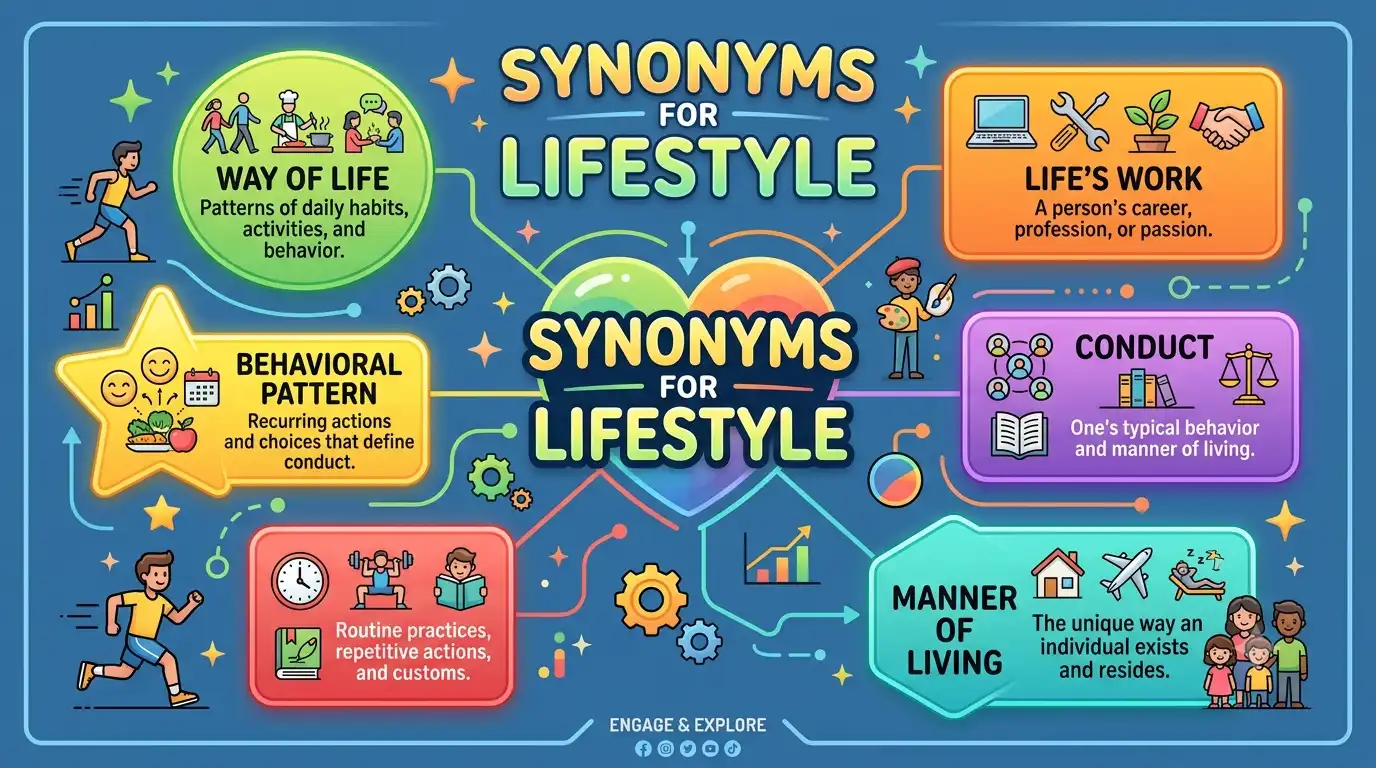
Exploring synonyms for lifestyle is an excellent way to expand your vocabulary and describe how people live with precision. Learning synonyms for lifestyle helps you express habits, routines, and daily choices far more vividly. When you master synonyms for lifestyle, your writing and everyday conversations become instantly more engaging.
Imagine a professional software developer who spends weekdays working remotely in a quiet coastal village and weekends hiking mountain trails. Describing her active balance as simply a “way of living” only tells part of her story. Lifestyle means the way a person or a group of people lives, including their daily habits, choices, and routines.
A rich vocabulary benefits many types of communicators:
- Students can write clear essays on social studies and personal habits without repeating the same phrases.
- Bloggers can draft catchy headers and relatable stories about health, travel, and wellness.
- Content writers can craft engaging articles that explain audience demographics effortlessly.
- Daily English users can discuss personal goals, routines, and cultural habits with confidence.
“To have another language is to possess a second soul.” — Charlemagne
“The secret of getting ahead is getting started.” — Mark Twain
Linguistic Breakdown of “Lifestyle”
Connotative Meaning
The word lifestyle carries a neutral to positive connotation, suggesting personal choice, deliberate habits, wellness, or cultural identity.
Etymology
- Coined by Alfred Adler: Introduced by Austrian psychologist Alfred Adler in 1929 to describe an individual’s basic character and approach to life.
- Compound Structure: Formed by combining the Middle English life (state of living) with style (manner or distinctive mode).
- Modern Popularization: Gained widespread usage in marketing and general media during the 1960s and 1970s.
Pronunciation
- US IPA: /ˈlaɪf.staɪl/
- UK IPA: /ˈlaɪf.staɪl/
Syllables & Affixation Pattern
- Syllables: 2 (life-style)
- Root Words: life (noun) + style (noun)
- Compound Type: Closed compound noun
Comparison Table of Key Synonyms
| Keyword | Meaning | Usage Type | Context |
|---|---|---|---|
| Way of life | The typical pattern of living of a person or group | General / Neutral | Culture, community, personal choices |
| Living style | The personal manner in which someone conducts daily life | Casual / Modern | Home design, daily choices, personal habits |
| Routine | A regular sequence of actions followed regularly | Casual / Practical | Daily schedules, work, fitness |
| Existence | The state or manner of living one’s life | Formal / Philosophical | Survival, simple living, deep reflection |
| Conduct | The way a person behaves in daily activities | Formal / Professional | Ethics, professional behavior, school settings |
| Walk of life | A person’s occupation, social status, or background | Formal / Social | Society, career, community discussions |
| Ethos | The characteristic spirit or culture of a group | Formal / Academic | Business values, cultural groups, philosophy |
| Day-to-day life | The ordinary events and tasks happening every day | Casual / Friendly | Personal blogs, friendly chats, journaling |
Main Content – 50 Synonyms for Lifestyle
1. Way of life
- Pronunciation: US: /weɪ ʌv laɪf/ | UK: /weɪ ɒv laɪf/
- Meaning: Way of life means the overall manner in which a group or individual lives.
- Examples:
- Farming is a quiet way of life for the valley residents.
- Moving to the city changed her entire way of life.
2. Living style
- Pronunciation: US: /ˈlɪv.ɪŋ staɪl/ | UK: /ˈlɪv.ɪŋ staɪl/
- Meaning: Living style means the personal habits and choices that shape how you live.
- Examples:
- His minimalist living style keeps his home very clean.
- She adopted a healthy living style after joining the gym.
3. Mode of living
- Pronunciation: US: /moʊd ʌv ˈlɪv.ɪŋ/ | UK: /məʊd ɒv ˈlɪv.ɪŋ/
- Meaning: Mode of living means a specific system or method of daily life.
- Examples:
- Nomad tribes maintain an ancient mode of living.
- Her simple mode of living helps her save money every month.
4. Life choice
- Pronunciation: US: /laɪf tʃɔɪs/ | UK: /laɪf tʃɔɪs/
- Meaning: Life choice means a major decision that shapes how you live.
- Examples:
- Choosing to eat healthy meals was a smart life choice.
- Becoming a freelance writer was a big life choice for him.
5. Existence
- Pronunciation: US: /ɪɡˈzɪs.təns/ | UK: /ɪɡˈzɪs.təns/
- Meaning: Existence means the continuous state of living day to day.
- Examples:
- He enjoys a peaceful existence in his forest cabin.
- The quiet island offers a calm existence away from crowds.
6. Routine
- Pronunciation: US: /ruːˈtiːn/ | UK: /ruːˈtiːn/
- Meaning: Routine means a regular pattern of daily activities.
- Examples:
- Morning exercise is an important part of my routine.
- A structured routine helps students focus on their studies.
7. Daily routine
- Pronunciation: US: /ˈdeɪ.li ruːˈtiːn/ | UK: /ˈdeɪ.li ruːˈtiːn/
- Meaning: Daily routine means the things you do every single day.
- Examples:
- Drinking fresh water is part of her daily routine.
- He changed his daily routine to include night walks.
8. Pattern of living
- Pronunciation: US: /ˈpæt̬.ɚn ʌv ˈlɪv.ɪŋ/ | UK: /ˈpæt.ən ɒv ˈlɪv.ɪŋ/
- Meaning: Pattern of living means repeated habits that define your life.
- Examples:
- Modern technology shapes our current pattern of living.
- Researchers study the health pattern of living in island towns.
9. Conduct
- Pronunciation: US: /ˈkɑːn.dʌkt/ | UK: /ˈkɒn.dʌkt/
- Meaning: Conduct means the way a person acts and behaves daily.
- Examples:
- Her respectful conduct impressed all her teachers.
- Good moral conduct builds trust among neighbors.
10. Behavior pattern
- Pronunciation: US: /bɪˈheɪ.vjɚ ˈpæt̬.ɚn/ | UK: /bɪˈheɪ.vjər ˈpæt.ən/
- Meaning: Behavior pattern means a repeated way of acting over time.
- Examples:
- Sleep tracker apps help identify your behavior pattern.
- Positive behavior patterns lead to better health outcomes.
11. Manner of living
- Pronunciation: US: /ˈmæn.ɚ ʌv ˈlɪv.ɪŋ/ | UK: /ˈmæn.ər ɒv ˈlɪv.ɪŋ/
- Meaning: Manner of living means the specific way you conduct your life.
- Examples:
- They prefer a quiet manner of living near the ocean.
- His lavish manner of living caught everyone’s attention.
12. Quality of life
- Pronunciation: US: /ˈkwɑː.lə.t̬i ʌv laɪf/ | UK: /ˈkwɒl.ə.ti ɒv laɪf/
- Meaning: Quality of life means how comfortable and happy your life is.
- Examples:
- Fresh air and clean water improve our quality of life.
- Regular physical activity elevates your overall quality of life.
13. Standard of living
- Pronunciation: US: /ˈstæn.dɚd ʌv ˈlɪv.ɪŋ/ | UK: /ˈstæn.dəd ɒv ˈlɪv.ɪŋ/
- Meaning: Standard of living means the level of wealth and comfort you have.
- Examples:
- The community enjoys a high standard of living.
- Economic growth raises the standard of living for families.
14. Station in life
- Pronunciation: US: /ˈsteɪ.ʃən ɪn laɪf/ | UK: /ˈsteɪ.ʃən ɪn laɪf/
- Meaning: Station in life means your social position or place in society.
- Examples:
- She worked hard to improve her station in life.
- Kindness matters regardless of a person’s station in life.
15. Habit
- Pronunciation: US: /ˈhæb.ɪt/ | UK: /ˈhæb.ɪt/
- Meaning: Habit means something you do regularly without thinking much.
- Examples:
- Reading before bed is a restful habit.
- Daily jogging quickly became his favorite habit.
16. Customs
- Pronunciation: US: /ˈkʌs.təmz/ | UK: /ˈkʌs.təmz/
- Meaning: Customs means traditional habits shared by a group of people.
- Examples:
- Local customs shape how holidays are celebrated here.
- Travelers love learning about foreign customs.
17. Way of living
- Pronunciation: US: /weɪ ʌv ˈlɪv.ɪŋ/ | UK: /weɪ ɒv ˈlɪv.ɪŋ/
- Meaning: Way of living means how a person chooses to spend their time and resources.
- Examples:
- A simple way of living brings peace to many people.
- Their active way of living includes hiking every weekend.
18. Worldview
- Pronunciation: US: /ˈwɝːld.vjuː/ | UK: /ˈwɜːld.vjuː/
- Meaning: Worldview means the general perspective through which you view life.
- Examples:
- Travel expands your worldview and builds empathy.
- Her positive worldview guides her everyday decisions.
19. Way of being
- Pronunciation: US: /weɪ ʌv ˈbiː.ɪŋ/ | UK: /weɪ ɒv ˈbiː.ɪŋ/
- Meaning: Way of being means your fundamental nature and attitude toward life.
- Examples:
- Her calm way of being reassures everyone around her.
- Mindfulness creates a peaceful way of being.
20. Philosophy of life
- Pronunciation: US: fɪˈlɑː.sə.fi ʌv laɪf/ | UK: /fɪˈlɒs.ə.fi ɒv laɪf/
- Meaning: Philosophy of life means your core beliefs that guide your actions.
- Examples:
- Helping others is my grandfather’s philosophy of life.
- Her philosophy of life focuses on continuous learning.
21. Path
- Pronunciation: US: /pæθ/ | UK: /pɑːθ/
- Meaning: Path means the direction or course your life takes.
- Examples:
- He chose a creative path after finishing university.
- Every individual follows a unique personal path.
22. Life path
- Pronunciation: US: /laɪf pæθ/ | UK: /laɪf pɑːθ/
- Meaning: Life path means the overall journey and series of choices in your life.
- Examples:
- Studying medicine set her on a rewarding life path.
- Reflecting on your goals helps guide your life path.
23. Walk of life
- Pronunciation: US: /wɑːk ʌv laɪf/ | UK: /wɔːk ɒv laɪf/
- Meaning: Walk of life means your background, profession, or social status.
- Examples:
- People from every walk of life attended the festival.
- The charity helps citizens from all walks of life.
24. Demeanor
- Pronunciation: US: /dɪˈmiː.nɚ/ | UK: /dɪˈmiː.nər/
- Meaning: Demeanor means outward behavior and manner of presenting oneself.
- Examples:
- She maintained a professional demeanor during the meeting.
- His friendly demeanor makes newcomers feel welcome.
25. Culture
- Pronunciation: US: /ˈkʌl.tʃɚ/ | UK: /ˈkʌl.tʃər/
- Meaning: Culture means the shared ideas, customs, and living habits of a group.
- Examples:
- Food is an essential part of coastal culture.
- Our company fosters a culture of open communication.
“Change your words and you change your world.” — Norman Vincent Peale
26. Way
- Pronunciation: US: /weɪ/ | UK: /weɪ/
- Meaning: Way means a particular manner of doing or living things.
- Examples:
- Respecting nature is the islanders’ way.
- Find a way that works best for your schedule.
27. Day-to-day life
- Pronunciation: US: /ˌdeɪ.təˈdeɪ laɪf/ | UK: /ˌdeɪ.təˈdeɪ laɪf/
- Meaning: Day-to-day life means the ordinary activities you do each day.
- Examples:
- Smart devices simplify our day-to-day life.
- She balances work and relaxation in her day-to-day life.
28. Everyday life
- Pronunciation: US: /ˈev.ri.deɪ laɪf/ | UK: /ˈev.ri.deɪ laɪf/
- Meaning: Everyday life means normal routines and common activities.
- Examples:
- Art can highlight the beauty in everyday life.
- Cooking meals together is a sweet part of everyday life.
29. Social position
- Pronunciation: US: /ˈsoʊ.ʃəl pəˈzɪʃ.ən/ | UK: /ˈsəʊ.ʃəl pəˈzɪʃ.ən/
- Meaning: Social position means your rank or standing in a community.
- Examples:
- His social position allowed him to support local schools.
- Character matters far more than social position.
30. Life situation
- Pronunciation: US: /laɪf ˌsɪtʃ.uˈeɪ.ʃən/ | UK: /laɪf ˌsɪtʃ.uˈeɪ.ʃən/
- Meaning: Life situation means the current circumstances surrounding your life.
- Examples:
- Moving to a new town changed her life situation.
- We adapted our budget to fit our current life situation.
31. Circumstances
- Pronunciation: US: /ˈsɝː.kəm.stæn.səz/ | UK: /ˈsɜː.kəm.stɑːn.səz/
- Meaning: Circumstances means the conditions and facts that affect your life.
- Examples:
- They succeeded despite difficult living circumstances.
- Favorable financial circumstances allowed them to travel.
32. Manner
- Pronunciation: US: /ˈmæn.ɚ/ | UK: /ˈmæn.ər/
- Meaning: Manner means the way in which something is done or lived.
- Examples:
- He greeted his guests in a warm manner.
- She organized her home in a neat manner.
33. Modus vivendi
- Pronunciation: US: /ˌmoʊ.dəs vɪˈven.di/ | UK: /ˌməʊ.dəs vɪˈven.di/
- Meaning: Modus vivendi means a practical arrangement or way of living together peacefully.
- Examples:
- Roommates established a comfortable modus vivendi.
- The two partners found a workable modus vivendi.
34. Life direction
- Pronunciation: US: /laɪf daɪˈrek.ʃən/ | UK: /laɪf daɪˈrek.ʃən/
- Meaning: Life direction means the general aim or goal guiding your decisions.
- Examples:
- Starting a business gave her a clear life direction.
- Career counseling helped him choose a strong life direction.
35. Daily habits
- Pronunciation: US: /ˈdeɪ.li ˈhæb.ɪts/ | UK: /ˈdeɪ.li ˈhæb.ɪts/
- Meaning: Daily habits means small actions performed consistently every day.
- Examples:
- Good daily habits build long-term wellness.
- Reading and drinking tea are my favorite daily habits.
36. Regime
- Pronunciation: US: /reɪˈʒiːm/ | UK: /reɪˈʒiːm/
- Meaning: Regime means a regulated system of diet, exercise, or living.
- Examples:
- The athlete follows a strict training regime.
- Her wellness regime includes meditation and yoga.
37. Schedule
- Pronunciation: US: /ˈskedʒ.uːl/ | UK: /ˈʃedʒ.uːl/
- Meaning: Schedule means a plan that outlines times for daily tasks.
- Examples:
- A flexible schedule makes working from home easier.
- He manages a busy work schedule with digital calendars.
38. Ethos
- Pronunciation: US: /ˈiː.θɑːs/ | UK: /ˈiː.θɒs/
- Meaning: Ethos means the core character or values of a person or group.
- Examples:
- The school’s ethos encourages teamwork and kindness.
- Sustainability is central to our company’s ethos.
39. Outlook
- Pronunciation: US: /ˈaʊt.lʊk/ | UK: /ˈaʊt.lʊk/
- Meaning: Outlook means your general attitude toward life and the future.
- Examples:
- She keeps an optimistic outlook on every challenge.
- Travel gave him a broader outlook on international cultures.
40. Life pattern
- Pronunciation: US: /laɪf ˈpæt̬.ɚn/ | UK: /laɪf ˈpæt.ən/
- Meaning: Life pattern means the regular structure of events shaping your routine.
- Examples:
- Retirement brought a quiet life pattern to his daily schedule.
- A healthy life pattern supports mental clarity.
41. Living habit
- Pronunciation: US: /ˈlɪv.ɪŋ ˈhæb.ɪt/ | UK: /ˈlɪv.ɪŋ ˈhæb.ɪt/
- Meaning: Living habit means a specific action you perform regularly in your home or routine.
- Examples:
- Early sleeping is a beneficial living habit.
- Recycling waste is a great living habit for families.
42. Way of working
- Pronunciation: US: /weɪ ʌv ˈwɝː.kɪŋ/ | UK: /weɪ ɒv ˈwɜː.kɪŋ/
- Meaning: Way of working means the methods and routine you use to complete tasks.
- Examples:
- Remote teams developed a flexible way of working.
- Her structured way of working ensures high productivity.
43. Living standard
- Pronunciation: US: /ˈlɪv.ɪŋ ˈstæn.dɚd/ | UK: /ˈlɪv.ɪŋ ˈstæn.dəd/
- Meaning: Living standard means the level of material comfort available to a person.
- Examples:
- Clean parks enhance the local living standard.
- Higher income improved their family’s living standard.
44. Personal style
- Pronunciation: US: /ˈpɝː.sən.əl staɪl/ | UK: /ˈpɜː.sən.əl staɪl/
- Meaning: Personal style means your unique way of dressing, acting, and living.
- Examples:
- Her home decor reflects her vibrant personal style.
- He expresses his personal style through minimalist clothing.
45. Living condition
- Pronunciation: US: /ˈlɪv.ɪŋ kənˈdɪʃ.ən/ | UK: /ˈlɪv.ɪŋ kənˈdɪʃ.ən/
- Meaning: Living condition means the physical environment in which you reside.
- Examples:
- Safe housing provides a healthy living condition.
- Renovations improved their home’s living condition.
46. State of living
- Pronunciation: US: /steɪt ʌv ˈlɪv.ɪŋ/ | UK: /steɪt ɒv ˈlɪv.ɪŋ/
- Meaning: State of living means the current physical or social state of your daily existence.
- Examples:
- A peaceful environment fosters a relaxed state of living.
- Sustainable energy promotes a cleaner state of living.
47. Daily practice
- Pronunciation: US: /ˈdeɪ.li ˈpræk.tɪs/ | UK: /ˈdeɪ.li ˈpræk.tɪs/
- Meaning: Daily practice means a regular activity done for personal growth.
- Examples:
- Journaling is an enriching daily practice.
- Meditation serves as a relaxing daily practice for him.
48. Life design
- Pronunciation: US: /laɪf dɪˈzaɪn/ | UK: /laɪf dɪˈzaɪn/
- Meaning: Life design means intentionally planning how you spend your time and energy.
- Examples:
- Thoughtful life design aligns your career with personal values.
- Minimalist life design simplifies daily choices.
49. Life arrangement
- Pronunciation: US: /laɪf əˈreɪndʒ.mənt/ | UK: /laɪf əˈreɪndʒ.mənt/
- Meaning: Life arrangement means the practical setup of your home and schedule.
- Examples:
- Shared housing is a convenient life arrangement for students.
- Their flexible life arrangement allows frequent travel.
50. Life pace
- Pronunciation: US: /laɪf peɪs/ | UK: /laɪf peɪs/
- Meaning: Life pace means the speed at which daily events and tasks occur.
- Examples:
- Country living offers a relaxed life pace.
- City living often demands a fast life pace.
Antonyms of “Lifestyle”
While lifestyle describes a chosen pattern of living, these terms represent its opposite—disruption, static immobility, or lack of structured living:
- Inactivity: US: /ˌɪn.ækˈtɪv.ə.t̬i/ | UK: /ˌɪn.ækˈtɪv.ə.ti/ – State of doing nothing or lacking active movement.
- Disorganization: US: /dɪsˌɔːr.ɡən.əˈzeɪ.ʃən/ | UK: /dɪsˌɔː.ɡən.aɪˈzeɪ.ʃən/ – Lack of systematic structure or order.
- Stagnation: US: /stæɡˈneɪ.ʃən/ | UK: /stæɡˈneɪ.ʃən/ – State of not developing, changing, or moving.
- Aimlessness: US: /ˈeɪm.ləs.nəs/ | UK: /ˈeɪm.ləs.nəs/ – Lack of clear goal, direction, or purpose.
Prototype Meaning and Categorization of “Lifestyle”
- Grammatical Category: Noun (Countable & Uncountable).
- Prototype Meaning: A distinctive, organized pattern of living, behavior, and personal choices characteristic of an individual or group.
- Semantic Field: Social behavior, daily habits, personal choices, routines, culture, and human living conditions.
Frequently Asked Questions (FAQ)
1. What is the most natural synonym for lifestyle?
The most common and versatile synonyms for lifestyle are way of life, living style, routine, and everyday life. These terms work well in both casual conversations and formal writing.
2. Is “lifestyle” appropriate for formal and academic writing?
Yes, lifestyle is widely accepted in academic and professional settings, particularly in health, sociology, and marketing research. However, terms like mode of living, quality of life, or pattern of living can add precision to formal reports.
3. What is the difference between “lifestyle” and “routine”?
Lifestyle refers to the overarching pattern of choices, habits, values, and environment that make up your life. Routine specifically describes the fixed sequence of actions you perform regularly, such as your morning schedule.
4. How can content writers choose the right synonym for lifestyle?
Choose based on your audience. Use everyday life or living style for lifestyle blogs, quality of life or standard of living for economic articles, and ethos or behavior pattern for formal essays.
5. Why should I use variations of “lifestyle” in my content?
Using varied synonyms avoids repetitive language, improves reader engagement, enhances SEO through natural semantic keywords, and makes your prose sound more natural.
6. Can “lifestyle” refer to an entire society?
Yes, lifestyle can describe the collective habits and cultural choices of an entire group, community, or society (for example, “a Mediterranean lifestyle”).
Conclusion
Mastering synonyms for lifestyle elevates your vocabulary and gives you the tools to articulate human behavior, personal choices, and daily habits with clarity. Replacing repetitive phrases with precise alternatives like way of life, living style, daily routine, or quality of life brings vitality and depth to your prose. Whether you are drafting an academic essay, writing a lifestyle blog post, preparing a business presentation, or engaging in everyday conversation, selecting the right word ensures your message resonates effectively with your audience.
Make it a conscious habit to incorporate these synonyms into your regular writing and speaking practice. Try experimenting with different options in your daily emails, personal journals, and creative projects to strengthen your expressive confidence and linguistic range.
“Words are a lens to focus one’s mind.” — Ayn Rand
“The true art of memory is the art of attention.” — Samuel Johnson

Andrew Collins is an academic English educator with over 12 years of experience helping university students, IELTS candidates, and ESL learners improve their writing vocabulary.