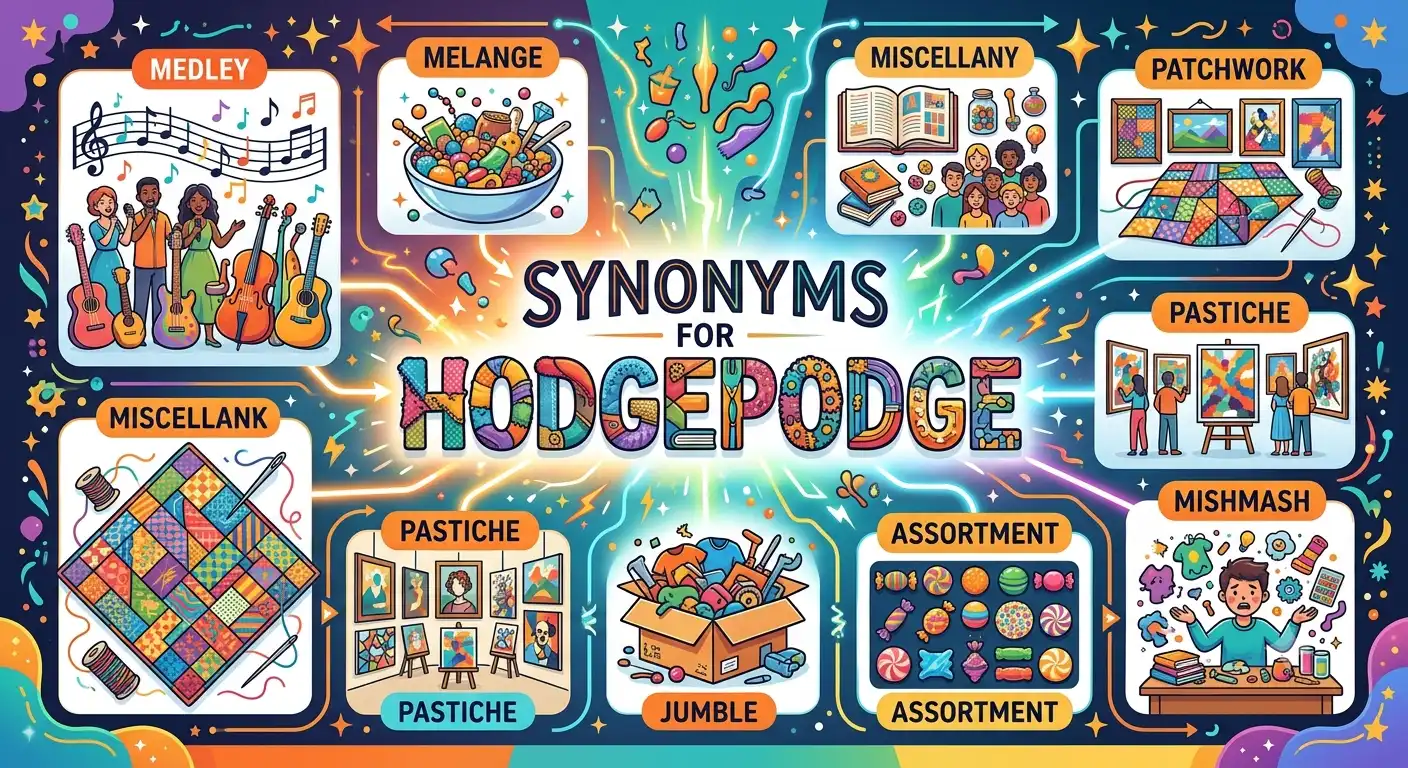
Learning synonyms for hodgepodge is a fun way to grow your vocabulary and speak more clearly. When you find the right synonyms for hodgepodge, you can describe messy, mixed-up things without using the same words. A hodgepodge is simply a confused mixture or a big jumble of different items.
Imagine walking into your kitchen after a busy family cooking session. You might see a stray tomato next to a baking pan, a stack of warm plates resting on top of a cookbook, and a wooden spoon sitting inside a coffee mug. This random mix of objects is a perfect example of a hodgepodge. Instead of always calling it a “mess,” you can use colorful terms to make your sentences pop.
This vocabulary list is a highly useful tool for many different groups of people. Students can use these terms to write smart English essays and avoid repeating the same basic words. Bloggers can use these descriptive terms to paint vivid pictures and keep readers hooked on their posts. Content writers can build deep professional trust by using exact terms for physical mixtures or complex ideas. Daily English users can easily share their thoughts and speak with greater precision.
“Creativity is often just a hodgepodge of old ideas spun into a brand new light.” — Unknown
“Life is a beautiful hodgepodge of moments, some messy and some perfect.” — Unknown
Lexical Profile of “Hodgepodge”
- Connotative Meaning: Disorganization, variety, chaos, charm, creativity, or clutter.
- Etymology:
- Origins: Derived from the Middle English word hotchpot, which was a type of thick, mixed vegetable and meat stew.
- Evolution: Entered English in the 15th century as hodgepodge to describe any mixed-up collection of things.
- Pronunciation:
- US IPA: /ˈhɑːdʒ.pɑːdʒ/
- UK IPA: /ˈhɒdʒ.pɒdʒ/
- Syllables: 2 syllables (hodge-podge).
- Affixation Pattern: Reduplicative compound word (rhyming compound).
Comparison Table of Key Synonyms
| Keyword | Meaning | Usage Type | Context |
|---|---|---|---|
| Jumble | A confused or messy pile of things | Casual | Bedrooms, storage boxes, thoughts |
| Medley | A pleasant mixture of musical pieces or things | Casual / Professional | Music, cooking, art |
| Mishmash | A messy mix of things that do not match | Casual | Plans, designs, writing |
| Melange | A diverse mixture of different items | Formal | Food, fashion, literature |
| Potpourri | A mixture of dried petals or various things | Casual / Formal | Home decor, collections of stories |
| Patchwork | Something made of many different parts | Casual | Blankets, laws, city planning |
| Clutter | A messy pile of too many objects | Casual | Desks, rooms, minds |
| Assortment | A collection of different types of things | Professional / Casual | Chocolates, tools, clothing |
“Our minds are a complex patchwork of memories, dreams, and quiet thoughts.” — Unknown
50 Synonyms for Hodgepodge
1. Jumble
- Pronunciation: US: /ˈdʒʌm.bəl/ & UK: /ˈdʒʌm.bəl/
- Meaning: This word means a messy pile of random things mixed together.
- Examples:
- The kids left a jumble of toys on the living room floor.
- I have a jumble of thoughts in my head right now.
2. Mishmash
- Pronunciation: US: /ˈmɪʃ.mæʃ/ & UK: /ˈmɪʃ.mæʃ/
- Meaning: This word means a confused mix of things that do not match at all.
- Examples:
- Her outfit was a strange mishmash of bright colors and patterns.
- The movie was a mishmash of comedy and scary action.
3. Medley
- Pronunciation: US: /ˈmɛd.li/ & UK: /ˈmed.li/
- Meaning: This word means a pleasant mixture of different songs, tastes, or things.
- Examples:
- The band played a beautiful medley of old love songs.
- We ate a hot medley of fresh summer vegetables for dinner.
4. Melange
- Pronunciation: US: /meɪˈlɑːnʒ/ & UK: /meɪˈlɒ̃ʒ/
- Meaning: This word means a diverse mixture of different items.
- Examples:
- The book is a beautiful melange of poems and short stories.
- The room was decorated with a colorful melange of old art.
5. Potpourri
- Pronunciation: US: /ˌpoʊ.pʊˈriː/ & UK: /ˌpəʊ.pʊˈriː/
- Meaning: This word means a mixture of dried sweet petals or a collection of random things.
- Examples:
- Mom put a bowl of sweet flower potpourri on the table.
- The concert was a wonderful potpourri of different musical styles.
6. Patchwork
- Pronunciation: US: /ˈpætʃ.wɝːk/ & UK: /ˈpætʃ.wɜːk/
- Meaning: This word means something that is made from many different pieces or parts.
- Examples:
- Grandmother made a cozy patchwork quilt for my bed.
- The park looked like a green patchwork of grass and trees.
7. Miscellany
- Pronunciation: US: /ˈmɪs.ə.leɪ.ni/ & UK: /mɪˈsel.ə.ni/
- Meaning: This word means a collection of different kinds of small items.
- Examples:
- His desk drawer was full of a miscellany of paper clips and keys.
- We bought a funny miscellany of old toys at the yard sale.
8. Conglomeration
- Pronunciation: US: /kənˌɡlɑː.məˈreɪ.ʃən/ & UK: /kənˌɡlɒm.əˈreɪ.ʃən/
- Meaning: This word means a large group of different things gathered into one mass.
- Examples:
- The old house was a weird conglomeration of different building styles.
- The museum has a giant conglomeration of old rusty tools.
9. Hotchpotch
- Pronunciation: US: /ˈhɑːtʃ.pɑːtʃ/ & UK: /ˈhɒtʃ.pɒtʃ/
- Meaning: This word means a confused mixture of things, similar to hodgepodge.
- Examples:
- The essay was a hotchpotch of random ideas with no clear order.
- His backyard was a hotchpotch of old chairs and garden tools.
10. Farrago
- Pronunciation: US: /fəˈrɑː.ɡoʊ/ & UK: /fəˈrɑː.ɡəʊ/
- Meaning: This word means a confused or random mixture of ideas or statements.
- Examples:
- The newspaper article was a farrago of false stories and gossip.
- He gave us a confusing farrago of excuses for being late.
11. Gallimaufry
- Pronunciation: US: /ˌɡæl.əˈmɔː.fri/ & UK: /ˌɡæl.ɪˈmɔː.fri/
- Meaning: This word means a chaotic or confusing mixture of different things.
- Examples:
- The small shop sold a weird gallimaufry of old books and maps.
- Her dinner plate was a funny gallimaufry of leftover foods.
12. Pastiche
- Pronunciation: US: /pæsˈtiːʃ/ & UK: /pæsˈtiːʃ/
- Meaning: This word means a piece of art or writing that copies different styles.
- Examples:
- The new song is a clever pastiche of classic jazz music.
- The movie is a funny pastiche of old detective stories.
13. Olio
- Pronunciation: US: /ˈoʊ.li.oʊ/ & UK: /ˈəʊ.li.əʊ/
- Meaning: This word means a mixture of different things, like a varied show or stew.
- Examples:
- The school talent show was a fun olio of dances and magic tricks.
- The cook prepared a tasty olio of meats and fresh herbs.
14. Salmagundi
- Pronunciation: US: /ˌsæl.məˈɡʌn.di/ & UK: /ˌsæl.məˈɡʌn.di/
- Meaning: This word means a mixed salad plate or a general mixture of things.
- Examples:
- We ordered a delicious salmagundi with eggs, meat, and greens.
- The book is a rich salmagundi of local history and recipes.
15. Goulash
- Pronunciation: US: /ˈɡuː.lɑːʃ/ & UK: /ˈɡuː.læʃ/
- Meaning: This word means a thick meat soup or a mixed-up set of things.
- Examples:
- We ate a warm bowl of beef goulash on a cold night.
- His speech was a funny goulash of jokes and serious facts.
16. Stew
- Pronunciation: US: /stuː/ & UK: /stjuː/
- Meaning: This word means a dish of cooked meat and vegetables, or a worried state of mind.
- Examples:
- My dad made a big pot of hot potato stew for lunch.
- He got into a big stew about losing his house keys.
17. Smorgasbord
- Pronunciation: US: /ˈsmɔːr.ɡəs.bɔːrd/ & UK: /ˈsmɔː.ɡəs.bɔːd/
- Meaning: This word means a large variety of foods or choices laid out on a table.
- Examples:
- The party offered a huge smorgasbord of delicious cakes and pies.
- The college has a great smorgasbord of cool science classes.
18. Hash
- Pronunciation: US: /hæʃ/ & UK: /hæʃ/
- Meaning: This word means a dish of chopped food or a messy mix of things.
- Examples:
- We ate a tasty breakfast hash with potatoes and ham.
- He made a total hash of his science project.
19. Salad
- Pronunciation: US: /ˈsæl.əd/ & UK: /ˈsæl.əd/
- Meaning: This word means a mixture of cold raw vegetables or a mixed-up group of items.
- Examples:
- I made a healthy green salad with tomatoes and cucumbers.
- The book was a colorful salad of bright pictures and poems.
20. Blend
- Pronunciation: US: /blɛnd/ & UK: /blend/
- Meaning: This word means a smooth mixture of different things combined together.
- Examples:
- This hot tea is a nice blend of lemon and sweet honey.
- The paint color was a perfect blend of blue and yellow.
21. Mixture
- Pronunciation: US: /ˈmɪks.tʃɚ/ & UK: /ˈmɪks.tʃə/
- Meaning: This word means a combination of different substances or things.
- Examples:
- Stir the cake mixture in the bowl with a big spoon.
- The crowd was a happy mixture of young kids and parents.
22. Assortment
- Pronunciation: US: /əˈsɔːrt.mənt/ & UK: /əˈsɔːt.mənt/
- Meaning: This word means a collection of different types of the same thing.
- Examples:
- He bought a delicious assortment of sweet chocolate candies.
- The store has a wide assortment of colorful winter hats.
23. Collection
- Pronunciation: US: /kəˈlɛk.ʃən/ & UK: /kəˈlek.ʃən/
- Meaning: This word means a group of similar things that someone has gathered together.
- Examples:
- My sister has a huge collection of shiny sea shells.
- The museum opened a new collection of ancient paintings.
24. Clutter
- Pronunciation: US: /ˈklʌt̬.ɚ/ & UK: /ˈklʌt.ə/
- Meaning: This word means a messy state with too many things in a room.
- Examples:
- We need to clean the heavy clutter off the living room desk.
- Too much visual clutter makes it hard to study.
25. Mess
- Pronunciation: US: /mɛs/ & UK: /mes/
- Meaning: This word means a dirty, untidy, or confused state.
- Examples:
- Please clean up the messy spill on the kitchen floor.
- My thoughts are in a big mess before the hard test.
26. Muddle
- Pronunciation: US: /ˈmʌd.əl/ & UK: /ˈmʌd.əl/
- Meaning: This word means a state of confusion or a messy mix-up.
- Examples:
- There was a bad muddle with our plane tickets at the desk.
- He got his words into a funny muddle during the speech.
27. Litter
- Pronunciation: US: /ˈlɪt̬.ɚ/ & UK: /ˈlɪt.ə/
- Meaning: This word means trash left lying around or a group of newborn animals.
- Examples:
- People should not throw ugly litter on the green grass.
- The black cat gave birth to a sweet litter of five kittens.
28. Chaos
- Pronunciation: US: /ˈkeɪ.ɑːs/ & UK: /ˈkeɪ.ɒs/
- Meaning: This word means a state of total confusion and lack of order.
- Examples:
- The heavy snowstorm caused total traffic chaos in the city.
- The house was in pure chaos during our big moving day.
29. Confusion
- Pronunciation: US: /kənˈfjuː.ʒən/ & UK: /kənˈfjuː.ʒən/
- Meaning: This word means a state of not understanding something clearly.
- Examples:
- There was a lot of confusion about the new school rules.
- His face showed deep confusion when he saw the map.
30. Heap
- Pronunciation: US: /hiːp/ & UK: /hiːp/
- Meaning: This word means an untidy pile of things on top of each other.
- Examples:
- He threw his dirty clothes into a big heap in the corner.
- We saw a giant heap of dry autumn leaves near the tree.
31. Pile
- Pronunciation: US: /paɪl/ & UK: /paɪl/
- Meaning: This word means a neat or messy stack of things.
- Examples:
- She sat down next to a tall pile of library books.
- Put the clean wood in a safe pile by the fireplace.
32. Aggregation
- Pronunciation: US: /ˌæɡ.rəˈɡeɪ.ʃən/ & UK: /ˌæɡ.rɪˈɡeɪ.ʃən/
- Meaning: This word means a group of different things gathered together.
- Examples:
- The website is a useful aggregation of local news stories.
- We saw a large aggregation of birds near the lake.
33. Accumulation
- Pronunciation: US: /əˌkjuː.mjəˈleɪ.ʃən/ & UK: /əˌkjuː.mjəˈleɪ.ʃən/
- Meaning: This word means a gradual gathering or growing pile of something over time.
- Examples:
- The heavy accumulation of snow blocked our front door.
- He cleaned the old accumulation of dust off the books.
34. Combination
- Pronunciation: US: /ˌkɑːm.bəˈneɪ.ʃən/ & UK: /ˌkɒm.bɪˈneɪ.ʃən/
- Meaning: This word means two or more things joined together to make a single unit.
- Examples:
- Blue and yellow make a beautiful combination of colors.
- This locked box requires a secret combination of numbers to open.
35. Compilation
- Pronunciation: US: /ˌkɑːm.pəˈleɪ.ʃən/ & UK: /ˌkɒm.pɪˈleɪ.ʃən/
- Meaning: This word means a collection of items like music or writing put into one place.
- Examples:
- He made a cool compilation of his favorite summer songs.
- The book is a compilation of funny short stories for kids.
36. Concoction
- Pronunciation: US: /kənˈkɑːk.ʃən/ & UK: /kənˈkɒk.ʃən/
- Meaning: This word means a mixture of different ingredients, especially a strange drink or soup.
- Examples:
- The kids made a weird concoction of juice and milk.
- She drank a hot herbal concoction to cure her cold.
37. Brew
- Pronunciation: US: /bruː/ & UK: /bruː/
- Meaning: This word means a mixed drink or a developing situation.
- Examples:
- She made a warm brew of organic green tea.
- A dangerous storm was starting to brew over the dark hills.
38. Mash
- Pronunciation: US: /mæʃ/ & UK: /mæʃ/
- Meaning: This word means a soft mixture made by crushing things together.
- Examples:
- My grandma made a sweet apple mash for dessert.
- You need to mash the warm potatoes with a metal fork.
39. Gumbo
- Pronunciation: US: /ˈɡʌm.boʊ/ & UK: /ˈɡʌm.bəʊ/
- Meaning: This word means a thick soup with meat and vegetables, or a rich mix.
- Examples:
- We ate a bowl of spicy seafood gumbo in New Orleans.
- The city is a wonderful cultural gumbo of many different people.
40. Motley
- Pronunciation: US: /ˈmɑːt.li/ & UK: /ˈmɒt.li/
- Meaning: This word means a diverse and unusual group of people or things.
- Examples:
- The pirate ship had a motley crew of wild sailors.
- He wore a motley coat made of many bright fabric scraps.
41. Variety
- Pronunciation: US: /vəˈraɪ.ə.t̬i/ & UK: /vəˈraɪ.ə.ti/
- Meaning: This word means a lot of different things of the same general type.
- Examples:
- The market sells a wide variety of fresh red apples.
- We love to watch a variety of funny shows on TV.
42. Hybrid
- Pronunciation: US: /ˈhaɪ.brɪd/ & UK: /ˈhaɪ.brɪd/
- Meaning: This word means something made by combining two different elements.
- Examples:
- He bought a hybrid car that runs on gas and electricity.
- This sweet fruit is a hybrid of a plum and an apricot.
43. Composite
- Pronunciation: US: /kəmˈpɑː.zɪt/ & UK: /ˈkɒm.pə.zɪt/
- Meaning: This word means something made of several distinct parts.
- Examples:
- The scientist made a composite material that is very strong.
- The police drew a composite picture of the lost suspect.
44. Gathering
- Pronunciation: US: /ˈɡæð.ɚ.ɪŋ/ & UK: /ˈɡæð.ər.ɪŋ/
- Meaning: This word means a group of people or things that have come together.
- Examples:
- We had a lovely family gathering for Thanksgiving dinner.
- The dark clouds showed a gathering of a massive storm.
45. Bundle
- Pronunciation: US: /ˈbʌn.dəl/ & UK: /ˈbʌn.dəl/
- Meaning: This word means a group of things tied or wrapped up together.
- Examples:
- He carried a heavy bundle of dry firewood into the cabin.
- The new baby was a tiny bundle of pure joy.
46. Pack
- Pronunciation: US: /pæk/ & UK: /pæk/
- Meaning: This word means a group of animals or a bundle of items.
- Examples:
- A wild pack of gray wolves ran through the snowy forest.
- She put a heavy pack of juice boxes in her backpack.
47. Batch
- Pronunciation: US: /bætʃ/ & UK: /bætʃ/
- Meaning: This word means a group of things made or processed at the same time.
- Examples:
- Mom baked a delicious batch of warm chocolate cookies.
- The teacher graded a new batch of science homework.
48. Amalgam
- Pronunciation: US: /əˈmæl.ɡəm/ & UK: /əˈmæl.ɡəm/
- Meaning: This word means a mixture or combination of different elements.
- Examples:
- Her art is a unique amalgam of classical and modern styles.
- The metal tooth filling is made of a strong silver amalgam.
49. Synthesis
- Pronunciation: US: /ˈsɪn.θə.sɪs/ & UK: /ˈsɪn.θə.sɪs/
- Meaning: This word means the combination of ideas to form a new theory or system.
- Examples:
- The essay was a brilliant synthesis of different science facts.
- Green leaves use photosynthesis to turn sunlight into food.
50. Fusion
- Pronunciation: US: /ˈfjuː.ʒən/ & UK: /ˈfjuː.ʒən/
- Meaning: This word means the joining of two or more things to form a single entity.
- Examples:
- The restaurant serves a delicious fusion of French and Japanese food.
- The star shines bright because of nuclear fusion in its core.
Antonyms of “Hodgepodge”
To completely master this vocabulary concept, you should also learn its opposite terms:
- Uniformity: The state of being entirely the same or consistent.
- Order: A systematic and neat arrangement of things.
- Organization: A structured and clear setup where everything has its place.
- Homogeneity: The quality of being made of entirely identical parts.
- System: A set of connected things working together in an orderly way.
Prototype Meaning and Categorization of “Hodgepodge”
The prototype meaning of “hodgepodge” is a confused, disorganized, or varied mixture of different things, ideas, or elements. We can group these 50 synonyms into four clear categories:
- Messy, Cluttered, or Chaotic Mixtures: Words that emphasize a lack of order, neatness, or clear thinking (e.g., jumble, mishmash, clutter, mess, muddle, litter, chaos, confusion, heap, pile).
- Tasty, Culinary, or Creative Mixes: Words that describe pleasant, artistic, or delicious combinations of items (e.g., medley, potpourri, goulash, stew, smorgasbord, hash, salad, concoction, brew, gumbo, pastiche, olio, salmagundi).
- Structured Collections and Groups: Words representing organized, gathered, or stored items (e.g., miscellany, conglomeration, assortment, collection, aggregation, accumulation, compilation, gathering, bundle, pack, batch).
- Blends, Combinations, and Fusions: Words describing pieces that are joined, combined, or integrated to form a new whole (e.g., patchwork, hotchpotch, farrago, gallimaufry, blend, mixture, motley, variety, hybrid, composite, amalgam, synthesis, fusion, combination).
FAQ About Synonyms for Hodgepodge
1. What is the difference between “hodgepodge” and “mishmash”?
While both mean a messy mixture, hodgepodge is often used for physical objects or abstract ideas thrown together. Mishmash carries a slightly more critical tone, often referring to a poorly planned or mismatched combination of designs, plans, or stories.
2. Can culinary words like “goulash” or “stew” be used to describe non-food items?
Yes. It is very common in informal speech and creative writing to use words like goulash or stew metaphorically to describe any messy mixture of ideas or situations.
3. Is “conglomeration” a professional synonym for hodgepodge?
Yes. Conglomeration is an excellent, professional term to use in business, science, or academic papers when describing a large group of elements gathered together without sounding too casual.
4. What does the term “hotchpotch” mean?
Hotchpotch is simply the British spelling and historical variant of the word hodgepodge. They share the exact same definition and origins.
5. When should I use “medley” instead of “jumble”?
Use medley when the mixture is pleasing, harmonious, or artistic (like a medley of songs or vegetables). Use jumble when the mixture is messy, confusing, and disorganized.
6. How does “clutter” differ from “hodgepodge”?
Clutter specifically refers to having too many physical objects in a space, making it messy. A hodgepodge is a mixture of different kinds of things, which may or may not look messy.
Conclusion
Expanding your English vocabulary by studying synonyms for hodgepodge is an excellent way to elevate your communication. When you learn to use these diverse, descriptive terms, your creative writing becomes more engaging, your blogging becomes more colorful, and your professional presentations sound far more authoritative. Instead of relying on the same simple words, you can paint clear pictures in the minds of your audience by selecting the exact right word for the situation.
Try to practice these fresh terms starting today! Use them when you draft an email to a coworker, write a descriptive essay for class, or talk with your friends about your weekend activities. The more you use them in casual settings, the more natural they will feel in your active vocabulary. Keep practicing, keep learning, and watch your communication skills flourish!
“Words are the keys to the heart, and a rich vocabulary opens every door.” — Unknown
“To speak with variety is to paint your thoughts with a full brush of colors.” — Unknown

Andrew Collins is an academic English educator with over 12 years of experience helping university students, IELTS candidates, and ESL learners improve their writing vocabulary.