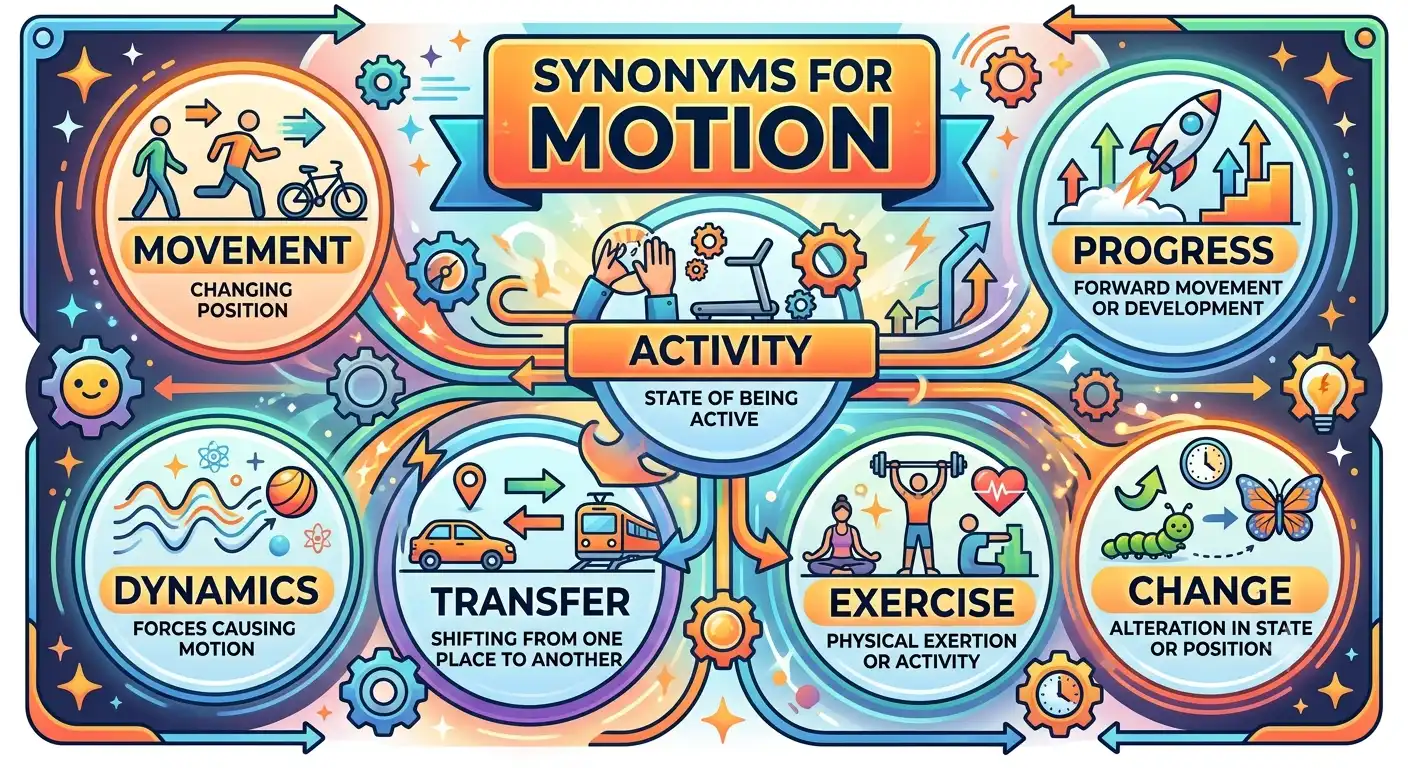
Learning synonyms for motion is a fantastic way to make your everyday writing and speech more exciting. When you explore different synonyms for motion, you can describe how things shift, slide, or race with perfect accuracy. Using synonyms for motion prevents you from repeating the word “movement” over and over, helping you sound much more professional and polished in your essays, emails, and stories.
Imagine watching a sleek cheetah sprint across the golden grasslands, or seeing a dry autumn leaf drift slowly to the cold ground. Both of these show actions, but they feel completely different because of the way they move. In simple English, motion is just the act of moving from one place to another, or changing your physical position.
This vocabulary guide is a highly useful tool for many different groups of people. Students can use these terms to write smart physics reports or write exciting stories for English class. Bloggers can use these action-packed words to paint vivid pictures and keep readers hooked on their posts. Content writers can build deep professional trust by using exact terms for physical actions or industrial processes. Daily English users can easily share their thoughts and speak with greater precision.
“Life is like riding a bicycle. To keep your balance, you must keep in motion.” — Albert Einstein
“Time is a storm in which we are all lost, but our motion makes us alive.” — Unknown
Lexical Profile of “Motion”
- Connotative Meaning: Progress, change, action, life, or transition. In basic physics, the kinetic energy ($E_k$) of an object in motion can be calculated based on its mass ($m$) and velocity ($v$): $$E_k = \frac{1}{2} m \cdot v^2$$ This formula shows how physical objects carry energy when they are in motion over time.
- Etymology:
- Origins: Derived from the Latin word motionem, which means “a moving” or “gesture.”
- Evolution: Entered Middle English via Old French in the 14th century to describe the act of moving or making a proposal.
- Pronunciation:
- US IPA: /ˈmoʊ.ʃən/
- UK IPA: /ˈməʊ.ʃən/
- Syllables: 2 syllables (mo-tion).
- Affixation Pattern: Root noun from the verb move with the suffix “-tion”. It can form the adjective motionless or motional.
Comparison Table of Key Synonyms
| Keyword | Meaning | Usage Type | Context |
|---|---|---|---|
| Movement | Changing place or position | Professional / Casual | Physical exercise, political groups, dances |
| Gesture | A movement of the body to show an idea | Casual | Body language, sign language, greetings |
| Activity | A condition of moving or doing things | Professional | Work projects, school tasks, fitness |
| Action | Doing something physical to get a result | Casual | Movies, daily chores, military plans |
| Drift | A slow, gentle movement carried by air or water | Casual | Weather, ocean currents, thoughts |
| Flow | The steady and smooth movement of a liquid | Professional | Rivers, traffic, electrical currents |
| Gait | A person’s or animal’s particular way of walking | Formal | Horse riding, medical checks, fashion walks |
| Stir | A very slight physical movement | Emotional / Casual | Quiet rooms, morning routines, cooking |
“All progress is change, but not all change is progress; we must keep moving.” — Unknown
50 Synonyms for Motion
1. Movement
- Pronunciation: US: /ˈmuːv.mənt/ & UK: /ˈmuːv.mənt/
- Meaning: This word means the act of changing your physical position or place.
- Examples:
- She noticed a quick movement in the green bushes.
- The dancer showed great movement during her performance on stage.
2. Action
- Pronunciation: US: /ˈæk.ʃən/ & UK: /ˈæk.ʃən/
- Meaning: This word means doing something physical instead of just talking about it.
- Examples:
- The police officer took quick action to save the lost puppy.
- We love to watch exciting action scenes in superhero movies.
3. Gesture
- Pronunciation: US: /ˈdʒɛs.tʃɚ/ & UK: /ˈdʒes.tʃə/
- Meaning: This word means a movement of your hands or head to show an idea or feeling.
- Examples:
- He made a friendly hand gesture to say hello to his new neighbor.
- A warm nod is a sweet gesture that shows you agree.
4. Flow
- Pronunciation: US: /floʊ/ & UK: /fləʊ/
- Meaning: This word means a smooth and continuous movement of a liquid or air.
- Examples:
- The cool river water has a steady flow down the mountain.
- Opening the window will help the flow of fresh air in this room.
5. Drift
- Pronunciation: US: /drɪft/ & UK: /drɪft/
- Meaning: This word means a slow and gentle movement carried by wind or water currents.
- Examples:
- We watched the red boat drift slowly across the quiet lake.
- The white snow started to drift against the wooden fence.
6. Shift
- Pronunciation: US: /ʃɪft/ & UK: /ʃɪft/
- Meaning: This word means a small change in position or direction.
- Examples:
- There was a sudden shift in the wind during our afternoon walk.
- Please shift your chair a little bit to the left side.
7. Run
- Pronunciation: US: /rʌn/ & UK: /rʌn/
- Meaning: This word means a fast movement using your legs to travel quickly.
- Examples:
- The children love to run around the green park after school.
- I need to run to the grocery store before it closes.
8. Glide
- Pronunciation: US: /ɡlaɪd/ & UK: /ɡlaɪd/
- Meaning: This word means to move smoothly and easily without any noise or effort.
- Examples:
- The beautiful swans glide across the clear pond water.
- The paper airplane can glide far when the wind is calm.
9. Slide
- Pronunciation: US: /slaɪd/ & UK: /slaɪd/
- Meaning: This word means to move smoothly along a wet or slippery surface.
- Examples:
- The kids love to slide down the snowy hill in winter.
- You can slide the glass door open to let the dog out.
10. Speed
- Pronunciation: US: /spiːd/ & UK: /spiːd/
- Meaning: This word means how fast something or someone moves.
- Examples:
- The red sports car traveled at a high speed down the road.
- He rode his bicycle with amazing speed to win the race.
11. Gait
- Pronunciation: US: /ɡeɪt/ & UK: /ɡeɪt/
- Meaning: This word means the special way a person or animal walks.
- Examples:
- The old man walked with a slow and heavy gait.
- The brown horse had a very smooth and steady gait.
12. Stir
- Pronunciation: US: /stɝː/ & UK: /stɜː/
- Meaning: This word means a very small or slight physical movement.
- Examples:
- The sleeping baby did not make a single stir all night.
- Use a wooden spoon to stir the sweet soup on the stove.
13. Pace
- Pronunciation: US: /peɪs/ & UK: /peɪs/
- Meaning: This word means the speed at which you walk, run, or move.
- Examples:
- We walked through the quiet forest at a relaxed pace.
- You need to keep a steady pace to finish the long race.
14. Flutter
- Pronunciation: US: /ˈflʌt̬.ɚ/ & UK: /ˈflʌt.ə/
- Meaning: This word means a quick, light, and flapping movement.
- Examples:
- We watched the yellow butterfly flutter around the bright flowers.
- The paper sheets began to flutter in the strong breeze.
15. Roll
- Pronunciation: US: /roʊl/ & UK: /rəʊl/
- Meaning: This word means to move by turning over and over on a surface.
- Examples:
- The round ball started to roll down the steep grassy hill.
- You can roll the heavy wooden barrel into the barn.
16. Swirl
- Pronunciation: US: /swɝːl/ & UK: /swɜːl/
- Meaning: This word means to move quickly in a circle or spiral shape.
- Examples:
- The dry autumn leaves swirl around the empty street.
- Watch the sweet cream swirl into your hot morning coffee.
17. Rotation
- Pronunciation: US: /roʊˈteɪ.ʃən/ & UK: /rəʊˈteɪ.ʃən/
- Meaning: This word means the movement of turning around a central point.
- Examples:
- The steady rotation of the fan keeps the bedroom cool.
- The earth completes one full rotation every single day.
18. Swell
- Pronunciation: US: /swɛl/ & UK: /swel/
- Meaning: This word means a slow, rolling movement of waves in the ocean.
- Examples:
- The large ocean swell made our little fishing boat rock.
- We could feel the gentle swell of the water under the dock.
19. Tremor
- Pronunciation: US: /ˈtrɛm.ɚ/ & UK: /ˈtrem.ə/
- Meaning: This word means a shaking or shivering movement of the ground or body.
- Examples:
- A small ground tremor shook the dishes in our kitchen cabinet.
- She felt a cold tremor pass through her arms.
20. Vibration
- Pronunciation: US: /vaɪˈbreɪ.ʃən/ & UK: /vaɪˈbreɪ.ʃən/
- Meaning: This word means a continuous, very fast shaking movement.
- Examples:
- The loud music caused a strong vibration in the floorboards.
- You can feel the phone vibration when someone calls you.
21. Wave
- Pronunciation: US: /weɪv/ & UK: /weɪv/
- Meaning: This word means a curving movement of water or a hand greeting.
- Examples:
- A giant wave crashed against the sandy beach shore.
- Give a friendly wave to your grandma before you leave.
22. Sweep
- Pronunciation: US: /swiːp/ & UK: /swiːp/
- Meaning: This word means a wide, smooth, and sweeping movement.
- Examples:
- The searchlight made a bright sweep across the dark yard.
- With one quick sweep of her hand, she cleared the table.
23. Flight
- Pronunciation: US: /flaɪt/ & UK: /flaɪt/
- Meaning: This word means the movement of flying through the air.
- Examples:
- The wild birds began their long south flight for winter.
- We watched the steady flight of the toy drone.
24. Jump
- Pronunciation: US: /dʒʌmp/ & UK: /dʒʌmp/
- Meaning: This word means to push yourself off the ground into the air.
- Examples:
- The happy frog can jump very far in the grass.
- You must jump over the deep puddle of water.
25. Leap
- Pronunciation: US: /liːp/ & UK: /liːp/
- Meaning: This word means a large, high, or long jump forward.
- Examples:
- The wild deer can leap over the high wooden fence easily.
- He made a brave leap across the rocky stream.
26. Bounce
- Pronunciation: US: /baʊns/ & UK: /baʊns/
- Meaning: This word means to spring back up after hitting a hard surface.
- Examples:
- The rubber ball will bounce high on the concrete floor.
- Kids love to bounce on the big backyard trampoline.
27. Swing
- Pronunciation: US: /swɪŋ/ & UK: /swɪŋ/
- Meaning: This word means to move back and forth from a fixed point.
- Examples:
- The heavy pendulum will swing slowly inside the old clock.
- The children love to swing on the playground chains.
28. Sway
- Pronunciation: US: /sweɪ/ & UK: /sweɪ/
- Meaning: This word means to move slowly from side to side.
- Examples:
- The tall pine trees sway gently in the evening wind.
- The green grass began to sway as the storm arrived.
29. Spin
- Pronunciation: US: /spɪn/ & UK: /spɪn/
- Meaning: This word means to turn around very quickly in a circle.
- Examples:
- The colorful toy top can spin for a long time.
- Watch the ice skater spin fast on the cold rink.
30. Rush
- Pronunciation: US: /rʌʃ/ & UK: /rʌʃ/
- Meaning: This word means to move with urgent speed or force.
- Examples:
- The excited fans rush through the open stadium doors.
- Please do not rush when you do your school homework.
31. Dash
- Pronunciation: US: /dæʃ/ & UK: /dæʃ/
- Meaning: This word means a sudden, quick run over a short distance.
- Examples:
- We had to make a quick dash to the car when it rained.
- The grey rabbit made a fast dash into the safety of the bushes.
32. Crawl
- Pronunciation: US: /krɔːl/ & UK: /krɔːl/
- Meaning: This word means to move slowly on your hands and knees.
- Examples:
- The sweet baby started to crawl across the living room rug.
- The caterpillars crawl slowly along the green garden leaves.
33. Creep
- Pronunciation: US: /kriːp/ & UK: /kriːp/
- Meaning: This word means to move very slowly and quietly so nobody sees you.
- Examples:
- The black cat tried to creep up on the tiny bird.
- We had to creep past our parents’ bedroom door at night.
34. Progress
- Pronunciation: US: /ˈprɑː.ɡres/ & UK: /ˈprəʊ.ɡres/
- Meaning: This word means forward movement toward a final destination or goal.
- Examples:
- The heavy train made slow progress up the snowy mountain.
- We watched the slow progress of the builders on our house.
35. Passage
- Pronunciation: US: /ˈpæs.ɪdʒ/ & UK: /ˈpæs.ɪdʒ/
- Meaning: This word means the movement of passing from one place or time to another.
- Examples:
- The narrow passage of the boat through the canal took hours.
- We marked the fast passage of time on our calendar.
36. Transit
- Pronunciation: US: /ˈtræn.zɪt/ & UK: /ˈtræn.zɪt/
- Meaning: This word means the movement of carrying goods or people from place to place.
- Examples:
- The new computer was damaged during transit to our office.
- The goods are currently in transit on a large cargo ship.
37. Travel
- Pronunciation: US: /ˈtræv.əl/ & UK: /ˈtræv.əl/
- Meaning: This word means the movement of going on a trip or journey.
- Examples:
- We plan to travel to the beautiful mountains this summer.
- Sound waves can travel very fast through clear water.
38. Voyage
- Pronunciation: US: /ˈvɔɪ.ɪdʒ/ & UK: /ˈvɔɪ.ɪdʒ/
- Meaning: This word means a very long journey or movement across the sea or space.
- Examples:
- The sailors went on a long sea voyage to find new lands.
- The spacecraft began its historic voyage to the red planet.
39. Journey
- Pronunciation: US: /ˈdʒɝː.ni/ & UK: /ˈdʒɜː.ni/
- Meaning: This word means the act of traveling from one distant place to another.
- Examples:
- The tired hikers completed their long journey through the desert.
- It was a wonderful journey across the scenic countryside.
40. Transport
- Pronunciation: US: /ˈtræn.spɔːrt/ & UK: /ˈtræn.spɔːt/
- Meaning: This word means the movement of taking people or things somewhere in a vehicle.
- Examples:
- The school bus provides daily transport for all the local children.
- We use trucks to transport fresh food to the grocery stores.
41. Transfer
- Pronunciation: US: /ˈtræns.fɝː/ & UK: /ˈtræns.fɜː/
- Meaning: This word means the movement of something from one place or person to another.
- Examples:
- The transfer of the money to my bank account was instant.
- We need to transfer these heavy boxes to the dry garage.
42. Migration
- Pronunciation: US: /maɪˈɡreɪ.ʃən/ & UK: /maɪˈɡreɪ.ʃən/
- Meaning: This word means the seasonal movement of animals from one region to another.
- Examples:
- We loved watching the autumn migration of the wild geese.
- The annual migration of the salmon up the river is beautiful.
43. Course
- Pronunciation: US: /kɔːrs/ & UK: /kɔːs/
- Meaning: This word means the direction or route that a movement follows.
- Examples:
- The wild river changed its natural course after the big flood.
- The giant ship kept its steady course through the dark night.
44. Stream
- Pronunciation: US: /striːm/ & UK: /striːm/
- Meaning: This word means a continuous, flowing movement of liquid, people, or things.
- Examples:
- A cold stream of fresh water came out of the pipe.
- A long stream of happy people walked down the main street.
45. Current
- Pronunciation: US: /ˈkɝː.ənt/ & UK: /ˈkʌr.ənt/
- Meaning: This word means a strong flowing movement of water, air, or electricity.
- Examples:
- The ocean current carried the bright plastic bottle far away.
- Be careful when swimming in the river due to the strong current.
46. Activity
- Pronunciation: US: /ækˈtɪv.ə.t̬i/ & UK: /ækˈtɪv.ə.ti/
- Meaning: This word means a situation where there is busy movement and action.
- Examples:
- There was a lot of physical activity on the school playground.
- The busy beehive was full of constant morning activity.
47. Hustle
- Pronunciation: US: /ˈhʌs.əl/ & UK: /ˈhʌs.əl/
- Meaning: This word means busy, rapid, and energetic movement.
- Examples:
- We love the exciting hustle and bustle of the big city.
- You need to hustle if you want to catch the early train.
48. Whirl
- Pronunciation: US: /wɝːl/ & UK: /wɜːl/
- Meaning: This word means a very rapid spinning or swirling movement.
- Examples:
- The dancer spun around in a beautiful, colorful whirl.
- His thoughts were in a wild whirl after the long meeting.
49. Surge
- Pronunciation: US: /sɝːdʒ/ & UK: /sɜːdʒ/
- Meaning: This word means a sudden and powerful forward or upward movement.
- Examples:
- A sudden surge of river water flooded the dry dirt road.
- The crowd made a massive forward surge when the gates opened.
50. Operation
- Pronunciation: US: /ˌɑː.pəˈreɪ.ʃən/ & UK: /ˌɒp.ərˈeɪ.ʃən/
- Meaning: This word means the planned action or working movement of a machine or system.
- Examples:
- The safe operation of the farm machinery is very important.
- The rescue operation began early in the morning.
Antonyms of “Motion”
To completely master this vocabulary concept, you should also learn its opposite terms:
- Stillness: The state of being completely quiet and not moving.
- Immobility: The inability to move or be moved from a position.
- Inactivity: A state of doing nothing or having no physical action.
- Rest: The state of stopping all movement to regain strength or energy.
- Stagnation: A state of standing still, with no flow, progress, or life.
Prototype Meaning and Categorization of “Motion”
The prototype meaning of “motion” is the act or process of moving, shifting, or changing physical position or place. We can group these 50 synonyms into four clear categories:
- Fast or Sudden Movements: Words that show a lot of speed, energy, or sudden shifts (e.g., run, speed, rush, dash, jump, leap, bounce, spin, surge, whirl).
- Smooth or Continuous Flow: Words that describe smooth, flowing, or elegant movements (e.g., movement, flow, drift, glide, slide, roll, swirl, rotation, swell, flight, swing, sway, course, stream, current).
- Slow, Shaking, or Small Motions: Words that describe tiny, gentle, or shaking actions (e.g., shift, gait, stir, pace, flutter, tremor, vibration, crawl, creep).
- Travel, Transition, and Action: Words representing progress, travel, or purposeful physical systems (e.g., action, gesture, sweep, wave, progress, passage, transit, travel, voyage, journey, transport, transfer, migration, activity, hustle, operation).
FAQ About Synonyms for Motion
1. What is the most common synonym for “motion”?
In everyday English, the most common synonym is movement. It is understood by everyone and can be used in almost any context, from sports to science.
2. Can “gait” be used to describe inanimate objects?
No. Gait is specifically used to describe the unique walking style or stride of humans and animals, such as horses or dogs.
3. What is the difference between “drift” and “flow”?
Drift is a very slow, passive movement caused by wind or water pushing an object. Flow is a smooth, continuous, and steady movement of a fluid itself.
4. What does the idiom “set in motion” mean?
This common idiom means to start a process, machine, or plan so that it begins to run or work.
5. Is “hustle” appropriate for formal business writing?
No. Hustle is a casual, energetic word. For professional writing, it is much better to use terms like efficiency, prompt action, or rapid progress.
6. How does “vibration” differ from “tremor”?
A vibration is a highly rapid, continuous shaking (like a phone buzzing). A tremor is a brief, isolated shake (like a small earthquake or a hand shiver).
Conclusion
Expanding your English vocabulary by studying synonyms for motion is a fantastic way to elevate your communication. When you learn to use these diverse, descriptive terms, your creative writing becomes more engaging, your blogging becomes more colorful, and your professional presentations sound far more authoritative. Instead of relying on the same simple words, you can paint clear pictures in the minds of your audience by selecting the exact right word for the situation.
Try to practice these fresh terms starting today! Use them when you draft an email to a coworker, write a descriptive essay for class, or talk with your friends about your weekend activities. The more you use them in casual settings, the more natural they will feel in your active vocabulary. Keep practicing, keep learning, and watch your communication skills flourish!
“Movement is a medicine for creating change in a person’s physical, emotional, and mental states.” — Carol Welch
“To keep our minds active, we must keep our language in constant motion.” — Unknown

Andrew Collins is an academic English educator with over 12 years of experience helping university students, IELTS candidates, and ESL learners improve their writing vocabulary.