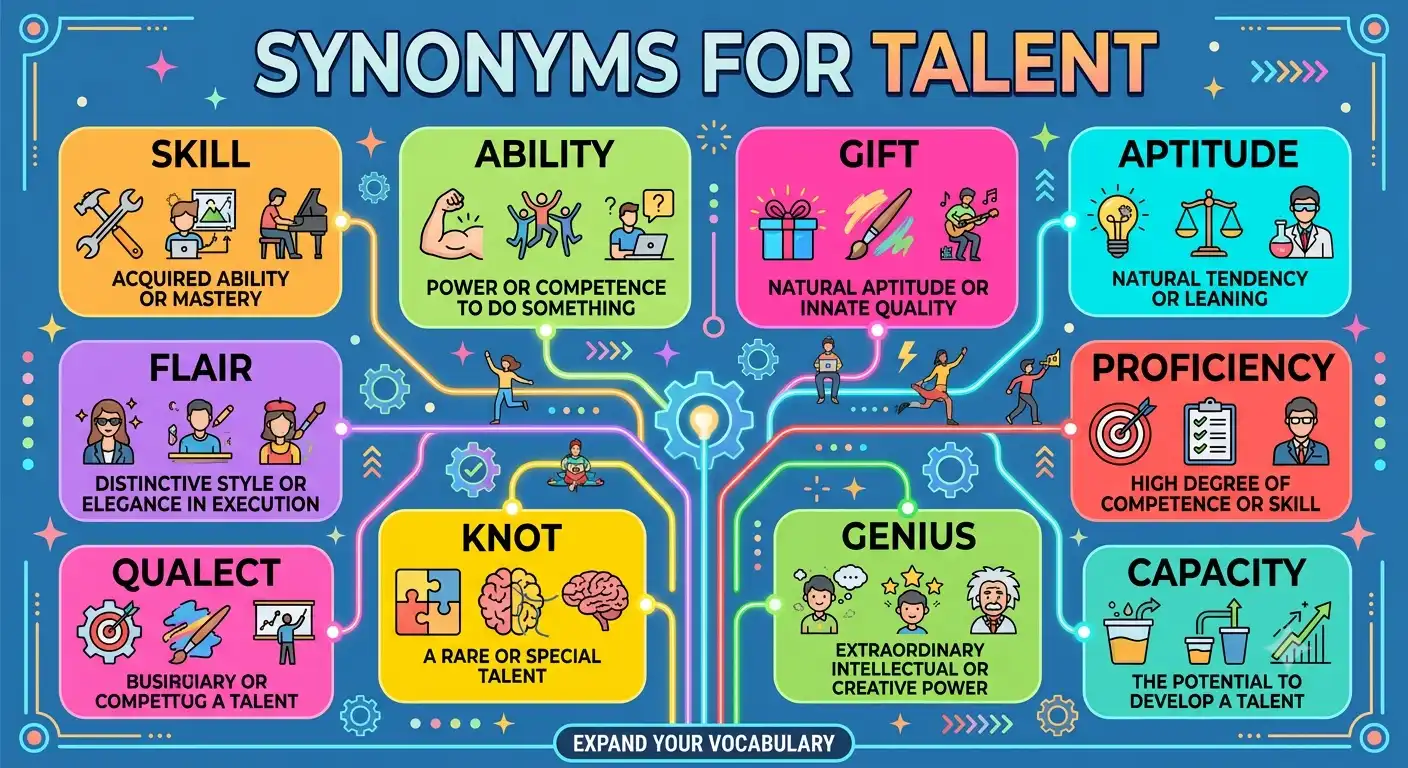
Exploring synonyms for talent is one of the most effective ways to broaden your vocabulary and describe human abilities with precision. Learning synonyms for talent allows you to showcase skills, gifts, and personal strengths much more dynamicly. When you understand how to use synonyms for talent, your essays, blog posts, and daily conversations immediately become more impactful.
Consider a young pianist who can play complex classical pieces effortlessly without reading sheet music. Calling her natural musical ability just a “skill” fails to capture the magic of her performance. Talent means a natural ability or special power to do something well.
A strong vocabulary benefits all kinds of language learners:
- Students can describe character traits and personal achievements in academic essays without repeating the same words.
- Bloggers can write compelling headines and relatable stories about personal development and career growth.
- Content writers can craft engaging articles that accurately highlight employee strengths and skill sets.
- Daily English users can praise friends, compliment colleagues, and express appreciation with confidence.
“Excellence is not an act, but a habit.” — Aristotle
“The future belongs to those who learn more skills and combine them in creative ways.” — Robert Greene
Linguistic Breakdown of “Talent”
Connotative Meaning
The word talent carries a highly positive connotation, associated with natural gift, high potential, creativity, and impressive skill.
Etymology
- Greek Origin: Derived from the Ancient Greek tálanton (a balance, unit of weight, or sum of money).
- Biblical Influence: Passed into Late Latin (talentum) and Old English through the Biblical “Parable of the Talents,” acquiring the meaning of a natural gift or capacity given by God.
- Modern Expansion: By the 15th century, shifted from monetary value to mental inclination or natural ability.
Pronunciation
- US IPA: /ˈtæl.ənt/
- UK IPA: /ˈtæl.ənt/
Syllables & Affixation Pattern
- Syllables: 2 (tal-ent)
- Root Word: Talent (noun)
- Affixation: Unaffixed root (base noun); forms adjectives like talented (+ed).
Comparison Table of Key Synonyms
| Keyword | Meaning | Usage Type | Context |
|---|---|---|---|
| Gift | A natural ability or capacity | Emotional / General | Arts, personal traits, natural skills |
| Aptitude | A natural capability for learning something | Formal / Academic | Education, career testing, learning |
| Forte | A thing at which someone excels | Casual / Modern | Work achievements, personal strengths |
| Flair | A special or instinctive aptitude | Stylish / Expressive | Fashion, cooking, artistic design |
| Expertise | High skill or knowledge in a particular field | Professional / Formal | Business, technical roles, resumes |
| Knack | An acquired or natural skill at doing something | Casual / Friendly | Daily tasks, solving quick problems |
| Prowess | Superior skill or ability in a specific activity | Formal / High-Impact | Athletics, academics, leadership |
| Craft | Skill in making or doing things | Practical / Artistic | Writing, woodworking, creative work |
Main Content – 50 Synonyms for Talent
1. Gift
- Pronunciation: US: /ɡɪft/ | UK: /ɡɪft/
- Meaning: Gift means a natural power or ability to do something well.
- Examples:
- She has a rare gift for playing the violin.
- His gift for storytelling makes his books popular.
2. Skill
- Pronunciation: US: /skɪl/ | UK: /skɪl/
- Meaning: Skill means an ability that you learn through practice and study.
- Examples:
- Learning to code is a useful digital skill.
- He practiced daily to improve his painting skill.
3. Ability
- Pronunciation: US: /əˈbɪl.ə.t̬i/ | UK: /əˈbɪl.ə.ti/
- Meaning: Ability means the physical or mental power to do something.
- Examples:
- Her ability to solve math problems quickly surprised the teacher.
- Regular practice boosts your writing ability.
4. Aptitude
- Pronunciation: US: /ˈæp.tə.tuːd/ | UK: /ˈæp.tɪ.tjuːd/
- Meaning: Aptitude means a natural capacity to learn or understand things easily.
- Examples:
- He showed a strong aptitude for science at an early age.
- The test measures your natural aptitude for mechanics.
5. Knack
- Pronunciation: US: /næk/ | UK: /næk/
- Meaning: Knack means a clever or special way of doing something easily.
- Examples:
- She has a knack for fixing broken bikes.
- My brother has a knack for remembering people’s names.
6. Flair
- Pronunciation: US: /fleər/ | UK: /fleər/
- Meaning: Flair means a natural style or exciting skill in doing something.
- Examples:
- The chef cooks every meal with artistic flair.
- She designs clothes with impressive creative flair.
7. Genius
- Pronunciation: US: /ˈdʒiː.ni.əs/ | UK: /ˈdʒiː.ni.əs/
- Meaning: Genius means exceptional natural power or high intellectual skill.
- Examples:
- Albert Einstein was famous for his scientific genius.
- Her musical genius was clear when she composed her first piece.
8. Capability
- Pronunciation: US: /ˌkeɪ.pəˈbɪl.ə.t̬i/ | UK: /ˌkeɪ.pəˈbɪl.ə.ti/
- Meaning: Capability means having the necessary skill or power to do a task.
- Examples:
- This computer has the capability to run heavy applications.
- The team demonstrated high capability during the project.
9. Expertise
- Pronunciation: US: /ˌek.spɝːˈtiːz/ | UK: /ˌek.spɜːˈtiːz/
- Meaning: Expertise means high-level skill or deep knowledge in a specific subject.
- Examples:
- We relied on her medical expertise during the emergency.
- His expertise in history helped us write the report.
10. Mastery
- Pronunciation: US: /ˈmæs.tɚ.i/ | UK: /ˈmɑː.stər.i/
- Meaning: Mastery means complete control or outstanding skill in a practice.
- Examples:
- It takes years of effort to reach mastery in chess.
- Her mastery of the French language impressed everyone.
11. Craft
- Pronunciation: US: /kræft/ | UK: /krɑːft/
- Meaning: Craft means a special skill used in making things by hand or art.
- Examples:
- Woodworking is a traditional craft requiring great patience.
- The author spent decades perfecting her writing craft.
12. Capacity
- Pronunciation: US: /kəˈpæs.ə.t̬i/ | UK: /kəˈpæs.ə.ti/
- Meaning: Capacity means the amount of talent or ability someone possesses.
- Examples:
- She has an amazing capacity to learn new languages.
- His capacity for work impresses all his managers.
13. Potential
- Pronunciation: US: /poʊˈten.ʃəl/ | UK: /pəˈten.ʃəl/
- Meaning: Potential means natural ability that can be developed in the future.
- Examples:
- The young athlete has huge potential for international success.
- Good teachers help students realize their full potential.
14. Faculty
- Pronunciation: US: /ˈfæk.əl.t̬i/ | UK: /ˈfæk.əl.ti/
- Meaning: Faculty means a natural physical or mental power.
- Examples:
- She retains her sharp mental faculties in her nineties.
- Hearing is a vital sensory faculty for human communication.
15. Cleverness
- Pronunciation: US: /ˈklev.ɚ.nəs/ | UK: /ˈklev.ə.nəs/
- Meaning: Cleverness means the state of being quick to learn or invent things.
- Examples:
- His cleverness helped him invent a useful household tool.
- We admired her cleverness in solving the hard riddle.
16. Proficiency
- Pronunciation: US: /prəˈfɪʃ.ən.si/ | UK: /prəˈfɪʃ.ən.si/
- Meaning: Proficiency means a high degree of skill or competence.
- Examples:
- Language proficiency is essential for studying abroad.
- She earned a certificate for her software proficiency.
17. Touch
- Pronunciation: US: /tʌtʃ/ | UK: /tʌtʃ/
- Meaning: Touch means a delicate or special skill in handling something.
- Examples:
- The artist added a gentle touch to the watercolor portrait.
- The baker has a magic touch with fruit pastries.
18. Art
- Pronunciation: US: /ɑːrt/ | UK: /ɑːt/
- Meaning: Art means a skill created through experience, study, or observation.
- Examples:
- Active listening is a valuable art in human relationships.
- Negotiation is a subtle art required in modern business.
19. Dexterity
- Pronunciation: US: /dekˈster.ə.t̬i/ | UK: /dekˈster.ə.ti/
- Meaning: Dexterity means skill in using your hands or mind quickly and accurately.
- Examples:
- Surgeons need great manual dexterity to perform operations.
- The magician displayed quick dexterity with playing cards.
20. Ingenuity
- Pronunciation: US: /ˌɪn.dʒəˈnuː.ə.t̬i/ | UK: /ˌɪn.dʒəˈnjuː.ə.ti/
- Meaning: Ingenuity means the skill of being clever, original, and inventive.
- Examples:
- The team solved the technical problem with creative ingenuity.
- Solar energy systems show human ingenuity at work.
21. Brilliance
- Pronunciation: US: /ˈbrɪl.jəns/ | UK: /ˈbrɪl.jəns/
- Meaning: Brilliance means outstanding brightness, skill, or intelligence.
- Examples:
- Her brilliance in research earned her an award.
- The actor performed with unmatched stage brilliance.
22. Facility
- Pronunciation: US: /fəˈsɪl.ə.t̬i/ | UK: /fəˈsɪl.ə.ti/
- Meaning: Facility means ease in performing a task or doing something well.
- Examples:
- He has a natural facility for picking up musical instruments.
- Her facility with numbers makes accounting very easy for her.
23. Competence
- Pronunciation: US: /ˈkɑːm.pə.t̬əns/ | UK: /ˈkɒm.pɪ.təns/
- Meaning: Competence means having enough skill and knowledge to do a job properly.
- Examples:
- The driver demonstrated high competence during the road test.
- Her professional competence builds trust among clients.
24. Savvy
- Pronunciation: US: /ˈsæv.i/ | UK: /ˈsæv.i/
- Meaning: Savvy means practical skill and common sense in real-world situations.
- Examples:
- She possesses strong financial savvy when making investments.
- Tech savvy employees adapt quickly to new software.
25. Instinct
- Pronunciation: US: /ˈɪn.stɪŋkt/ | UK: /ˈɪn.stɪŋkt/
- Meaning: Instinct means a natural, unlearned power or reaction.
- Examples:
- Great athletes rely on quick instincts during game play.
- Her instinct for design helped her decorate the apartment.
“Talent wins games, but teamwork and intelligence win championships.” — Michael Jordan
26. Virtuosity
- Pronunciation: US: /ˌvɝː.tʃuˈɑː.sə.t̬i/ | UK: /ˌvɜː.tʃuˈɒs.ə.ti/
- Meaning: Virtuosity means high technical skill in music or artistic performance.
- Examples:
- The audience applauded his piano virtuosity.
- Her performance showed technical virtuosity and deep emotion.
27. Calling
- Pronunciation: US: /ˈkɑː.lɪŋ/ | UK: /ˈkɔː.lɪŋ/
- Meaning: Calling means a strong inner feeling that you have a talent for a job.
- Examples:
- Teaching children felt like her true calling in life.
- He pursued medicine because he felt a powerful calling.
28. Bent
- Pronunciation: US: /bent/ | UK: /bent/
- Meaning: Bent means a natural inclination or talent toward a specific interest.
- Examples:
- She has an artistic bent and loves painting landscapes.
- His mechanical bent made him a great engineer.
29. Endowment
- Pronunciation: US: /ɪnˈdaʊ.mənt/ | UK: /ɪnˈdaʊ.mənt/
- Meaning: Endowment means a natural quality or talent given to someone.
- Examples:
- Intellectual endowment helps students grasp difficult concepts fast.
- Her vocal endowment made her a stand-out opera singer.
30. Readiness
- Pronunciation: US: /ˈred.i.nəs/ | UK: /ˈred.i.nəs/
- Meaning: Readiness means a quick natural power or willingness to do something.
- Examples:
- His quick readiness in answering questions impressed the judge.
- She showed mental readiness during the competition.
31. Power
- Pronunciation: US: /ˈpaʊ.ɚ/ | UK: /ˈpaʊ.ər/
- Meaning: Power means the ability or strength to do a specific action.
- Examples:
- Her power of persuasion convinced the board members.
- Writers hold the power to inspire readers everywhere.
32. Prowess
- Pronunciation: US: /ˈpraʊ.es/ | UK: /ˈpraʊ.es/
- Meaning: Prowess means distinguished skill, bravery, or ability in a field.
- Examples:
- The team proved their athletic prowess in the final match.
- She was awarded for her academic prowess in chemistry.
33. Magic
- Pronunciation: US: /ˈmædʒ.ɪk/ | UK: /ˈmædʒ.ɪk/
- Meaning: Magic means a special, wonderful quality or skill that produces great results.
- Examples:
- The gardener worked her magic to grow beautiful roses.
- His magic on the guitar amazed everyone in the room.
34. Turn
- Pronunciation: US: /tɝːn/ | UK: /tɜːn/
- Meaning: Turn means a natural skill or tendency to do something well.
- Examples:
- She has a neat turn of phrase when writing poetry.
- He showed a practical turn for fixing home appliances.
35. Flair for
- Pronunciation: US: /fleər fɔːr/ | UK: /fleər fɔː/
- Meaning: Flair for means a natural talent or passion for doing something.
- Examples:
- My sister has a flair for learning foreign languages.
- He has a flair for dramatic performance on stage.
36. Natural ability
- Pronunciation: US: /ˈnætʃ.ɚ.əl əˈbɪl.ə.t̬i/ | UK: /ˈnætʃ.ər.əl əˈbɪl.ə.ti/
- Meaning: Natural ability means a skill you were born with rather than taught.
- Examples:
- Her natural ability made her a fast runner from childhood.
- Cooking came easily to him because of his natural ability.
37. Adroitness
- Pronunciation: US: /əˈdrɔɪt.nəs/ | UK: /əˈdrɔɪt.nəs/
- Meaning: Adroitness means skill, cleverness, or quickness in handling tasks.
- Examples:
- The manager handled the argument with social adroitness.
- His physical adroitness made him a skilled gymnast.
38. Expertness
- Pronunciation: US: /ˈek.spɝːt.nəs/ | UK: /ˈek.spɜːt.nəs/
- Meaning: Expertness means the quality of having expert skill in an area.
- Examples:
- The repair required a high level of technical expertness.
- Her expertness in gardening kept the plants healthy.
39. Whiz
- Pronunciation: US: /wɪz/ | UK: /wɪz/
- Meaning: Whiz means a person who has an amazing natural talent for something.
- Examples:
- My cousin is a computer whiz who builds his own devices.
- She is a math whiz who completes tests in half the time.
40. Strong suit
- Pronunciation: US: /strɑːŋ suːt/ | UK: /strɒŋ suːt/
- Meaning: Strong suit means something that a person does very well.
- Examples:
- Public speaking is definitely her strong suit.
- Patience is his strong suit when teaching young children.
41. Forte
- Pronunciation: US: /ˈfɔːr.teɪ/ | UK: /ˈfɔː.teɪ/
- Meaning: Forte means a strong ability or something you are especially good at.
- Examples:
- Graphic design is his primary forte at the agency.
- Organizing large events is her biggest forte.
42. Caliber
- Pronunciation: US: /ˈkæl.ə.bɚ/ | UK: /ˈkæl.ɪ.bər/
- Meaning: Caliber means the level of quality, skill, or ability a person has.
- Examples:
- The company hires workers of high professional caliber.
- Her musical caliber improved after years of studying.
43. Spark
- Pronunciation: US: /spɑːrk/ | UK: /spɑːk/
- Meaning: Spark means a small, bright piece of talent or original creativity.
- Examples:
- The young student showed a spark of creative genius.
- Her idea added a fresh spark to the team project.
44. Precision
- Pronunciation: US: /prəˈsɪʒ.ən/ | UK: /prəˈsɪʒ.ən/
- Meaning: Precision means the quality of doing something with high accuracy and skill.
- Examples:
- The watchmaker works with incredible hand precision.
- Her gymnastics routine was executed with absolute precision.
45. Dexterousness
- Pronunciation: US: /ˈdek.strəs.nəs/ | UK: /ˈdek.strəs.nəs/
- Meaning: Dexterousness means physical or mental skill in doing complex tasks smoothly.
- Examples:
- Knitting intricate sweaters requires great dexterousness.
- The pianist displayed impressive dexterousness across the keys.
46. Technical skill
- Pronunciation: US: /ˈtek.nɪ.kəl skɪl/ | UK: /ˈtek.nɪ.kəl skɪl/
- Meaning: Technical skill means the practical knowledge needed to perform specific jobs.
- Examples:
- Software engineering demands high technical skill.
- She developed her technical skill by completing hands-on labs.
47. Mastery level
- Pronunciation: US: /ˈmæs.tɚ.i ˈlev.əl/ | UK: /ˈmɑː.stər.i ˈlev.əl/
- Meaning: Mastery level means the highest degree of proficiency in a subject or craft.
- Examples:
- He reached a mastery level in martial arts after ten years.
- Her mastery level in painting was clear in every canvas.
48. Acumen
- Pronunciation: US: /əˈkjuː.mən/ | UK: /ˈæk.ju.mən/
- Meaning: Acumen means the ability to make good judgments and quick decisions.
- Examples:
- Her business acumen helped the company double its profit.
- He showed strong financial acumen during the negotiations.
49. Intelligence
- Pronunciation: US: /ɪnˈtel.ə.dʒəns/ | UK: /ɪnˈtel.ɪ.dʒəns/
- Meaning: Intelligence means the mental ability to learn, understand, and solve problems.
- Examples:
- Emotional intelligence helps people get along with others.
- Her natural intelligence made learning new concepts easy.
50. Craftsmanship
- Pronunciation: US: /ˈkræfts.mən.ʃɪp/ | UK: /ˈkrɑːfts.mən.ʃɪp/
- Meaning: Craftsmanship means superior quality and skill in hand-crafted work.
- Examples:
- The custom wooden table shows beautiful craftsmanship.
- Readers appreciate the fine craftsmanship of her historical novels.
Antonyms of “Talent”
While talent refers to natural power, ability, or exceptional skill, these terms represent its opposite—inability, lack of skill, or weakness:
- Inability: US: /ˌɪn.əˈbɪl.ə.t̬i/ | UK: /ˌɪn.əˈbɪl.ə.ti/ – The lack of physical or mental power to do something.
- Incompetence: US: /ɪnˈkɑːm.pə.t̬əns/ | UK: /ɪnˈkɒm.pɪ.təns/ – Lack of physical or mental skill to do a job properly.
- Clumsiness: US: /ˈklʌm.zi.nəs/ | UK: /ˈklʌm.zi.nəs/ – Lack of grace or physical adroitness in movement.
- Ineptitude: US: /ɪnˈep.tə.tuːd/ | UK: /ɪnˈep.tɪ.tjuːd/ – A total lack of skill or ability at a task.
Prototype Meaning and Categorization of “Talent”
- Grammatical Category: Noun (Countable & Uncountable).
- Prototype Meaning: A natural, innate capacity or special ability to accomplish tasks or express creativity exceptionally well.
- Semantic Field: Human capabilities, psychological aptitudes, skills, achievements, and personal traits.
Frequently Asked Questions (FAQ)
1. What is the most common synonym for talent?
The most versatile synonyms for talent are gift, ability, skill, and aptitude. These words work smoothly across casual speech, academic writing, and professional contexts.
2. What is the difference between talent and skill?
Talent usually refers to a natural ability you are born with or develop easily. Skill refers to an ability that you gain through practice, training, and deliberate effort over time.
3. Is “forte” a good synonym for talent in business writing?
Yes, forte works well in professional contexts when describing an individual’s main strength or area of personal excellence (e.g., “Data analysis is her forte”).
4. How can content writers use synonyms for talent in resumes?
To avoid repeating “talented,” use precise options like expertise, proficiency, technical skill, business acumen, or demonstrated prowess when detailing achievements.
5. Can “gift” be used interchangeably with “talent”?
In almost all contexts, yes. Both “gift” and “talent” describe natural powers, though “gift” often carries a slightly warmer or more artistic connotation.
6. Why is expanding your vocabulary for “talent” important?
Using varied synonyms avoids repetitive phrasing, improves clarity, engages readers, and elevates the professional tone of your writing and speech.
Conclusion
Mastering synonyms for talent enriches your expressive range and allows you to highlight human potential, professional abilities, and creative strengths with accuracy. Replacing repetitive terms with sharp alternatives like aptitude, expertise, knack, or flair gives your prose energy and clarity. Whether you are drafting a university essay, publishing a blog article, revising a resume, or talking with colleagues, selecting the precise word makes your message resonate far more effectively.
Make it a habit to practice these new terms in your regular communication. Try using different synonyms in your daily emails, creative writing, and discussions to build your confidence and expand your linguistic flexibility.
“Hide not your talents, for for use they were made. What’s a sundial in the shade?” — Benjamin Franklin
“The person with a new idea is a crank until the idea succeeds.” — Mark Twain

Andrew Collins is an academic English educator with over 12 years of experience helping university students, IELTS candidates, and ESL learners improve their writing vocabulary.