The word “over” is very common in daily speech and writing.
It can describe position, time, completion, or control.
Learning synonyms for “over” helps you speak more clearly and avoid repeating the same word.
Quick Answer: What Does ‘Over’ Mean?
“Over” can mean above something, finished, across, or more than a certain amount.
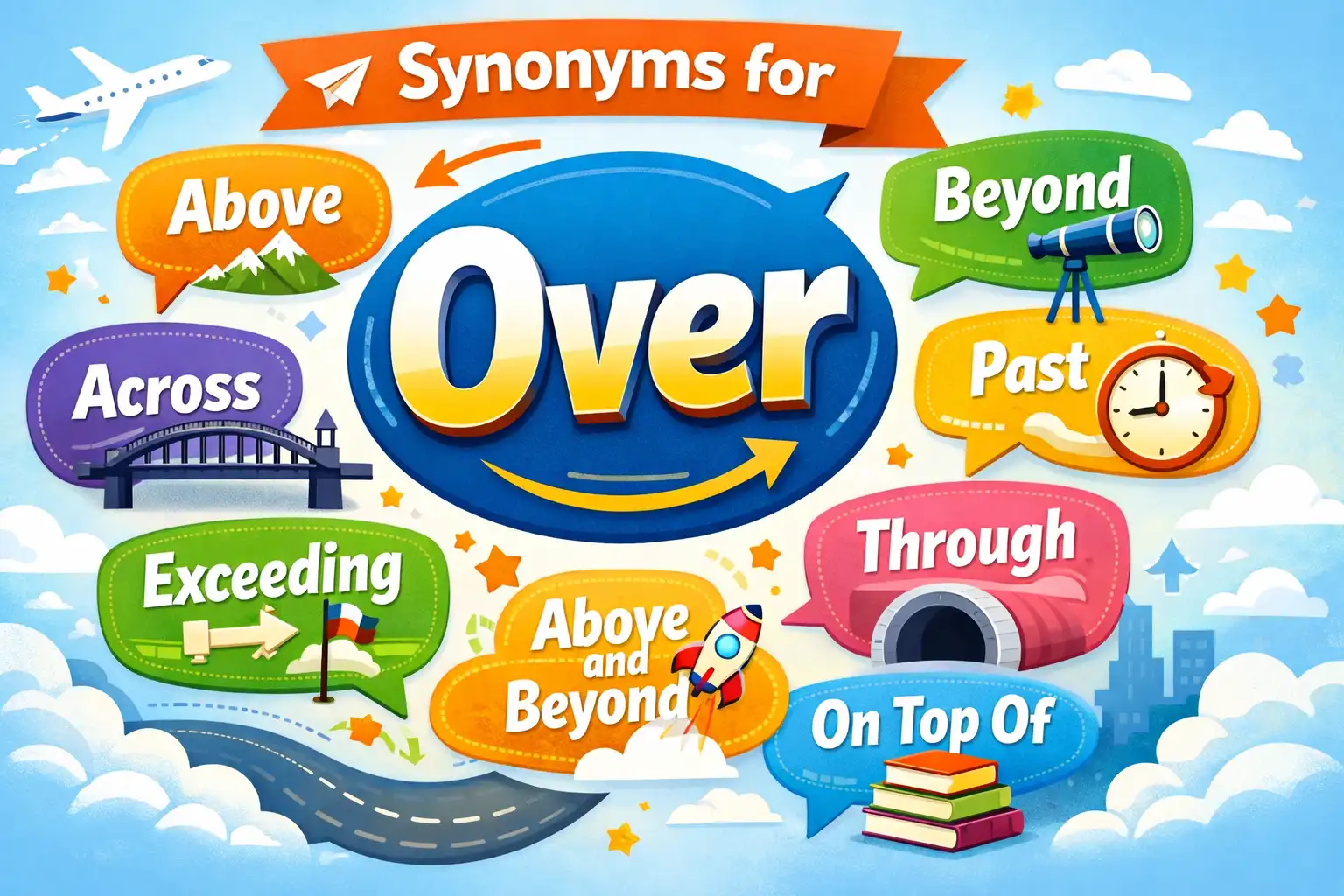
Common synonyms include:
- Above
- Across
- Beyond
- More than
- Finished
- Through
- Past
- On top of
Meaning of Over
“Over” usually means higher than something, across something, or completed.
Example:
The plane flew over the city.
Categories of Synonyms
1. Position (Physical Location)
These words describe something higher or covering something else.
Examples: above, on top of
2. Movement (Crossing or Passing)
These words describe going from one side to another.
Examples: across, past, beyond, through
3. Amount or Completion
These words describe quantity or something being finished.
Examples: more than, finished
Synonyms Table
| Word | Simple Meaning | Example Sentence |
| Above | Higher than something | The lamp hangs above the table. |
| Across | From one side to another | She walked across the street. |
| Beyond | Farther than | The mountains are beyond the river. |
| More than | A higher number | He has more than 100 books. |
| Finished | Completed | The game is finished. |
| Through | From start to end | She read through the report. |
| Past | After or beyond | It is past midnight. |
| On top of | Directly above | The keys are on top of the desk. |
Master Synonyms List (Grouped by Level)
Beginner / Simple
Above
Simple meaning: higher than
Example: The picture is above the sofa.
Across
Simple meaning: from one side to another
Example: We swam across the lake.
Past
Simple meaning: beyond or after
Example: It is past 9 p.m.
Intermediate
Beyond
Simple meaning: farther than
Example: The village is beyond the hills.
Through
Simple meaning: from beginning to end
Example: She worked through the night.
More than
Simple meaning: a greater amount
Example: The project cost more than expected.
Advanced / Formal
Finished
Simple meaning: completed
Example: The meeting is finished. (Neutral/Formal)
On top of
Simple meaning: directly above
Example: The report is on top of the file cabinet. (Neutral)
Formal vs Informal Synonyms
- More than is neutral and common in all contexts.
- Finished sounds more formal than casual speech like “it’s over.”
- On top of is common in conversation.
- Beyond is slightly more formal and often used in writing.
Always choose based on your audience and purpose.
Real-Life Usage Examples
Conversation
The movie is over.
The cat jumped over the fence.
Academic Writing
The results were beyond expectations.
The study included more than 200 students.
Business Writing
The project is finished.
Sales increased by more than 15 percent.
Blogging
Travel beyond your comfort zone.
Walk across the bridge for a great view.
Emotional Expression
It’s finally over.
I am past that difficult time.
Similar Words Comparison
Over vs Above
- Over can mean higher or covering.
- Above only means higher, not covering.
Example:
The plane flew over the house.
The clock is above the door.
Over vs Across
- Over can mean higher than.
- Across means from one side to another.
Example:
He jumped over the wall.
She walked across the room.
Example Sentences
- The helicopter flew over the city.
- The painting hangs above the bed.
- We drove across the desert.
- The party is over.
- It costs more than ten dollars.
- The river flows beyond the town.
- She stayed up past midnight.
- The snow fell over the hills.
- He read through the contract carefully.
- The meeting finished at noon.
- The bridge goes over the river.
- The answer is beyond my understanding.
- The book is on top of the shelf.
- The storm is finally over.
Common Mistakes
- Using above when movement is needed.
Incorrect: He walked above the street.
Correct: He walked across the street. - Using over instead of more than for numbers in formal writing.
Formal writing prefers: more than 50 people. - Confusing past and passed.
“Past” shows time or position.
“Passed” is a verb. - Using “over” too often in the same paragraph.
Use synonyms to improve clarity.
Tips / Best Practices
- Choose based on meaning: position, movement, or amount.
- Think about tone: formal or casual.
- Use simple synonyms for ESL writing.
- Avoid repeating “over” too many times.
- Always check if the synonym changes the meaning.
When NOT to Use Over
Do not replace “over” when it is part of fixed phrases:
- “Over and over”
- “Over time”
- “All over the world”
Changing these may sound unnatural.
Opposite Words (Antonyms)
- Under
- Below
- Beneath
- Less than
- Before
FAQs
What does “over” mean?
It can mean higher than something, across something, or finished.
Is “over” formal or informal?
It is neutral and used in both speech and writing.
How can I use it in conversation?
Example: The game is over.
What is the best synonym for “over”?
It depends on context. “Above” works for position. “More than” works for numbers.
Can “over” be replaced with “above”?
Sometimes, but only when talking about height, not movement or completion.
Conclusion
Understanding synonyms for “over” helps you avoid repetition and choose the exact meaning you need.
Whether you are describing position (above), movement (across), or amount (more than), the right synonym makes your message clearer and more professional.
Strong vocabulary improves:
- Writing clarity
- Speaking confidence
- Academic accuracy
- Business communication
Start today: write 5 sentences using different synonyms for “over.”
Practice them in conversation, emails, or social media posts. The more you use them, the more natural they will feel.

Andrew Collins writes vocabulary-focused articles that explore word meanings and alternative expressions for better communication.