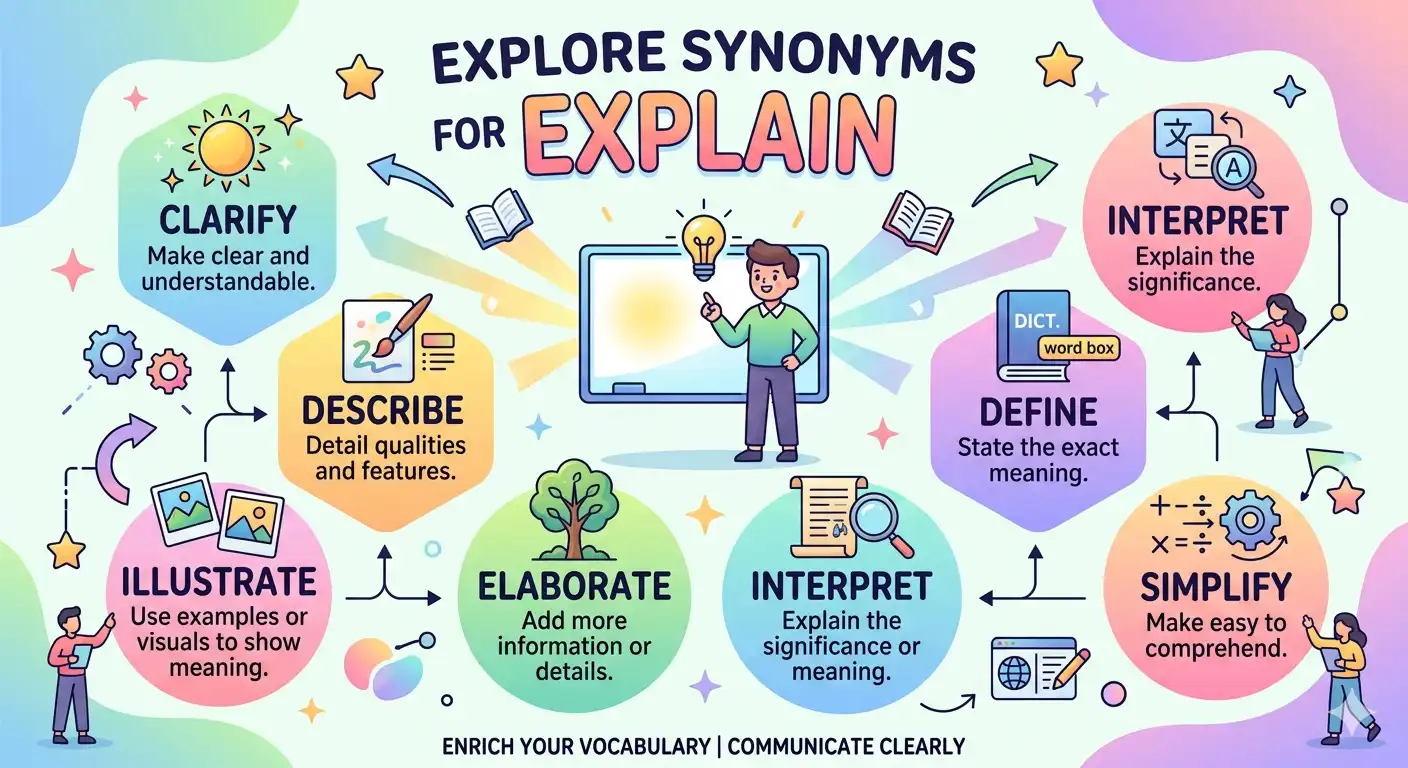
Finding the best synonyms for explain can instantly elevate your writing and make your descriptions stand out. When you use diverse synonyms for explain, you keep your audience engaged and avoid sounding repetitive. Mastering these synonyms for explain helps you share instructions, teach new ideas, and express yourself with perfect precision.
Imagine trying to teach your younger sibling how to ride a bicycle. If you just repeat the same instructions over and over without changing your words, they will quickly get confused and lose interest. Instead of repeating yourself, shifting to a fresh term like “show” or “walk through” can make the lesson click instantly. Using a more precise word lets your readers or listeners feel the actual clarity of your thoughts.
In very simple English, “explain” means to make something clear or easy to understand by talking about it in detail. Students need these terms to write more vivid and descriptive essays that earn better marks. Bloggers and content writers use them to craft compelling headlines and emotionally engaging articles that hook readers. Daily English speakers use them to express their thoughts clearly and make a stronger impression on others.
“If you can’t explain it simply, you don’t understand it well enough.” — Albert Einstein
“The art of communication is the language of leadership.” — James Humes
Linguistic Profile of “Explain”
To truly understand how to use synonyms for explain, let’s look at the linguistic makeup of the word itself.
- Connotative Meaning: As a verb, “explain” carries a sense of clarity, logic, guidance, and helpful instruction. It makes ideas feel accessible, organized, and easy to grasp.
- Etymology:
- Derived from Middle English explanen (meaning to make plain or clear).
- Rooted in the Latin explanare (to make flat, plain, or smooth), which comes from ex- (out) and planus (flat or plain).
- Pronunciation: US:
/ɪkˈspleɪn/| UK:/ɪkˈspleɪn/ - Syllables: ex-plain ($2$ syllables)
- Affixation Pattern: Prefix ex- combined with the root word plain (from planus).
Comparison of Core Synonyms
| Keyword | Meaning | Usage Type | Context |
|---|---|---|---|
| Explain | To make something clear by giving details. | Neutral / Versatile | Everyday conversations, teaching, or giving directions. |
| Clarify | To make a confusing point easy to understand. | Professional | Meetings, emails, or solving a misunderstanding. |
| Describe | To tell what someone or something is like. | Conversational | Telling a story, describing a scene, or talking about an object. |
| Elaborate | To add more details to a simple statement. | Formal | Academic papers, project proposals, or deep discussions. |
| Illustrate | To explain by using examples or pictures. | Professional | Presentations, teaching, or writing textbooks. |
50 Detailed Synonyms for Explain
1. Clarify
Pronunciation: US: /ˈklær.ə.faɪ/ | UK: /ˈklær.ɪ.faɪ/
Meaning: This means to make something clear and easy to understand.
Examples:
- Please clarify your plans for the weekend.
- She wrote a quick note to clarify the rules of the game.
2. Describe
Pronunciation: US: /dɪˈskraɪb/ | UK: /dɪˈskraɪb/
Meaning: This means to tell what someone or something is like in words.
Examples:
- Can you describe what your new dog looks like?
- He used beautiful words to describe the sunset.
3. Elaborate
Pronunciation: US: /iˈlæb.ə.reɪt/ | UK: /iˈlæb.ə.reɪt/
Meaning: This means to add more details to what you are saying.
Examples:
- The teacher asked her to elaborate on her science project.
- I would like to elaborate on my main idea.
4. Illustrate
Pronunciation: US: /ˈɪl.ə.streɪt/ | UK: /ˈɪl.ə.streɪt/
Meaning: This means to make something clear by giving examples or showing pictures.
Examples:
- He used a chart to illustrate the growth of the company.
- Let me share a story to illustrate my point.
5. Define
Pronunciation: US: /dɪˈfaɪn/ | UK: /dɪˈfaɪn/
Meaning: This means to explain the exact meaning of a word or idea.
Examples:
- The dictionary can help you define tough words.
- We need to define our goals before we begin.
6. Demonstrate
Pronunciation: US: /ˈdem.ən.streɪt/ | UK: /ˈdem.ən.streɪt/
Meaning: This means to show how something works by doing it yourself.
Examples:
- She will demonstrate how to bake a chocolate cake.
- The coach will demonstrate the correct way to swing the bat.
7. Interpret
Pronunciation: US: /ɪnˈtɜːr.prɪt/ | UK: /ɪnˈtɜː.prɪt/
Meaning: This means to explain the hidden meaning of something like a dream or a poem.
Examples:
- He helped me interpret the message in the old letter.
- How do you interpret this modern painting?
8. Translate
Pronunciation: US: /trænzˈleɪt/ | UK: /trænzˈleɪt/
Meaning: This means to change words from one language or form into another.
Examples:
- She can translate the Spanish book into English for you.
- Please translate this technical jargon into simple terms.
9. Disclose
Pronunciation: US: /dɪˈskloʊz/ | UK: /dɪˈskləʊz/
Meaning: This means to make a secret or new fact known to people.
Examples:
- The company will disclose its plans tomorrow morning.
- He refused to disclose where he hid the key.
10. Reveal
Pronunciation: US: /rɪˈviːl/ | UK: /rɪˈviːl/
Meaning: This means to show something that was hidden or secret.
Examples:
- She opened the box to reveal a beautiful gold ring.
- The map will reveal the path to the treasure.
11. Detail
Pronunciation: US: /dɪˈteɪl/ | UK: /ˈdiː.teɪl/
Meaning: This means to list or talk about every single part of something.
Examples:
- The guide will detail the history of the castle.
- He took some time to detail his trip to the mountains.
12. Unfold
Pronunciation: US: /ʌnˈfoʊld/ | UK: /ʌnˈfəʊld/
Meaning: This means to reveal or explain a story slowly over time.
Examples:
- We watched the mystery unfold as we read the book.
- She let her plan unfold during the meeting.
13. Explicate
Pronunciation: US: /ˈek.splɪ.keɪt/ | UK: /ˈek.splɪ.keɪt/
Meaning: This means to explain a complex idea or piece of writing in great detail.
Examples:
- The professor will explicate the ancient poem in class.
- He wrote an essay to explicate the new law.
14. Decipher
Pronunciation: US: /dɪˈsaɪ.fɚ/ | UK: /dɪˈsaɪ.fər/
Meaning: This means to find the meaning of something that is hard to read or understand.
Examples:
- Can you help me decipher this messy handwriting?
- It is hard to decipher the meaning of this code.
15. Simplify
Pronunciation: US: /ˈsɪm.plə.faɪ/ | UK: /ˈsɪm.plɪ.faɪ/
Meaning: This means to make something much easier to understand or do.
Examples:
- Please simplify the math problem so the kids can solve it.
- You can simplify your life by cleaning your room.
16. Decode
Pronunciation: US: /diːˈkoʊd/ | UK: /diːˈkəʊd/
Meaning: This means to discover the meaning of a secret message or signal.
Examples:
- The smart spy was able to decode the secret letter.
- We need to decode what these blinking lights mean.
17. Solve
Pronunciation: US: /sɑːlv/ | UK: /sɒlv/
Meaning: This means to find the correct answer to a problem or mystery.
Examples:
- She used clues to solve the fun puzzle.
- He worked hard to solve the hard question on his test.
18. Outline
Pronunciation: US: /ˈaʊt.laɪn/ | UK: /ˈaʊt.laɪn/
Meaning: This means to give a short description of the main points of something.
Examples:
- He made a list to outline his ideas for the book.
- The boss will outline our tasks for the day.
19. Summarize
Pronunciation: US: /ˈsʌm.ə.raɪz/ | UK: /ˈsʌm.ə.raɪz/
Meaning: This means to give a short statement of the main points.
Examples:
- Can you summarize the movie in just two sentences?
- She will summarize the meeting for the team.
20. Trace
Pronunciation: US: /treɪs/ | UK: /treɪs/
Meaning: This means to follow or describe the history or path of something.
Examples:
- The book will trace the history of soccer.
- She tried to trace her family tree back many years.
21. Untangle
Pronunciation: US: /ʌnˈtæŋ.ɡəl/ | UK: /ʌnˈtæŋ.ɡəl/
Meaning: This means to make a complicated situation clear and easy.
Examples:
- The lawyer helped to untangle the messy property case.
- We need to untangle these mixed-up facts.
22. Characterize
Pronunciation: US: /ˈkær.ək.tə.raɪz/ | UK: /ˈkær.ək.tə.raɪz/
Meaning: This means to describe the most important qualities of someone or something.
Examples:
- How would you characterize his writing style?
- They characterize the new leader as very kind and fair.
23. Portray
Pronunciation: US: /pɔːrˈtreɪ/ | UK: /pɔːˈtreɪ/
Meaning: This means to describe or show something in a specific way.
Examples:
- The news tried to portray the event as a success.
- Her painting seems to portray a peaceful country home.
24. Show
Pronunciation: US: /ʃoʊ/ | UK: /ʃəʊ/
Meaning: This means to make something visible or clear by pointing to it.
Examples:
- Let me show you where the park is on the map.
- His smile will show you that he is happy.
“To explain is to clear the air, to clarify is to heal.” — Unknown
25. Teach
Pronunciation: US: /tiːtʃ/ | UK: /tiːtʃ/
Meaning: This means to give knowledge or show someone how to do something.
Examples:
- My uncle will teach me how to swim this summer.
- She wants to teach history to high school students.
26. Break down
Pronunciation: US: /breɪk daʊn/ | UK: /breɪk daʊn/
Meaning: This means to divide a big idea into smaller, easier parts.
Examples:
- Let me break down the cost of our vacation.
- The coach will break down the play so we understand it.
27. Spell out
Pronunciation: US: /spel aʊt/ | UK: /spel aʊt/
Meaning: This means to explain something in extremely clear and simple steps.
Examples:
- You do not need to spell out every single detail for me.
- The contract will spell out your duties at work.
28. Shed light on
Pronunciation: US: /ʃed laɪt ɑːn/ | UK: /ʃed laɪt ɒn/
Meaning: This means to provide new information that makes something easier to understand.
Examples:
- These new facts will shed light on the mystery.
- Can anyone shed light on why the computer is broken?
29. Clear up
Pronunciation: US: /klɪr ʌp/ | UK: /klɪər ʌp/
Meaning: This means to solve a misunderstanding or make a confusion disappear.
Examples:
- I hope we can clear up this little argument today.
- The doctor spoke to him to clear up his worries.
30. Expound
Pronunciation: US: /ɪkˈspaʊnd/ | UK: /ɪkˈspaʊnd/
Meaning: This means to give a detailed statement or explanation of a theory.
Examples:
- The scientist loved to expound on his space theories.
- She began to expound her views on modern art.
31. Walk through
Pronunciation: US: /wɔːk θruː/ | UK: /wɔːk θruː/
Meaning: This means to guide someone step-by-step through a process.
Examples:
- Let me walk through the software setup with you.
- He will walk through the fire drill rules for the students.
32. Analyze
Pronunciation: US: /ˈæn.əl.aɪz/ | UK: /ˈæn.əl.aɪz/
Meaning: This means to study something closely to explain how it works.
Examples:
- We need to analyze the results of our science experiment.
- The expert will analyze the old building to see if it is safe.
33. Map out
Pronunciation: US: /mæp aʊt/ | UK: /mæp aʊt/
Meaning: This means to plan or describe a path or journey in detail.
Examples:
- We should map out our road trip before we leave.
- The team met to map out the next steps of the project.
34. Discuss
Pronunciation: US: /dɪˈskʌs/ | UK: /dɪˈskʌs/
Meaning: This means to talk about something with other people to share ideas.
Examples:
- We will discuss our book in class on Friday.
- Parents often discuss safety rules with their children.
35. State
Pronunciation: US: /steɪt/ | UK: /steɪt/
Meaning: This means to say something clearly and directly.
Examples:
- Please state your full name and address for the form.
- The sign will state the rules of the swimming pool.
36. Frame
Pronunciation: US: /freɪm/ | UK: /freɪm/
Meaning: This means to express an idea in a specific, helpful way.
Examples:
- You should frame your answer as a positive thing.
- She tried to frame the problem so it was easy to solve.
37. Express
Pronunciation: US: /ɪkˈspres/ | UK: /ɪkˈspres/
Meaning: This means to show a feeling or thought using words or actions.
Examples:
- It is healthy to express your feelings when you are sad.
- He wrote a card to express his thanks to his teacher.
38. Rephrase
Pronunciation: US: /riːˈfreɪz/ | UK: /riːˈfreɪz/
Meaning: This means to say something again using different words to make it clearer.
Examples:
- Let me rephrase my question so it is easier to answer.
- She had to rephrase her comment during the discussion.
39. Rationalize
Pronunciation: US: /ˈræʃ.ən.əl.aɪz/ | UK: /ˈræʃ.ən.əl.aɪz/
Meaning: This means to try to explain or find a good reason for a behavior.
Examples:
- He tried to rationalize why he arrived late to class.
- You cannot easily rationalize buying things you do not need.
40. Justify
Pronunciation: US: /ˈdʒʌs.tə.faɪ/ | UK: /ˈdʒʌs.tɪ.faɪ/
Meaning: This means to show or prove that something is right or reasonable.
Examples:
- She had to justify her choice to change her college major.
- How can you justify spending so much money on a coat?
41. Document
Pronunciation: US: /ˈdɑː.kjə.ment/ | UK: /ˈdɒk.jʊ.ment/
Meaning: This means to record the details of an event in writing or pictures.
Examples:
- He used his camera to document his trip around the world.
- The doctor will document your health history on this form.
42. Report
Pronunciation: US: /rɪˈpɔːrt/ | UK: /rɪˈpɔːt/
Meaning: This means to give people information about something you saw or did.
Examples:
- She will report her findings to the school board today.
- Please report any problems to the main office immediately.
43. Present
Pronunciation: US: /prɪˈzent/ | UK: /prɪˈzent/
Meaning: This means to show or introduce an idea to an audience.
Examples:
- The group will present their science project on Friday.
- He is ready to present his new business plan to the boss.
44. Convey
Pronunciation: US: /kənˈveɪ/ | UK: /kənˈveɪ/
Meaning: This means to express thoughts, feelings, or ideas so others understand them.
Examples:
- A warm hug can convey love without using any words.
- She tried to convey her excitement about the new job.
45. Communicate
Pronunciation: US: /kəˈmjuː.nə.keɪt/ | UK: /kəˈmjuː.nɪ.keɪt/
Meaning: This means to share information, ideas, or news with other people.
Examples:
- We can communicate with our friends using online messages.
- It is important to communicate clearly in a teamwork project.
46. Dissect
Pronunciation: US: /daɪˈsekt/ | UK: /daɪˈsekt/
Meaning: This means to examine and explain every single part of something very closely.
Examples:
- The critics will dissect every scene of the new movie.
- Let us dissect the problem to see where we went wrong.
47. Illumine
Pronunciation: US: /ɪˈluː.mɪn/ | UK: /ɪˈluː.mɪn/
Meaning: This means to make an idea bright, clear, and easy to see.
Examples:
- Her wise words helped to illumine the hard textbook topic.
- A good teacher can illumine a child’s mind.
48. Demystify
Pronunciation: US: /ˌdiːˈmɪs.tə.faɪ/ | UK: /ˌdiːˈmɪs.tɪ.faɪ/
Meaning: This means to make a difficult, mysterious subject easy for anyone to understand.
Examples:
- The book was written to demystify how computers work.
- She wants to demystify the process of buying a home.
49. Narrate
Pronunciation: US: /ˈnær.eɪt/ | UK: /nəˈreɪt/
Meaning: This means to tell a story or explain events in the order they happened.
Examples:
- He was hired to narrate the exciting nature video.
- She began to narrate the story of her family’s move.
50. Unravel
Pronunciation: US: /ʌnˈræv.əl/ | UK: /ʌnˈræv.əl/
Meaning: This means to solve or explain a very complicated mystery.
Examples:
- The detective worked hard to unravel the bank robbery case.
- Scientists are trying to unravel the secrets of distant planets.
Antonyms of “Explain”
If you want to say the opposite of explain, you can use these words:
- Confuse: To make something difficult to understand or unclear in someone’s mind.
- Obscure: To hide or cover something up so it is very hard to see or comprehend.
- Complicate: To make a topic or problem much more difficult than it needs to be.
- Conceal: To keep a secret or hide information from others on purpose.
- Mislead: To give wrong information that causes someone to make a mistake.
Prototype Meaning and Categorization of “Explain”
Linguists categorize words to help us understand where they fit in our minds. Here is how “explain” fits into English categories:
- Prototype Meaning: To give detailed information about something so that it transitions from being unknown or confusing to being fully understood.
- Grammatical Category: Verb.
- Semantic Domain: Communication, education, logic, sharing information, and mental clarity.
Frequently Asked Questions
1. What is the simple meaning of explain?
The word “explain” means to make a thought, action, or situation clear and easy for someone else to understand.
2. Can explain be used to describe actions?
Yes! You can explain how to do an action, like showing someone how to build a shelf or how to solve a math puzzle.
3. What is the difference between explain and clarify?
“Explain” means giving all the details about a topic, while “clarify” means making a specific, confusing point simple and free from mistakes.
4. What are some formal synonyms for explain to use in essays?
For school papers, use formal words like “explicate,” “expound,” “demonstrate,” or “analyze” to make your writing sound academic.
5. Why should writers learn synonyms for explain?
Using different words prevents your paragraphs from sounding boring and allows you to match your tone to your specific readers.
6. When should I use “spell out” instead of “explain”?
Use “spell out” when you want to emphasize that you are sharing every single step very carefully, leaving no room for confusion.
Conclusion
Expanding your vocabulary with synonyms for explain is a beautiful step toward becoming a more confident and fluent writer. When you learn to vary your words, you instantly improve your blogging, speaking, writing, and daily communication skills. Instead of repeating the same simple words, you can paint a clear and colorful picture with your sentences that will keep your readers hooked from the very first line to the last.
We encourage you to start practicing these new terms today. Try slipping a professional word like “clarify” into your next school essay, or use a comforting word like “clear up” in an email to a friend. Even in daily conversations, swapping out repetitive words for fresh options will make you sound more articulate and creative. With just a little bit of practice, your words will flow with a beautiful, natural rhythm that everyone will enjoy reading.
“Speak clearly, if you speak at all; carve every word before you let it fall.” — Oliver Wendell Holmes Sr.
“The difference between the right word and the almost right word is the difference between lightning and a lightning bug.” — Mark Twain

Andrew Collins is an academic English educator with over 12 years of experience helping university students, IELTS candidates, and ESL learners improve their writing vocabulary.