Finding the best synonyms for powerful can instantly elevate your writing and make your descriptions stand out. When you use diverse synonyms for powerful, you keep your audience engaged and avoid sounding repetitive. Mastering these synonyms for powerful helps you describe strength, influence, and impact with perfect precision.
Imagine watching a massive storm knock down a giant oak tree in your backyard. Simply calling the wind “big” or “hard” does not capture the true force of nature. Using a more precise word lets your readers feel the actual force of the event. For instance, describing a storm as “mighty” immediately paints a picture of its immense energy.
In very simple English, “powerful” means having a lot of strength, force, or control over people and things. Students need these terms to write more vivid and descriptive essays that earn better marks. Bloggers and content writers use them to craft compelling headlines and emotionally engaging articles that hook readers. Daily English speakers use them to express their thoughts clearly and make a stronger impression on others.
“The most common way people give up their power is by thinking they don’t have any.” — Alice Walker
“Strength does not come from winning. Your struggles develop your strengths.” — Arnold Schwarzenegger
Linguistic Profile of “Powerful”
To truly understand how to use synonyms for powerful, let’s look at the linguistic makeup of the word itself.
- Connotative Meaning: As an adjective, “powerful” carries a sense of authority, physical strength, deep influence, or high energy. It makes things sound strong, important, and hard to stop.
- Etymology:
- Derived from Middle English pouer (meaning ability, strength, or control).
- Rooted in Old French poeir (to be able), which comes from the Vulgar Latin potere.
- Pronunciation: US:
/ˈpaʊ.ɚ.fəl/| UK:/ˈpaʊ.ə.fəl/ - Syllables: pow-er-ful ($3$ syllables)
- Affixation Pattern: Base word power combined with the adjectival suffix -ful (meaning full of).
Comparison of Core Synonyms
| Keyword | Meaning | Usage Type | Context |
|---|---|---|---|
| Powerful | Having great strength, force, or influence. | Neutral / Versatile | Everyday situations, leadership, physical objects, or emotions. |
| Strong | Physically tough or mentally firm. | Conversational | Muscles, coffee, walls, beliefs, or winds. |
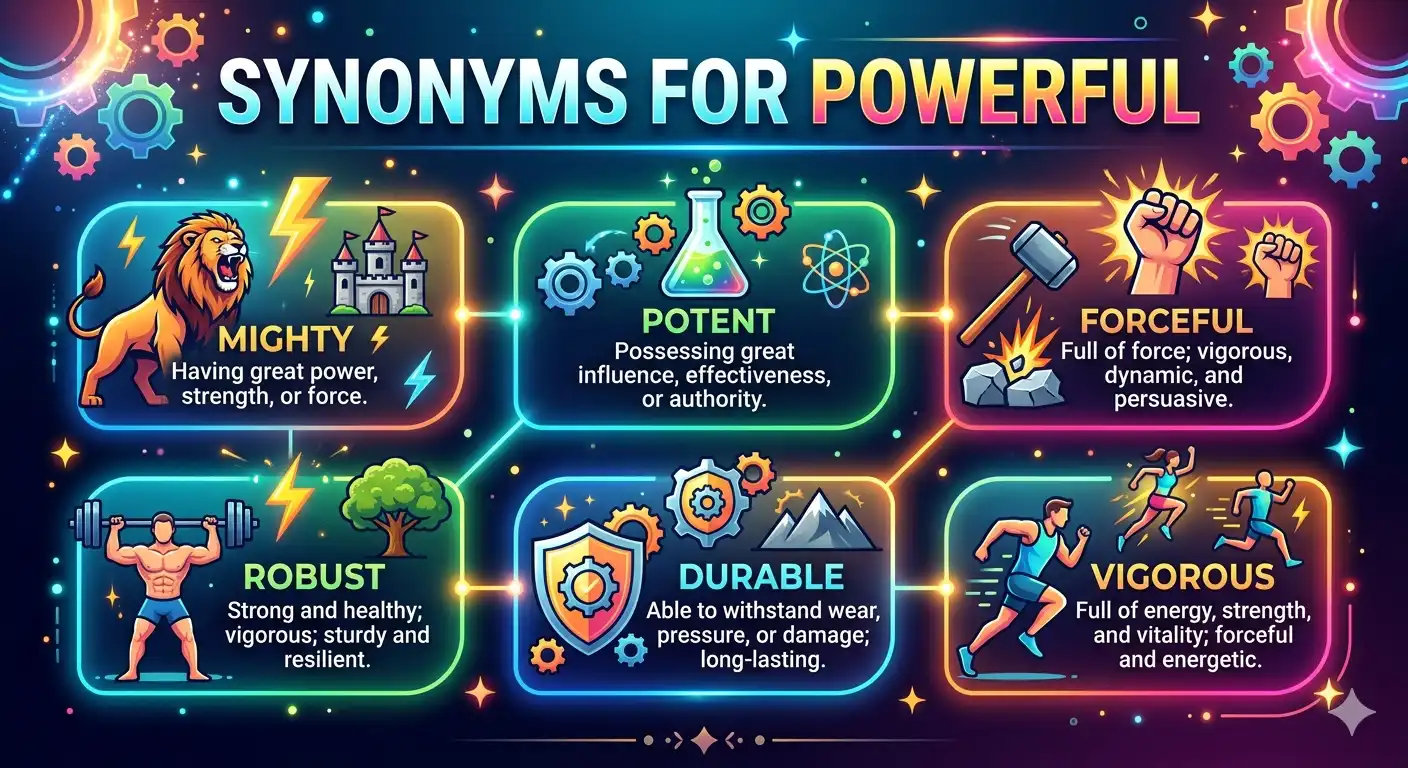
| Mighty | Having enormous force or scale. | Literary / Intense | Giant armies, rivers, storms, or ancient heroes. |
| Influential | Having the power to shape thoughts or actions. | Professional | Famous people, teachers, ideas, or books. |
| Potent | Producing a strong chemical or mental effect. | Formal | Medicines, smells, arguments, or magic drinks. |
50 Detailed Synonyms for Powerful
1. Strong
Pronunciation: US: /strɔːŋ/ | UK: /strɒŋ/
Meaning: This describes having great physical power or mental firmness.
Examples:
- He used his strong arms to lift the heavy box.
- She has a strong belief in doing what is right.
2. Mighty
Pronunciation: US: /ˈmaɪ.t̬i/ | UK: /ˈmaɪ.ti/
Meaning: This describes something with huge size, power, or force.
Examples:
- A mighty wind blew the old shed over.
- The mighty river rushed down the mountain side.
3. Potent
Pronunciation: US: /ˈpoʊ.t̬ənt/ | UK: /ˈpəʊ.tənt/
Meaning: This means having a very strong effect or chemical power.
Examples:
- The doctor gave him a potent medicine for his cough.
- That perfume has a very potent smell.
4. Dominant
Pronunciation: US: /ˈdɑː.mə.nənt/ | UK: /ˈdɒm.ɪ.nənt/
Meaning: This describes being more important, strong, or noticeable than others.
Examples:
- Blue was the dominant color in the painting.
- The tall player was dominant under the basketball hoop.
5. Influential
Pronunciation: US: /ˌɪn.fluˈen.ʃəl/ | UK: /ˌɪn.fluˈen.ʃəl/
Meaning: This means having the power to change how people think or behave.
Examples:
- He is an influential writer who inspires many kids.
- Her advice was highly influential in my choice.
6. Forceful
Pronunciation: US: /ˈfɔːrs.fəl/ | UK: /ˈfɔːs.fəl/
Meaning: This describes acting with a lot of energy, speed, or power.
Examples:
- She gave a forceful speech that made everyone clap.
- A forceful kick sent the ball across the field.
7. Robust
Pronunciation: US: /roʊˈbʌst/ | UK: /rəʊˈbʌst/
Meaning: This describes being strong, healthy, and unlikely to break.
Examples:
- The farmer built a robust wooden fence.
- He feels robust and happy after his morning run.
8. Vigorous
Pronunciation: US: /ˈvɪɡ.ɚ.əs/ | UK: /ˈvɪɡ.ər.əs/
Meaning: This means done with great energy, strength, and effort.
Examples:
- We took a vigorous walk up the steep hill.
- He gave the rug a vigorous shake to clean it.
9. Dynamic
Pronunciation: US: /daɪˈnæm.ɪk/ | UK: /daɪˈnæm.ɪk/
Meaning: This describes being full of energy, new ideas, and active power.
Examples:
- Our new teacher has a dynamic way of teaching.
- The city has a dynamic and exciting culture.
10. Tough
Pronunciation: US: /tʌf/ | UK: /tʌf/
Meaning: This means strong enough to withstand rough treatment or difficult conditions.
Examples:
- Leather is a very tough material for boots.
- The little puppy is tough and loves to play in the rain.
11. Muscular
Pronunciation: US: /ˈmʌs.kjə.lɚ/ | UK: /ˈmʌs.kjə.lər/
Meaning: This describes having large, strong muscles.
Examples:
- The muscular horse pulled the heavy cart easily.
- He has a muscular frame from years of swimming.
12. Brawny
Pronunciation: US: /ˈbrɑː.ni/ | UK: /ˈbrɔː.ni/
Meaning: This means physically strong, big, and muscular.
Examples:
- A brawny worker lifted the iron beam.
- The lumberjack was a tall, brawny man.
13. Hardy
Pronunciation: US: /ˈhɑːr.di/ | UK: /ˈhɑː.di/
Meaning: This describes being able to live through cold weather or hard conditions.
Examples:
- These hardy plants can survive a cold winter.
- The hardy sailors did not fear the cold wind.
14. Sturdy
Pronunciation: US: /ˈstɝː.di/ | UK: /ˈstɜː.di/
Meaning: This describes being strongly made and solid.
Examples:
- You should use a sturdy ladder to paint the ceiling.
- The old oak tree has a very sturdy trunk.
15. Solid
Pronunciation: US: /ˈsɑː.lɪd/ | UK: /ˈsɒl.ɪd/
Meaning: This describes being firm, strong, and reliable.
Examples:
- The house was built on a solid rock foundation.
- He gave me some solid advice before my test.
16. Intense
Pronunciation: US: /ɪnˈtens/ | UK: /ɪnˈtens/
Meaning: This describes being very great, strong, or sharp in feeling.
Examples:
- The hot sun gave off an intense heat.
- She felt an intense joy when she won the race.
17. Fierce
Pronunciation: US: /fɪrs/ | UK: /fɪəs/
Meaning: This describes being wild, strong, and highly energetic.
Examples:
- The lion gave a fierce growl at the visitors.
- A fierce storm hit the coast last night.
18. Severe
Pronunciation: US: /səˈvɪr/ | UK: /sɪˈvɪər/
Meaning: This describes something very harsh, serious, or extreme.
Examples:
- The winter cold was severe this year.
- The team suffered a severe loss on Saturday.
19. Extreme
Pronunciation: US: /ɪkˈstriːm/ | UK: /ɪkˈstriːm/
Meaning: This describes being of the highest degree or very great.
Examples:
- Climbing that mountain takes extreme care.
- They faced extreme heat in the dry desert.
20. Sharp
Pronunciation: US: /ʃɑːrp/ | UK: /ʃɑːp/
Meaning: This describes being quick, smart, clear, or very sudden.
Examples:
- He has a sharp mind for solving puzzles.
- She felt a sharp pain in her ankle when she tripped.
21. Heavy-duty
Pronunciation: US: /ˌhev.iˈduː.t̬i/ | UK: /ˌhev.iˈdʒuː.ti/
Meaning: This describes something made to do hard work without breaking.
Examples:
- We bought heavy-duty trash bags for the yard work.
- These heavy-duty boots are perfect for hiking.
22. Authoritative
Pronunciation: US: /əˈθɔːr.ə.t̬eɪ.t̬ɪv/ | UK: /ɔːˈθɒr.ɪ.tə.tɪv/
Meaning: This describes showing authority, knowledge, and command.
Examples:
- The captain spoke in a calm, authoritative voice.
- She wrote an authoritative book about birds.
23. Commanding
Pronunciation: US: /kəˈmæn.dɪŋ/ | UK: /kəˈmɑːn.dɪŋ/
Meaning: This describes having a powerful look or position that gets attention.
Examples:
- The castle sits in a commanding position on the hill.
- He had a commanding presence when he entered the room.
24. Leading
Pronunciation: US: /ˈliː.dɪŋ/ | UK: /ˈliː.dɪŋ/
Meaning: This describes being the most important, successful, or advanced.
Examples:
- She is a leading expert on space science.
- Our school is the leading team in the city.
25. Prominent
Pronunciation: US: /ˈprɑː.mə.nənt/ | UK: /ˈprɒm.ɪ.nənt/
Meaning: This describes being famous, important, or easy to see.
Examples:
- The church spire is a prominent feature of the town.
- He invited several prominent citizens to the dinner.
“Power is not given to you. You have to take it.” — Beyoncé Knowles
26. Prevailing
Pronunciation: US: /prɪˈveɪ.lɪŋ/ | UK: /prɪˈveɪ.lɪŋ/
Meaning: This describes being the most common, strongest, or dominant.
Examples:
- The prevailing wind blows from the west.
- That was the prevailing opinion among the group.
27. Supreme
Pronunciation: US: /suːˈpriːm/ | UK: /suːˈpriːm/
Meaning: This describes being the highest in rank, power, or importance.
Examples:
- The supreme leader made the final decision.
- She showed supreme courage during the emergency.
28. Sovereign
Pronunciation: US: /ˈsɑːv.rən/ | UK: /ˈsɒv.rɪn/
Meaning: This describes having independent, royal, or absolute authority.
Examples:
- The country became a sovereign nation last year.
- The king holds sovereign power over the land.
29. Almighty
Pronunciation: US: /ɑːlˈmaɪ.t̬i/ | UK: /ɔːlˈmaɪ.ti/
Meaning: This describes having absolute, unlimited power.
Examples:
- They looked up at the almighty peaks of the mountains.
- An almighty crash came from the kitchen when the shelf fell.
30. Invincible
Pronunciation: US: /ɪnˈvɪn.sə.bəl/ | UK: /ɪnˈvɪn.sə.bəl/
Meaning: This describes being too strong to be defeated or ruined.
Examples:
- The champion boxer seemed invincible in the ring.
- Our team felt invincible after winning ten games in a row.
31. Unstoppable
Pronunciation: US: /ʌnˈstɑː.pə.bəl/ | UK: /anˈstɒp.ə.bəl/
Meaning: This describes being impossible to stop or hold back.
Examples:
- The runaway train was completely unstoppable.
- Her desire to learn made her unstoppable in class.
32. Irresistible
Pronunciation: US: /ˌɪr.əˈzɪs.tə.bəl/ | UK: /ˌɪr.ɪˈzɪs.tə.bəl/
Meaning: This describes being too attractive or strong to turn away or fight.
Examples:
- The warm chocolate cookies were irresistible.
- He felt an irresistible urge to laugh at the joke.
33. Indomitable
Pronunciation: US: /ɪnˈdɑː.mɪ.t̬ə.bəl/ | UK: /ɪnˈdɒm.ɪ.tə.bəl/
Meaning: This describes having a brave spirit that cannot be broken.
Examples:
- Despite many failures, she showed an indomitable will to win.
- The small country fought back with indomitable pride.
34. Compelling
Pronunciation: US: /kəmˈpel.ɪŋ/ | UK: /kəmˈpel.ɪŋ/
Meaning: This describes being so exciting or strong that you must pay attention.
Examples:
- The book has a very compelling story from start to finish.
- He gave a compelling reason for arriving late.
35. Persuasive
Pronunciation: US: /pɚˈsweɪ.sɪv/ | UK: /pəˈsweɪ.sɪv/
Meaning: This describes being able to make someone do or believe something.
Examples:
- She wrote a persuasive letter asking for longer recess.
- His arguments were highly persuasive to the jury.
36. Impressive
Pronunciation: US: /ɪmˈpres.ɪv/ | UK: /ɪmˈpres.ɪv/
Meaning: This describes causing admiration because of size, skill, or quality.
Examples:
- The tall castle was an impressive sight.
- He did an impressive job rebuilding the old car.
37. Striking
Pronunciation: US: /ˈstraɪ.kɪŋ/ | UK: /ˈstraɪ.kɪŋ/
Meaning: This describes being highly unusual, beautiful, or easy to notice.
Examples:
- There was a striking difference between the two brothers.
- She has a striking resemblance to her grandmother.
38. Tremendous
Pronunciation: US: /trɪˈmen.dəs/ | UK: /trɪˈmen.dəs/
Meaning: This describes being very large, loud, great, or exciting.
Examples:
- The rocket made a tremendous noise as it launched.
- They made a tremendous effort to clean up the park.
39. Immense
Pronunciation: US: /ɪˈmens/ | UK: /ɪˈmens/
Meaning: This describes being extremely large or vast in scale.
Examples:
- The ocean is an immense body of water.
- She has an immense talent for playing the piano.
40. Colossal
Pronunciation: US: /kəˈlɑː.səl/ | UK: /kəˈlɒs.əl/
Meaning: This describes being incredibly huge or gigantic.
Examples:
- They built a colossal statue in the middle of the square.
- Making that mistake was a colossal waste of time.
41. Monumental
Pronunciation: US: /ˌmɑːn.jəˈmen.t̬əl/ | UK: /ˌmɒn.jʊˈmen.təl/
Meaning: This describes being historically important, massive, or highly impressive.
Examples:
- Building the pyramids was a monumental task.
- This discovery is a monumental achievement for science.
42. Formidable
Pronunciation: US: /fɔːrˈmɪd.ə.bəl/ | UK: /ˈfɔː.mɪ.də.bəl/
Meaning: This describes causing fear or deep respect because of strength or size.
Examples:
- The champion is a formidable opponent on the court.
- They had to cross a formidable mountain range to get home.
43. Drastic
Pronunciation: US: /ˈdræs.tɪk/ | UK: /ˈdræs.tɪk/
Meaning: This describes having a highly sudden, strong, or severe effect.
Examples:
- We had to make drastic changes to save our business.
- The weather took a drastic turn for the worse.
44. Energetic
Pronunciation: US: /ˌen.ɚˈdʒet̬.ɪk/ | UK: /ˌen.əˈdʒet.ɪk/
Meaning: This describes being full of active, lively power and physical force.
Examples:
- The energetic puppy ran around the yard all afternoon.
- We danced to an energetic beat at the party.
45. Power-packed
Pronunciation: US: /ˈpaʊ.ɚ.pækt/ | UK: /ˈpaʊ.ə.pækt/
Meaning: This describes containing a lot of energy, strength, or excitement.
Examples:
- The juice is a power-packed drink full of healthy vitamins.
- The movie has a power-packed opening scene.
46. Heavyweight
Pronunciation: US: /ˈhev.i.weɪt/ | UK: /ˈhev.i.weɪt/
Meaning: This describes being very heavy, important, or highly influential.
Examples:
- The heavyweight champion won the belt back.
- She is a heavyweight politician in local government.
47. Overwhelming
Pronunciation: US: /ˌoʊ.vɚˈwel.mɪŋ/ | UK: /ˌəʊ.vəˈwel.mɪŋ/
Meaning: This describes being so strong or massive that it is hard to fight.
Examples:
- He felt an overwhelming joy when his son was born.
- The team won by an overwhelming number of votes.
48. Effective
Pronunciation: US: /əˈfek.tɪv/ | UK: /ɪˈfek.tɪv/
Meaning: This describes producing the exact result that was wanted.
Examples:
- This soap is highly effective at removing tough dirt.
- The teacher used an effective method to help us learn.
49. Direct
Pronunciation: US: /daɪˈrekt/ | UK: /daɪˈrekt/
Meaning: This describes going straight to the point without stopping.
Examples:
- He gave a direct answer to my simple question.
- The light has a direct path through the window.
50. Electric
Pronunciation: US: /iˈlek.trɪk/ | UK: /iˈlek.trɪk/
Meaning: This describes feeling highly exciting, thrilling, or full of energy.
Examples:
- There was an electric feeling in the crowd before the concert.
- The singer gave an electric performance on stage.
Antonyms of “Powerful”
If you want to say the opposite of powerful, you can use these words:
- Weak: Lacking physical strength, energy, or mental force.
- Feeble: Extremely weak, fragile, or without any real energy.
- Powerless: Lacking the authority, control, or ability to change things.
- Fragile: Easily broken, damaged, or hurt.
- Helpless: Unable to defend yourself or act without someone’s assistance.
Prototype Meaning and Categorization of “Powerful”
Linguists categorize words to help us understand where they fit in our minds. Here is how “powerful” fits into English categories:
- Prototype Meaning: Possessing great physical force, authoritative control, deep influence, or high impact.
- Grammatical Category: Adjective.
- Semantic Domain: Strength, energy, leadership, authority, and physical weight.
Frequently Asked Questions
1. What is the simple meaning of powerful?
The word “powerful” means having a lot of physical strength, high energy, control, or the ability to make things happen.
2. Can powerful be used to describe people and objects?
Yes! You can use it to describe strong people, like a “powerful leader,” or physical things, like a “powerful car engine.”
3. What is the difference between strong and powerful?
“Strong” usually describes solid physical muscles or tough materials, while “powerful” focuses on active force, control, and influence.
4. What are some formal synonyms for powerful to use in school essays?
For academic papers, use formal words like “influential,” “authoritative,” “formidable,” or “potent” to sound professional.
5. Why should writers learn synonyms for powerful?
Using different words helps you show the exact type of strength or impact you are talking about without boring your readers.
Conclusion
Expanding your vocabulary with synonyms for powerful is a beautiful step toward becoming a more confident and fluent writer. When you learn to vary your words, you instantly improve your blogging, speaking, writing, and daily communication skills. Instead of repeating the same simple words, you can paint a clear and colorful picture with your sentences that will keep your readers hooked from the very first line to the last.
We encourage you to start practicing these new terms today. Try slipping a professional word like “influential” into your next school essay, or use a comforting word like “robust” in an email to a friend. Even in daily conversations, swapping out repetitive words for fresh options will make you sound more articulate and creative. With just a little bit of practice, your words will flow with a beautiful, natural rhythm that everyone will enjoy reading.
“Words are, of course, the most powerful drug used by mankind.” — Rudyard Kipling
“Kind words can be short and easy to speak, but their echoes are truly endless.” — Mother Teresa

Andrew Collins is an academic English educator with over 12 years of experience helping university students, IELTS candidates, and ESL learners improve their writing vocabulary.