Micro Introduction
The word still is very common in English. People use it in daily conversation, writing, and formal communication.
Learning synonyms for still helps you avoid repetition and speak more clearly.
Direct Answer
Still means not moving, continuing, or even now. It can describe quiet movement or an ongoing situation.
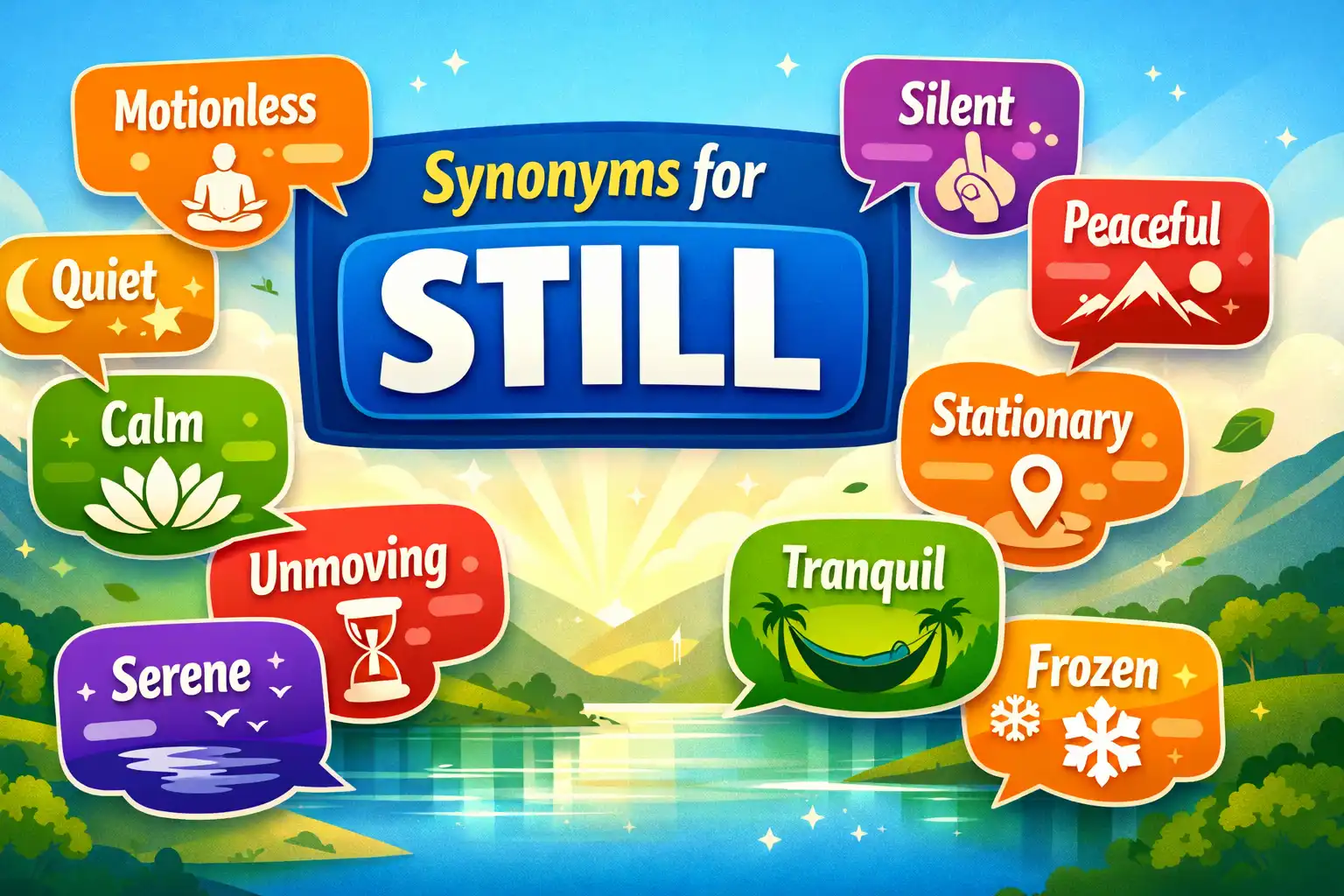
Common synonyms include:
- motionless
- calm
- silent
- quiet
- stationary
- unmoving
- yet
- nevertheless
Meaning of Still
Still has several meanings:
- Not moving
- Continuing until now
- Despite something
Example:
She is still waiting for the bus.
Categories of Synonyms
1. Physical Stillness
Used when something is not moving.
Examples: motionless, stationary.
2. Quiet or Calm Condition
Used when there is little sound or activity.
Examples: silent, calm, quiet.
3. Continuing or Contrast Meaning
Used when something continues or shows contrast.
Examples: yet, nevertheless.
Synonyms Table
| Word | Simple Meaning | Example Sentence |
| motionless | not moving | The cat was motionless on the sofa. |
| calm | peaceful and quiet | The sea looked calm today. |
| silent | without sound | The room became silent. |
| quiet | making little noise | Please stay quiet. |
| stationary | not changing position | The car remained stationary. |
| unmoving | not moving at all | He stood unmoving in fear. |
| yet | until now | I haven’t finished yet. |
| nevertheless | despite that | It was raining; nevertheless, we left. |
Master Synonyms List (Grouped by Level)
Beginner / Simple
Quiet
Meaning: making little or no noise
Example: The baby is quiet now.
Calm
Meaning: peaceful and relaxed
Example: She stayed calm during the storm.
Yet
Meaning: until now
Example: I haven’t eaten yet.
Intermediate
Motionless
Meaning: completely still
Example: The dog remained motionless.
Silent
Meaning: without any sound
Example: The crowd was silent.
Stationary (Formal)
Meaning: not moving from one place
Example: The train was stationary for hours.
Advanced / Formal
Unmoving (Formal)
Meaning: not changing position
Example: He stood unmoving at the door.
Nevertheless (Formal)
Meaning: in spite of that
Example: It was risky; nevertheless, she agreed.
Formal vs Informal Synonyms
- Quiet and calm are common in daily conversation.
- Stationary and nevertheless are more formal and used in academic or business writing.
- Yet is neutral and works in most situations.
Choose based on your audience and tone.
Real-Life Usage Examples
Conversation:
“Why is the baby so quiet today?”
Academic Writing:
“The object remained stationary during the experiment.”
Business Writing:
“Sales are still increasing this quarter.”
Blogging:
“Even after many years, this movie is still popular.”
Emotional Expression:
“I am still thinking about what you said.”
Similar Words Comparison
Still vs Quiet
Still often refers to no movement.
Quiet refers to little or no sound.
Example:
The lake was still.
The room was quiet.
Still vs Yet
Still shows continuation.
Yet is often used in negative sentences or questions.
Example:
She is still working.
She hasn’t finished yet.
Example Sentences
- The water was still at sunrise.
- He is still my best friend.
- The children stood motionless.
- The night became silent.
- The train remained stationary.
- She stayed calm under pressure.
- I haven’t called her yet.
- The air felt quiet and cool.
- He sat unmoving for minutes.
- It was difficult; nevertheless, we continued.
- The forest was still and peaceful.
- She is still learning English.
- The baby stayed calm during the flight.
- The office was silent after hours.
Common Mistakes
- ❌ Using quiet for movement
Wrong: The car was quiet on the road.
Correct: The car was stationary. - ❌ Using yet in positive sentences incorrectly
Wrong: I am yet ready.
Correct: I am not ready yet. - ❌ Confusing still and calm
Still = no movement
Calm = relaxed feeling - ❌ Overusing “still” in writing
Use synonyms to avoid repetition.
Tips / Best Practices
- Choose based on meaning: movement, sound, or time.
- Match the formality to your audience.
- Keep sentences clear and natural.
- Avoid repeating “still” too often.
- Do not replace it if the synonym changes the meaning.
When NOT to Use Still
Do not replace still when it means “even.”
Example:
“This is still better.”
Here, replacing it with “quiet” or “motionless” would be incorrect.
Also avoid changing it when it shows strong continuation in emotional statements.
Opposite Words (Antonyms)
- moving
- active
- noisy
- loud
- restless
FAQs
What does still mean?
It means not moving, continuing until now, or despite something.
Is still formal or informal?
It is neutral and works in both formal and informal English.
How can I use it in conversation?
Example: “Are you still working here?”
What is the best synonym for still?
It depends on context. For movement, use “motionless.” For time, use “yet.”
Can still be replaced with quiet?
Only when talking about sound, not movement or time.
Conclusion
Learning synonyms for still helps you speak more clearly and write more naturally. When you understand the different meanings—movement, time, or contrast—you can choose the right word with confidence.
Stronger vocabulary leads to better communication in conversation, academic writing, business emails, and blogging.
👉 Try using three new synonyms in your next sentence.
👉 Explore our other vocabulary guides to expand your word power and improve your English faster.

Andrew Collins writes vocabulary-focused articles that explore word meanings and alternative expressions for better communication.