Introduction
Synonyms for poor are alternative terms and expressions used to describe a lack of money, low quality, or insufficient resources. Finding the right synonyms for poor helps you avoid repeating the same basic word, keeping your writing fresh, precise, and expressive. When you rely too much on a single descriptor, your sentences quickly lose their impact and emotional depth. Imagine working hard on a story or report, only to realize you have used the same tired word five times in a single paragraph. Good writing thrives on precision and variety. When you discover different synonyms for poor, your sentences instantly become more vivid, accurate, and captivating for your readers.
For example, instead of writing “The old house was in poor condition,” you can say, “The old house was in dilapidated condition.”
In very simple English, poor means having very little money or being of low quality.
This phrase is useful for:
- Students writing clear, descriptive essays and reports.
- Bloggers creating vivid and engaging stories.
- Content writers building precise and professional copy.
- Daily English users speaking with greater clarity.
“The right word may be effective, but no one ever was hurt by leaving it to the right time.” — Mark Twain
“Style is knowing who you are, what you want to say, and not giving a damn.” — Gore Vidal
Linguistic Profile of “Poor”
- Connotative Meaning: Deprived, humble, lacking, suboptimal, or unfortunate.
- Etymology: Originates from Old French pouvre, derived from Latin pauper, meaning producing little or having small means.
- Pronunciation (US): /pʊr/
- Pronunciation (UK): /pʊə/
- Syllables: One syllable total (poor).
- Affixation Pattern: Base adjective root (no complex affixation).
Comparison Table
| Keyword | Meaning | Usage Type | Context |
|---|---|---|---|
| Poor | Lacking money or quality | Casual / Standard | Everyday speech and general writing |
| Destitute | Extremely poor and lacking basic needs | Formal / Serious | Social commentary and news |
| Impoverished | Made poor or deprived of resources | Academic / Formal | Economic reports and historical texts |
| Needy | Requiring financial or material help | Emotional / Casual | Charity work and personal appeals |
| Substandard | Below acceptable quality standards | Professional / Technical | Business reviews and product testing |
| Meager | Lacking in quantity or quality | Literary / Descriptive | Descriptions of food, pay, or space |
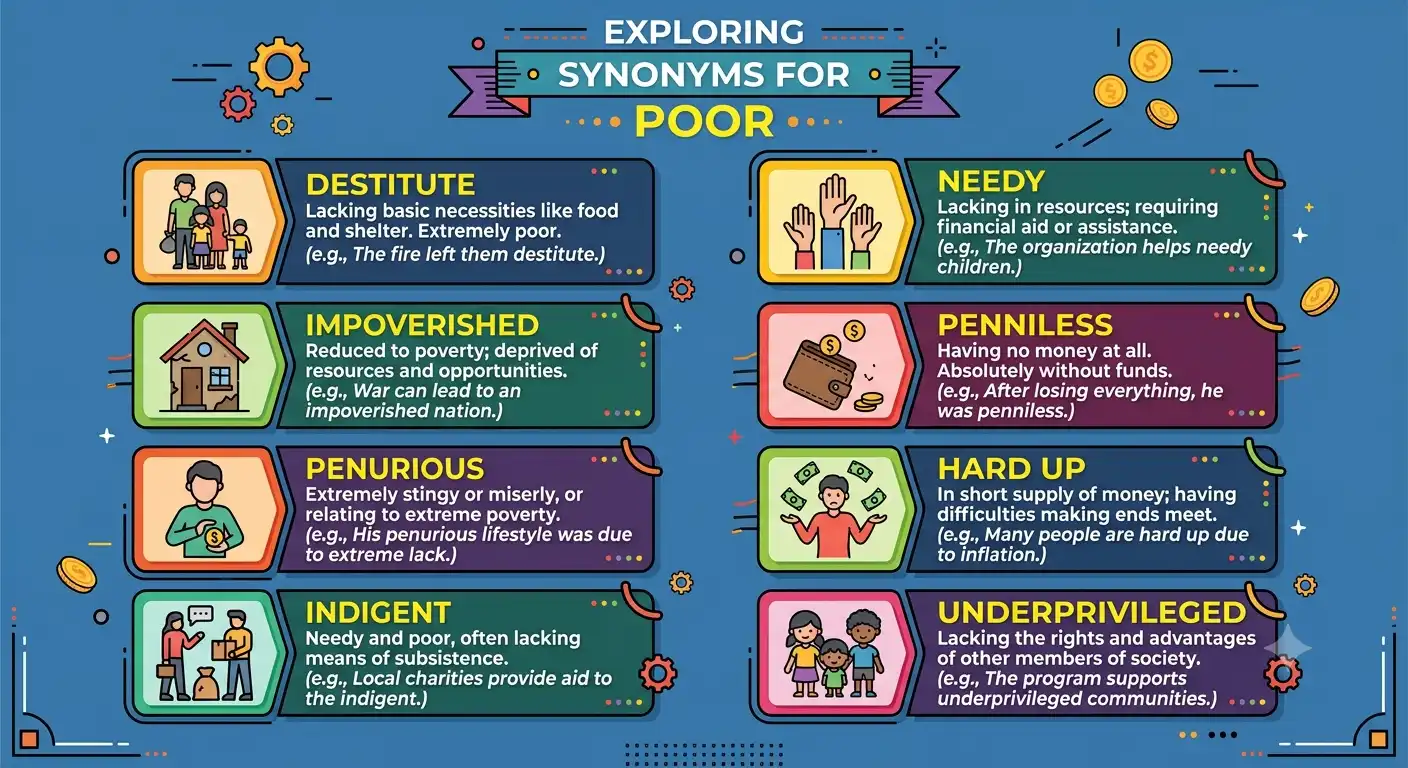
1. Destitute
Pronunciation (US & UK): /ˈdɛstɪtuːt/ Meaning: It means being extremely poor without any money, food, or home. Examples:
- The harsh storm left many local families destitute and homeless.
- Charities work hard to support destitute people in the city.
2. Impoverished
Pronunciation (US & UK): /ɪmˈpɑːvərɪʃt/ Meaning: It means made very poor and deprived of basic living resources. Examples:
- The charity built schools in impoverished rural communities.
- Generations of families grew up in impoverished neighborhoods.
3. Needy
Pronunciation (US & UK): /ˈniːdi/ Meaning: It means lacking the basic necessities of life and requiring help. Examples:
- Volunteers collected warm winter coats for needy children.
- The community center provides free meals to needy residents.
4. Penurious
Pronunciation (US & UK): /pəˈnjʊriəs/ Meaning: It means extremely poor or showing extreme stinginess. Examples:
- He lived a penurious lifestyle despite earning decent money.
- The village suffered through long, penurious winter months.
5. Indigent
Pronunciation (US & UK): /ˈɪndɪdʒənt/ Meaning: It means poor and lacking the means for comfortable survival. Examples:
- The city offers legal aid services to indigent residents.
- Free clinics provide medical care for indigent families.
6. Bankrupt
Pronunciation (US & UK): /ˈbæŋkrʌpt/ Meaning: It means legally declared unable to pay debts. Examples:
- The local factory went bankrupt after losing major contracts.
- Bad investments left the small business completely bankrupt.
7. Broke
Pronunciation (US & UK): /broʊk/ Meaning: It means having completely run out of money temporarily. Examples:
- I am completely broke until my next paycheck arrives.
- He spent his last dollars and felt totally broke.
8. Insolvent
Pronunciation (US & UK): /ɪnˈsɑːlvənt/ Meaning: It means unable to pay what you owe to others. Examples:
- The failing company was declared legally insolvent.
- Experts tried to rescue the insolvent retail store.
9. Penniless
Pronunciation (US & UK): /ˈpɛniləs/ Meaning: It means having absolutely no money left at all. Examples:
- He arrived in the big city young and penniless.
- One bad decision left her stranded and penniless.
10. Deprived
Pronunciation (US & UK): /dɪˈpraɪvd/ Meaning: It means lacking basic benefits, comfort, or safety. Examples:
- Sleep-deprived students struggled to focus during morning tests.
- Children in deprived areas need extra educational support.
11. Disadvantaged
Pronunciation (US & UK): /ˌdɪsədˈvæntɪdʒd/ Meaning: It means lacking the normal social or economic advantages. Examples:
- Programs offer extra funding to disadvantaged schools.
- Scholarships help disadvantaged students attend college.
12. Hard-up
Pronunciation (US & UK): /ˌhɑːrd ˈʌp/ Meaning: It means having very little money for a short time. Examples:
- We are a bit hard-up this month after buying repairs.
- Students are often hard-up during exam weeks.
13. Skint
Pronunciation (US & UK): /skɪnt/ Meaning: It means having no money left in your pockets. Examples:
- I cannot go out tonight because I am completely skint.
- Payday is next week, so everyone is skint right now.
14. Impecunious
Pronunciation (US & UK): /ˌɪmpɪˈkjuːniəs/ Meaning: It means having very little or no money habitually. Examples:
- The impecunious artist traded paintings for hot meals.
- Writers often experience impecunious days early in life.
15. Pauperized
Pronunciation (US & UK): /ˈpɔːpəraɪzd/ Meaning: It means reduced to a state of extreme poverty. Examples:
- High taxes pauperized many small farming families.
- Economic shifts left workers pauperized and stressed.
16. Ruined
Pronunciation (US & UK): /ˈruːɪnd/ Meaning: It means having lost all money, status, or success. Examples:
- Bad stock trades left him financially ruined.
- The storm ruined their crops and income source.
17. Undersourced
Pronunciation (US & UK): /ˌʌndərˈsɔːrst/ Meaning: It means lacking sufficient resources, funding, or tools. Examples:
- Rural clinics are often undersourced and overcrowded.
- The project failed because the team was severely undersourced.
18. Underfunded
Pronunciation (US & UK): /ˌʌndərˈfʌndɪd/ Meaning: It means not receiving enough money to operate well. Examples:
- The public library system remains heavily underfunded.
- Teachers protested against underfunded school programs.
19. Substandard
Pronunciation (US & UK): /sʌbˈstændərd/ Meaning: It means below the required or acceptable quality level. Examples:
- Tenants complained about substandard housing conditions.
- Inspectors rejected the batch due to substandard materials.
20. Deficient
Pronunciation (US & UK): /dɪˈfɪʃənt/ Meaning: It means not having enough of a specified quality or element. Examples:
- His diet was deficient in essential vitamins and minerals.
- The safety report was deficient in key details.
21. Flawed
Pronunciation (US & UK): /flɔːd/ Meaning: It means having blemishes, faults, or weaknesses. Examples:
- The experiment produced flawed results the first time.
- He pointed out a flawed logic in my argument.
22. Faulty
Pronunciation (US & UK): /ˈfɔːlti/ Meaning: It means working badly or containing mistakes. Examples:
- The mechanic discovered faulty wiring inside the car engine.
- We returned the toaster because it had a faulty switch.
23. Defective
Pronunciation (US & UK): /dɪˈfɛktɪv/ Meaning: It means imperfect or having a physical manufacturing error. Examples:
- The store issued a refund for the defective phone charger.
- Factory workers recalled the defective toy batch immediately.
24. Imperfect
Pronunciation (US & UK): /ɪmˈpɜːrfɪkt/ Meaning: It means not perfect; having flaws or mistakes. Examples:
- Every human being is wonderfully imperfect.
- The initial design was imperfect but showed great promise.
25. Inferior
Pronunciation (US & UK): /ɪnˈfɪriər/ Meaning: It means lower in quality, rank, or value compared to others. Examples:
- Cheap steel can be inferior to forged iron.
- Never accept an inferior product for your money.
26. Mediocre
Pronunciation (US & UK): /ˌmiːdiˈoʊkər/ Meaning: It means of only moderate or low quality; ordinary. Examples:
- The restaurant served mediocre food at high prices.
- He delivered a mediocre presentation to the board.
27. Shoddy
Pronunciation (US & UK): /ˈʃɑːdi/ Meaning: It means badly made or done with low care. Examples:
- The contractor did shoddy work on the back porch.
- Customers left bad reviews over shoddy clothing quality.
28. Meager
Pronunciation (US & UK): /ˈmiːɡər/ Meaning: It means lacking in quantity or quality; very small. Examples:
- The stray cat survived on meager scraps of food.
- Workers complained about their meager daily wages.
29. Scanty
Pronunciation (US & UK): /ˈskænti/ Meaning: It means small or insufficient in quantity or amount. Examples:
- Police found only scanty evidence at the scene.
- Winter rain left water reserves at scanty levels.
30. Sparse
Pronunciation (US & UK): /spɑːrs/ Meaning: It means thinly dispersed or scattered across an area. Examples:
- Vegetation is sparse across the dry desert landscape.
- Attendance at the morning meeting was quite sparse.
31. Slender
Pronunciation (US & UK): /ˈslɛndər/ Meaning: It means very narrow, thin, or barely sufficient. Examples:
- They won the game by a slender margin of points.
- Our financial resources remain very slender this month.
32. Lean
Pronunciation (US & UK): /liːn/ Meaning: It means producing little or providing minimal support. Examples:
- The company faced lean profits during the winter season.
- Farmers harvested crops during lean agricultural years.
33. Scant
Pronunciation (US & UK): /skænt/ Meaning: It means barely sufficient or adequate in amount. Examples:
- There was scant time left to finish the final exam.
- The witness paid scant attention to passing cars.
34. Minimal
Pronunciation (US & UK): /ˈmɪnɪməl/ Meaning: It means of a minimum amount, quantity, or degree. Examples:
- Damage to the building was minimal after the storm.
- Put forth minimal effort and expect minimal results.
35. Pitiful
Pronunciation (US & UK): /ˈpɪtɪfəl/ Meaning: It means deserving or arousing pity due to poor state. Examples:
- The puppy let out a pitiful whine at the door.
- Their donation amount was frankly pitiful.
36. Lamentable
Pronunciation (US & UK): /ˈlæməntəbəl/ Meaning: It means deplorably bad or unsatisfactory in nature. Examples:
- The team showed lamentable defense during the match.
- Literacy rates in the district are lamentable.
37. Pathetic
Pronunciation (US & UK): /pəˈθɛtɪk/ Meaning: It means miserably inadequate, weak, or low quality. Examples:
- Cell phone reception inside the basement was pathetic.
- He offered a pathetic excuse for missing practice.
38. Dismal
Pronunciation (US & UK): /ˈdɪzməl/ Meaning: It means causing gloom or depressing in quality. Examples:
- Sales figures for November were quite dismal.
- We canceled our picnic due to dismal weather.
39. Woeful
Pronunciation (US & UK): /ˈwoʊfəl/ Meaning: It means characterized by serious inadequacy or grief. Examples:
- The car had woeful braking performance on ice.
- Student test scores were in woeful shape.
40. Sorry
Pronunciation (US & UK): /ˈsɑːri/ Meaning: It means feeling or expressing wretchedness or regret.
“Perfection is achieved, not when there is nothing more to add, but when there is nothing left to take away.” — Antoine de Saint-Exupéry Examples:
- The old car sat in a sorry state of repair.
- He made a sorry attempt to fix the broken fence.
41. Wretched
Pronunciation (US & UK): /ˈrɛtʃɪd/ Meaning: It means of very poor quality or in a state of misery. Examples:
- They lived in a wretched shack near the train tracks.
- I caught a wretched cold right before my vacation.
42. Unfavorable
Pronunciation (US & UK): /ʌnˈfeɪvərəbəl/ Meaning: It means expressing disapproval or pointing to bad conditions. Examples:
- Strong winds created unfavorable sailing conditions.
- The review gave unfavorable feedback on the film.
43. Adversarial
Pronunciation (US & UK): /ˌædvərˈɛriəl/ Meaning: It means involving conflict or opposition. Examples:
- The two politicians maintained an adversarial relationship.
- Courtroom trials are inherently adversarial processes.
44. Unfortunate
Pronunciation (US & UK): /ʌnˈfɔːrtʃənət/ Meaning: It means having bad luck or resulting in a bad outcome. Examples:
- Missing the train was an unfortunate delay.
- It was an unfortunate mistake that cost us time.
45. Regrettable
Pronunciation (US & UK): /rɪˈɡrɛtəbəl/ Meaning: It means deserving to be regretted; undesirable. Examples:
- The fight was a regrettable moment for everyone.
- Closing the community center was a regrettable choice.
46. Disadvantageous
Pronunciation (US & UK): /ˌdɪsædvənˈteɪdʒəs/ Meaning: It means causing an unfavorable circumstance or loss. Examples:
- Signing the contract early was disadvantageous for us.
- Playing against the wind proved disadvantageous.
47. Unprofitable
Pronunciation (US & UK): /ʌnˈprɑːfɪtəbəl/ Meaning: It means failing to yield financial gain or benefit. Examples:
- The cafe closed its unprofitable weekend shift.
- Running ads on that page was unprofitable.
48. Barren
Pronunciation (US & UK): /ˈbærən/ Meaning: It means too poor to produce much vegetation or growth. Examples:
- Nothing grew in the barren desert soil.
- The creative project hit a barren spell of ideas.
49. Sterile
Pronunciation (US & UK): /ˈstɛrəl/ Meaning: It means lacking imagination, life, or substance. Examples:
- The office decor felt cold and sterile.
- Their musical style grew sterile over time.
50. Unproductive
Pronunciation (US & UK): /ˌʌnprəˈdʌktɪv/ Meaning: It means yielding little or no useful results. Examples:
- The long meeting turned out completely unproductive.
- Sitting indoors all day left me feeling unproductive.
Antonyms of “Poor”
Because “poor” spans multiple meanings (such as low wealth or low quality), its opposites depend on the context. Direct antonyms representing wealth, abundance, and excellence include:
- Rich
- Wealthy
- Prosperous
- Affluent
- Superior
- Excellent
Prototype Meaning and Categorization
As a versatile descriptive adjective, poor belongs to the functional category of evaluative modifiers. Its prototypical function is to attribute a deficit—whether financial, qualitative, or quantitative—to a noun, enabling speakers to convey scarcity or low standard.
Frequently Asked Questions
What does “poor” mean?
“Poor” most commonly means having very little money or lacking sufficient material possessions. It can also describe items of low quality or inadequate quantity.
Is “poor” formal or informal?
“Poor” is a standard, neutral word used across both casual conversations and professional writing. However, stronger synonyms like destitute or substandard offer more precision depending on context.
Can I use “poor” to describe food or weather?
Yes, you can say “poor weather” or “poor soil,” but substituting words like dismal, barren, or meager often adds richer imagery to your writing.
How do I avoid repeating “poor” too often?
You can swap it out with alternative terms from our list, such as impoverished, substandard, meager, or destitute, depending on whether you mean financial lack or low quality.
What is the best alternative for academic writing?
In formal academic papers or economic reports, words like impoverished, indigent, or substandard work wonderfully to maintain a scholarly tone.
Conclusion
Mastering vocabulary and expanding your collection of synonyms for poor transforms your writing from average to exceptional. When you deliberately choose varied descriptors, your sentences flow smoothly, hold reader interest, and project confidence. Learning synonyms improves writing by banishing repetition, enhances blogging by keeping audience engagement high, elevates speaking by adding natural rhythm, and sharpens overall communication.
Try practicing these words today in your daily emails, school essays, and conversations with friends. Small changes to your everyday vocabulary make a massive difference in how people understand and enjoy your message. Keep experimenting with language, stay curious, and watch your writing skills grow stronger every single day!
“Language is the dress of thought.” — Samuel Johnson
“Words are lens to focus our understanding.” — Ayn Rand
“The limits of my language mean the limits of my world.” — Ludwig Wittgenstein

Andrew Collins is an academic English educator with over 12 years of experience helping university students, IELTS candidates, and ESL learners improve their writing vocabulary.