Introduction
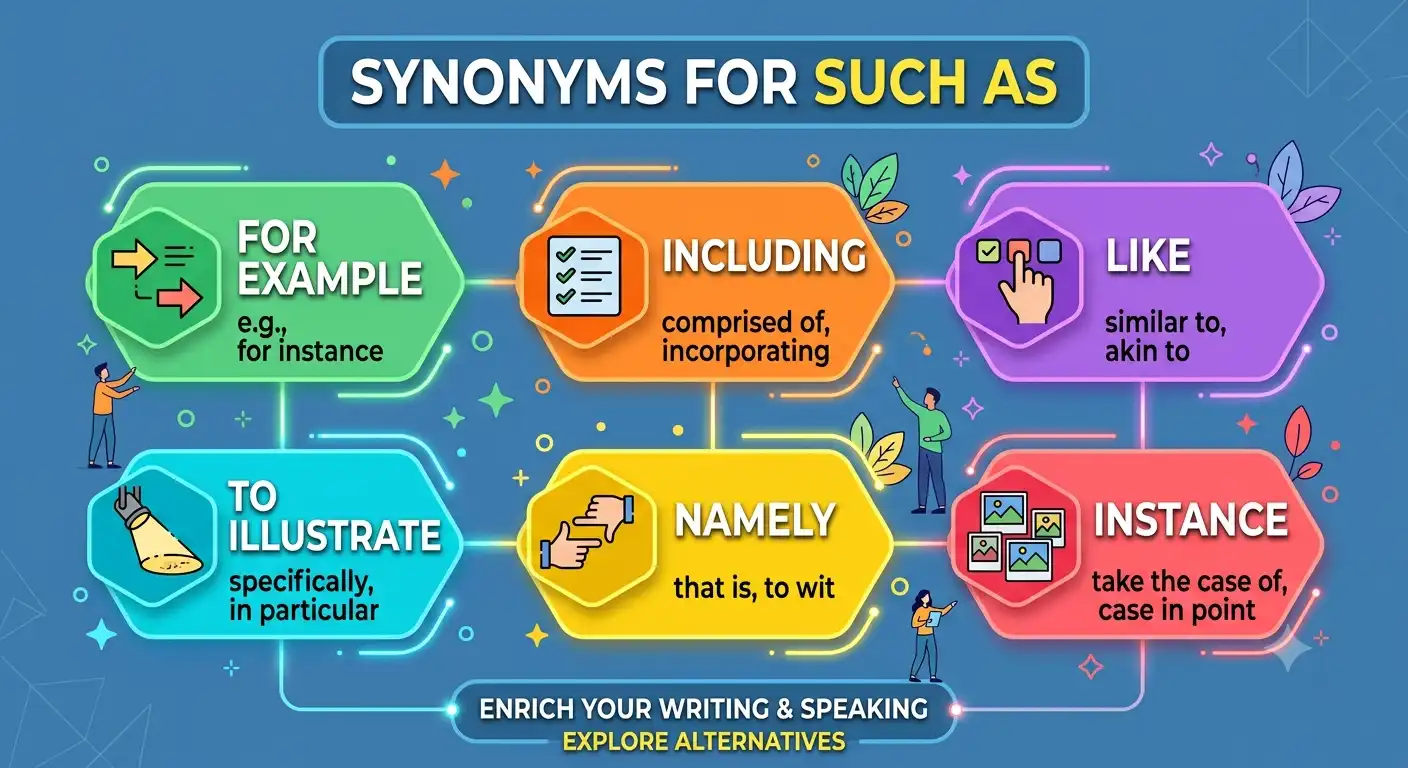
Synonyms for such as are alternative terms and phrases used to introduce examples, clarify ideas, and make your writing more engaging. Using synonyms for such as helps you avoid repeating the same phrase over and over, keeping your writing fresh and interesting. Finding the right synonyms for such as transforms repetitive paragraphs into smooth, flowing prose. Imagine staring at a blinking cursor on your screen. You have written a great sentence about your favorite hobbies, but you find yourself using the same transition phrase yet again. It feels repetitive, boring, and flat. Good writing is all about variety and rhythm. When you master different alternative phrases, your paragraphs instantly flow better, and your sentences capture your reader’s attention from the very first glance.
For example, instead of writing “I love outdoor sports such as hiking and biking,” you can say, “I love outdoor sports including hiking and biking.”
In very simple English, such as means “for example” or “like this.”
This phrase is useful for:
- Students writing clear essays and reports.
- Bloggers creating catchy and engaging posts.
- Content writers building smooth transitions.
- Daily English users speaking more clearly.
“Variety’s the very spice of life, that gives it all its flavor.” — William Cowper
“Words are, of course, the most powerful drug used by mankind.” — Rudyard Kipling
Linguistic Profile of “Such As”
- Connotative Meaning: Helpful, illustrative, precise, and inclusive.
- Etymology:
- “Such” originates from Old English swylc, meaning “of this kind.”
- “As” originates from Old English alswa / swa, meaning “in the manner of.”
- Pronunciation (US): /sʌtʃ æz/
- Pronunciation (UK): /sʌtʃ æz/
- Syllables: Two words, two syllables total (such / as).
- Affixation Pattern: Compound phrasal linker (adjective-pronoun + preposition/conjunction).
Comparison Table
| Keyword | Meaning | Usage Type | Context |
|---|---|---|---|
| Such as | For instance or like | Casual / Professional | General examples and lists |
| Like | Similar to | Casual | Everyday speech and casual writing |
| Including | Having as a part | Professional / Formal | Business reports and academic papers |
| For example | As an instance | Standard / Neutral | Essays, articles, and explanations |
| For instance | As a case in point | Professional | Formal writing and speeches |
| Namely | Specifically identified | Formal / Academic | Precise legal or technical lists |
1. Like
Pronunciation (US & UK): /laɪk/ Meaning: It means similar to or used for giving a simple example. Examples:
- She enjoys sweet foods like chocolate and candy.
- Do you have hobbies like painting or reading?
2. Including
Pronunciation (US & UK): /ɪnˈkluːdɪŋ/ Meaning: It means having something as part of a larger group. Examples:
- All the team members, including Mark, arrived on time.
- The menu has many options, including vegan burgers.
3. Namely
Pronunciation (US & UK): /ˈneɪmli/ Meaning: It means specifically naming someone or something. Examples:
- Two students won the prize, namely Anna and Ben.
- We need one more item, namely a blue pen.
4. For instance
Pronunciation (US & UK): /fɔːr ˈɪnstəns/ Meaning: It means giving an example to explain something. Examples:
- Many birds fly south; for instance, geese travel far.
- Some colors are bright; for instance, neon green.
5. Specifically
Pronunciation (US & UK): /spəˈsɪfɪkli/ Meaning: It means pointing out an exact detail or example. Examples:
- I bought fruit, specifically crisp red apples.
- She likes art, specifically modern abstract paintings.
6. Particularly
Pronunciation (US & UK): /pərˈtɪkjələrli/ Meaning: It means more than usual or in a special way. Examples:
- He enjoys sweet treats, particularly warm chocolate cookies.
- The wind was strong, particularly near the ocean.
7. Notably
Pronunciation (US & UK): /ˈnoʊtəbli/ Meaning: It means especially important or worthy of attention. Examples:
- Several cities grew fast, notably Austin and Denver.
- Many animals are smart, notably dolphins and chimps.
8. Chiefly
Pronunciation (US & UK): /ˈtʃiːfli/ Meaning: It means mostly or mainly for the most part. Examples:
- The store sells items, chiefly handmade wooden toys.
- He eats healthy foods, chiefly fresh green vegetables.
9. Primarily
Pronunciation (US & UK): /ˈpraɪmərɪli/ Meaning: It means for the most part or above all else. Examples:
- The club welcomes kids, primarily local school students.
- She wears clothes, primarily soft cotton shirts.
10. Assuredly
Pronunciation (US & UK): /əˈʃʊrɪdli/ Meaning: It means definitely or without any doubt. Examples:
- Good choices, assuredly healthy snacks, keep you fit.
- Safe tools, assuredly sturdy hammers, make building easy.
11. Expressly
Pronunciation (US & UK): /ɪkˈsprɛsli/ Meaning: It means clearly and directly for a purpose. Examples:
- Rules, expressly safety guidelines, protect everyone here.
- Gifts, expressly birthday presents, bring big smiles.
12. Precisely
Pronunciation (US & UK): /prɪˈsaɪsli/ Meaning: It means exactly and without any doubt. Examples:
- Correct answers, precisely simple math facts, earn points.
- Tools, precisely sharp scissors, cut paper cleanly.
13. Universally
Pronunciation (US & UK): /ˌjuːnɪˈvɜːrsəli/ Meaning: It means by everyone everywhere in the world. Examples:
- True facts, universally known rules, guide us daily.
- Good habits, universally helpful routines, build success.
14. Ostensibly
Pronunciation (US & UK): /ɑːˈstɛnsəbli/ Meaning: It means seemingly true on the surface level. Examples:
- Fun games, ostensibly simple puzzles, challenge minds.
- Small boxes, ostensibly empty packages, held surprises.
15. Exempli gratia
Pronunciation (US & UK): /ɛɡˌzɛmpli ˈɡreɪʃiə/ Meaning: It is a Latin phrase meaning for example. Examples:
- Use brief notes, exempli gratia quick reminders, daily.
- Wear warm gear, exempli gratia thick woolen coats.
16. E.g.
Pronunciation (US & UK): /ˌiːˈdʒiː/ Meaning: It is a short written abbreviation for for example. Examples:
- Bring pets, e.g., friendly dogs or quiet cats.
- Pick a season, e.g., bright summer or cool autumn.
17. As
Pronunciation (US & UK): /æz/ Meaning: It means in the role or function of something. Examples:
- He worked hard as a local store manager.
- She sang sweetly as a choir group member.
18. Like as
Pronunciation (US & UK): /laɪk æz/ Meaning: It is an old or regional way to say similar. Examples:
- Tall trees, like as green pines, stood tall.
- Quick cats, like as wild panthers, hunt quietly.
19. Such
Pronunciation (US & UK): /sʌtʃ/ Meaning: It means of this exact type or quality. Examples:
- I never saw such bright red roses before.
- She wore such a pretty blue dress today.
20. Similar to
Pronunciation (US & UK): /ˈsɪmələr tuː/ Meaning: It means sharing common traits with something else. Examples:
- Dogs, similar to wolves, bark at strangers.
- Pears, similar to apples, grow on trees.
21. Akin to
Pronunciation (US & UK): /əˈkɪn tuː/ Meaning: It means closely related or sharing traits. Examples:
- Jogging is akin to running a short race.
- Joy is akin to feeling deeply happy.
22. Comparable to
Pronunciation (US & UK): /ˈkɑːmpərəbəl tuː/ Meaning: It means able to be likened to another thing. Examples:
- This car is comparable to a fast sports sedan.
- Gold is comparable to silver in high value.
23. Equivalent to
Pronunciation (US & UK): /ɪˈkwɪvələnt tuː/ Meaning: It means having the same value or meaning. Examples:
- One meter is equivalent to one hundred centimeters.
- A smile is equivalent to a warm greeting.
24. Matching
Pronunciation (US & UK): /ˈmætʃɪŋ/ Meaning: It means going well together or looking alike. Examples:
- She wore matching red shoes and socks.
- The room has matching blue walls and curtains.
25. Parallel to
Pronunciation (US & UK): /ˈpærəlel tuː/ Meaning: It means side by side and matching direction. Examples:
- The train tracks run parallel to the road.
- Draw a line parallel to the top edge.
26. Alike
Pronunciation (US & UK): /əˈlaɪk/ Meaning: It means very similar in appearance or nature. Examples:
- The twin brothers look completely alike.
- Their ideas on art are very much alike.
27. Corresponding
Pronunciation (US & UK): /ˌkɔːrəˈspɑːndɪŋ/ Meaning: It means matching or connected to something else. Examples:
- Match each question with its corresponding answer number.
- The left shoe has a corresponding right shoe.
28. Related to
Pronunciation (US & UK): /rɪˈleɪtɪd tuː/ Meaning: It means connected by a shared trait or family. Examples:
- Monkeys are closely related to great apes.
- Physics is related to math and science.
29. Connected with
Pronunciation (US & UK): /kəˈnɛktɪd wɪð/ Meaning: It means linked together in some way. Examples:
- Success is connected with hard daily work.
- The kitchen is connected with the dining room.
30. Associated with
Pronunciation (US & UK): /əˈsoʊʃieɪtɪd wɪð/ Meaning: It means linked or connected in a general way. Examples:
- Dark clouds are associated with heavy rain storms.
- Smiles are associated with feeling happy inside.
31. Tied to
Pronunciation (US & UK): /taɪd tuː/ Meaning: It means physically or closely linked to something. Examples:
- The boat was tied to a wooden dock.
- High grades are tied to careful study habits.
32. Linked with
Pronunciation (US & UK): /lɪŋkt wɪð/ Meaning: It means joined or connected together securely. Examples:
- Strong teamwork is linked with winning games.
- The chains were linked with heavy iron rings.
33. Analogous to
Pronunciation (US & UK): /əˈnæləɡəs tuː/ Meaning: It means comparable in certain specific ways. Examples:
- A brain is analogous to a computer processor.
- Plant roots are analogous to human feet foundations.
34. Proportional to
Pronunciation (US & UK): /prəˈpɔːrʃənl tuː/ Meaning: It means changing in proper balance or size. Examples:
- Pay is proportional to hours worked on shifts.
- Price is proportional to item weight and size.
35. Consonant with
Pronunciation (US & UK): /ˈkɑːnsənənt wɪð/ Meaning: It means in agreement or harmony with something. Examples:
- His calm actions were consonant with his words.
- Safe driving is consonant with local traffic laws.
36. Accordant with
Pronunciation (US & UK): /əˈkɔːrdənt wɪð/ Meaning: It means agreeing or matching nicely together. Examples:
- Her bright outfit was accordant with the party theme.
- The choice was accordant with company safety rules.
37. Consistent with
Pronunciation (US & UK): /kənˈsɪstənt wɪð/ Meaning: It means acting or looking the same way always. Examples:
- His daily scores are consistent with top students.
- The weather report was consistent with sunny skies.
38. Reflecting
Pronunciation (US & UK): /rɪˈflɛktɪŋ/ Meaning: It means showing or mirroring a quality clearly. Examples:
- Her smile was reflecting true inner joy.
- The clean water was reflecting blue sky clouds.
39. Typifying
Pronunciation (US & UK): /ˈtɪpɪfaɪɪŋ/ Meaning: It means serving as a typical example of. Examples:
- The old house was typifying classic country style.
- The fast car was typifying modern speed design.
40. Illustrating
Pronunciation (US & UK): /ˈɪləstreɪtɪŋ/ Meaning: It means explaining or making clear with examples. Examples:
- The teacher was illustrating math problems on boards.
- Good books use pictures illustrating fun stories.
41. Exemplifying
Pronunciation (US & UK): /ɪɡˈzɛmplɪfaɪɪŋ/ Meaning: It means showing an example of a good quality. Examples:
- She was exemplifying kindness by helping neighbors.
- The brave soldier was exemplifying true courage.
42. Demonstrating
Pronunciation (US & UK): /ˈdɛmənstreɪtɪŋ/ Meaning: It means showing clearly how something works. Examples:
- He was demonstrating safe kitchen knife skills.
- The coach was demonstrating proper tennis swings.
43. Exhibiting
Pronunciation (US & UK): /ɪɡˈzɪbɪtɪŋ/ Meaning: It means showing a quality or item publicly. Examples:
- The young artist was exhibiting colorful paintings.
- Dogs are exhibiting loyalty to their owners.
44. Displaying
Pronunciation (US & UK): /dɪˈspleɪɪŋ/ Meaning: It means putting something on show for all. Examples:
- The store window was displaying shiny new watches.
- The proud cat was displaying its soft fur.
45. Manifesting
Pronunciation (US & UK): /ˈmænɪfɛstɪŋ/ Meaning: It means showing something clearly by signs. Examples:
- The warm sun was manifesting spring weather.
- Her tired eyes were manifesting sleepless nights.
46. Showing
Pronunciation (US & UK): /ˈʃoʊɪŋ/ Meaning: It means letting someone see an item or idea. Examples:
- He was showing his new red bicycle.
- Maps are showing the best travel routes.
47. Representing
Pronunciation (US & UK): /ˌrɛprɪˈzɛntɪŋ/ Meaning: It means standing as a symbol for someone. Examples:
- The white dove is representing peace worldwide.
- She was representing her school in contests.
48. Typified by
Pronunciation (US & UK): /ˈtɪpɪfaɪd baɪ/ Meaning: It means characterized or shown by a feature. Examples:
- Summer days are typified by bright sunshine.
- Good health is typified by daily active habits.
49. Characterized by
Pronunciation (US & UK): /ˈkɛrəktəraɪzd baɪ/ Meaning: It means having a specific feature or trait.
Language is the dress of thought; every time you speak your mind, your mind is shown at parade. Examples:
- Spring weather is characterized by blooming flowers.
- His writing style is characterized by short sentences.
50. Embodying
Pronunciation (US & UK): /ɪmˈbɑːdiɪŋ/ Meaning: It means being a visible expression of an idea. Examples:
- The great leader was embodying true peace.
- The new statue is embodying freedom and hope.
Antonyms of “Such As”
Because “such as” is a grammatical linker used for introducing examples, direct opposites do not exist in the traditional sense. However, phrases that perform the opposite function—such as excluding items, showing difference, or pointing out exceptions—include:
- Except for
- Aside from
- Other than
- Exclusive of
- Barring
Prototype Meaning and Categorization
As a multi-word phrasal linker, such as belongs to the functional category of transitional prepositions and correlative connectors. Its prototypical function is to bridge a general category to specific subordinate members, making abstract concepts concrete and understandable for readers.
Frequently Asked Questions
What does “such as” mean?
“Such as” means “for example” or “like this.” It is used to introduce one or more examples of a general category you just mentioned.
Is “such as” formal or informal?
It is neutral. You can use it safely in casual daily conversations as well as in professional emails, school essays, and blog posts.
Can I use a comma before “such as”?
Usually, you do not need a comma before “such as” when it restricts or defines a group directly. However, if you are introducing a non-essential parenthetical list, a comma may precede it.
How do I avoid repeating “such as” too often?
You can swap it out with alternative terms from our list, such as “including,” “for instance,” “like,” or “namely,” depending on your context.
What is the best alternative for academic writing?
In formal academic papers, words like “including,” “for instance,” or “namely” work wonderfully to maintain a professional and scholarly tone.
Conclusion
Learning synonyms and expanding your vocabulary makes your writing clearer and much more engaging. When you actively build your lexicon, your sentences gain better rhythm and flow effortlessly from one thought to the next. Learning synonyms improves writing by eliminating annoying word repetition, enhances blogging by keeping your readers hooked from start to finish, elevates speaking by giving you confident delivery options, and sharpens overall communication across all formats.
Encourage yourself to practice these words every day. Try incorporating them naturally into your emails, school essays, and casual daily conversations with friends and colleagues. Small, deliberate changes to your vocabulary create a huge impact on how clearly people understand your thoughts. Keep experimenting with language, stay curious, and watch your skills grow stronger!
“Language is the roadmap of a culture. It tells you where its people come from and where they are going.” — Rita Mae Brown
“The limits of my language mean the limits of my world.” — Ludwig Wittgenstein
“Words have weight, sound, and appearance; they write as well as speak.” — Samuel Johnson

Andrew Collins is an academic English educator with over 12 years of experience helping university students, IELTS candidates, and ESL learners improve their writing vocabulary.