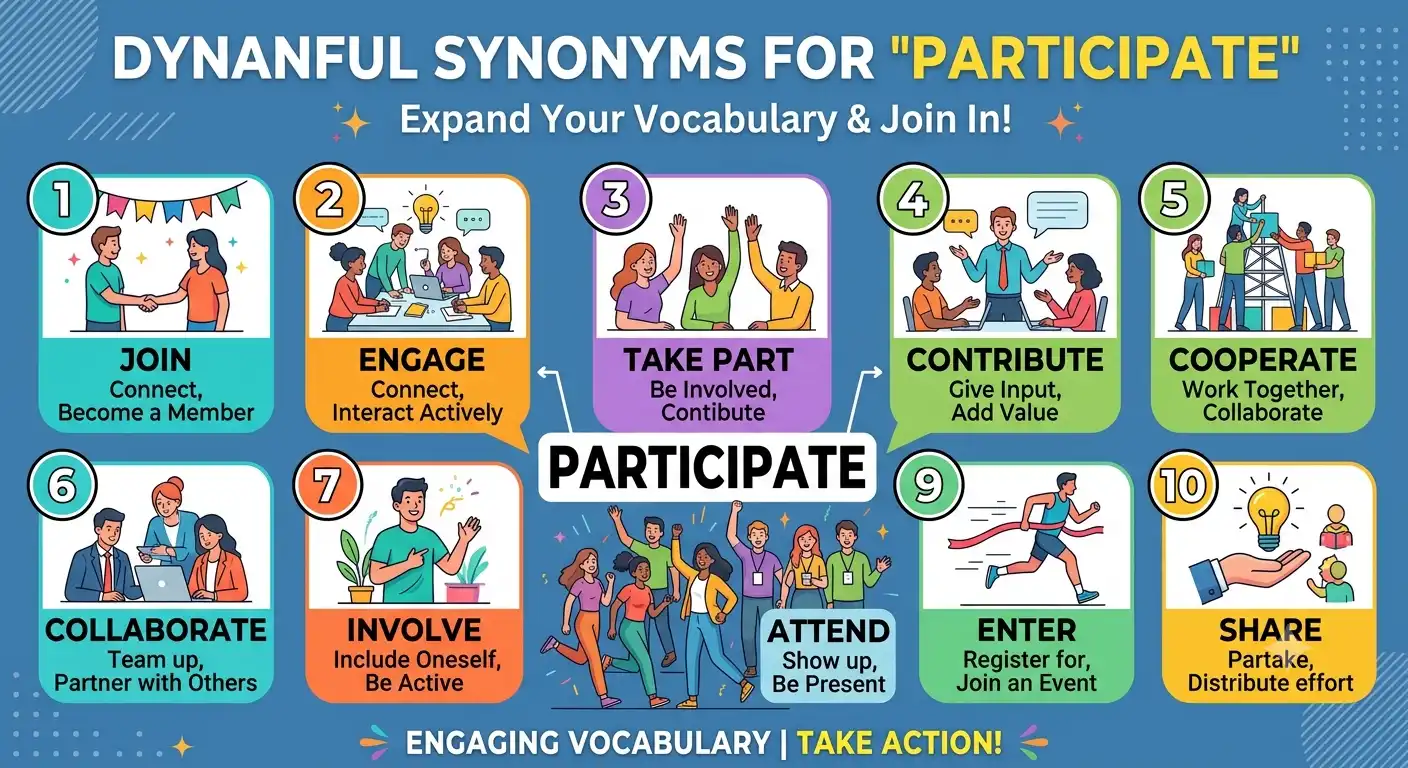
Learning diverse synonyms for participate helps you express action, teamwork, and active involvement with precision. When you study synonyms for participate, you unlock fresh ways to describe joining events, sharing ideas, and collaborating in school or work settings. Expanding your vocabulary with versatile synonyms for participate keeps your writing dynamic and ensures your everyday communication remains captivating.
Imagine joining a bustling community project or speaking up during a crucial work meeting. Repeating the word “participate” again and again makes your writing sound stiff, mechanical, and monotone. By picking the exact right word for your context, you immediately convey enthusiasm, leadership, or casual cooperation. In simple terms, participate means to join in, take part, or do an activity with other people. For example, when children join a soccer game during recess, they participate in the sport.
“Tell me and I forget. Teach me and I remember. Involve me and I learn.” — Benjamin Franklin
In Grade 3 English, participate means to join in and do something together with a group.
“Individual commitment to a group effort—that is what makes a team work.” — Vince Lombardi
Building a strong list of synonyms for participate offers clear benefits for every type of communicator:
- Students can write engaging essays and class presentations without repeating basic verbs.
- Bloggers can draft lively introductions and maintain strong reader interest across posts.
- Content writers can craft tailored marketing copy and call-to-action phrases for diverse audiences.
- Daily English users can speak naturally and confidently in workplace discussions and social gatherings.
Linguistic Breakdown of “Participate”
Connotative Meaning
The word participate carries an active, inclusive, and positive emotional tone. It implies willingness, community spirit, shared effort, and helpful contribution toward a common goal.
Etymology
- Prefix/Suffix: Prefix parti- (part) + Suffix -ate (verb-forming suffix).
- Root Word: Latin participātus, past participle of participāre (to share in, partake).
- Historical Path: Originates from Latin pars (part) + capere (to take), entering Middle English as participaten to mean taking part in an activity.
Pronunciation
- US IPA: /pɑːrˈtɪs.ə.peɪt/
- UK IPA: /pɑːˈtɪs.ɪ.peɪt/
Syllables & Affixation Pattern
- Syllables: 4 (par-tic-i-pate)
- Root Word: Part / Capere
- Affixation: Prefix parti-, Suffix -ate
Comparison Table of Key Synonyms
| Keyword | Meaning | Usage Type | Context |
|---|---|---|---|
| Join | To become a member or take part in something | Casual / Universal | Clubs, sports, casual groups, parties |
| Take Part | To do an activity alongside other people | Conversational | Classroom tasks, events, group work |
| Engage | To get involved or pay close attention | Professional / Academic | Business meetings, research, discussions |
| Contribute | To give time, effort, or money to help | Positive / Collaborative | Team projects, charities, group efforts |
| Attend | To be present at an event or meeting | Formal / Polite | Conferences, classes, ceremonies |
| Cooperate | To work together politely with others | Cooperative / Professional | Workplaces, team tasks, negotiations |
| Pitch In | To jump in and help with a shared chore | Informal / Friendly | Group chores, community work, family tasks |
| Volunteer | To offer your help freely without pay | Helpful / Generous | Non-profits, community service, events |
Main Content – 50 Synonyms for Participate
“Life is a daring adventure or nothing at all, so step up and play your part.” — Helen Keller
1. Join
- Pronunciation: US: /dʒɔɪn/ | UK: /dʒɔɪn/
- Meaning: Join means to become part of a group or do an activity together.
- Examples:
- Sarah decided to join the school science club this year.
- Please join us at the table for dinner.
2. Take Part
- Pronunciation: US: /teɪk pɑːrt/ | UK: /teɪk pɑːt/
- Meaning: Take part means to do an activity with other people.
- Examples:
- Many students like to take part in the annual art contest.
- We were excited to take part in the city parade.
3. Engage
- Pronunciation: US: /ɪnˈɡeɪdʒ/ | UK: /ɪnˈɡeɪdʒ/
- Meaning: Engage means to pay attention and take an active role in something.
- Examples:
- Good teachers encourage every child to engage in class lessons.
- The speaker asked the audience to engage in the debate.
4. Contribute
- Pronunciation: US: /kənˈtrɪb.juːt/ | UK: /kənˈtrɪb.juːt/
- Meaning: Contribute means to give your ideas or work to help a group succeed.
- Examples:
- Everyone can contribute fresh ideas during our group meeting.
- He offered to contribute snacks for the team party.
5. Attend
- Pronunciation: US: /əˈtend/ | UK: /əˈtend/
- Meaning: Attend means to go to and be present at an event.
- Examples:
- Over one hundred people will attend the summer festival.
- She plans to attend the morning workshop on Friday.
6. Involve
- Pronunciation: US: /ɪnˈvɑːlv/ | UK: /ɪnˈvɒlv/
- Meaning: Involve means to include someone in an activity or plan.
- Examples:
- The coach likes to involve every player in the practice match.
- Please involve your team members when making the final choice.
7. Share
- Pronunciation: US: /ʃer/ | UK: /ʃeər/
- Meaning: Share means to take a portion of an activity or responsibility with others.
- Examples:
- We share the duty of cleaning up after art class.
- The partners share equal control over the new project.
8. Enter
- Pronunciation: US: /ˈen.t̬ɚ/ | UK: /ˈen.tə/
- Meaning: Enter means to sign up for or join a contest or game.
- Examples:
- Mark chose to enter the local spelling bee competition.
- You can enter the race by filling out this quick form.
9. Assist
- Pronunciation: US: /əˈsɪst/ | UK: /əˈsɪst/
- Meaning: Assist means to help someone complete an activity or job.
- Examples:
- Two volunteers came to assist with setting up the chairs.
- I am happy to assist you with your project today.
10. Help
- Pronunciation: US: /help/ | UK: /help/
- Meaning: Help means to do work that makes an activity easier for others.
- Examples:
- Can you help us paint the community garden fence?
- She always likes to help when her friends build projects.
11. Cooperate
- Pronunciation: US: /koʊˈɑː.pə.reɪt/ | UK: /kəʊˈɒp.ər.eɪt/
- Meaning: Cooperate means to work together nicely to get something done.
- Examples:
- Children learn to cooperate when they play team sports.
- The two departments agreed to cooperate on the project.
12. Collaborate
- Pronunciation: US: /kəˈlæb.ə.reɪt/ | UK: /kəˈlæb.ə.reɪt/
- Meaning: Collaborate means to work closely with others to create something great.
- Examples:
- Authors often collaborate with artists to make storybooks.
- Our class will collaborate to write a group presentation.
13. Partner
- Pronunciation: US: /ˈpɑːrt.nɚ/ | UK: /ˈpɑːt.nə/
- Meaning: Partner means to join together with another person for an activity.
- Examples:
- I decided to partner with Leo for the science experiment.
- The schools will partner to host a charity fair.
14. Enlist
- Pronunciation: US: /ɪnˈlɪst/ | UK: /ɪnˈlɪst/
- Meaning: Enlist means to sign up to take part in a cause or group.
- Examples:
- Many residents chose to enlist in the neighborhood watch.
- The club wants to enlist new members this weekend.
15. Enroll
- Pronunciation: US: /ɪnˈroʊl/ | UK: /ɪnˈrəʊl/
- Meaning: Enroll means to sign up officially for a course or group.
- Examples:
- You can enroll in the music class online today.
- She decided to enroll in the summer swimming program.
16. Sign Up
- Pronunciation: US: /saɪn ʌp/ | UK: /saɪn ʌp/
- Meaning: Sign up means to put your name on a list to join an activity.
- Examples:
- Don’t forget to sign up for the book club before Friday.
- He was quick to sign up for the soccer tournament.
17. Pitch In
- Pronunciation: US: /pɪtʃ ɪn/ | UK: /pɪtʃ ɪn/
- Meaning: Pitch in means to jump in and help a group finish a job.
- Examples:
- If we all pitch in, we can clean the room in ten minutes.
- Everyone decided to pitch in and buy a gift for the teacher.
18. Chime In
- Pronunciation: US: /tʃaɪm ɪn/ | UK: /tʃaɪm ɪn/
- Meaning: Chime in means to add your voice or opinion to a conversation.
- Examples:
- Feel free to chime in if you have a good idea.
- She waited for a pause before she decided to chime in.
19. Chip In
- Pronunciation: US: /tʃɪp ɪn/ | UK: /tʃɪp ɪn/
- Meaning: Chip in means to contribute small amounts of help or money.
- Examples:
- We can all chip in a dollar to buy project supplies.
- The kids offered to chip in and help set the table.
20. Jump In
- Pronunciation: US: /dʒʌmp ɪn/ | UK: /dʒʌmp ɪn/
- Meaning: Jump in means to start participating without waiting.
- Examples:
- You can jump in whenever you feel ready to speak.
- The children could not wait to jump in and play the game.
21. Step Up
- Pronunciation: US: /step ʌp/ | UK: /step ʌp/
- Meaning: Step up means to take action and lead or help in a group activity.
- Examples:
- Maria chose to step up and lead the class project.
- When help was needed, several volunteers stepped up.
22. Sit In
- Pronunciation: US: /sɪt ɪn/ | UK: /sɪt ɪn/
- Meaning: Sit in means to attend a meeting or class as a visitor.
- Examples:
- The new teacher came to sit in on our history class.
- Can I sit in during your team meeting today?
23. Play a Role
- Pronunciation: US: /pleɪ ə roʊl/ | UK: /pleɪ ə rəʊl/
- Meaning: Play a role means to perform a specific task in a group effort.
- Examples:
- Every team member must play a role in making the event successful.
- She was proud to play a role in the school play.
24. Be Active
- Pronunciation: US: /biː ˈæk.tɪv/ | UK: /biː ˈæk.tɪv/
- Meaning: Be active means to do things enthusiastically inside a group.
- Examples:
- Try to be active during the classroom group talk.
- He likes to be active in local community projects.
25. Go In For
- Pronunciation: US: /ɡoʊ ɪn fɔːr/ | UK: /ɡəʊ ɪn fɔː/
- Meaning: Go in for means to choose to participate in an activity or sport.
- Examples:
- Many students go in for outdoor track sports in spring.
- She decided to go in for the art contest this year.
26. Partake
- Pronunciation: US: /pɑːrˈteɪk/ | UK: /pɑːˈteɪk/
- Meaning: Partake means a formal word that means to share or take part in something.
- Examples:
- Guests were invited to partake in the feast.
- All members can partake in the annual vote.
27. Hand In
- Pronunciation: US: /hænd ɪn/ | UK: /hænd ɪn/
- Meaning: Hand in means to submit your work so you are counted in an activity.
- Examples:
- Please hand in your project form before noon.
- She was eager to hand in her entry for the contest.
28. Lend a Hand
- Pronunciation: US: /lend ə hænd/ | UK: /lend ə hænd/
- Meaning: Lend a hand means to give help to others who are working.
- Examples:
- Neighbors came together to lend a hand with rebuilding the playground.
- I am happy to lend a hand with your moving tasks.
29. Intervene
- Pronunciation: US: /ˌɪn.t̬ɚˈviːn/ | UK: /ˌɪn.təˈviːn/
- Meaning: Intervene means to step into an activity to help fix a problem.
- Examples:
- The referee had to intervene during the heated game.
- A mediator stepped in to intervene and help the group agree.
30. Associate
- Pronunciation: US: /əˈsoʊ.ʃi.eɪt/ | UK: /əˈsəʊ.si.eɪt/
- Meaning: Associate means to join with others as a partner or companion.
- Examples:
- He likes to associate with people who enjoy outdoor sports.
- The two clubs often associate to host events.
31. Connect
- Pronunciation: US: /kəˈnekt/ | UK: /kəˈnekt/
- Meaning: Connect means to join together with people to share an activity.
- Examples:
- Social events help new students connect with each other.
- We met online to connect on our upcoming research project.
32. Mix In
- Pronunciation: US: /mɪks ɪn/ | UK: /mɪks ɪn/
- Meaning: Mix in means to join with a crowd or group seamlessly.
- Examples:
- The host helped the new guest mix in with the group.
- Try to mix in and talk to people at the party.
33. Mingle
- Pronunciation: US: /ˈmɪŋ.ɡəl/ | UK: /ˈmɪŋ.ɡəl/
- Meaning: Mingle means to move around and talk to many people at a gathering.
- Examples:
- Guests began to mingle as music started playing.
- She likes to mingle with coworkers during lunch breaks.
34. Get Involved
- Pronunciation: US: /ɡet ɪnˈvɑːlvd/ | UK: /ɡet ɪnˈvɒlvd/
- Meaning: Get involved means to start participating actively in an activity or group.
- Examples:
- High school is a great time to get involved in sports.
- He decided to get involved in local charity work.
35. Team Up
- Pronunciation: US: /tiːm ʌp/ | UK: /tiːm ʌp/
- Meaning: Team up means to join forces with another person or group.
- Examples:
- Two classes will team up to clean the school park.
- Let us team up to finish this puzzle faster.
36. Support
- Pronunciation: US: /səˈpɔːrt/ | UK: /səˈpɔːt/
- Meaning: Support means to give help and encouragement to a group effort.
- Examples:
- Parents came out to support the school bake sale.
- I am here to support your team during the match.
37. Aid
- Pronunciation: US: /eɪd/ | UK: /eɪd/
- Meaning: Aid means to provide help or assistance in an ongoing task.
- Examples:
- Volunteers arrived to aid in building the park bench.
- Technology can aid students during group learning.
38. Voice In
- Pronunciation: US: /vɔɪs ɪn/ | UK: /vɔɪs ɪn/
- Meaning: Voice in means to share your personal thoughts in a group decision.
- Examples:
- Every member gets to voice in on the final choices.
- She wanted to voice in before the plan was approved.
39. Feature
- Pronunciation: US: /ˈfiː.tʃɚ/ | UK: /ˈfiː.tʃə/
- Meaning: Feature means to take a prominent or special part in an activity.
- Examples:
- The show will feature performances from local singers.
- Today’s lesson will feature a guest speaker.
40. Star
- Pronunciation: US: /stɑːr/ | UK: /stɑː/
- Meaning: Star means to play a leading or main role in an event or show.
- Examples:
- Emma was chosen to star in the annual school play.
- Two famous athletes will star in the charity match.
41. Present
- Pronunciation: US: /ˈprez.ənt/ | UK: /ˈprez.ənt/
- Meaning: Present means to show up and share your work with a group.
- Examples:
- Each group will present their ideas to the class.
- He was proud to present his findings at the meeting.
42. Show Up
- Pronunciation: US: /ʃoʊ ʌp/ | UK: /ʃəʊ ʌp/
- Meaning: Show up means to arrive and participate in an event.
- Examples:
- Dozens of fans showed up to support the home team.
- Make sure to show up on time for practice.
43. Come Along
- Pronunciation: US: /kʌm əˈlɑːŋ/ | UK: /kʌm əˈlɒŋ/
- Meaning: Come along means to join someone when they go to an activity.
- Examples:
- Would you like to come along to the library with us?
- He asked his friend to come along to the game.
44. Dive In
- Pronunciation: US: /daɪv ɪn/ | UK: /daɪv ɪn/
- Meaning: Dive in means to start taking part in something with great energy.
- Examples:
- Let us dive in and start solving the math problem.
- She couldn’t wait to dive in and help paint the wall.
45. Tack On
- Pronunciation: US: /tæk ɑːn/ | UK: /tæk ɒn/
- Meaning: Tack on means to add your contribution to an existing group effort.
- Examples:
- He decided to tack on his own research to the group poster.
- You can tack on a brief comment at the end of the meeting.
46. Integrate
- Pronunciation: US: /ˈɪn.t̬ə.ɡreɪt/ | UK: /ˈɪn.tɪ.ɡreɪt/
- Meaning: Integrate means to join smoothly into a group or system.
- Examples:
- The teacher helped the new student integrate into class activities.
- It takes time to integrate into a brand new team.
47. Be Present
- Pronunciation: US: /biː ˈprez.ənt/ | UK: /biː ˈprez.ənt/
- Meaning: Be present means to attend and give full focus during an event.
- Examples:
- Please be present and ready for the morning assembly.
- He promised to be present during his son’s game.
48. Serve
- Pronunciation: US: /sɝːv/ | UK: /sɜːv/
- Meaning: Serve means to perform duties and participate in a committee or role.
- Examples:
- She was honored to serve on the student council.
- Volunteers serve meals at the local shelter every weekend.
49. Compete
- Pronunciation: US: /kəmˈpiːt/ | UK: /kəmˈpiːt/
- Meaning: Compete means to take part in a game or contest against others.
- Examples:
- Athletes from ten schools will compete in the tournament.
- I like to compete in fun board games with my family.
50. Volunteer
- Pronunciation: US: /ˌvɑː.lənˈtɪr/ | UK: /ˌvɒl.ənˈtɪə/
- Meaning: Volunteer means to offer your time and effort to help freely.
- Examples:
- Many students volunteer to clean up the neighborhood park.
- She decided to volunteer at the animal shelter on Saturdays.
Antonyms of “Participate”
While participate means to join in and take an active role in an event or task, these antonyms describe staying away, sitting out, or avoiding involvement:
- Abstain: US: /æbˈsteɪn/ | UK: /əbˈsteɪn/ – To choose not to take part in an activity or vote.
- Withdraw: US: /wɪðˈdrɑː/ | UK: /wɪðˈdrɔː/ – To remove oneself completely from an activity or group.
- Avoid: US: /əˈvɔɪd/ | UK: /əˈvɔɪd/ – To keep away from taking part in something.
- Sit Out: US: /sɪt aʊt/ | UK: /sɪt aʊt/ – To refrain from participating in a specific game or turn.
Prototype Meaning and Categorization of “Participate”
- Grammatical Category: Intransitive Verb (often paired with the preposition in).
- Prototype Meaning: The core act of an individual taking an active, physical, intellectual, or social share in a collective human endeavor.
- Semantic Field: Cooperation, social interaction, team effort, community engagement, and active presence.
Frequently Asked Questions (FAQ)
1. What is the most common synonym for participate?
The most widespread everyday synonyms for participate are join, take part, engage, and get involved. These options fit comfortably across casual chats, classrooms, and business environments.
2. Is “take part” more formal than “participate”?
No, take part is generally more conversational and natural in everyday speech, whereas participate carries a slightly higher level of formality suitable for official documents and academic writing.
3. What is the difference between “participate” and “attend”?
Attend simply means being physically or virtually present at an event (such as sitting in an audience). Participate means actively contributing, speaking, or doing something during that event.
4. Can “engage” be used as a direct replacement for “participate”?
Yes, engage works as a strong professional or academic replacement for participate, especially when describing active mental involvement, discussion, or interactive tasks.
5. Why should writers learn different synonyms for participate?
Using varied synonyms for participate prevents repetitive phrasing, sharpens your exact meaning, matches your brand or voice, and keeps your readers fully engaged from start to finish.
6. What preposition is used after “participate”?
The verb participate is almost always followed by the preposition in (for example, “participate in the contest” or “participate in class”).
Conclusion
Expanding your command of synonyms for participate transforms how clearly and powerfully you communicate. Replacing repetitive words with vivid options like collaborate, pitch in, engage, or take part adds precision, warmth, and energy to your writing style. Using varied vocabulary keeps your prose vibrant, prevents boring repetition, and helps you build deeper connections with every reader or listener.
“Words are the catalyst for action, and action is the spirit of participation.” — Unknown
“Great things in business are never done by one person; they are done by a team of people.” — Steve Jobs
Whether you are composing business emails, drafting academic essays, or chatting naturally in everyday conversations, a rich vocabulary gives you lasting confidence. Dedicate time to practicing these 50 dynamic synonyms in your daily writing and speaking habits, and watch your communication effectiveness grow every day.

Andrew Collins is an academic English educator with over 12 years of experience helping university students, IELTS candidates, and ESL learners improve their writing vocabulary.