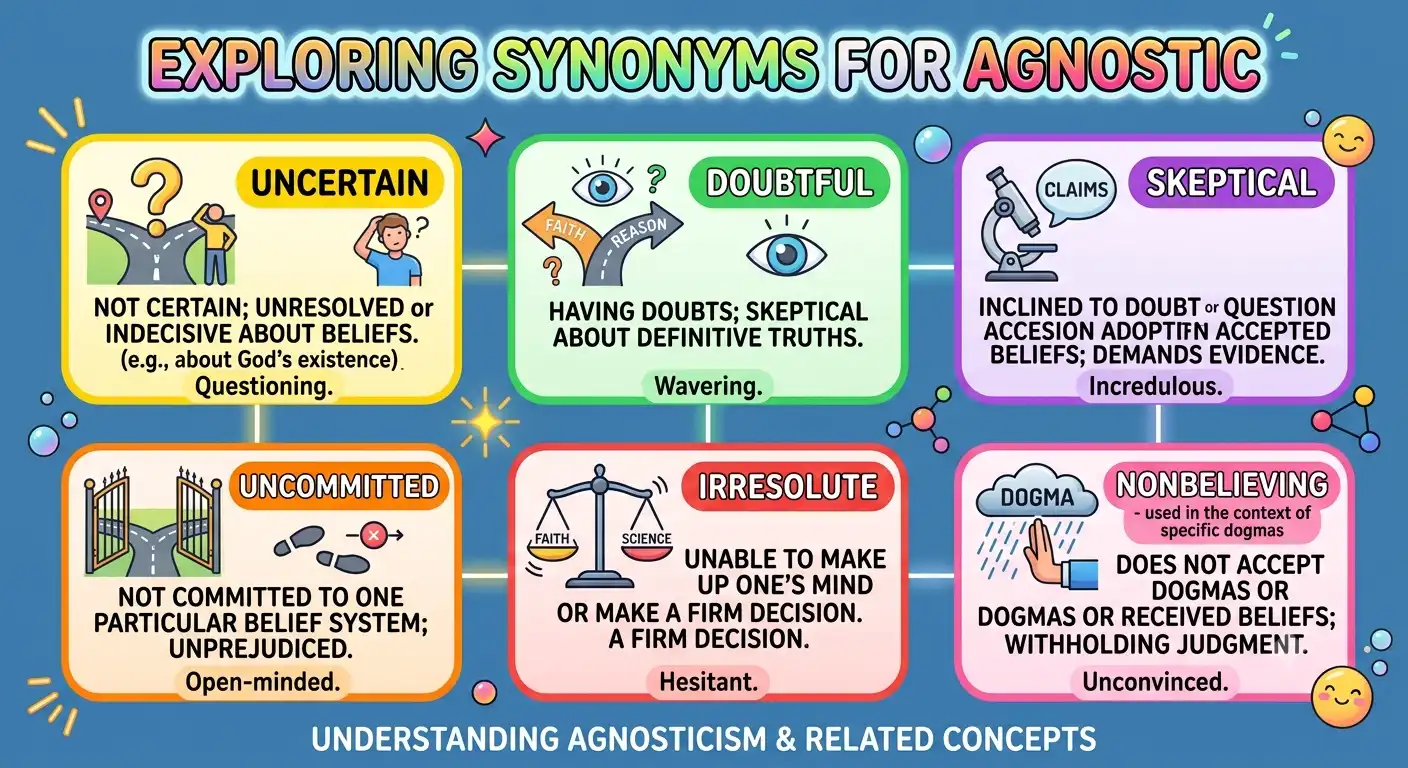
Exploring rich synonyms for agnostic helps you describe doubt, neutrality, and open-minded thinking with true clarity. When you learn synonyms for agnostic, you gain flexible words to express uncertainty about beliefs, ideas, or complex choices. Understanding diverse synonyms for agnostic gives your speech and writing greater precision across academic, professional, and everyday settings.
Imagine listening to a intense debate where two people insist they hold the absolute truth, while a quiet observer chooses to wait for solid facts before taking a side. That thoughtful observer shows what it means to be an agnostic. In Grade 3 English, an agnostic is simply a person who believes we cannot know for sure if something—like God or a big claim—is true or false without clear proof. For example, when a student admits they do not know whether life exists on other planets because scientists lack proof, they take an agnostic position.
“Uncertainty is an uncomfortable position, but certainty is an absurd one.” — Voltaire
Learning a rich list of synonyms for agnostic empowers many types of writers and speakers:
- Students can craft compelling persuasive essays without reusing repetitive words.
- Bloggers can write engaging headlines and captivate curious readers.
- Content writers can choose nuanced vocabulary to match exact brand tones.
- Daily English users can discuss philosophical or practical topics with ease and confidence.
“Doubt is the mother of discovery.” — Anonymous
Linguistic Breakdown of “Agnostic”
Connotative Meaning
The word agnostic carries a neutral, analytical, and intellectually honest tone. It suggests a desire for evidence rather than stubborn refusal or blind faith.
Etymology
- Prefix/Suffix: Prefix a- (without) + Suffix -ic (adjective/noun forming).
- Root Word: Greek gnōstos (known / knowledge).
- Historical Path: Coined in 1869 by British biologist T.H. Huxley from Greek agnōstos (unknowable, unknown), entering modern English to describe open-minded skepticism.
Pronunciation
- US IPA: /æɡˈnɑː.stɪk/
- UK IPA: /æɡˈnɒs.tɪk/
Syllables & Affixation Pattern
- Syllables: 3 (ag-nos-tic)
- Root Word: Gnos / Gnosis
- Affixation: Prefix a-, Suffix -tic
Comparison Table of Key Synonyms
| Keyword | Meaning | Usage Type | Context |
|---|---|---|---|
| Skeptic | A person who doubts accepted claims until proven | Intellectual / Conversational | Debates, science, everyday discussions |
| Doubter | A person who feels unsure about a statement | Casual / Conversational | Personal beliefs, group choices |
| Questioner | Someone who asks questions to test ideas | Curious / Academic | Classrooms, research, investigations |
| Fence-sitter | A person who refuses to pick a side in a dispute | Informal / Critical | Politics, workplace conflicts |
| Neutral | Not supporting either side in a disagreement | Professional / Objective | News reporting, diplomacy, sports |
| Uncommitted | Free from any pledge or firm choice | Formal / Functional | Elections, business deals, decisions |
| Freethinker | A person who forms opinions based on logic | Philosophical / Positive | Literature, philosophy, debates |
| Undecided | Having made no final choice yet | Simple / Everyday | Voting, shopping, opinion polls |
Main Content – 50 Synonyms for Agnostic
“The wise man avoids all extremes and seeks truth in balance.” — Proverb
1. Skeptic
- Pronunciation: US: /ˈskep.tɪk/ | UK: /ˈskep.tɪk/
- Meaning: A skeptic is a person who wants proof before believing something.
- Examples:
- My brother is a skeptic when he hears internet rumors.
- The scientist remained a skeptic until she saw the test results.
2. Doubter
- Pronunciation: US: /ˈdaʊ.t̬ɚ/ | UK: /ˈdaʊ.tə/
- Meaning: A doubter is someone who feels unsure about a claim.
- Examples:
- The speaker answered every question to convince the doubter.
- Even the biggest doubter had to smile at the good news.
3. Questioner
- Pronunciation: US: /ˈkwes.tʃə.nɚ/ | UK: /ˈkwes.tʃə.nə/
- Meaning: A questioner is a person who asks questions to find the truth.
- Examples:
- She was a curious questioner during the science field trip.
- A good questioner helps the team find hidden mistakes.
4. Nonbeliever
- Pronunciation: US: /ˌnɑːn.bəˈliː.vɚ/ | UK: /ˌnɒn.bɪˈliː.və/
- Meaning: A nonbeliever is a person who does not hold a specific belief.
- Examples:
- He spoke politely as a nonbeliever at the town meeting.
- The museum tour welcomed believers and nonbelievers alike.
5. Disbeliever
- Pronunciation: US: /ˌdɪs.bəˈliː.vɚ/ | UK: /ˌdɪs.bɪˈliː.və/
- Meaning: A disbeliever is someone who refuses to accept an idea without evidence.
- Examples:
- The magician proved the disbeliever wrong with a neat trick.
- She listened like a disbeliever when he told the wild tale.
6. Freethinker
- Pronunciation: US: /ˈfriːˈθɪŋ.kɚ/ | UK: /ˈfriːˈθɪŋ.kə/
- Meaning: A freethinker forms opinions using reason instead of tradition.
- Examples:
- As a freethinker, he reads books from many different cultures.
- The author was a famous freethinker of his time.
7. Fence-sitter
- Pronunciation: US: /ˈfensˌsɪt.̬ɚ/ | UK: /ˈfensˌsɪt.ə/
- Meaning: A fence-sitter is a person who hesitates to choose a side.
- Examples:
- The politician was called a fence-sitter on the new tax rule.
- Do not remain a fence-sitter when your team needs a vote.
8. Neutral
- Pronunciation: US: /ˈnuː.trəl/ | UK: /ˈnjuː.trəl/
- Meaning: A neutral person does not take sides in an argument.
- Examples:
- The referee must stay neutral during the big game.
- She gave a neutral answer to keep peace in the room.
9. Uncommitted
- Pronunciation: US: /ˌʌn.kəˈmɪt.̬ɪd/ | UK: /ˌʌn.kəˈmɪt.ɪd/
- Meaning: Uncommitted means not bound to any single belief or choice.
- Examples:
- Many voters are still uncommitted before the election.
- He preferred to remain uncommitted until he read the contract.
10. Undecided
- Pronunciation: US: /ˌʌn.dɪˈsaɪ.dɪd/ | UK: /ˌʌn.dɪˈsaɪ.dɪd/
- Meaning: Undecided means not having made up your mind yet.
- Examples:
- Sarah is undecided about which college course to take.
- The jury was still undecided after hours of discussion.
11. Unconvinced
- Pronunciation: US: /ˌʌn.kənˈvɪnst/ | UK: /ˌʌn.kənˈvɪnst/
- Meaning: Unconvinced means not fully believing what you were told.
- Examples:
- The buyer left the shop feeling unconvinced by the salesman.
- He looked unconvinced by the strange story.
12. Sceptic
- Pronunciation: US: /ˈskep.tɪk/ | UK: /ˈskep.tɪk/
- Meaning: Sceptic is the British spelling for someone who doubts claims.
- Examples:
- The British judge remained a sceptic during the hearing.
- Every good editor is a bit of a sceptic.
13. Cynic
- Pronunciation: US: /ˈsɪn.ɪk/ | UK: /ˈsɪn.ɪk/
- Meaning: A cynic is a person who distrusts the motives of others.
- Examples:
- The old cynic doubted that the project would succeed.
- Try not to be a cynic when someone offers help.
14. Nonpartisan
- Pronunciation: US: /ˌnɑːnˈpɑːr.t̬ə.zæn/ | UK: /ˌnɒn.pɑː.tɪˈzæn/
- Meaning: Nonpartisan means free from bias toward any political group.
- Examples:
- The group provides nonpartisan news updates to voters.
- They formed a nonpartisan committee to study the issue.
15. Uninvolved
- Pronunciation: US: /ˌʌn.ɪnˈvɑːlvd/ | UK: /ˌʌn.ɪnˈvɒlvd/
- Meaning: Uninvolved means not taking part in a debate or conflict.
- Examples:
- He stayed uninvolved in his neighbors’ argument.
- Uninvolved observers watched the debate quietly.
16. Inquirer
- Pronunciation: US: /ɪnˈkwaɪ.rɚ/ | UK: /ɪnˈkwaɪ.rə/
- Meaning: An inquirer is a person who seeks knowledge by asking questions.
- Examples:
- The young inquirer asked many questions about stars.
- The library is a great place for every honest inquirer.
17. Empiricist
- Pronunciation: US: /ɪmˈpɪr.ə.sɪst/ | UK: /ɪmˈpɪr.ɪ.sɪst/
- Meaning: An empiricist relies on real experiments and observable facts.
- Examples:
- As an empiricist, she trusts facts over wild guesses.
- The doctor took an empiricist approach to testing the medicine.
18. Rationalist
- Pronunciation: US: /ˈræʃ.ən.əl.ɪst/ | UK: /ˈræʃ.nəl.ɪst/
- Meaning: A rationalist bases opinions on reason and clear logic.
- Examples:
- He thinks like a rationalist when solving hard math problems.
- The rationalist asked for logic instead of emotional appeals.
19. Secularist
- Pronunciation: US: /ˈsek.jə.lɚ.ɪst/ | UK: /ˈsek.jə.lə.rɪst/
- Meaning: A secularist wants public life kept separate from religion.
- Examples:
- The secularist spoke in favor of public school neutrality.
- Laws should treat everyone fairly, argued the secularist.
20. Realist
- Pronunciation: US: /ˈriː.ə.lɪst/ | UK: /ˈrɪə.lɪst/
- Meaning: A realist accepts things as they actually are in life.
- Examples:
- A true realist looks at facts before spending money.
- She is a realist who plans for rainy days.
21. Heathen
- Pronunciation: US: /ˈhiː.ðən/ | UK: /ˈhiː.ðən/
- Meaning: A heathen is an informal word for someone outside a religion.
- Examples:
- Old stories often tell tales of distant heathen tribes.
- He used the word jokingly to describe his lack of faith.
22. Non-denominational
- Pronunciation: US: /ˌnɑːn.dɪˈnɑː.məˈneɪ.ʃən.əl/ | UK: /ˌnɒn.dɪˈnɒm.ɪˈneɪ.ʃən.əl/
- Meaning: Not tied to any specific religious group or church.
- Examples:
- They gathered at a non-denominational community center.
- The charity offers non-denominational support to all people.
23. Open-minded
- Pronunciation: US: /ˌoʊ.pənˈmaɪn.dɪd/ | UK: /ˌəʊ.pənˈmaɪn.dɪd/
- Meaning: Willing to listen to new ideas and arguments fairly.
- Examples:
- An open-minded student listens to all views in class.
- Stay open-minded when trying a new way to solve problems.
24. Objective
- Pronunciation: US: /əbˈdʒek.tɪv/ | UK: /əbˈdʒek.tɪv/
- Meaning: Viewing facts without personal feelings or bias getting in the way.
- Examples:
- Journalists should try to be objective when reporting news.
- The judge gave an objective review of the case.
25. Impartial
- Pronunciation: US: /ɪmˈpɑːr.ʃəl/ | UK: /ɪmˈpɑː.ʃəl/
- Meaning: Treating all sides equally without picking a favorite.
- Examples:
- We need an impartial judge to settle the debate.
- She gave impartial advice to both of her friends.
26. Unbiased
- Pronunciation: US: /ʌnˈbaɪ.əst/ | UK: /ʌnˈbaɪ.əst/
- Meaning: Free from prejudice or favoring one side over another.
- Examples:
- The survey collects unbiased feedback from all customers.
- He tried to give an unbiased opinion on the movie.
27. Disinterested
- Pronunciation: US: /dɪsˈɪn.trə.stɪd/ | UK: /dɪsˈɪn.trəs.tɪd/
- Meaning: Free from personal self-interest in an outcome.
- Examples:
- A disinterested third party helped resolve the disagreement.
- She acted as a disinterested leader during the vote.
28. Detached
- Pronunciation: US: /dɪˈtætʃt/ | UK: /dɪˈtætʃt/
- Meaning: Looking at a situation calmly without taking sides.
- Examples:
- The doctor remained detached while analyzing the symptoms.
- He gave a cool and detached view of the topic.
29. Hesitant
- Pronunciation: US: /ˈhez.ə.tənt/ | UK: /ˈhez.ɪ.tənt/
- Meaning: Slow to decide or act because of feeling unsure.
- Examples:
- She was hesitant to sign the agreement without reading it.
- The puppy was hesitant to jump into the water.
30. Uncertain
- Pronunciation: US: /ʌnˈsɝː.tən/ | UK: /ʌnˈsɜː.tən/
- Meaning: Not completely sure about a fact or choice.
- Examples:
- We are uncertain about tomorrow’s weather forecast.
- He felt uncertain about which path to take.
31. Unsure
- Pronunciation: US: /ʌnˈʃʊr/ | UK: /ʌnˈʃɔː/
- Meaning: Lacking confidence in a decision or statement.
- Examples:
- I am unsure of the correct answer to question five.
- The child looked unsure before stepping onto the stage.
32. Wavering
- Pronunciation: US: /ˈweɪ.vɚ.ɪŋ/ | UK: /ˈweɪ.vər.ɪŋ/
- Meaning: Moving back and forth between two choices or ideas.
- Examples:
- His wavering opinion showed he needed more facts.
- The voter held a wavering stance on the candidate.
33. Suspicious
- Pronunciation: US: /səˈspɪʃ.əs/ | UK: /səˈspɪʃ.əs/
- Meaning: Feeling that something might not be true or honest.
- Examples:
- She was suspicious of claims that sounded too good.
- The guard felt suspicious when the door was left open.
34. Unpersuaded
- Pronunciation: US: /ˌʌn.pɚˈsweɪ.dɪd/ | UK: /ˌʌn.pəˈsweɪ.dɪd/
- Meaning: Not convinced by an argument or speech.
- Examples:
- The audience remained unpersuaded by his short speech.
- She was unpersuaded that the plan would work on time.
35. Non-aligned
- Pronunciation: US: /ˌnɑːn.əˈlaɪnd/ | UK: /ˌnɒn.əˈlaɪnd/
- Meaning: Not allied with any political or religious power.
- Examples:
- The small nation chose to stay non-aligned in the war.
- Several non-aligned members voted against the proposal.
36. Independent
- Pronunciation: US: /ˌɪn.dɪˈpen.dənt/ | UK: /ˌɪn.dɪˈpen.dənt/
- Meaning: Thinking or acting without control from outside groups.
- Examples:
- She is an independent thinker who asks deep questions.
- The report came from an independent research team.
37. Non-subscribing
- Pronunciation: US: /ˌnɑːn.səbˈskraɪ.bɪŋ/ | UK: /ˌnɒn.səbˈskraɪ.bɪŋ/
- Meaning: Refusing to agree with or sign standard doctrines.
- Examples:
- A non-subscribing member declined to sign the document.
- The church welcomed non-subscribing visitors warmly.
38. Non-conforming
- Pronunciation: US: /ˌnɑːn.kənˈfɔːr.mɪŋ/ | UK: /ˌnɒn.kənˈfɔː.mɪŋ/
- Meaning: Not following set rules or traditional ideas.
- Examples:
- Her non-conforming style inspired fellow artists.
- He held non-conforming views on popular trends.
39. Dissenter
- Pronunciation: US: /dɪˈsen.t̬ɚ/ | UK: /dɪˈsen.tə/
- Meaning: A person who openly disagrees with common beliefs.
- Examples:
- One dissenter voted no during the board meeting.
- History remembers the dissenter who spoke out for justice.
40. Materialist
- Pronunciation: US: /məˈtɪr.i.ə.lɪst/ | UK: /məˈtɪə.ri.ə.lɪst/
- Meaning: Someone who believes only physical matter truly exists.
- Examples:
- A materialist focuses on physical evidence in science.
- He explained his view using a materialist perspective.
41. Positivist
- Pronunciation: US: /ˈpɑː.zə.t̬ɪ.vɪst/ | UK: /ˈpɒz.ɪ.tɪ.vɪst/
- Meaning: A thinker who trusts only facts verified by sensory data.
- Examples:
- The professor presented a positivist argument in class.
- Positivist science demands strong measurable proof.
42. Humanist
- Pronunciation: US: /ˈhjuː.mə.nɪst/ | UK: /ˈhjuː.mən.ɪst/
- Meaning: A person focused on human values rather than divine claims.
- Examples:
- The humanist author wrote about kindness and reason.
- They founded a humanist charity to help homeless youth.
43. Agnosticist
- Pronunciation: US: /æɡˈnɑː.stə.sɪst/ | UK: /æɡˈnɒs.tɪ.sɪst/
- Meaning: A person who defends or teaches agnostic philosophy.
- Examples:
- The scholar wrote a book as a dedicated agnosticist.
- An agnosticist welcomes healthy debate on big ideas.
44. Unpledged
- Pronunciation: US: /ˌʌnˈpledʒd/ | UK: /ˌʌnˈpledʒd/
- Meaning: Not bound by a promise or formal vote yet.
- Examples:
- Unpledged delegates held the power in the final round.
- He stayed unpledged until he heard both offers.
45. Non-member
- Pronunciation: US: /ˌnɑːnˈmem.bɚ/ | UK: /ˌnɒnˈmem.bə/
- Meaning: A person who does not belong to a specific organization.
- Examples:
- Non-members must pay a small entry fee at the gate.
- The workshop is open to members and non-members alike.
46. Non-subscriber
- Pronunciation: US: /ˌnɑːn.səbˈskraɪ.bɚ/ | UK: /ˌnɒn.səbˈskraɪ.bə/
- Meaning: Someone who does not support or buy into a system.
- Examples:
- Non-subscribers can read three free articles per month.
- He remained a non-subscriber to popular dogmas.
47. Dispassionate
- Pronunciation: US: /dɪsˈpæʃ.ən.ət/ | UK: /dɪsˈpæʃ.ən.ət/
- Meaning: Able to think without emotional interference.
- Examples:
- She gave a dispassionate review of the complex problem.
- Scientists need dispassionate habits when evaluating data.
48. Non-believing
- Pronunciation: US: /ˌnɑːn.bəˈliː.vɪŋ/ | UK: /ˌnɒn.bɪˈliː.vɪŋ/
- Meaning: Not holding a firm belief in unproven statements.
- Examples:
- The non-believing guest listened respectfully to the speech.
- She took a non-believing approach to the ghost story.
49. Searcher
- Pronunciation: US: /ˈsɝː.tʃɚ/ | UK: /ˈsɜː.tʃə/
- Meaning: A person who keeps seeking truth without settling too soon.
- Examples:
- Every true searcher travels to find deeper answers.
- He lived as a lifelong searcher of truth.
50. Inquisitor
- Pronunciation: US: /ɪnˈkwɪz.ə.t̬ɚ/ | UK: /ɪnˈkwɪz.ɪ.tə/
- Meaning: A person who asks hard questions to dig into facts.
- Examples:
- The news reporter acted as a sharp inquisitor during the interview.
- A good inquisitor uncovers details others miss.
Antonyms of “Agnostic”
While an agnostic holds back judgment and waits for evidence, these antonyms represent firm conviction, certainty, or dogmatic belief:
- Believer: US: /bəˈliː.vɚ/ | UK: /bɪˈliː.və/ – A person who firmly accepts a doctrine or idea.
- Dogmatist: US: /ˈdɑːɡ.mə.tɪst/ | UK: /ˈdɒɡ.mə.tɪst/ – Someone who asserts opinions as absolute truth without proof.
- Gnostic: US: /ˈnɑː.stɪk/ | UK: /ˈnɒs.tɪk/ – A person who claims secret or certainty of spiritual knowledge.
- Devotee: US: /ˌdev.əˈtiː/ | UK: /ˌdev.əˈtiː/ – A strongly committed follower of a belief or cause.
Prototype Meaning and Categorization of “Agnostic”
- Grammatical Category: Noun and Adjective.
- Prototype Meaning: An individual who asserts that the truth value of certain claims—especially spiritual or metaphysical ones—is unknown or inherently unknowable.
- Semantic Field: Epistemology, belief systems, skepticism, philosophy, and intellectual neutrality.
Frequently Asked Questions (FAQ)
1. What is the most common synonym for agnostic?
The most common everyday synonyms for agnostic are skeptic, doubter, questioner, and neutral. These terms fit naturally into casual, academic, and business conversations.
2. Is an agnostic the same as an atheist?
No. An atheist specifically lacks belief in God or asserts that God does not exist, whereas an agnostic maintains that human beings cannot know for sure without definitive proof.
3. Can “agnostic” be used outside of religion?
Yes! In modern English, agnostic often describes a neutral stance toward technology or choices (such as “platform-agnostic software,” meaning software that runs on any operating system).
4. What is the difference between “skeptic” and “agnostic”?
A skeptic actively doubts statements until clear evidence appears. An agnostic specifically highlights that certainty itself may be impossible to achieve regarding a given question.
5. Why should writers build a strong vocabulary around “agnostic”?
Mastering varied synonyms for agnostic lets writers express fine shades of uncertainty, maintain journalistic balance, and avoid repetitive word choices in essays or articles.
6. What preposition follows “agnostic”?
The word agnostic is commonly paired with about or toward (for example, “She is agnostic about the new policy”).
Conclusion
Expanding your command of synonyms for agnostic elevates your vocabulary and sharpens your communication. Using precise words like skeptic, freethinker, impartial, or uncommitted gives your writing clarity and nuance. Whether you write academic essays, publish blog posts, or engage in thoughtful conversations, choosing the exact right synonym helps you sound confident and articulate.
“Doubt is not a pleasant condition, but certainty is an absurd one.” — Voltaire
“The importance of asking questions is higher than having instant answers.” — Anonymous
Take time to practice these 50 dynamic words in your daily journaling, email replies, and creative writing. With consistent practice, you will express open-mindedness and intellectual balance naturally in every sentence you create.

Andrew Collins is an academic English educator with over 12 years of experience helping university students, IELTS candidates, and ESL learners improve their writing vocabulary.