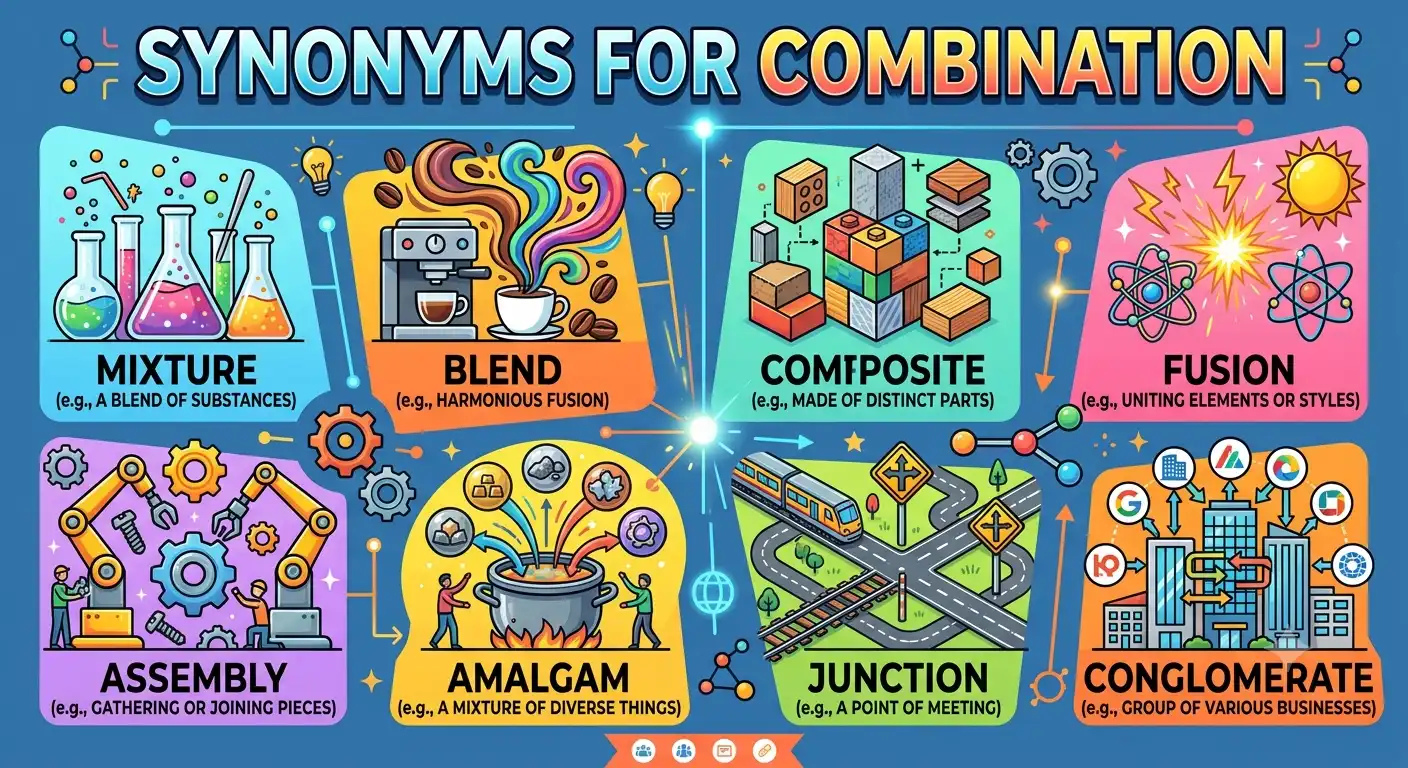
When you explore synonyms for combination, you unlock clearer ways to express how things join together. Discovering different synonyms for combination helps you avoid repeating the same word in your essays, articles, and conversations. Whether you are blending ingredients or uniting business ideas, knowing rich synonyms for combination gives your vocabulary precision and variety.
Imagine a chef working in a busy kitchen who mixes fresh tomatoes, garlic, and basil to craft a delicious pasta sauce. That mix of ingredients creates something entirely new and exciting. A combination is simply two or more things put together to make a single whole.
“Creativity is just connecting things. When you ask creative people how they did something, they feel a little guilty because they didn’t really do it, they just saw something.” — Steve Jobs
Learning extra words for joining things helps many people communicate better every day:
- Students can write stronger research papers and academic essays.
- Bloggers can keep their articles fresh, lively, and enjoyable to read.
- Content writers can craft persuasive marketing copy with crisp vocabulary.
- Daily English users can speak naturally and clearly in personal or work settings.
“Synergy is the highest activity of all in life; it creates new and unheard-of alternatives.” — Stephen Covey
Linguistic Breakdown of “Combination”
Connotative Meaning
The term combination carries a neutral to highly positive connotation. It suggests order, cooperation, and creation. Depending on the synonym you select, the tone can shift toward artistic harmony, formal business strategy, or casual mixing.
Etymology
- Old French: Derived from combination (meaning “a joining together”).
- Late Latin: Rooted in combinatio, from combinare (“to join two by two”).
- Latin Roots: Formed from com- (“together”) and bini (“two by two”).
Pronunciation
- US IPA: /ˌkɑːm.bəˈneɪ.ʃən/
- UK IPA: /ˌkɒm.bɪˈneɪ.ʃən/
Syllables & Affixation Pattern
- Syllables: 4 (com-bi-na-tion)
- Prefix: com- (meaning “together”)
- Root: bine (from bini, meaning “two by two”)
- Suffix: -ation (noun-forming suffix indicating an action or state)
Comparison Table of Key Synonyms
| Keyword | Meaning | Usage Type | Context |
|---|---|---|---|
| Blend | A gentle mix where parts merge smoothly | Casual / Creative | Cooking, colors, music styles |
| Fusion | Joining different elements into a single unit | Modern / Professional | Food recipes, music, technology |
| Amalgam | A blend of diverse elements | Formal | Corporate structure, cultural mix |
| Union | Joining people or things together permanently | Formal / Emotional | Marriage, labor organizations, states |
| Alliance | A partnership formed for mutual benefit | Professional | Business deals, international politics |
| Composite | Something made of several distinct parts | Technical / Formal | Building materials, scientific research |
| Hybrid | A mix of two different things or systems | Professional / Technical | Technology, cars, plant breeding |
| Synthesis | Combining ideas to form a single theory | Academic | Essay writing, research, philosophy |
“The magic happens when you bring different elements together in total harmony.” — Unknown
Main Content – 50 Synonyms for Combination
1. Blend
- Pronunciation: US: /blend/ | UK: /blend/
- Meaning: A soft mix of two or more things put together.
- Examples:
- This coffee is a smooth blend of two distinct beans.
- Her speech was a sweet blend of humor and wisdom.
2. Mixture
- Pronunciation: US: /ˈmɪks.tʃɚ/ | UK: /ˈmɪks.tʃər/
- Meaning: Something made by putting different things together.
- Examples:
- Add water to the flour mixture and stir slowly.
- His face showed a mixture of surprise and joy.
3. Fusion
- Pronunciation: US: /ˈfjuː.ʒən/ | UK: /ˈfjuː.ʒən/
- Meaning: The joining of different things into one new thing.
- Examples:
- The restaurant serves a unique fusion of Asian and Italian food.
- Their album is a fusion of jazz and modern rock music.
4. Amalgam
- Pronunciation: US: /əˈmæl.ɡəm/ | UK: /əˈmæl.ɡəm/
- Meaning: A collection of different things combined into a whole.
- Examples:
- The film is an amalgam of action and comedy.
- Her style is an amalgam of old and new fashions.
5. Compound
- Pronunciation: US: /ˈkɑːm.paʊnd/ | UK: /ˈkɒm.paʊnd/
- Meaning: Something made by uniting two or more elements.
- Examples:
- Water is a chemical compound made of hydrogen and oxygen.
- The new medicine is a compound of natural herbs.
6. Union
- Pronunciation: US: /ˈjuː.njən/ | UK: /ˈjuː.njən/
- Meaning: The state of being joined together as one unit.
- Examples:
- Their marriage was a happy union of two families.
- The workers formed a union to protect their rights.
7. Synthesis
- Pronunciation: US: /ˈsɪn.θə.sɪs/ | UK: /ˈsɪn.θə.sɪs/
- Meaning: Combining different ideas to create a single plan.
- Examples:
- The paper presents a synthesis of recent scientific research.
- Her artwork is a synthesis of traditional and digital painting.
8. Mix
- Pronunciation: US: /mɪks/ | UK: /mɪks/
- Meaning: A combination of different things or people.
- Examples:
- We played a great mix of old and new songs.
- The party had a fun mix of students and teachers.
9. Merge
- Pronunciation: US: /mɝːdʒ/ | UK: /mɜːdʒ/
- Meaning: Joining two separate things into one.
- Examples:
- The two small towns planned to merge their police teams.
- Drivers must merge carefully when entering the main highway.
10. Alliance
- Pronunciation: US: /əˈlaɪ.əns/ | UK: /əˈlaɪ.əns/
- Meaning: An agreement between groups to work together.
- Examples:
- The two tech companies formed a global business alliance.
- Countries created an alliance to protect the regional environment.
11. Merger
- Pronunciation: US: /ˈmɝː.dʒɚ/ | UK: /ˈmɜː.dʒər/
- Meaning: The combining of two companies into one big company.
- Examples:
- The corporate merger created the largest bank in the country.
- Employees felt excited about the merger of both offices.
12. Composite
- Pronunciation: US: /kəmˈpɑː.zət/ | UK: /kəmˈpɒz.ɪt/
- Meaning: Made up of several different parts or materials.
- Examples:
- The door is made from a light composite material.
- The police officer drew a composite sketch of the suspect.
13. Hybrid
- Pronunciation: US: /ˈhaɪ.brɪd/ | UK: /ˈhaɪ.brɪd/
- Meaning: Something made by combining two different types or systems.
- Examples:
- A hybrid car uses both gasoline and electric power.
- The school offers a hybrid learning model with online classes.
14. Integration
- Pronunciation: US: /ˌɪn.t̬əˈɡreɪ.ʃən/ | UK: /ˌɪn.tɪˈɡreɪ.ʃən/
- Meaning: Putting different parts together to work smoothly as one.
- Examples:
- The integration of the new software took three days.
- Smooth cultural integration makes communities friendlier and stronger.
15. Coalition
- Pronunciation: US: /ˌkoʊ.əˈlɪʃ.ən/ | UK: /ˌkəʊ.əˈlɪʃ.ən/
- Meaning: A group formed when political parties or groups unite.
- Examples:
- Three political parties formed a coalition to govern the city.
- The environmental coalition campaigned for cleaner river water.
16. Association
- Pronunciation: US: /əˌsoʊ.siˈeɪ.ʃən/ | UK: /əˌsəʊ.siˈeɪ.ʃən/
- Meaning: A group of people joined together for a shared purpose.
- Examples:
- She joined the local neighborhood association last month.
- The medical association published a helpful guide on sleep.
17. Aggregation
- Pronunciation: US: /ˌæɡ.rəˈɡeɪ.ʃən/ | UK: /ˌæɡ.rɪˈɡeɪ.ʃən/
- Meaning: A collection of items gathered into a single total.
- Examples:
- News websites use data aggregation to show top stories.
- The total score is an aggregation of four test results.
18. Collection
- Pronunciation: US: /kəˈlek.ʃən/ | UK: /kəˈlek.ʃən/
- Meaning: A group of things brought together in one place.
- Examples:
- He showed us his rare collection of antique stamps.
- The library has a large collection of science books.
19. Assembly
- Pronunciation: US: /əˈsem.bli/ | UK: /əˈsem.bli/
- Meaning: A group of items or people gathered together.
- Examples:
- All students gathered in the hall for morning assembly.
- Factory workers finished the car assembly in two hours.
20. Joining
- Pronunciation: US: /ˈdʒɔɪ.nɪŋ/ | UK: /ˈdʒɔɪ.nɪŋ/
- Meaning: Connecting two or more things together securely.
- Examples:
- The joining of the two ropes took only a moment.
- Careful joining of the wooden planks made a firm table.
21. Convergence
- Pronunciation: US: /kənˈvɝː.dʒəns/ | UK: /kənˈvɜː.dʒəns/
- Meaning: The act of different things coming together at one point.
- Examples:
- The convergence of two rivers created a wide lake.
- Media convergence brings news directly to mobile devices.
22. Unification
- Pronunciation: US: /ˌjuː.nə.fəˈkeɪ.ʃən/ | UK: /ˌjuː.nɪ.fɪˈkeɪ.ʃən/
- Meaning: The process of bringing things together as a single whole.
- Examples:
- The unification of the two regions brought long peace.
- The coach worked hard for the unification of the team.
23. Junction
- Pronunciation: US: /ˈdʒʌŋk.ʃən/ | UK: /ˈdʒʌŋk.ʃən/
- Meaning: A place where two or more things meet or join.
- Examples:
- Turn left when you reach the busy road junction.
- The town grew near the junction of two major railways.
24. Conjunction
- Pronunciation: US: /kənˈdʒʌŋk.ʃən/ | UK: /kənˈdʒʌŋk.ʃən/
- Meaning: Things happening or coming together at the same time.
- Examples:
- The fair took place in conjunction with the city holiday.
- Good diet in conjunction with exercise keeps you healthy.
25. Consolidation
- Pronunciation: US: /kənˌsɑː.ləˈdeɪ.ʃən/ | UK: /kənˌsɒl.ɪˈdeɪ.ʃən/
- Meaning: Bringing several small things together into one firm group.
- Examples:
- The consolidation of three warehouses saved the company money.
- Business consolidation helped small stores stay open.
26. Pairing
- Pronunciation: US: /ˈper.ɪŋ/ | UK: /ˈpeə.rɪŋ/
- Meaning: Putting two related things together as a set.
- Examples:
- The chef suggested a fine pairing of cheese and fruit.
- Student pairing helped both partners complete the science project.
27. Coupling
- Pronunciation: US: /ˈkʌp.lɪŋ/ | UK: /ˈkʌp.lɪŋ/
- Meaning: The joining of two items or ideas together.
- Examples:
- The train cars were linked with a heavy metal coupling.
- Coupling hard work with clear goals brings steady success.
28. Mashup
- Pronunciation: US: /ˈmæʃ.ʌp/ | UK: /ˈmæʃ.ʌp/
- Meaning: A creative mix of elements from different source media.
- Examples:
- The DJ played a popular mashup of two top songs.
- The video was a fun mashup of famous movie scenes.
29. Medley
- Pronunciation: US: /ˈmed.li/ | UK: /ˈmed.li/
- Meaning: A musical or creative piece made from varied songs or parts.
- Examples:
- The band played a cheerful medley of holiday tunes.
- Breakfast featured a colorful medley of fresh summer fruits.
30. Variety
- Pronunciation: US: /vəˈraɪ.ə.t̬i/ | UK: /vəˈraɪ.ə.ti/
- Meaning: A collection of different types of things.
- Examples:
- The bakery offers a wide variety of fresh bread.
- We saw a rich variety of colorful birds in the park.
31. Assortment
- Pronunciation: US: /əˈsɔːrt.mənt/ | UK: /əˈsɔːt.mənt/
- Meaning: A group of different things gathered together.
- Examples:
- She bought a sweet assortment of chocolates for her friend.
- The tool kit includes a broad assortment of small screws.
32. Coalescence
- Pronunciation: US: /ˌkoʊ.əˈles.əns/ | UK: /ˌkəʊ.əˈles.əns/
- Meaning: The process of growing or coming together into one body.
- Examples:
- Small rain drops merged in a slow coalescence on the window.
- The coalescence of several small groups formed a strong union.
33. Network
- Pronunciation: US: /ˈnet.wɝːk/ | UK: /ˈnet.wɜːk/
- Meaning: A large system of connected people, computers, or roads.
- Examples:
- The company built a fast network of computer servers.
- She built a wide network of helpful professional friends.
34. Partnership
- Pronunciation: US: /ˈpɑːrt.nɚ.ʃɪp/ | UK: /ˈpɑːt.nə.ʃɪp/
- Meaning: An arrangement where two people or groups work together.
- Examples:
- They formed a business partnership to open a local clinic.
- Strong team partnership helps complete large tasks quickly.
35. Confederation
- Pronunciation: US: /kənˌfed.əˈreɪ.ʃən/ | UK: /kənˌfed.əˈreɪ.ʃən/
- Meaning: An organization of groups united for a common purpose.
- Examples:
- The sports confederation organized the national championship.
- Local tribes formed a peaceful confederation long ago.
36. League
- Pronunciation: US: /liːɡ/ | UK: /liːɡ/
- Meaning: A group of teams or groups that work together in a union.
- Examples:
- Our soccer team plays in the regional youth league.
- The city joined a league of eco-friendly towns.
37. Federation
- Pronunciation: US: /ˌfed.əˈreɪ.ʃən/ | UK: /ˌfed.əˈreɪ.ʃən/
- Meaning: A group of states or organizations linked under a single head.
- Examples:
- The national chess federation held its big annual tournament.
- Several provinces joined together into a single federation.
38. Arrangement
- Pronunciation: US: /əˈreɪndʒ.mənt/ | UK: /əˈreɪndʒ.mənt/
- Meaning: A group of things placed in a specific orderly pattern.
- Examples:
- The table featured a beautiful arrangement of garden flowers.
- They made a friendly arrangement to share travel costs.
39. Intermixture
- Pronunciation: US: /ˌɪn.t̬ɚˈmɪks.tʃɚ/ | UK: /ˌɪn.təˈmɪks.tʃər/
- Meaning: A complex blend of different elements mixed together.
- Examples:
- The painting shows a vivid intermixture of red and blue dyes.
- Culture grows through the intermixture of ideas and traditions.
40. Melding
- Pronunciation: US: /ˈmel.dɪŋ/ | UK: /ˈmel.dɪŋ/
- Meaning: The smooth joining or blending of two or more things.
- Examples:
- The recipe relies on the careful melding of spices.
- The project was a melding of technology and creative design.
41. Cross
- Pronunciation: US: /krɑːs/ | UK: /krɒs/
- Meaning: A mix produced by combining two different breeds or ideas.
- Examples:
- The new fruit is a cross between an orange and a lemon.
- The movie is a cross between a thriller and a mystery.
42. Concoction
- Pronunciation: US: /kənˈkɑːk.ʃən/ | UK: /kənˈkɒk.ʃən/
- Meaning: A unusual combination of ingredients or ideas.
- Examples:
- The chef created a tasty cold concoction for summer.
- He made up a wild concoction of stories to explain his delay.
43. Hodgepodge
- Pronunciation: US: /ˈhɑːdʒ.pɑːdʒ/ | UK: /ˈhɒdʒ.pɒdʒ/
- Meaning: A confused mixture or random collection of items.
- Examples:
- The attic was filled with a hodgepodge of old toys.
- His essay felt like a hodgepodge of unrelated facts.
44. Jumble
- Pronunciation: US: /ˈdʒʌm.bəl/ | UK: /ˈdʒʌm.bəl/
- Meaning: An untidy mix of different things scattered together.
- Examples:
- Key chains sat in a messy jumble on the kitchen counter.
- Her thoughts were in a jumble before the public talk.
45. Conglomerate
- Pronunciation: US: /kənˈɡlɑː.mɚ.ət/ | UK: /kənˈɡlɒm.ər.ət/
- Meaning: A large company formed by combining several smaller firms.
- Examples:
- The media conglomerate owns television networks and newspapers.
- Several small businesses merged to form a giant conglomerate.
46. Merging
- Pronunciation: US: /ˈmɝː.dʒɪŋ/ | UK: /ˈmɜː.dʒɪŋ/
- Meaning: The active process of combining two things together into one.
- Examples:
- The merging of the two schools took place over summer.
- Merging these two ideas will make a stronger strategy.
47. Intertwining
- Pronunciation: US: /ˌɪn.t̬ɚˈtwaɪ.nɪŋ/ | UK: /ˌɪn.təˈtwaɪ.nɪŋ/
- Meaning: Twisting or combining two threads or ideas together closely.
- Examples:
- The intertwining of the two vines covered the garden fence.
- The novel tells an intertwining story of two old friends.
48. Pool
- Pronunciation: US: /puːl/ | UK: /puːl/
- Meaning: A shared collection of resources or money gathered together.
- Examples:
- Employees pooled their savings to buy a shared office car.
- The company has a large pool of talented designers.
49. Gathering
- Pronunciation: US: /ˈɡæð.ɚ.ɪŋ/ | UK: /ˈɡæð.ər.ɪŋ/
- Meaning: A bringing together of people or things into one group.
- Examples:
- Family members enjoyed a warm gathering over the weekend.
- The gathering of research data took several months.
50. Cluster
- Pronunciation: US: /ˈklʌs.tɚ/ | UK: /ˈklʌs.tər/
- Meaning: A close group or combination of similar things together.
- Examples:
- A bright cluster of stars lit up the night sky.
- Small shops form a busy cluster near the train station.
Antonyms of “Combination”
When you need to describe separating or breaking things apart rather than joining them, use these primary antonyms:
- Separation: US: /ˌsep.əˈreɪ.ʃən/ | UK: /ˌsep.əˈreɪ.ʃən/ – The act of moving or keeping things apart.
- Division: US: /dɪˈvɪʒ.ən/ | UK: /dɪˈvɪʒ.ən/ – Splitting something into different parts or groups.
- Detachment: US: /dɪˈtætʃ.mənt/ | UK: /dɪˈtætʃ.mənt/ – Disconnecting or unfastening a part from a whole.
- Dissolution: US: /ˌdɪs.əˈluː.ʃən/ | UK: /ˌdɪs.əˈluː.ʃən/ – The official breaking up of a group, union, or contract.
Prototype Meaning and Categorization of “Combination”
- Grammatical Category: Noun (Countable and Uncountable).
- Prototype Meaning: The result or act of uniting two or more separate items, ideas, or entities into a single unified whole.
- Semantic Field: Union, composition, physical mixing, organizational structure, logic, and mathematics.
Frequently Asked Questions (FAQ)
1. What is the most common formal synonym for combination?
The most common formal synonyms for combination are synthesis, amalgam, and integration. You will frequently encounter synthesis in academic research and integration or amalgam in professional business environments.
2. Is “fusion” different from a basic “mixture”?
Yes, fusion usually implies that the combined elements have merged so completely that they form an entirely new, seamless entity (such as fusion cuisine or fusion music). A mixture often refers to items placed together where individual parts remain distinct.
3. Can I use words like “hodgepodge” in corporate business reports?
Words like hodgepodge or jumble carry an informal, slightly negative tone suggesting disorder. In formal business reports, replace them with professional terms such as composite, assortment, or aggregation.
4. Which synonym for combination works best in creative essay writing?
In creative writing, evocative words like blend, melding, intertwining, or medley add colorful imagery and subtle depth to your descriptions.
5. How do I know whether to use “merger” or “alliance”?
Use merger when two separate organizations permanently combine into a single company. Use alliance when two or more independent groups agree to collaborate for a specific goal while keeping their separate identities.
6. Why should non-native speakers practice learning synonyms for combination?
Learning precise synonyms allows non-native speakers to explain complex concepts accurately, write varied professional emails, avoid repetitive phrasing, and score higher on standardized English exams.
Conclusion
Expanding your English vocabulary with varied synonyms for combination transforms the way you express ideas. Instead of relying repeatedly on basic words, choosing terms like blend, synthesis, fusion, or integration adds exact precision, elegance, and clarity to your writing and speech.
Mastering these words gives students an advantage in academic essays, empowers bloggers to write lively content, and helps professionals draft crisp workplace communications.
“Words are, in my not-so-humble opinion, our most inexhaustible source of magic.” — J.K. Rowling
Make it a habit to practice using new words like amalgam, medley, or coalition in your everyday emails, stories, and conversations. Over time, your vocabulary will expand naturally, making your communication far more effective and engaging.
“The limit of your language is the limit of your world.” — Ludwig Wittgenstein

Andrew Collins is an academic English educator with over 12 years of experience helping university students, IELTS candidates, and ESL learners improve their writing vocabulary.