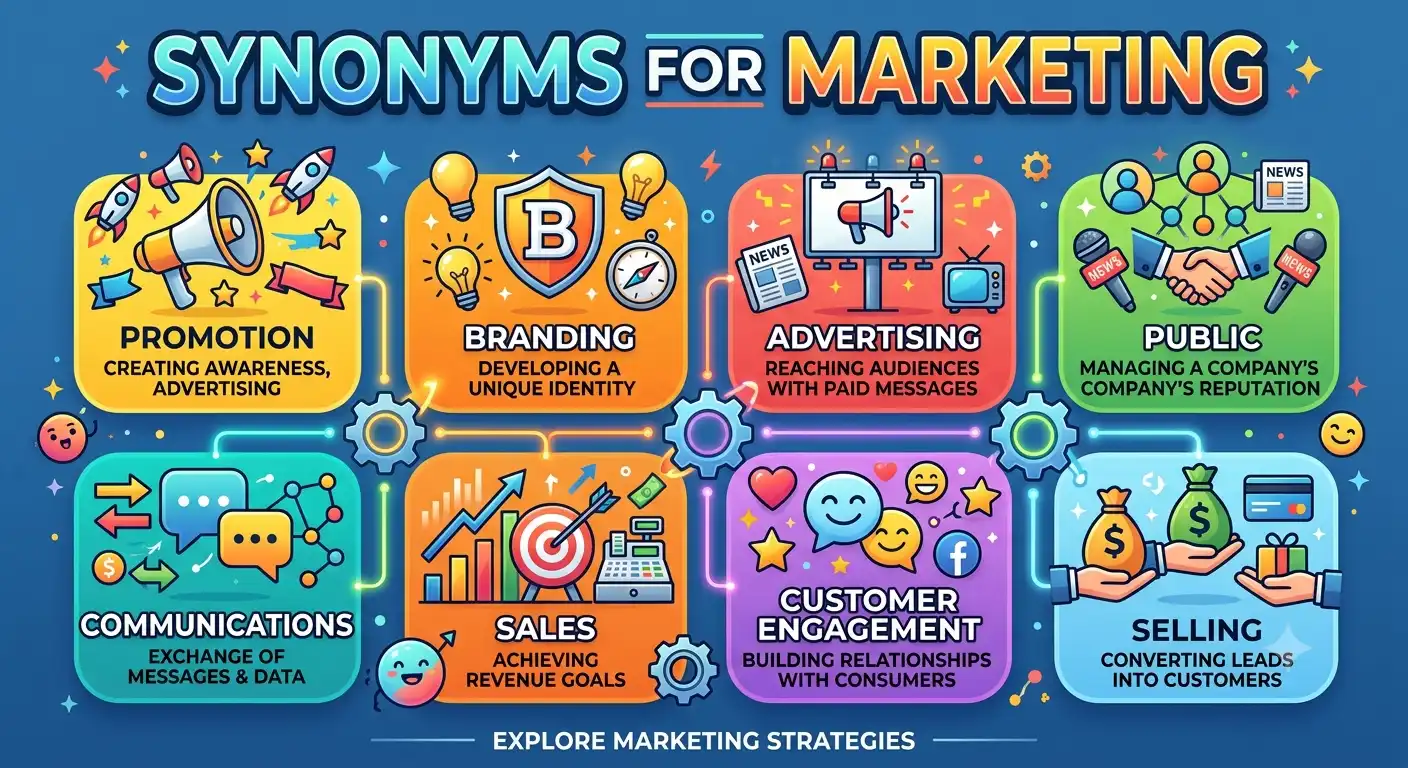
When you explore synonyms for marketing, you discover dynamic ways to talk about promoting products, services, and ideas. Learning synonyms for marketing helps you express business strategies with clarity without repeating the same term constantly. Understanding diverse synonyms for marketing allows you to choose precise terms whether you are writing a corporate report, crafting an ad campaign, or pitching a fresh business proposal.
Picture a neighborhood baker who bakes delicious fresh bread every morning. If no one knows the bakery exists, nobody comes in to buy anything. To attract customers, the baker hangs a colorful banner outside, hands out flyers, and posts photos of hot pastries on social media. This active effort to showcase a product and connect with buyers is what marketing is all about. At its core, marketing means telling people about a product or service so they want to buy it.
Building a strong vocabulary of business terms benefits many types of writers and speakers:
- Students can write compelling business essays and academic presentations.
- Bloggers can create engaging, varied content about business trends and digital growth.
- Content writers can draft persuasive copy for websites, newsletters, and sales pages.
- Daily English users can discuss work projects, strategy, and shopping choices with confidence.
“Marketing is no longer about the stuff that you make, but about the stories you tell.” — Seth Godin
“Good marketing makes the company look smart. Great marketing makes the customer feel smart.” — Joe Chernov
Linguistic Breakdown of “Marketing”
Connotative Meaning
The word marketing carries an active, growth-oriented connotation in modern English. While it naturally refers to commercial strategy and sales growth, specific synonyms can alter the tone toward creative storytelling, bold persuasion, aggressive hype, or official public announcements.
Etymology
- Old French: Derived from marchiet (meaning “market or trading place”).
- Latin Origin: Rooted in mercatus (meaning “trade, traffic, or market place”).
- Historical Evolution: Entered Middle English as market, eventually adopting the active verb suffix -ing in modern English to describe the continuous act of promoting and selling goods.
Pronunciation
- US IPA: /ˈmɑːr.kɪ.t̬ɪŋ/
- UK IPA: /ˈmɑː.kɪ.tɪŋ/
Syllables & Affixation Pattern
- Syllables: 3 (mar-ket-ing)
- Prefix: None
- Root: market
- Suffix: -ing (present participle / gerund inflectional suffix)
Comparison Table of Key Synonyms
| Keyword | Meaning | Usage Type | Context |
|---|---|---|---|
| Promotion | Activities that encourage sales or awareness | Professional | Advertising campaigns, discounts |
| Advertising | Paid public announcements for products | Commercial | TV commercials, online banner ads |
| Publicity | Notice or attention given by the media | Professional | Press releases, news coverage |
| Branding | Creating a unique identity for a product | Professional | Logos, tagline development |
| Pitching | Presenting an idea to persuade someone | Professional / Casual | Business meetings, sales talks |
| Outreach | Effort to bring services or information to people | Professional | Community programs, email outreach |
| Hype | Intense or exaggerated publicity | Informal / Casual | Product launches, entertainment |
| Merchandising | Promoting the sale of goods in stores | Commercial | Retail displays, product placement |
“Stopping advertising to save money is like stopping your clock to save time.” — Henry Ford
Main Content – 50 Synonyms for Marketing
1. Promotion
- Pronunciation: US: /prəˈmoʊ.ʃən/ | UK: /prəˈməʊ.ʃən/
- Meaning: Action taken to make a product or service popular.
- Examples:
- The store started a spring promotion to boost book sales.
- Our team planned a social media promotion for the new phone.
2. Advertising
- Pronunciation: US: /ˈæd.vɚ.taɪ.zɪŋ/ | UK: /ˈæd.və.taɪ.zɪŋ/
- Meaning: The business of drawing public attention to goods and services.
- Examples:
- They spent their budget on online advertising this month.
- Creative advertising helps small companies find new buyers.
3. Commercialization
- Pronunciation: US: /kəˌmɝː.ʃəl.əˈzeɪ.ʃən/ | UK: /kəˌmɜː.ʃəl.aɪˈzeɪ.ʃən/
- Meaning: The process of managing something for financial gain.
- Examples:
- The commercialization of new solar technology took two years.
- Fast commercialization helped the startup earn early profits.
4. Merchandising
- Pronunciation: US: /ˈmɝː.tʃən.daɪ.zɪŋ/ | UK: /ˈmɜː.tʃən.daɪ.zɪŋ/
- Meaning: The activity of promoting the sale of goods in stores.
- Examples:
- Bright store displays are essential for good merchandising.
- The movie company made millions from toy merchandising.
5. Publicity
- Pronunciation: US: /pʌbˈlɪs.ə.t̬i/ | UK: /pʌbˈlɪs.ə.ti/
- Meaning: Attention given to someone or something by the media.
- Examples:
- The charity event received positive publicity in the news.
- Good publicity helped the young artist sell her paintings.
6. Branding
- Pronunciation: US: /ˈbræn.dɪŋ/ | UK: /ˈbræn.dɪŋ/
- Meaning: The practice of creating a unique picture and name for a company.
- Examples:
- Strong branding makes a business easy to recognize.
- They updated their company branding with a fresh logo.
7. Campaigning
- Pronunciation: US: /kæmˈpeɪ.nɪŋ/ | UK: /kæmˈpeɪ.nɪŋ/
- Meaning: Working in an organized way toward a goal.
- Examples:
- The agency spent weeks campaigning for eco-friendly products.
- Digital campaigning reaches millions of voters quickly.
8. Selling
- Pronunciation: US: /ˈsel.ɪŋ/ | UK: /ˈsel.ɪŋ/
- Meaning: The act of exchanging goods or services for money.
- Examples:
- Online selling allows small businesses to reach worldwide buyers.
- Honest selling builds trust between customers and store owners.
9. Pitching
- Pronunciation: US: /ˈpɪtʃ.ɪŋ/ | UK: /ˈpɪtʃ.ɪŋ/
- Meaning: Presenting a business idea to persuade people to buy.
- Examples:
- She spent all night preparing for pitching her project.
- Pitching to investors requires clear facts and energy.
10. Endorsement
- Pronunciation: US: /ɪnˈdɔːrs.mənt/ | UK: /ɪnˈdɔːs.mənt/
- Meaning: A public statement recommending a product or service.
- Examples:
- The famous athlete signed a major shoe endorsement deal.
- A warm endorsement from a doctor helped sales grow.
11. Outreach
- Pronunciation: US: /ˈaʊt.riːtʃ/ | UK: /ˈaʊt.riːtʃ/
- Meaning: An effort to bring services or info to community members.
- Examples:
- Community outreach helped the clinic inform citizens about care.
- Email outreach connected the sales team with local clients.
12. Hype
- Pronunciation: US: /haɪp/ | UK: /haɪp/
- Meaning: Intensive or exaggerated public promotion.
- Examples:
- The game lived up to all the hype before its release.
- Media hype created long lines outside the new tech shop.
13. Public Relations
- Pronunciation: US: /ˈpʌb.lɪk rɪˈleɪ.ʃənz/ | UK: /ˈpʌb.lɪk rɪˈleɪ.ʃənz/
- Meaning: Managing the public image of a company or person.
- Examples:
- She works in public relations to handle news inquiries.
- Good public relations builds trust with customers.
14. Prospecting
- Pronunciation: US: /ˈprɑː.spek.tɪŋ/ | UK: /ˈprɒs.pek.tɪŋ/
- Meaning: Searching for potential customers or business leads.
- Examples:
- Phone prospecting helped the rep find three new clients today.
- Daily prospecting is key for growing sales leads.
15. Sponsorship
- Pronunciation: US: /ˈspɑːn.sɚ.ʃɪp/ | UK: /ˈspɒn.sə.ʃɪp/
- Meaning: Financial support given to an event or team for publicity.
- Examples:
- Corporate sponsorship funded the local soccer tournament.
- The podcast gained a new sponsorship from a tech store.
16. Telemarketing
- Pronunciation: US: /ˈtel.əˌmɑːr.kɪ.t̬ɪŋ/ | UK: /ˈtel.ɪˌmɑː.kɪ.tɪŋ/
- Meaning: Selling goods or services directly by phone.
- Examples:
- The company reduced telemarketing in favor of social media.
- Polite telemarketing helped them collect feedback from users.
17. E-marketing
- Pronunciation: US: /iːˈmɑːr.kɪ.t̬ɪŋ/ | UK: /iːˈmɑː.kɪ.tɪŋ/
- Meaning: Promoting products using digital channels like the web.
- Examples:
- E-marketing allows businesses to reach buyers across the globe.
- She studied modern e-marketing techniques in college.
18. Positioning
- Pronunciation: US: /pəˈzɪʃ.ən.ɪŋ/ | UK: /pəˈzɪʃ.ən.ɪŋ/
- Meaning: Placing a brand clearly in the minds of shoppers.
- Examples:
- Careful product positioning made their coffee seem high-end.
- Strategic positioning helped them stand out from rivals.
19. Rebranding
- Pronunciation: US: /ˌriːˈbræn.dɪŋ/ | UK: /ˌriːˈbræn.dɪŋ/
- Meaning: Changing the corporate image or style of a business.
- Examples:
- The company announced a complete rebranding with new colors.
- Rebranding helped the old restaurant attract young diners.
20. Press
- Pronunciation: US: /pres/ | UK: /pres/
- Meaning: News coverage that draws attention to an event or brand.
- Examples:
- The product release received favorable press nationwide.
- She sent press kits to local newspaper reporters.
21. Promotion-drive
- Pronunciation: US: /prəˈmoʊ.ʃən draɪv/ | UK: /prəˈməʊ.ʃən draɪv/
- Meaning: An organized effort to increase product sales quickly.
- Examples:
- Their winter promotion-drive doubled online orders.
- The team launched a sales promotion-drive before holidays.
22. Buzz
- Pronunciation: US: /bʌz/ | UK: /bʌz/
- Meaning: Excitement or talk generated among the public about something.
- Examples:
- The new smartphone created massive online buzz.
- Good word-of-mouth creates lasting consumer buzz.
23. Plug
- Pronunciation: US: /plʌɡ/ | UK: /plʌɡ/
- Meaning: A quick public mention to promote a product or service.
- Examples:
- The guest gave a quick plug for his new book.
- The host gave our local shop a friendly plug on radio.
24. Huckstering
- Pronunciation: US: /ˈhʌk.stɚ.ɪŋ/ | UK: /ˈhʌk.stər.ɪŋ/
- Meaning: Promoting or selling goods in an aggressive way.
- Examples:
- Street huckstering attracted curious crowds downtown.
- Loud huckstering made the busy market feel energetic.
25. Marketability
- Pronunciation: US: /ˌmɑːr.kɪ.t̬əˈbɪl.ə.t̬i/ | UK: /ˌmɑː.kɪ.təˈbɪl.ə.ti/
- Meaning: The ease with which a product can be sold.
- Examples:
- Simple designs often improve a product’s marketability.
- Testing proved the high marketability of the new toy.
26. Lead Generation
- Pronunciation: US: /liːd ˌdʒen.əˈreɪ.ʃən/ | UK: /liːd ˌdʒen.əˈreɪ.ʃən/
- Meaning: The process of attracting potential buyers for a business.
- Examples:
- Website forms are effective for online lead generation.
- Strategic lead generation kept the sales pipeline full.
27. Growth Hacking
- Pronunciation: US: /ɡroʊθ ˈhæk.ɪŋ/ | UK: /ɡrəʊθ ˈhæk.ɪŋ/
- Meaning: Rapid low-cost strategies used to grow a customer base.
- Examples:
- Smart growth hacking helped the app gain a million users.
- Modern tech startups rely heavily on growth hacking.
28. Content Strategy
- Pronunciation: US: /ˈkɑːn.tent ˈstræt.ə.dʒi/ | UK: /ˈkɒn.tent ˈstræt.ə.dʒi/
- Meaning: Planning and managing helpful media to attract customers.
- Examples:
- A clear content strategy improves website traffic over time.
- Their content strategy focused on informative blog posts.
29. Copywriting
- Pronunciation: US: /ˈkɑː.pi.raɪ.t̬ɪŋ/ | UK: /ˈkɒp.i.raɪ.tɪŋ/
- Meaning: Writing persuasive text meant for promotional materials.
- Examples:
- Good copywriting turns casual readers into paying buyers.
- She took a course to improve her sales copywriting.
30. Commercials
- Pronunciation: US: /kəˈmɝː.ʃəlz/ | UK: /kəˈmɜː.ʃəlz/
- Meaning: Short promotional broadcasts on radio or television.
- Examples:
- Funny commercials during game shows grab public interest.
- The firm produced TV commercials for holiday sales.
31. Networking
- Pronunciation: US: /ˈnet.wɝː.kɪŋ/ | UK: /ˈnet.wɜː.kɪŋ/
- Meaning: Connecting with people to exchange business opportunities.
- Examples:
- Business networking helped him meet future partners.
- She attended a local networking lunch to share her work.
32. Trade
- Pronunciation: US: /treɪd/ | UK: /treɪd/
- Meaning: The general business of buying and selling goods.
- Examples:
- International trade supports local manufacturing jobs.
- The harbor was filled with ships engaged in trade.
33. Retailing
- Pronunciation: US: /ˈriː.teɪ.lɪŋ/ | UK: /ˈriː.teɪ.lɪŋ/
- Meaning: The activity of selling goods directly to consumers.
- Examples:
- Online retailing has grown rapidly over recent years.
- She managed a successful career in fashion retailing.
34. Wholesaling
- Pronunciation: US: /ˈhoʊl.seɪ.lɪŋ/ | UK: /ˈhəʊl.seɪ.lɪŋ/
- Meaning: Selling goods in large quantities to store owners.
- Examples:
- The factory focuses on wholesaling to national stores.
- Bulk wholesaling helps lower prices for shopkeepers.
35. Canvassing
- Pronunciation: US: /ˈkæn.vəs.ɪŋ/ | UK: /ˈkæn.vəs.ɪŋ/
- Meaning: Asking people in an area for support or orders.
- Examples:
- Door-to-door canvassing introduced the brand to neighbors.
- Canvassing the district brought in many new customers.
36. Display
- Pronunciation: US: /dɪˈspleɪ/ | UK: /dɪˈspleɪ/
- Meaning: Showing products attractively to encourage sales.
- Examples:
- The window display caught the eye of every passerby.
- Proper product display increases store visits.
37. Advocacy
- Pronunciation: US: /ˈæd.və.kə.si/ | UK: /ˈæd.və.kə.si/
- Meaning: Public support and recommendation for a brand.
- Examples:
- Brand advocacy from happy users increased app downloads.
- Customer advocacy is powerful for long-term growth.
38. Broadcaster
- Pronunciation: US: /ˈbrɑːd.kæs.tɚ/ | UK: /ˈbrɔːd.kɑː.stər/
- Meaning: Transmitting promotional content across television or radio.
- Examples:
- The local broadcaster shared news about the store opening.
- A radio broadcaster ran our promotional ads all week.
39. Pitch
- Pronunciation: US: /pɪtʃ/ | UK: /pɪtʃ/
- Meaning: A short speech designed to sell a product or service.
- Examples:
- His short sales pitch convinced the buyer immediately.
- Practice your business pitch before meeting clients.
40. Puffery
- Pronunciation: US: /ˈpʌf.ɚ.i/ | UK: /ˈpʌf.ər.i/
- Meaning: Exaggerated praise used to promote something.
- Examples:
- Clever puffery made the simple snack sound amazing.
- Ads often use harmless puffery to grab quick attention.
41. Salesmanship
- Pronunciation: US: /ˈseɪlz.mən.ʃɪp/ | UK: /ˈseɪlz.mən.ʃɪp/
- Meaning: Skill in persuading people to buy products.
- Examples:
- Excellent salesmanship helped her earn top awards at work.
- Friendly salesmanship builds great customer relationships.
42. Exposure
- Pronunciation: US: /ɪkˈspoʊ.ʒɚ/ | UK: /ɪkˈspəʊ.ʒər/
- Meaning: The state of being seen by a public audience.
- Examples:
- Social media offers high exposure for new artists.
- Sponsoring sports teams gives a brand great exposure.
43. Sloganeering
- Pronunciation: US: /ˌsloʊ.ɡəˈnɪr.ɪŋ/ | UK: /ˌsləʊ.ɡəˈnɪə.rɪŋ/
- Meaning: Using catchy phrases to promote an idea or item.
- Examples:
- Memorable sloganeering makes brand phrases famous.
- Their sloganeering made the new product easy to recall.
44. Vending
- Pronunciation: US: /ˈven.dɪŋ/ | UK: /ˈven.dɪŋ/
- Meaning: The act of selling items through machines or stalls.
- Examples:
- Street vending is common in busy downtown plazas.
- Smart vending machines now accept digital payments.
45. Soft Sell
- Pronunciation: US: /sɑːft sel/ | UK: /sɒft sel/
- Meaning: A gentle and subtle way of persuading a customer.
- Examples:
- Her soft sell approach made buyers feel comfortable.
- A soft sell works best when offering costly services.
46. Hard Sell
- Pronunciation: US: /hɑːrd sel/ | UK: /hɑːd sel/
- Meaning: An aggressive, highly direct way of selling something.
- Examples:
- Avoid using a hard sell on shoppers who want to browse.
- His intense hard sell pushed the client to make a decision.
47. Customer Acquisition
- Pronunciation: US: /ˈkʌs.tə.mɚ ˌæk.wəˈzɪʃ.ən/ | UK: /ˈkʌs.tə.mər ˌæk.wɪˈzɪʃ.ən/
- Meaning: Process of bringing new customers to a business.
- Examples:
- Email campaigns lowered their customer acquisition costs.
- Customer acquisition is vital for emerging companies.
48. Demand Generation
- Pronunciation: US: /dɪˈmænd ˌdʒen.əˈreɪ.ʃən/ | UK: /dɪˈmɑːnd ˌdʒen.əˈreɪ.ʃən/
- Meaning: Creating interest and excitement for products.
- Examples:
- Free webinars are useful for B2B demand generation.
- Strong demand generation leads to steady sales growth.
49. Publicizing
- Pronunciation: US: /ˈpʌb.lə.saɪ.zɪŋ/ | UK: /ˈpʌb.lɪ.saɪ.zɪŋ/
- Meaning: Making information widely known to the public.
- Examples:
- Publicizing the grand opening drew big crowds.
- They focused on publicizing their environmental initiatives.
50. Merchandize-drive
- Pronunciation: US: /ˈmɝː.tʃən.daɪz draɪv/ | UK: /ˈmɜː.tʃən.daɪz draɪv/
- Meaning: A focused campaign to boost goods in retail locations.
- Examples:
- The holiday merchandize-drive pushed sales past targets.
- Retailers organized a spring merchandize-drive across stores.
Antonyms of “Marketing”
When you need to describe actions opposite to promoting or generating sales, consider these primary antonyms:
- Boycott: US: /ˈbɔɪ.kɑːt/ | UK: /ˈbɔɪ.kɒt/ – A refusal to buy or deal with a person or business as a protest.
- Suppression: US: /səˈpreʃ.ən/ | UK: /səˈpreʃ.ən/ – The act of keeping information or products hidden from public view.
- Concealment: US: /kənˈsiːl.mənt/ | UK: /kənˈsiːl.mənt/ – Hiding a service or item away from public awareness.
- Demarketing: US: /diːˈmɑːr.kɪ.t̬ɪŋ/ | UK: /diːˈmɑː.kɪ.tɪŋ/ – Efforts aimed at reducing demand for a product intentionally.
Prototype Meaning and Categorization of “Marketing”
- Grammatical Category: Noun (Uncountable / Mass Noun).
- Prototype Meaning: The active strategy and process of promoting, selling, and distributing products or services to customers.
- Semantic Field: Commerce, business growth, advertising, economic trade, public relations, and consumer communication.
Frequently Asked Questions (FAQ)
1. What is the most common formal synonym for marketing?
The most common formal synonyms for marketing are promotion, commercialization, and public relations. You will often find promotion and commercialization in corporate strategic plans, while public relations appears in corporate communications.
2. Can I use casual terms like “hype” or “buzz” in formal business reports?
Terms like hype and buzz represent informal language. It is best to avoid them in formal academic papers or corporate executive reports. Instead, use professional terms like publicity, promotion, or brand awareness.
3. What is the difference between marketing and advertising?
Marketing is the broad overall strategy that covers research, product placement, branding, and sales strategy. Advertising is a specific component within marketing that involves paying for public announcements and ads.
4. Which synonym for marketing works best in creative content?
In creative writing and narrative storytelling, descriptive terms like outreach, pitching, sloganeering, or advocacy create vivid imagery and clearly show how a character or company connects with people.
5. Is “marketing” used as a verb or a noun?
The word marketing functions as an uncountable noun in everyday business English. However, it originates from the present participle of the verb market (e.g., “They are marketing a new app”).
6. How does learning varied synonyms for marketing benefit non-native English speakers?
Mastering varied synonyms for marketing enables non-native speakers to navigate professional meetings comfortably, understand complex business news, write polished workplace emails, and communicate business ideas effectively.
Conclusion
Expanding your English vocabulary with varied synonyms for marketing empowers you to express business ideas with precision and style. Instead of repeating the word marketing in every paragraph, selecting terms like promotion, branding, outreach, or advertising adds clarity, variety, and professional polish to your communication. Mastering these terms ensures that your business documents, blog posts, and daily talks remain engaging and clear.
Consistent daily practice is the best way to make these business terms feel natural in your vocabulary. Try integrating words such as pitching, publicity, or positioning into your daily emails, academic essays, and spoken conversations. Over time, your language abilities will become richer, more persuasive, and highly effective for professional success.
“The aim of marketing is to know and understand the customer so well the product or service fits him and sells itself.” — Peter Drucker
“Word of mouth is the best medium of all.” — William Bernbach

Andrew Collins is an academic English educator with over 12 years of experience helping university students, IELTS candidates, and ESL learners improve their writing vocabulary.