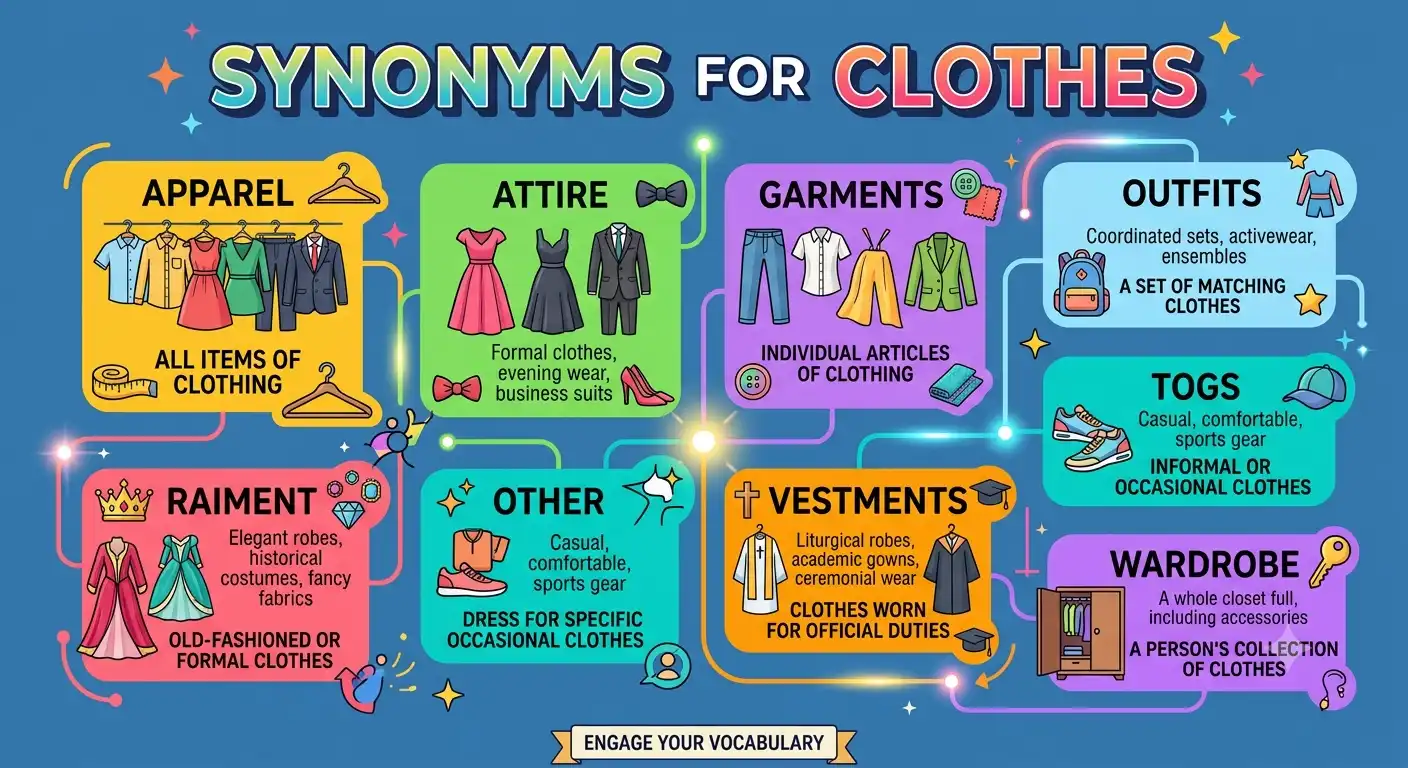
When you study synonyms for clothes, you gain the tools to write with style and precision. Learning synonyms for clothes helps you avoid repeating the same basic words over and over in your essays and stories. Exploring fresh synonyms for clothes allows you to describe everyday outfits, fancy dresses, or historic costumes with ease.
Imagine walking into a friend’s house on a rainy afternoon and seeing them dressed in oversized sweatpants and a thick knitted sweater. You could simply say they are wearing comfortable clothes. However, choosing a specific word like loungewear or threads paint a much clearer picture in the reader’s mind. Clothes are the items of fabric, wool, or synthetic material that human beings wear to cover their bodies, stay warm, and express their personal style.
Building a rich collection of words for daily garments helps many different people:
- Students can describe fictional characters and historical figures in school assignments.
- Bloggers can write vivid fashion reviews and lifestyle posts that capture attention.
- Content writers can craft engaging product descriptions for online stores.
- Daily English users can understand casual slang, idioms, and formal terms easily.
“Style is a way to say who you are without having to speak.” — Rachel Zoe
“Elegance is not standing out, but being remembered.” — Giorgio Armani
Linguistic Breakdown of “Clothes”
Connotative Meaning
The word clothes carries a neutral, practical connotation in everyday English. It refers directly to any items worn on the body without implying high fashion, extreme luxury, or rags, though specific synonyms can shift the tone to casual, formal, archaic, or humorous.
Etymology
- Old English: Derived from clāþ (meaning “a cloth, woven material, or sail”).
- Proto-Germanic: Related to kalbaz (meaning “something clumped or pressed together”).
- Historical Evolution: Pluralized in Middle English as clathes to mean garments made from woven cloth, eventually morphing into the modern collective noun clothes.
Pronunciation
- US IPA: /kloʊðz/ or /kloʊz/
- UK IPA: /kləʊðz/ or /kləʊz/
Syllables & Affixation Pattern
- Syllables: 1 (clothes)
- Prefix: None
- Root: cloth
- Suffix: -es (plural inflectional suffix)
Comparison Table of Key Synonyms
| Keyword | Meaning | Usage Type | Context |
|---|---|---|---|
| Apparel | Items worn to cover the human body | Formal / Commercial | Retail stores, business reports |
| Attire | Formal or specialized clothing | Formal / Elegant | Weddings, red-carpet events |
| Garments | Individual pieces of clothing | Descriptive / Neutral | Manufacturing, fashion design |
| Outfit | A full set of matching clothes | Casual / Daily | Social outings, school routines |
| Garb | Clothes distinct to a role or style | Descriptive / Literary | Costumes, historical roles |
| Threads | Casual or stylish clothing | Informal / Slang | Streetwear, youth conversations |
| Duds | Informal or old clothes | Casual / Playful | Relaxing at home, casual chats |
| Raiment | Fine or beautiful garments | Archaic / Literary | Poetry, historical fiction |
“Fashion is the armor to survive the reality of everyday life.” — Bill Cunningham
Main Content – 50 Synonyms for Clothes
1. Apparel
- Pronunciation: US: /əˈpær.əl/ | UK: /əˈpær.əl/
- Meaning: Items of clothing sold in stores or worn by people.
- Examples:
- The department store sells high-quality winter apparel.
- She bought new athletic apparel for her morning runs.
2. Attire
- Pronunciation: US: /əˈtaɪ.ɚ/ | UK: /əˈtaɪ.ər/
- Meaning: Clothes worn for a specific or formal occasion.
- Examples:
- Please wear formal attire to the wedding ceremony.
- His professional attire impressed everyone at the job interview.
3. Garments
- Pronunciation: US: /ˈɡɑːr.mənts/ | UK: /ˈɡɑː.mənts/
- Meaning: Individual items of clothing made from fabric.
- Examples:
- The tailor carefully stitched the silk garments.
- You should hang delicate garments on padded hangers.
4. Clothing
- Pronunciation: US: /ˈkloʊ.ðɪŋ/ | UK: /ˈkləʊ.ðɪŋ/
- Meaning: Things that people wear to cover their bodies.
- Examples:
- Warm clothing is essential during cold winter months.
- They donated boxes of clean clothing to the shelter.
5. Outfit
- Pronunciation: US: /ˈaʊt.fɪt/ | UK: /ˈaʊt.fɪt/
- Meaning: A set of clothes worn together for an event.
- Examples:
- She chose a bright outfit for her birthday party.
- He put on a warm outfit before going outside.
6. Garb
- Pronunciation: US: /ɡɑːrb/ | UK: /ɡɑːb/
- Meaning: Clothing associated with a particular style or job.
- Examples:
- The doctor wore clean medical garb in the clinic.
- Actors dressed in medieval garb walked onto the stage.
7. Raiment
- Pronunciation: US: /ˈreɪ.mənt/ | UK: /ˈreɪ.mənt/
- Meaning: Beautiful or fine clothes described in stories.
- Examples:
- The queen wore royal raiment woven with silver threads.
- The old poem described travelers in humble raiment.
8. Vestments
- Pronunciation: US: /ˈvest.mənts/ | UK: /ˈvest.mənts/
- Meaning: Special robes worn during religious ceremonies.
- Examples:
- The priest wore white vestments during the morning service.
- Traditional vestments were preserved in the church museum.
9. Threads
- Pronunciation: US: /θredz/ | UK: /θredz/
- Meaning: Stylish or casual clothes in modern slang.
- Examples:
- He showed off his cool new threads at school.
- You look great in those stylish threads.
10. Duds
- Pronunciation: US: /dʌdz/ | UK: /dʌdz/
- Meaning: Informal or comfortable daily clothes.
- Examples:
- He changed into his work duds after breakfast.
- Pack your casual duds for the weekend camping trip.
11. Togs
- Pronunciation: US: /tɑːɡz/ | UK: /tɒɡz/
- Meaning: Casual clothes or swimwear for outdoors.
- Examples:
- Grab your swimming togs before heading to the beach.
- She put on her running togs for a quick jog.
12. Getup
- Pronunciation: US: /ˈɡet.ʌp/ | UK: /ˈɡet.ʌp/
- Meaning: An unusual or striking combination of clothes.
- Examples:
- Everyone laughed at his funny party getup.
- Why are you wearing that strange getup today?
13. Rig
- Pronunciation: US: /rɪɡ/ | UK: /rɪɡ/
- Meaning: A special set of clothes for work or activity.
- Examples:
- The firefighter put on his heavy protective rig.
- She stepped out in her full hiking rig.
14. Costume
- Pronunciation: US: /ˈkɑːs.tuːm/ | UK: /ˈkɒs.tʃuːm/
- Meaning: Clothes worn to look like another person or character.
- Examples:
- My little brother wore a superhero costume to school.
- The theater group made detailed costumes for the play.
15. Wardrobe
- Pronunciation: US: /ˈwɔːrd.roʊb/ | UK: /ˈwɔː.drəʊb/
- Meaning: The entire collection of clothes that a person owns.
- Examples:
- She updated her winter wardrobe with new coats.
- His wardrobe contains mostly dark blue suits.
16. Vesture
- Pronunciation: US: /ˈves.tʃɚ/ | UK: /ˈves.tʃər/
- Meaning: An old word for covering clothes or robes.
- Examples:
- The ancient statue was covered in rich vesture.
- Historical figures were painted in ceremonial vesture.
17. Habit
- Pronunciation: US: /ˈhæb.ɪt/ | UK: /ˈhæb.ɪt/
- Meaning: A special tunic or dress worn by members of a religious group.
- Examples:
- The nun wore a simple black and white habit.
- Monks walked through the quiet gardens in traditional habits.
18. Array
- Pronunciation: US: /əˈreɪ/ | UK: /əˈreɪ/
- Meaning: An impressive or formal display of clothes.
- Examples:
- The royal family appeared in splendid array.
- She stood out in her colorful party array.
19. Trappings
- Pronunciation: US: /ˈtræp.ɪŋz/ | UK: /ˈtræp.ɪŋz/
- Meaning: Decorative clothes and accessories that show high status.
- Examples:
- He arrived with all the fancy trappings of wealth.
- The general wore the full trappings of his rank.
20. Dress
- Pronunciation: US: /dres/ | UK: /dres/
- Meaning: Clothing in general or a one-piece garment.
- Examples:
- Traditional dress varies across different countries.
- She picked out a bright blue dress for dinner.
21. Finery
- Pronunciation: US: /ˈfaɪ.nɚ.i/ | UK: /ˈfaɪ.nər.i/
- Meaning: Very fancy, elegant, or expensive clothes.
- Examples:
- Guests arrived at the ballroom in all their finery.
- She loved dressing up in her holiday finery.
22. Gear
- Pronunciation: US: /ɡɪr/ | UK: /ɡɪər/
- Meaning: Specialized clothes used for sport, work, or outdoor travel.
- Examples:
- Don’t forget your rainy weather gear today.
- He bought new safety gear for mountain climbing.
23. Glad Rags
- Pronunciation: US: /ɡlæd ræɡz/ | UK: /ɡlæd ræɡz/
- Meaning: Your best clothes worn for social celebrations.
- Examples:
- Put on your glad rags and let’s go dancing tonight!
- They dressed in their glad rags for the annual gala.
24. Ensemble
- Pronunciation: US: /ɑːnˈsɑːm.bəl/ | UK: /ɒnˈsɒm.bəl/
- Meaning: A complete, neatly matched set of clothes.
- Examples:
- Her stylish ensemble included a matching hat and shoes.
- He chose a simple black ensemble for the evening event.
25. Uniform
- Pronunciation: US: /ˈjuː.nə.fɔːrm/ | UK: /ˈjuː.nɪ.fɔːm/
- Meaning: Standard clothes worn by members of an organization.
- Examples:
- Students must wear a clean school uniform every day.
- The police officer looked sharp in his navy uniform.
26. Livery
- Pronunciation: US: /ˈlɪv.ɚ.i/ | UK: /ˈlɪv.ər.i/
- Meaning: Special uniform worn by servants or official staff.
- Examples:
- The palace guards stood tall in red livery.
- Hotel staff wore neat livery at the front entrance.
27. Robes
- Pronunciation: US: /roʊbz/ | UK: /rəʊbz/
- Meaning: Long, loose garments worn for comfort or ceremony.
- Examples:
- Graduates put on their dark robes before the ceremony.
- He relaxed at home in a soft bath robe.
28. Kit
- Pronunciation: US: /kɪt/ | UK: /kɪt/
- Meaning: A set of clothes for playing sports or working outdoors.
- Examples:
- The football players changed into their team kit.
- Keep a spare rain kit in your car trunk.
29. Turnout
- Pronunciation: US: /ˈtɝːn.aʊt/ | UK: /ˈtɜːn.aʊt/
- Meaning: The overall appearance of someone’s clothes and grooming.
- Examples:
- His clean turnout made a good impression on the manager.
- She took pride in her neat turnout every morning.
30. Wear
- Pronunciation: US: /wer/ | UK: /weər/
- Meaning: Clothes made for a specific purpose or season.
- Examples:
- The shop specializes in durable outdoor wear.
- Lightweight summer wear keeps you cool in July.
31. Activewear
- Pronunciation: US: /ˈæk.tɪv.wer/ | UK: /ˈæk.tɪv.weər/
- Meaning: Comfortable clothes designed for exercise and sports.
- Examples:
- She prefers stretchy activewear when doing yoga.
- Breathable activewear helps athletes stay dry during games.
32. Formalwear
- Pronunciation: US: /ˈfɔːr.məl.wer/ | UK: /ˈfɔː.məl.weər/
- Meaning: Elegant clothes worn for official celebrations or dinners.
- Examples:
- Renting formalwear is popular for prom nights.
- The dinner party required dark suits and formalwear.
33. Casualwear
- Pronunciation: US: /ˈkæʒ.u.əl.wer/ | UK: /ˈkæʒ.ju.əl.weər/
- Meaning: Relaxed clothes for daily personal use.
- Examples:
- Jeans and t-shirts are classic examples of casualwear.
- Our office allows employees to wear casualwear on Fridays.
34. Outerwear
- Pronunciation: US: /ˈaʊ.t̬ɚ.wer/ | UK: /ˈaʊ.tə.weər/
- Meaning: Heavy clothes worn over other items outdoors.
- Examples:
- Hang your coats and outerwear in the front hallway.
- Warm outerwear protects you from winter winds.
35. Sportswear
- Pronunciation: US: /ˈspɔːrts.wer/ | UK: /ˈspɔːts.weər/
- Meaning: Casual or athletic clothes designed for sports.
- Examples:
- He bought new sportswear for the tennis tournament.
- Modern sportswear is made from lightweight fabrics.
36. Loungewear
- Pronunciation: US: /ˈlaʊndʒ.wer/ | UK: /ˈlaʊndʒ.weər/
- Meaning: Soft, relaxed clothes worn for resting at home.
- Examples:
- She loves wearing cozy loungewear on Sunday mornings.
- Fleece pants are popular loungewear for winter days.
37. Sleepwear
- Pronunciation: US: /ˈsliːp.wer/ | UK: /ˈsliːp.weər/
- Meaning: Comfortable clothes made specifically for sleeping.
- Examples:
- Pack your warm sleepwear for the cabin trip.
- Children picked out matching cotton sleepwear.
38. Undergarments
- Pronunciation: US: /ˈʌn.dɚˌɡɑːr.mənts/ | UK: /ˈʌn.dəˌɡɑː.mənts/
- Meaning: Clothes worn next to the skin underneath other items.
- Examples:
- Pack extra undergarments for your long vacation.
- Soft cotton undergarments prevent skin irritation.
39. Habiliment
- Pronunciation: US: /həˈbɪl.ə.mənt/ | UK: /həˈbɪl.ɪ.mənt/
- Meaning: An old term for distinctive clothes or equipment.
- Examples:
- The knight was dressed in heavy iron habiliment.
- Old stories describe travelers in traveling habiliments.
40. Accoutrements
- Pronunciation: US: /əˈkuː.t̬ɚ.mənts/ | UK: /əˈkuː.trə.mənts/
- Meaning: Additional items of clothing and gear worn for a purpose.
- Examples:
- The hiker carried all necessary accoutrements in his pack.
- His official uniform came with shiny brass accoutrements.
41. Toggery
- Pronunciation: US: /ˈtɑː.ɡɚ.i/ | UK: /ˈtɒɡ.ər.i/
- Meaning: A playful or old-fashioned name for clothes.
- Examples:
- She packed her summer toggery into a big suitcase.
- The local shop sold fashionable winter toggery.
42. Regalia
- Pronunciation: US: /rɪˈɡeɪ.li.ə/ | UK: /rɪˈɡeɪ.li.ə/
- Meaning: Impressive traditional clothes worn for special ceremonies.
- Examples:
- Kings and queens stood in full ceremonial regalia.
- Graduates walked across the stage in academic regalia.
43. Workwear
- Pronunciation: US: /ˈwɝːk.wer/ | UK: /ˈwɜːk.weər/
- Meaning: Tough clothes designed for physical labor.
- Examples:
- Construction workers need heavy-duty workwear.
- Sturdy boots are an essential part of safety workwear.
44. Drapery
- Pronunciation: US: /ˈdreɪ.pɚ.i/ | UK: /ˈdreɪ.pər.i/
- Meaning: Fabric or long clothes hanging in graceful folds.
- Examples:
- The classical statue was carved with flowing drapery.
- She swept into the room in elegant silk drapery.
45. Attirement
- Pronunciation: US: /əˈtaɪ.ɚ.mənt/ | UK: /əˈtaɪ.ə.mənt/
- Meaning: An archaic term for clothes or decorative dress.
- Examples:
- Her glorious attirement amazed all guests at the ball.
- The prince appeared in majestic attirement.
46. Vestiary
- Pronunciation: US: /ˈves.ti.er.i/ | UK: /ˈves.ti.ər.i/
- Meaning: Relating to clothes or a place where clothes are kept.
- Examples:
- The theater added new vestiary collections for the season.
- He made small vestiary choices to look sharper at work.
47. Suit
- Pronunciation: US: /suːt/ | UK: /suːt/
- Meaning: A set of matching jacket and trousers or skirt.
- Examples:
- He wore a clean charcoal suit to his interview.
- She bought a comfortable wool suit for business trips.
48. Disguise
- Pronunciation: US: /dɪsˈɡaɪz/ | UK: /dɪsˈɡaɪz/
- Meaning: Clothes worn to hide a person’s true identity.
- Examples:
- The detective wore a clever disguise in public.
- His simple disguise made him look like a local tourist.
49. Vestment
- Pronunciation: US: /ˈvest.mənt/ | UK: /ˈvest.mənt/
- Meaning: An official garment or ceremonial robe.
- Examples:
- Each sacred vestment was embroidered with gold thread.
- The choir members put on their clean blue vestments.
50. Caparison
- Pronunciation: US: /kəˈpær.ə.sən/ | UK: /kəˈpær.ɪ.sən/
- Meaning: Rich decorative coverings or fancy clothing outfit.
- Examples:
- The parade horses were decorated in rich caparison.
- Knights appeared in bright caparison for the tournament.
Antonyms of “Clothes”
When you need to describe the complete absence of clothing or bare human skin, use these direct antonyms:
- Nudity: US: /ˈnuː.də.t̬i/ | UK: /ˈnjuː.də.ti/ – The state of wearing no clothes at all.
- Nakedness: US: /ˈneɪ.kɪd.nəs/ | UK: /ˈneɪ.kɪd.nəs/ – The condition of being completely uncovered or exposed.
- Bareness: US: /ˈber.nəs/ | UK: /ˈbeə.nəs/ – The quality of having no outer covering or protective layer.
- Undress: US: /ʌnˈdres/ | UK: /ʌnˈdres/ – The state of being partially or fully unclothed.
Prototype Meaning and Categorization of “Clothes”
- Grammatical Category: Plural Noun (Uncountable / Collective Noun).
- Prototype Meaning: Manufactured fabric items designed to cover, protect, and decorate the human body.
- Semantic Field: Fashion, human culture, textile manufacturing, daily self-care, personal style, and identity.
Frequently Asked Questions (FAQ)
1. What is the most common formal synonym for clothes?
The most common formal synonyms for clothes are apparel and attire. You will frequently find apparel in business and retail contexts, while attire is used for event dress codes such as “business formal attire.”
2. Can I use words like “threads” or “duds” in school essays?
Words like threads and duds are casual modern slang. It is best to avoid them in formal academic essays. Instead, use terms like garments, apparel, or clothing.
3. What is the difference between an outfit and an ensemble?
An outfit refers to any set of clothes worn together. An ensemble implies a carefully coordinated, stylish set of matching garments and accessories curated for a complete visual effect.
4. Which synonym for clothes works best in creative storytelling?
In fiction and narrative writing, descriptive synonyms like garb, raiment, finery, or attire create rich imagery and help establish a story’s era, mood, and setting.
5. Why is “clothes” only used as a plural word?
The word clothes is a plurale tantum noun, meaning it exists only in the plural form. To refer to a single item, English speakers use singular words like garment, item of clothing, or specific names like shirt or pants.
6. How does learning different synonyms for clothes benefit non-native English speakers?
Mastering varied synonyms for clothes allows non-native speakers to understand nuanced dress codes, read classic literature easily, follow modern fashion trends, and express themselves naturally in diverse social situations.
Conclusion
Expanding your English vocabulary with varied synonyms for clothes gives you precise control over your speech and writing. Instead of relying on the word clothes every time, choosing terms like attire, apparel, garments, or threads adds color, accuracy, and tone to your sentences. Understanding these words ensures you pick the perfect expression for formal essays, fashion blogs, or casual daily chats.
Consistent practice is key to making these new terms feel natural. Try incorporating words like ensemble, wardrobe, or garb into your daily emails, creative journals, and spoken practice. Over time, your language skills will become richer, clearer, and far more engaging to everyone who reads or listens to your words.
“Create your own visual style… let it be unique for yourself and yet identifiable for others.” — Orson Welles
“Words create sentences; sentences create paragraphs; sometimes sentences quicken and breathe.” — Stephen King

Andrew Collins is an academic English educator with over 12 years of experience helping university students, IELTS candidates, and ESL learners improve their writing vocabulary.