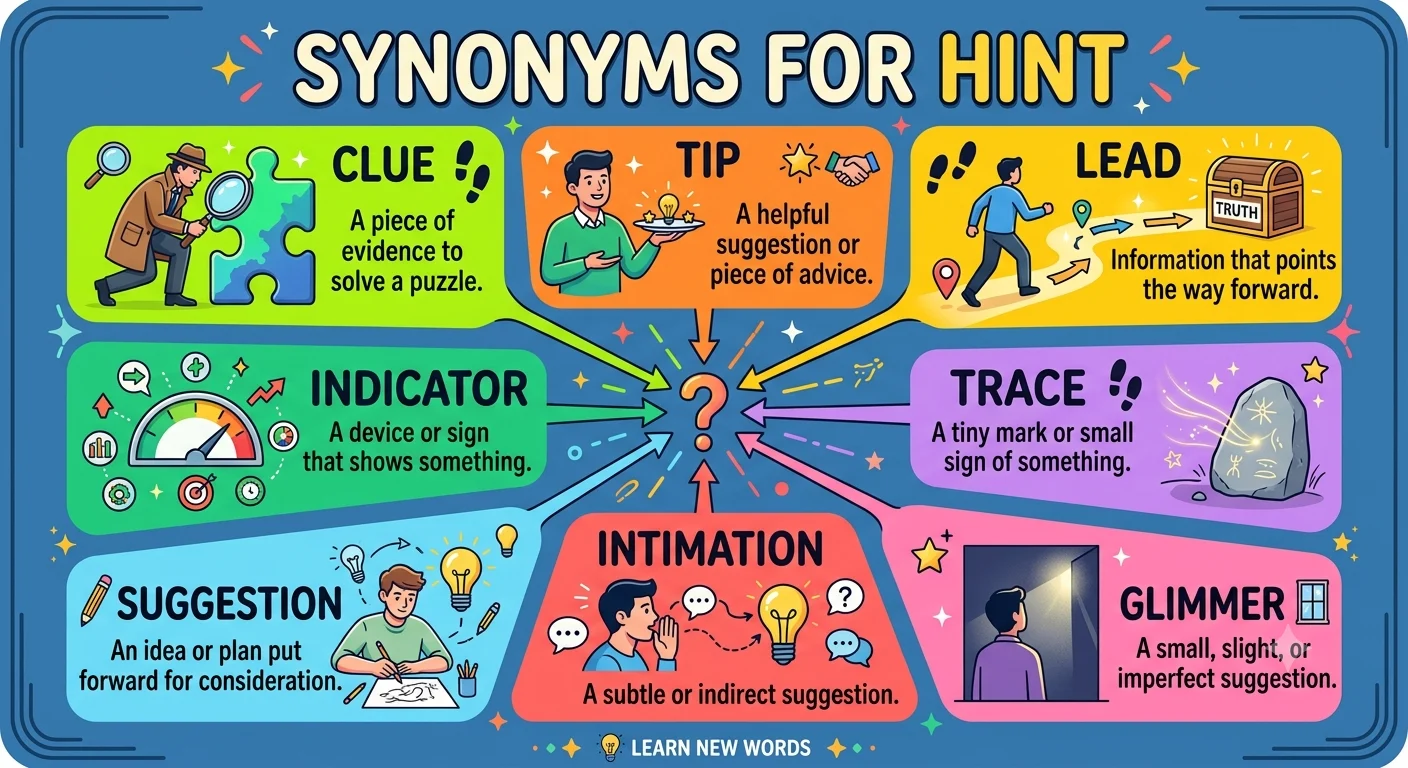
Finding the right synonyms for hint allows you to describe subtle clues, indirect comments, and tiny amounts with exact clarity. When you explore different synonyms for hint, you can avoid repeating the same basic words across your articles, essays, and everyday conversations. Learning these versatile synonyms for hint helps you communicate subtle thoughts, gentle warnings, and hidden signals effortlessly.
Picture sitting at a dinner table while your friend glances quietly toward the clock. They do not say they want to leave, but their subtle eye movement gives you a clear signal. That tiny gesture is a classic hint. In everyday life, someone might drop a soft comment about a gift they want without directly asking for it.
In simple words, a hint is a small clue or indirect signal that points to a hidden idea or fact. It helps people guess what is true without saying everything out loud.
Mastering this word helps many types of communicators:
- Students can explain hidden literary themes and character motives clearly.
- Bloggers can write engaging stories and smooth transitions.
- Content writers can craft persuasive headlines and subtle calls to action.
- Daily English users can express gentle suggestions and read social signals naturally.
“The art of art, the glory of expression and the sunshine of the light of letters, is simplicity.” — Walt Whitman
“Words are a lens to focus one’s mind.” — Ayn Rand
Linguistic Breakdown of Hint
Connotative Meaning
The word hint carries a generally neutral to helpful connotation. It refers to a gentle piece of guidance or a subtle clue meant to assist someone without giving away the full answer. In social contexts, it can occasionally imply mild secrecy or passive communication, but it rarely carries a negative tone.
Etymology
- Old English Root: Related to the Old English word hentan (meaning “to grasp” or “to catch hold of”).
- Middle English Shift: Evolved into hynt (meaning “a catch” or “an opportunity”).
- 17th Century Meaning: Developed its modern sense of “a slight mention” or “an indirect suggestion” in the 1600s.
Pronunciation
- US IPA: /hɪnt/
- UK IPA: /hɪnt/
Syllables & Affixation Pattern
- Syllables: 1 (hint)
- Prefix: None
- Root: hint
- Suffix: None
Comparison Table of Key Synonyms
| Keyword | Meaning | Usage Type | Context |
|---|---|---|---|
| Hint | A small indirect sign or piece of advice | Neutral / Casual | Everyday talk, puzzles, subtle advice |
| Clue | A piece of evidence that helps solve a mystery | Neutral / Informative | Games, investigations, problem-solving |
| Tip | A quick, practical piece of advice | Casual / Helpful | Workplace, study habits, sports |
| Pointer | A useful advice note or helpful direction | Casual / Professional | Mentorship, guides, daily tasks |
| Insinuation | An indirect mark that usually suggests something negative | Formal / Critical | Arguments, drama, political talk |
| Trace | A very small amount left behind | Technical / Descriptive | Science, cooking, searching |
| Intimation | A formal or subtle announcement of something | Formal / Literary | Writing, business news, poetry |
| Inkling | A slight idea or vague feeling about a fact | Conversational | Personal thoughts, quiet surprises |
“Good words are worth much, and cost little.” — George Herbert
Main Content – 50 Synonyms for Hint
1. Clue
- Pronunciation: US: /kluː/ | UK: /kluː/
- Meaning: A small piece of information that helps solve a secret or problem.
- Examples:
- The detective found a tiny clue near the door.
- She gave me a clear clue about her birthday gift.
2. Tip
- Pronunciation: US: /tɪp/ | UK: /tɪp/
- Meaning: A short piece of helpful advice.
- Examples:
- My teacher gave me a helpful tip for the test.
- He shared a useful tip on how to plant seeds.
3. Pointer
- Pronunciation: US: /ˈpɔɪn.t̬ɚ/ | UK: /ˈpɔɪn.tər/
- Meaning: A simple direction or useful piece of advice.
- Examples:
- The coach gave us a quick pointer before the game.
- Thanks for the pointer on fixing my bike.
4. Signal
- Pronunciation: US: /ˈsɪɡ.nəl/ | UK: /ˈsɪɡ.nəl/
- Meaning: An action or light that tells someone to do something.
- Examples:
- A green light is a clear signal to go.
- Her smile was a positive signal to start talking.
5. Cue
- Pronunciation: US: /kjuː/ | UK: /kjuː/
- Meaning: A word or action that tells an actor or person to start.
- Examples:
- The music was his cue to walk onto the stage.
- Nodding your head is a cue that you agree.
6. Trace
- Pronunciation: US: /treɪs/ | UK: /treɪs/
- Meaning: A very small mark or amount of something.
- Examples:
- There was a trace of sugar in the warm tea.
- She spoke without a trace of fear in her voice.
7. Inkling
- Pronunciation: US: /ˈɪŋk.lɪŋ/ | UK: /ˈɪŋk.lɪŋ/
- Meaning: A slight idea or small feeling about something happening.
- Examples:
- I had an inkling that we would win today.
- He gave no inkling of his secret plans.
8. Indication
- Pronunciation: US: /ˌɪn.dəˈkeɪ.ʃən/ | UK: /ˌɪn.dɪˈkeɪ.ʃən/
- Meaning: A sign that shows what is clear or true.
- Examples:
- Dark clouds are a clear indication of rain.
- His tone was a strong indication of his joy.
9. Intimation
- Pronunciation: US: /ˌɪn.təˈmeɪ.ʃən/ | UK: /ˌɪn.tɪˈmeɪ.ʃən/
- Meaning: A quiet or formal hint about a fact.
- Examples:
- She received an intimation about her new job.
- He gave an intimation that he would leave soon.
10. Suggestion
- Pronunciation: US: /səɡˈdʒes.tʃən/ | UK: /səˈdʒes.tʃən/
- Meaning: An idea put forward for someone to consider.
- Examples:
- I like your suggestion for lunch today.
- She made a gentle suggestion to rest.
11. Insinuation
- Pronunciation: US: /ɪnˌsɪn.juˈeɪ.ʃən/ | UK: /ɪnˌsɪn.juˈeɪ.ʃən/
- Meaning: An indirect remark that points to something unpleasant.
- Examples:
- I did not like his rude insinuation about my work.
- Her speech contained an insinuation of doubt.
12. Allusion
- Pronunciation: US: /əˈluː.ʒən/ | UK: /əˈluː.ʒən/
- Meaning: A quick or indirect mention of a story or person.
- Examples:
- The book made an allusion to an old myth.
- His comment was an allusion to our past trip.
13. Whisper
- Pronunciation: US: /ˈwɪs.pɚ/ | UK: /ˈwɪs.pər/
- Meaning: A soft words spoken quietly or a tiny rumor.
- Examples:
- A soft whisper told us the secret news.
- There was a whisper of wind in the trees.
14. Touch
- Pronunciation: US: /tʌtʃ/ | UK: /tʌtʃ/
- Meaning: A very small amount of a detail or feeling.
- Examples:
- Add a touch of salt to the soup.
- Her bedroom has a touch of blue paint.
15. Dash
- Pronunciation: US: /dæʃ/ | UK: /dæʃ/
- Meaning: A fast movement or a tiny drop of food seasoning.
- Examples:
- Put a dash of pepper on the warm eggs.
- He added a dash of humor to his talk.
16. Smattering
- Pronunciation: US: /ˈsmæt̬.ɚ.ɪŋ/ | UK: /ˈsmæt.ər.ɪŋ/
- Meaning: A small and scattered amount of knowledge or things.
- Examples:
- He knows a smattering of French words.
- A smattering of rain hit the roof.
17. Shade
- Pronunciation: US: /ʃeɪd/ | UK: /ʃeɪd/
- Meaning: A dark area away from light or a tiny change in color.
- Examples:
- She wore a light shade of green today.
- His words had a shade of doubt in them.
18. Implication
- Pronunciation: US: /ˌɪm.pləˈkeɪ.ʃən/ | UK: /ˌɪm.plɪˈkeɪ.ʃən/
- Meaning: An unsaid meaning that people can guess easily.
- Examples:
- The implication was that we needed to leave.
- She understood the deep implication of his choice.
19. Glimmer
- Pronunciation: US: /ˈɡlɪm.ɚ/ | UK: /ˈɡlɪm.ər/
- Meaning: A small, faint light or a tiny bit of hope.
- Examples:
- We saw a glimmer of hope in the news.
- A glimmer of light shone through the glass.
20. Sign
- Pronunciation: US: /saɪn/ | UK: /saɪn/
- Meaning: A board, gesture, or mark that shows information.
- Examples:
- A stop sign stands at the corner.
- Yawning is a sign that you are tired.
21. Suggestive remark
- Pronunciation: US: /səɡˈdʒes.tɪv rɪˈmɑːrk/ | UK: /səˈdʒes.tɪv rɪˈmɑːk/
- Meaning: A comment that leads someone to think of an unsaid idea.
- Examples:
- He made a suggestive remark about the surprise party.
- Her suggestive remark made everyone laugh quietly.
22. Streak
- Pronunciation: US: /striːk/ | UK: /striːk/
- Meaning: A long thin line or a small part of a personality.
- Examples:
- A streak of light crossed the dark sky.
- He has a wild streak in his character.
23. Tinge
- Pronunciation: US: /tɪndʒ/ | UK: /tɪndʒ/
- Meaning: A tiny trace of color or a small feeling.
- Examples:
- Her cheeks had a pink tinge from the cold.
- His letter had a tinge of sadness in it.
24. Wink
- Pronunciation: US: /wɪŋk/ | UK: /wɪŋk/
- Meaning: Closing one eye quickly as a secret signal.
- Examples:
- He gave me a sly wink across the room.
- A friendly wink showed that he was joking.
25. Nod
- Pronunciation: US: /nɑːd/ | UK: /nɒd/
- Meaning: Moving your head down and up as a sign.
- Examples:
- She gave a quick nod to show approval.
- A silent nod signaled the start of the test.
26. Whispered word
- Pronunciation: US: /ˈwɪs.pɚd wɝːd/ | UK: /ˈwɪs.pəd wɜːd/
- Meaning: A quiet comment meant to guide someone secretly.
- Examples:
- A whispered word saved him from a mistake.
- Her whispered word gave me great courage.
27. Lead
- Pronunciation: US: /liːd/ | UK: /liːd/
- Meaning: Information that helps a person find a path or answer.
- Examples:
- The detective followed a new lead today.
- That tip proved to be a good lead.
28. Symptom
- Pronunciation: US: /ˈsɪmp.təm/ | UK: /ˈsɪmp.təm/
- Meaning: A sign of illness or a signal that a problem exists.
- Examples:
- A cough is a common symptom of a cold.
- High prices are a symptom of bad market news.
29. Premonition
- Pronunciation: US: /ˌprɪː.məˈnɪʃ.ən/ | UK: /ˌprem.əˈnɪʃ.ən/
- Meaning: A strong feeling that something is about to happen.
- Examples:
- She had a premonition that rain would fall.
- His premonition saved them from a bad trip.
30. Suspicion
- Pronunciation: US: /səˈspɪʃ.ən/ | UK: /səˈspɪʃ.ən/
- Meaning: A belief or feeling that something is true without clear proof.
- Examples:
- I have a strong suspicion that he is right.
- Her suspicion grew as he stayed silent.
31. Omen
- Pronunciation: US: /ˈoʊ.mən/ | UK: /ˈəʊ.mən/
- Meaning: An event or sign believed to predict the future.
- Examples:
- Seeing a rainbow was seen as a good omen.
- The sudden storm felt like a dark omen.
32. Token
- Pronunciation: US: /ˈtoʊ.kən/ | UK: /ˈtəʊ.kən/
- Meaning: An object or sign that shows a feeling or fact.
- Examples:
- He gave her flowers as a token of thanks.
- This gift is a token of our strong friendship.
33. Evidence
- Pronunciation: US: /ˈev.ə.dəns/ | UK: /ˈev.ɪ.dəns/
- Meaning: Facts or signs that prove something is true.
- Examples:
- Footprints in snow were evidence of a visitor.
- Scientists gathered strong evidence for the claim.
34. Mark
- Pronunciation: US: /mɑːrk/ | UK: /mɑːk/
- Meaning: A visible spot or sign that points to something.
- Examples:
- Mud left a brown mark on the floor.
- Her bright smile was a mark of true joy.
35. Proof
- Pronunciation: US: /pruːf/ | UK: /pruːf/
- Meaning: Information that shows a fact is definitely true.
- Examples:
- He showed his photo ID as proof of age.
- Winning the trophy was proof of their skill.
36. Manifestation
- Pronunciation: US: /ˌmæn.ə.fesˈteɪ.ʃən/ | UK: /ˌmæn.ɪ.fesˈteɪ.ʃən/
- Meaning: A clear sign that shows an idea or feeling physically.
- Examples:
- Trembling hands were a manifestation of fear.
- The art show was a manifestation of her talent.
37. Ray
- Pronunciation: US: /reɪ/ | UK: /reɪ/
- Meaning: A line of light or a small piece of good hope.
- Examples:
- A warm ray of sun warmed the cold room.
- Her sweet words brought a ray of comfort.
38. Speck
- Pronunciation: US: /spek/ | UK: /spek/
- Meaning: A tiny spot or very small piece of something.
- Examples:
- A tiny speck of dust landed on the desk.
- There was not a speck of truth in that rumor.
39. Drop
- Pronunciation: US: /drɑːp/ | UK: /drɒp/
- Meaning: A tiny round piece of liquid or a small amount.
- Examples:
- A single drop of rain hit his cheek.
- Add a drop of oil to the squeaky door.
40. Bit
- Pronunciation: US: /bɪt/ | UK: /bɪt/
- Meaning: A small piece or short amount of time.
- Examples:
- Wait a bit while I get my coat.
- She saved every bit of useful data.
41. Particle
- Pronunciation: US: /ˈpɑːr.t̬ə.kəl/ | UK: /ˈpɑː.tɪ.kəl/
- Meaning: An extremely tiny piece of matter or truth.
- Examples:
- A particle of dirt got into his eye.
- There was not a particle of doubt left.
42. Whiff
- Pronunciation: US: /wɪf/ | UK: /wɪf/
- Meaning: A brief smell or tiny sign of something present.
- Examples:
- I caught a whiff of sweet flower perfume.
- A whiff of trouble made him step back.
43. Shadow
- Pronunciation: US: /ˈʃæd.oʊ/ | UK: /ˈʃæd.əʊ/
- Meaning: A dark shape on a surface or a tiny trace.
- Examples:
- The tree cast a long shadow on the grass.
- He spoke without a shadow of hesitation.
44. Print
- Pronunciation: US: /prɪnt/ | UK: /prɪnt/
- Meaning: A mark left on a surface by a shoe or finger.
- Examples:
- The cat left a wet print on the rug.
- They checked the glass for a finger print.
45. Impression
- Pronunciation: US: /ɪmˈpreʃ.ən/ | UK: /ɪmˈpreʃ.ən/
- Meaning: An idea or feeling made on your mind by something.
- Examples:
- The house made a lasting impression on us.
- I had the impression that she was happy.
46. Reminder
- Pronunciation: US: /rɪˈmaɪn.dɚ/ | UK: /rɪˈmaɪn.dər/
- Meaning: Something that helps you remember a fact or task.
- Examples:
- A note on the desk served as a reminder.
- The chime was a gentle reminder to rest.
47. Prompt
- Pronunciation: US: /prɑːmpt/ | UK: /prɒmpt/
- Meaning: A sign or word that reminds someone what to say or do.
- Examples:
- The teacher gave a helpful writing prompt.
- A quick prompt helped him remember his speech.
48. Innuendo
- Pronunciation: US: /ˌɪn.juˈen.doʊ/ | UK: /ˌɪn.juˈen.dəʊ/
- Meaning: An indirect remark that suggests something inappropriate.
- Examples:
- His comment was full of silly innuendo.
- She ignored the rude innuendo and kept working.
49. Admonition
- Pronunciation: US: /ˌæd.məˈnɪʃ.ən/ | UK: /ˌæd.məˈnɪʃ.ən/
- Meaning: A soft warning or gentle advice about behavior.
- Examples:
- He listened to his mother’s gentle admonition.
- The guard issued a quiet admonition to be safe.
50. Intimating note
- Pronunciation: US: /ˈɪn.tə.meɪ.t̬ɪŋ noʊt/ | UK: /ˈɪn.tɪ.meɪ.tɪŋ nəʊt/
- Meaning: A brief written message that suggests a secret fact.
- Examples:
- She left an intimating note on his desk.
- An intimating note alerted us to the change.
Antonyms of Hint
Understanding words that mean the opposite of hint helps you describe open facts and direct statements clearly:
- Declaration: US: /ˌdek.ləˈreɪ.ʃən/ | UK: /ˌdek.ləˈreɪ.ʃən/ – A clear, formal statement made out loud.
- Assertion: US: /əˈsɝː.ʃən/ | UK: /əˈsɜː.ʃən/ – A confident and direct claim of fact.
- Directness: US: /dəˈrekt.nəs/ | UK: /daɪˈrekt.nəs/ – Speaking openly without hiding any details.
- Explication: US: /ˌek.spləˈkeɪ.ʃən/ | UK: /ˌek.splɪˈkeɪ.ʃən/ – A full and clear explanation of an idea.
- Certainty: US: /ˈsɝː.tən.ti/ | UK: /ˈsɜː.tən.ti/ – Something that is completely known without any doubt.
Prototype Meaning and Categorization of Hint
- Grammatical Category: Noun / Verb.
- Prototype Meaning: A subtle signal, indirect clue, or minor trace meant to guide perception without full disclosure.
- Semantic Field: Communication, problem-solving, psychology, social cues, and linguistics.
Frequently Asked Questions (FAQ)
1. What is the most common synonym for hint?
The most common everyday synonym for hint is clue, tip, or pointer, depending on whether you are solving a mystery or asking for quick advice.
2. Can a hint be used as a verb?
Yes, hint functions as both a noun and a verb. For example, as a verb: “She hinted that a surprise was coming soon.”
3. What is the main difference between “hint” and “clue”?
A hint is usually an intentional signal dropped by a person to help someone guess an answer. A clue can be any physical object or piece of evidence left behind, whether intended or not.
4. How do I use “hint” to describe a tiny amount?
In descriptive writing, you can use hint to mean a tiny trace, such as “a hint of vanilla in the cake” or “a hint of red in the evening sky.”
5. Is “innuendo” always a synonym for hint?
While innuendo refers to an indirect statement like a hint, it specifically carries a negative or critical tone, whereas hint is generally neutral or helpful.
6. Why should writers learn synonyms for hint?
Using varied synonyms prevents repetitive writing, clarifies whether a signal is helpful or critical, and keeps prose interesting for readers.
Conclusion
Expanding your vocabulary with these synonyms for hint gives you precise tools to elevate your writing, blogging, public speaking, and daily communication. Instead of relying on the same simple words, choosing distinct terms like clue, pointer, inkling, or intimation lets you capture exact feelings and situations. Rich word choices build clear mental images, make your stories engaging, and give your communication professional polish.
Try weaving these terms into your daily routines. Use descriptive synonyms in your next work email, incorporate precise vocabulary into your essays, or experiment with subtle expressions in everyday conversations with friends. Small refinements in your language build lasting confidence and help your ideas shine.
“Language is the dress of thought.” — Samuel Johnson
“Words are, in my not-so-humble opinion, our most inexhaustible source of magic.” — J.K. Rowling

Andrew Collins is an academic English educator with over 12 years of experience helping university students, IELTS candidates, and ESL learners improve their writing vocabulary.