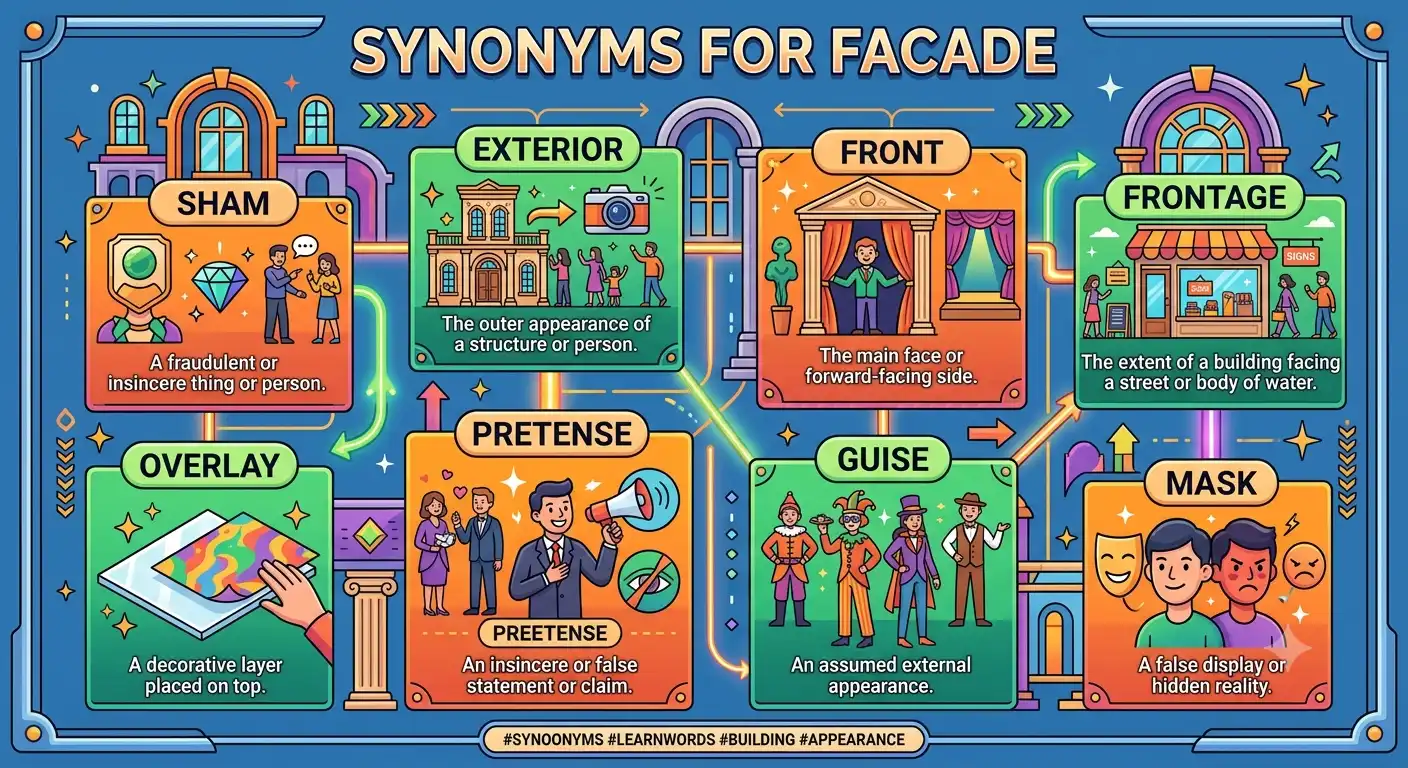
Understanding the best synonyms for facade helps you describe outer appearances, false fronts, and architected surfaces with precision. When you learn different synonyms for facade, you can avoid repeating the exact same word across your articles and essays. Exploring these synonyms for facade gives you the vocabulary needed to depict both physical structures and hidden human emotions clearly.
Imagine walking down a bustling downtown street lined with grand, glass-covered skyscrapers. From the sidewalk, every building looks bright, expensive, and indestructible. But if you step down the alley behind one, you might see cracked brick, rust, and old pipes. That polished glass wall on the street is a classic facade. In daily life, someone might wear a big smile at a party while feeling sad inside, hiding behind a personal facade.
In simple words, a facade is the front of a building or an outer appearance that hides what is real on the inside. It is a surface look that keeps the truth out of sight.
Mastering this concept helps many types of writers:
- Students can analyze literature, theater, and character motives with deeper vocabulary.
- Bloggers can describe people, places, and trends with fresh language.
- Content writers can craft engaging stories and descriptive product reviews.
- Daily English users can talk about social situations and clear observations naturally.
“Everything we see is a shadow cast by that which we do not see.” — Martin Luther King Jr.
“We all wear masks, and the time comes when we cannot remove them without removing some of our own skin.” — André Berthiaume
Linguistic Breakdown of Facade
Connotative Meaning
The word facade carries two main connotations. In architecture, it is neutral and descriptive, referring to the front face of a building. In human behavior, it carries a slightly negative or deceptive connotation, implying a fake exterior designed to hide real thoughts, weaknesses, or defects.
Etymology
- French Origin: Borrowed from the French word façade (meaning “frontage” or “face”).
- Italian Root: Derived from the Italian word facciata, which stems from faccia (meaning “face”).
- Latin Basis: Traced back to the Vulgar Latin facia and Classical Latin facies (meaning “appearance” or “form”).
- 17th Century Adoption: Entered the English language in the 1600s as an architectural term before taking on figurative meanings.
Pronunciation
- US IPA: /fəˈsɑːd/
- UK IPA: /fəˈsɑːd/
Syllables & Affixation Pattern
- Syllables: 2 (fa-cade)
- Prefix: None
- Root: face / faccia (meaning “face” or “surface”)
- Suffix: -ade (noun suffix indicating an action, process, or structural feature)
Comparison Table of Key Synonyms
“Words have no power to impress the mind without the exquisite horror of their reality.” — Edgar Allan Poe
| Keyword | Meaning | Usage Type | Context |
|---|---|---|---|
| Facade | The front of a building or a false outer look | Neutral / Descriptive | Architecture, human personality |
| Veneer | A thin outer layer that hides a plain interior | Formal / Critical | Furniture design, surface behavior |
| Mask | A cover worn over the face or true feelings | Common / Casual | Costumes, emotional defense |
| Pretense | An attempt to make something fake seem real | Formal / Analytical | Relationships, drama, politics |
| Exterior | The outside part or surface of something | Neutral / Technical | Buildings, objects, physical traits |
| Disguise | Appearance changed to hide true identity | Conversational | Costumes, crime stories, secrecy |
| Front | An outward look used to hide true intentions | Casual / Professional | Business, social confidence |
| Guise | An external form or style that misleads | Formal / Literary | Storytelling, deceitful motives |
Main Content – 50 Synonyms for Facade
1. Front
- Pronunciation: US: /frʌnt/ | UK: /frʌnt/
- Meaning: The outer surface or false behavior used to hide something.
- Examples:
- He put up a brave front during the hard test.
- The shop was just a front for their quiet operation.
2. Exterior
- Pronunciation: US: /ɪkˈstɪr.i.ɚ/ | UK: /ɪkˈstɪə.ri.ər/
- Meaning: The outside part or surface of a structure or person.
- Examples:
- The store has a clean stone exterior.
- She has a tough exterior, but she is very kind.
3. Mask
- Pronunciation: US: /mæsk/ | UK: /mɑːsk/
- Meaning: Something that covers or hides your real feelings or face.
- Examples:
- His polite smile was a mask for his anger.
- She wore a fake mask of calm during the storm.
4. Veneer
- Pronunciation: US: /vəˈnɪr/ | UK: /vəˈnɪər/
- Meaning: A thin outer layer that covers the real material inside.
- Examples:
- The desk has a thin wood veneer over cheap board.
- Her calm tone was just a thin veneer over panic.
5. Disguise
- Pronunciation: US: /dɪsˈɡaɪz/ | UK: /dɪsˈɡaɪz/
- Meaning: Clothes or a look that hides who you really are.
- Examples:
- The actor wore a clever disguise on the street.
- He spoke with a fake voice as a disguise.
6. Pretense
- Pronunciation: US: /ˈpriː.tens/ | UK: /prɪˈtens/
- Meaning: Acting in a way that makes something false seem true.
- Examples:
- She dropped all pretense and told the truth.
- Their friendship was a complete pretense.
7. Cover
- Pronunciation: US: /ˈkʌv.ɚ/ | UK: /ˈkʌv.ər/
- Meaning: Something that hides or protects what is underneath.
- Examples:
- Snow provided a thick cover for the garden.
- Loud music served as a cover for their secret meeting.
8. Illusion
- Pronunciation: US: /ɪˈluː.ʒən/ | UK: /ɪˈluː.ʒən/
- Meaning: Something that looks real but is actually fake.
- Examples:
- The trick created an illusion of floating water.
- His confidence was only an illusion.
9. Show
- Pronunciation: US: /ʃoʊ/ | UK: /ʃəʊ/
- Meaning: An outward display meant to attract attention or trick people.
- Examples:
- They put on a big show of being helpful.
- Don’t be fooled by his fancy show.
10. Guise
- Pronunciation: US: /ɡaɪz/ | UK: /ɡaɪz/
- Meaning: An outward look that hides the true nature of something.
- Examples:
- He visited the building under the guise of an inspector.
- The wolf approached in the guise of a sheep.
11. Screen
- Pronunciation: US: /skriːn/ | UK: /skriːn/
- Meaning: Something that blocks sight or protects a secret.
- Examples:
- Smoke created a thick screen in front of the team.
- He used busy work as a screen for his mistakes.
12. Visage
- Pronunciation: US: /ˈvɪz.ɪdʒ/ | UK: /ˈvɪz.ɪdʒ/
- Meaning: The face or outward appearance of a person.
- Examples:
- The old man had a stern visage.
- Her smiling visage brightened the entire room.
13. Face
- Pronunciation: US: /feɪs/ | UK: /feɪs/
- Meaning: The front surface of a head or building.
- Examples:
- The clock face was lit up at night.
- He tried to put on a happy face for his kids.
14. Masquerade
- Pronunciation: US: /ˌmæs.kəˈreɪd/ | UK: /ˌmæs.kərˈeɪd/
- Meaning: A fake appearance or false pretenses.
- Examples:
- Their whole marriage was a tragic masquerade.
- He could not keep up the masquerade any longer.
15. Camouflage
- Pronunciation: US: /ˈkæm.ə.flɑːʒ/ | UK: /ˈkæm.ə.flɑːʒ/
- Meaning: Colors or covers that hide something in plain sight.
- Examples:
- The green coat served as camouflage in the woods.
- Anger is often camouflage for deep sorrow.
16. Blind
- Pronunciation: US: /blaɪnd/ | UK: /blaɪnd/
- Meaning: Something built to hide secret activity behind it.
- Examples:
- The small store was a blind for an illegal club.
- Hunters built a blind out of tree branches.
17. Surface
- Pronunciation: US: /ˈsɝː.fɪs/ | UK: /ˈsɜː.fɪs/
- Meaning: The top or outside layer of anything.
- Examples:
- Water droplets sat on the smooth metal surface.
- On the surface, the plan looks very easy.
18. False front
- Pronunciation: US: /fɑːls frʌnt/ | UK: /fɒls frʌnt/
- Meaning: A wall or attitude built to look larger or better than it is.
- Examples:
- Old western towns often had buildings with a false front.
- His sweet words were just a false front.
19. Outer shell
- Pronunciation: US: /ˈaʊ.t̬ɚ ʃel/ | UK: /ˈaʊ.tər ʃel/
- Meaning: The hard or visible outside part of an object.
- Examples:
- The turtle retreated inside its outer shell.
- He dropped his tough outer shell around close friends.
20. Window dressing
- Pronunciation: US: /ˈwɪn.doʊ ˌdres.ɪŋ/ | UK: /ˈwɪn.dəʊ ˌdres.ɪŋ/
- Meaning: Features added to make something look better than it really is.
- Examples:
- The low price was just sales window dressing.
- Their promises were empty window dressing.
21. Cloak
- Pronunciation: US: /kloʊk/ | UK: /kləʊk/
- Meaning: A cover that hides or protects a secret.
- Examples:
- Darkness provided a cloak for their escape.
- She wore a cloak of silence after the news.
22. Smokescreen
- Pronunciation: US: /ˈsmoʊk.skriːn/ | UK: /ˈsməʊk.skriːn/
- Meaning: An action designed to distract people from the truth.
- Examples:
- The loud speech was a smokescreen to hide bad news.
- He raised fake issues as a clever smokescreen.
23. Falsehood
- Pronunciation: US: /ˈfɑːls.hʊd/ | UK: /ˈfɒls.hʊd/
- Meaning: A state of being untrue or deceptive.
- Examples:
- The story was built on a complete falsehood.
- He saw right through her gentle falsehood.
24. Pose
- Pronunciation: US: /poʊz/ | UK: /pəʊz/
- Meaning: A fake posture or behavior meant to trick others.
- Examples:
- His strict attitude was just a pose.
- She took on a calm pose during the interview.
25. Affectation
- Pronunciation: US: /ˌæf.ekˈteɪ.ʃən/ | UK: /ˌæf.ekˈteɪ.ʃən/
- Meaning: Fake behavior adopted to impress other people.
- Examples:
- His fancy accent was a silly affectation.
- She spoke without any affectation or pride.
26. Display
- Pronunciation: US: /dɪˈspleɪ/ | UK: /dɪˈspleɪ/
- Meaning: An arrangement intended to be seen by others.
- Examples:
- The store built a colorful shoe display.
- His sad look was an intentional public display.
27. Frontage
- Pronunciation: US: /ˈfrʌn.t̬ɪdʒ/ | UK: /ˈfrʌn.tɪdʒ/
- Meaning: The front edge or side of a building or piece of land.
- Examples:
- The hotel has a wide beach frontage.
- The shop frontage was painted bright blue.
28. Veil
- Pronunciation: US: /veɪl/ | UK: /veɪl/
- Meaning: A thin fabric or cover that hides what is behind it.
- Examples:
- Fog hung like a heavy veil over the lake.
- She hid her anger behind a thin veil of polite words.
29. Simulation
- Pronunciation: US: /ˌsɪm.jəˈleɪ.ʃən/ | UK: /ˌsɪm.jəˈleɪ.ʃən/
- Meaning: The creation of a false appearance or imitation.
- Examples:
- The pilot trained using a computer simulation.
- His concern was a fake simulation of care.
30. Shield
- Pronunciation: US: /ʃiːld/ | UK: /ʃiːld/
- Meaning: A barrier or person used for protection from harm.
- Examples:
- The heavy wall acted as a wind shield.
- He used humor as a shield against sad feelings.
31. Shell
- Pronunciation: US: /ʃel/ | UK: /ʃel/
- Meaning: The outer layer or remaining structure of something.
- Examples:
- Only the stone shell of the house remained.
- He pulled into his shell when strangers arrived.
32. Air
- Pronunciation: US: /er/ | UK: /eər/
- Meaning: A particular impression or quality given off by someone.
- Examples:
- She walked into the office with an air of power.
- He put on a false air of mystery.
33. Mien
- Pronunciation: US: /miːn/ | UK: /miːn/
- Meaning: A person’s appearance, look, or manner.
- Examples:
- The doctor had a calm and gentle mien.
- His quiet mien made people trust him fast.
34. Image
- Pronunciation: US: /ˈɪm.ɪdʒ/ | UK: /ˈɪm.ɪdʒ/
- Meaning: The public impression that a person or company presents.
- Examples:
- The brand spent millions on its public image.
- He carefully manages his online image.
35. Seeming
- Pronunciation: US: /ˈsiː.mɪŋ/ | UK: /ˈsiː.mɪŋ/
- Meaning: An outward appearance that may not match reality.
- Examples:
- Despite her seeming calm, her hands were shaking.
- The seeming simplicity of the test tricked everyone.
36. Persona
- Pronunciation: US: /pɚˈsoʊ.nə/ | UK: /pəˈsəʊ.nə/
- Meaning: The personality you show to the public world.
- Examples:
- His stage persona is loud and funny.
- She keeps a strict professional persona at work.
37. Posture
- Pronunciation: US: /ˈpɑːs.tʃɚ/ | UK: /ˈpɒs.tʃər/
- Meaning: A stance or approach chosen to make a specific impression.
- Examples:
- The company took a tough posture during negotiations.
- His bold posture hid his deep doubts.
38. Gloss
- Pronunciation: US: /ɡlɑːs/ | UK: /ɡlɒs/
- Meaning: A shiny surface shine that covers plain material.
- Examples:
- The fresh paint added a bright gloss to the door.
- A cheap gloss of charm covered his poor habits.
39. Shroud
- Pronunciation: US: /ʃraʊd/ | UK: /ʃraʊd/
- Meaning: A cloth or cover that completely wraps or hides something.
- Examples:
- A thick shroud of fog covered the valley.
- Mystery remained like a shroud over the story.
40. Exteriority
- Pronunciation: US: /ɪkˌstɪr.iˈɔːr.ə.t̬i/ | UK: /ɪkˌstɪə.riˈɒr.ə.ti/
- Meaning: The quality of being on the outside.
- Examples:
- The essay focused on the exteriority of the design.
- She judged objects purely by their exteriority.
41. Bluff
- Pronunciation: US: /blʌf/ | UK: /blʌf/
- Meaning: A confident appearance meant to deceive someone.
- Examples:
- The player won the game with a bold bluff.
- His threat was just a temporary bluff.
42. Pretext
- Pronunciation: US: /ˈpriː.tekst/ | UK: /ˈpriː.tekst/
- Meaning: A fake reason given to hide the true purpose of an action.
- Examples:
- He called her under the pretext of asking for help.
- Rain was a good pretext to stay inside.
43. Cover-up
- Pronunciation: US: /ˈkʌv.ɚ.ʌp/ | UK: /ˈkʌv.ər.ʌp/
- Meaning: An attempt to hide mistakes or illegal deeds from view.
- Examples:
- The news exposed a massive corporate cover-up.
- They planned a cover-up to save their reputation.
44. Counterfeit
- Pronunciation: US: /ˈkaʊn.t̬ɚ.fɪt/ | UK: /ˈkaʊn.tə.fɪt/
- Meaning: An imitation made to look genuine and trick people.
- Examples:
- The police found a counterfeit bill in his wallet.
- Her polite smile was a complete counterfeit.
45. Facet
- Pronunciation: US: /ˈfæs.ət/ | UK: /ˈfæs.ɪt/
- Meaning: One side or view of a surface or topic.
- Examples:
- Every facet of the diamond caught the bright light.
- We looked at every facet of the problem.
46. Facade wall
- Pronunciation: US: /fəˈsɑːd wɑːl/ | UK: /fəˈsɑːd wɔːl/
- Meaning: The primary decorative front wall of a structure.
- Examples:
- Workers restored the historic facade wall.
- The glass facade wall glowed in the evening sun.
47. Coloration
- Pronunciation: US: /ˌkʌl.əˈreɪ.ʃən/ | UK: /ˌkʌl.əˈreɪ.ʃən/
- Meaning: The outer appearance or tone of something.
- Examples:
- The bird has bright coloration on its wings.
- His story had a dark emotional coloration.
48. False show
- Pronunciation: US: /fɑːls ʃoʊ/ | UK: /fɒls ʃəʊ/
- Meaning: An untruthful display of feelings or wealth.
- Examples:
- He put on a false show of generosity.
- Avoid making a false show of knowledge.
49. External look
- Pronunciation: US: /ɪkˈstɝː.nəl lʊk/ | UK: /ɪkˈstɜː.nəl lʊk/
- Meaning: The visual state of something seen from the outside.
- Examples:
- The external look of the car was modern and clean.
- Don’t judge a house by its external look.
50. Outward view
- Pronunciation: US: /ˈaʊt.wɚd vjuː/ | UK: /ˈaʊt.wəd vjuː/
- Meaning: What can be seen by looking at the surface from outside.
- Examples:
- The outward view of the building is breathtaking.
- His outward view showed total calm during stress.
Antonyms of Facade
Learning words with opposite meanings helps you describe openness, truth, and structural interiors clearly:
- Interior: US: /ɪnˈtɪr.i.ɚ/ | UK: /ɪnˈtɪə.ri.ər/ – The inside part of a building or person.
- Reality: US: /riˈæl.ə.t̬i/ | UK: /riˈæl.ə.ti/ – The state of things as they actually exist.
- Truth: US: /truːθ/ | UK: /truːθ/ – Facts that match real events and honest thought.
- Sincerity: US: /sɪnˈser.ə.t̬i/ | UK: /sɪnˈser.ə.ti/ – Honesty without any fake show or trickery.
- Genuineness: US: /ˈdʒen.ju.ɪn.nəs/ | UK: /ˈdʒen.ju.ɪn.nəs/ – The quality of being real and authentic.
Prototype Meaning and Categorization of Facade
- Grammatical Category: Noun / Compound Noun.
- Prototype Meaning: The architectural front of a building or an intentional superficial exterior hiding an internal reality.
- Semantic Field: Architecture, psychology, human behavior, theater, deception, and design.
Frequently Asked Questions (FAQ)
1. What is the most common synonym for facade?
The most common everyday synonym for facade is front, exterior, or mask, depending on whether you are talking about a building or human behavior.
2. Is facade spelled with a special accent?
Yes, in traditional French, it is spelled façade with a cedilla (ç). In modern English writing, both facade and façade are accepted as correct.
3. How do I choose between “facade” and “veneer”?
Use facade when referring to the entire front of a building or a full behavioral front. Use veneer when describing a very thin outer layer covering plain material, like wood laminate or surface politeness.
4. Can facade be used in business writing?
Yes, in business writing, facade describes false appearances, such as a company maintaining a stable public image while facing financial troubles inside.
5. What is the difference between “facade” and “mask”?
A facade usually describes a complete outer appearance or structure. A mask specifically refers to something covering a face or hiding immediate emotions.
6. Why should writers learn synonyms for facade?
Using varied synonyms keeps descriptive writing fresh, prevents repetitive phrasing in essays, and gives readers a clearer picture of physical objects and emotional states.
Conclusion
Expanding your vocabulary with these synonyms for facade gives you the precise tools needed to elevate your communication across writing, blogging, speaking, and daily conversation. Instead of using the same basic descriptions, you can choose words like veneer, guise, visage, or smokescreen to capture exact nuances. Rich language creates memorable imagery, helps your stories stand out, and gives your prose professional authority.
Try using these new words in your daily habits. Swap out plain language in your next work email, incorporate descriptive synonyms into your essays, or use them to express your observations in casual conversations with friends. Small changes in your word choices make a powerful difference in how clearly your ideas are understood.
“No man can wear one face to himself and another to the multitude, without finally getting bewildered as to which may be the true.” — Nathaniel Hawthorne
“Truth is so rare that it is delightful to tell it.” — Emily Dickinson

Andrew Collins is an academic English educator with over 12 years of experience helping university students, IELTS candidates, and ESL learners improve their writing vocabulary.