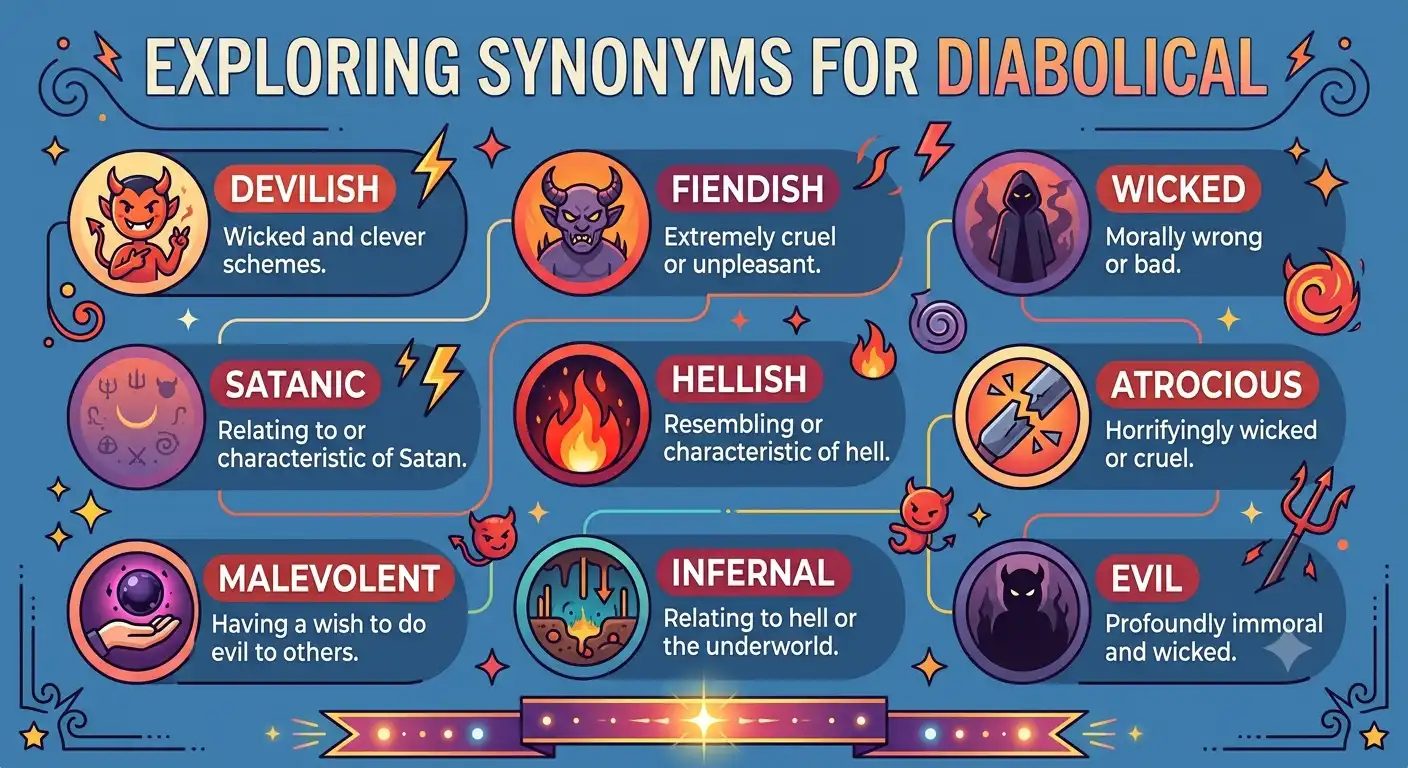
Exploring rich synonyms for diabolical helps you describe extreme wickedness, villainous plans, or shockingly bad weather with total precision. When you learn these synonyms for diabolical, you can express intense emotions and dramatic situations without using repetitive words. Mastering powerful synonyms for diabolical expands your vocabulary and lifts your writing to professional standards.
Picture a classic animated movie where a scheming villain rubs his hands together while plotting to steal all the town’s ice cream on a hot summer day. That clever, wicked plan is what people call diabolical. In simple Grade 3 English, diabolical means very evil, extremely bad, or outrageously cruel. It is like describing something so bad that it feels like a trick from a dark fairy tale monster. For example, a sudden, blinding blizzard right before an outdoor wedding is a diabolical turn of weather, and a cartoon villain’s plot to trap a hero is a diabolical scheme.
“The only thing necessary for the triumph of evil is for good men to do nothing.” — Edmund Burke
Building a versatile vocabulary with synonyms for diabolical provides practical benefits across many communication fields:
- Students can analyze literature, write creative stories, and describe historical villains with precise terms.
- Bloggers can review movies, describe shocking plot twists, and recount challenging travel experiences vibrantly.
- Content writers can craft engaging articles on crime fiction, game design, and dramatic commentary without repetition.
- Daily English users can describe terrible weather, outrageously hard exam questions, or sneaky workplace tricks smoothly.
“Deep into that darkness peering, long I stood there wondering, fearing.” — Edgar Allan Poe
Linguistic Breakdown of “Diabolical”
Connotative Meaning
The adjective diabolical carries a strong, intense, and sinister tone. It suggests extreme evil, malice, or outrageous hardship far beyond ordinary unpleasantness. Figuratively, it denotes something outrageously difficult, painfully bad, or clever in a cruel way.
Etymology
- Root Word: Ancient Greek diabolos (meaning slanderer, accuser, or devil).
- Late Latin: Diabolicus (pertaining to the devil).
- Old French: Diabolique (fiendish or devilish).
- Middle English: Entered English in the late 14th century to describe actions or traits associated with the devil.
Pronunciation
- US IPA: /ˌdaɪ.əˈbɑː.lɪ.kəl/
- UK IPA: /ˌdaɪ.əˈbɒl.ɪ.kəl/
Syllables & Affixation Pattern
- Syllables: 5 (di-a-bol-i-cal)
- Root Word: Diabolos / Devil
- Affixation: Derived adjective formed with suffix -ical (forming adjectives of relationship or quality).
Comparison Table of Key Synonyms
| Keyword | Meaning | Usage Type | Context |
|---|---|---|---|
| Fiendish | Extremely cruel, wicked, or cunning | Emotional / Casual | Movie villains, tricky puzzles, cruel acts |
| Wicked | Bad, evil, or morally wrong | Casual / General | Fairy tales, naughty behavior, stories |
| Demonic | Seeming to come from an evil spirit | Dramatic / Formal | Horror movies, intense anger, dark art |
| Nefarious | Extremely wicked or criminal in nature | Professional / Formal | Crime news, legal papers, political commentary |
| Atrocious | Horrifyingly wicked or extremely bad | Casual / Formal | Bad weather, terrible service, violent acts |
| Sinister | Giving the impression that something evil is happening | Emotional / Literary | Mystery novels, dark alleys, eerie sounds |
| Heinous | Utterly odious or wicked | Formal / Legal | Legal trials, severe crimes, historical events |
| Vicious | Deliberately cruel or violent | Casual / Emotional | Wild animal attacks, harsh rumors, fights |
Main Content – 50 Synonyms for Diabolical
1. Fiendish
- Pronunciation: US: /ˈfiːn.dɪʃ/ | UK: /ˈfiːn.dɪʃ/
- Meaning: Extremely cruel, clever, or wicked like a monster.
- Examples:
- The mystery book featured a fiendish puzzle that no one could solve easily.
- The dark villain hatched a fiendish plot to lock the main gates.
2. Wicked
- Pronunciation: US: /ˈwɪk.ɪd/ | UK: /ˈwɪk.ɪd/
- Meaning: Bad, wrong, or intentional about causing harm to others.
- Examples:
- The wicked witch cast a dark spell on the sleeping kingdom.
- He gave a wicked laugh before hiding his brother’s favorite toy.
3. Demonic
- Pronunciation: US: /dɪˈmɑː.nɪk/ | UK: /dɪˈmɒn.ɪk/
- Meaning: Wild, evil, or seeming to come from a dark spirit.
- Examples:
- The scary movie had a demonic creature lurking in the shadows.
- A demonic howl echoed through the empty forest at midnight.
4. Evil
- Pronunciation: US: /ˈiː.vəl/ | UK: /ˈiː.vəl/
- Meaning: Very bad and harmful to good people or things.
- Examples:
- Good heroes always stand up to fight against evil forces.
- The king banished the evil counselor from the castle grounds.
5. Devilish
- Pronunciation: US: /ˈdev.əl.ɪʃ/ | UK: /ˈdev.əl.ɪʃ/
- Meaning: Sneaky, mischievous, or like a little devil.
- Examples:
- The toddler had a devilish smile while reaching for the cake.
- She played a devilish trick on her friend during April Fools’ Day.
6. Nefarious
- Pronunciation: US: /nəˈfer.i.əs/ | UK: /nəˈfeə.ri.əs/
- Meaning: Highly criminal, immoral, or outrageously evil.
- Examples:
- Police stopped the gang from carrying out their nefarious plans.
- The report exposed the nefarious activities of the corrupt firm.
7. Villainous
- Pronunciation: US: /ˈvɪl.ə.nəs/ | UK: /ˈvɪl.ə.nəs/
- Meaning: Matching the bad behavior of an evil story character.
- Examples:
- The villainous captain tried to steal the buried gold treasure.
- His villainous actions turned the entire town against him quickly.
8. Atrocious
- Pronunciation: US: /əˈtroʊ.ʃəs/ | UK: /əˈtrəʊ.ʃəs/
- Meaning: Horrifyingly cruel or of extremely poor quality.
- Examples:
- Stormy weather created atrocious driving conditions along the highway.
- The dictator was remembered for his atrocious treatment of citizens.
9. Monstrous
- Pronunciation: US: /ˈmɑːn.strəs/ | UK: /ˈmɒn.strəs/
- Meaning: Shockingly huge, ugly, cruel, or unnaturally bad.
- Examples:
- A monstrous wave crashed against the tiny fishing boat.
- It was a monstrous crime that shocked the quiet neighborhood.
10. Malevolent
- Pronunciation: US: /məˈlev.əl.ənt/ | UK: /məˈlev.əl.ənt/
- Meaning: Wishing to cause harm or bad luck to other people.
- Examples:
- The old house seemed to possess a malevolent energy inside.
- She felt a malevolent glare watching her from across the room.
11. Malicious
- Pronunciation: US: /məˈlɪʃ.əs/ | UK: /məˈlɪʃ.əs/
- Meaning: Intending to hurt or upset someone on purpose.
- Examples:
- Someone spread malicious rumors to hurt her good reputation.
- The computer virus was designed with malicious intent to steal data.
12. Heinous
- Pronunciation: US: /ˈheɪ.nəs/ | UK: /ˈheɪ.nəs/
- Meaning: Exceptionally bad, hateful, or deserving total condemnation.
- Examples:
- The judge gave a long sentence for the heinous act.
- News reporters covered the heinous event with deep sadness.
13. Iniquitous
- Pronunciation: US: /ɪˈnɪk.wə.t̬əs/ | UK: /ɪˈnɪk.wɪ.təs/
- Meaning: Grossly unfair and morally wrong in every way.
- Examples:
- Citizens protested against the iniquitous laws passed by rulers.
- Slavery was an iniquitous system that destroyed countless lives.
14. Vicious
- Pronunciation: US: /ˈvɪʃ.əs/ | UK: /ˈvɪʃ.əs/
- Meaning: Violent, dangerous, and ready to attack without pity.
- Examples:
- Guard dogs kept a vicious watch around the fenced yard.
- The boxer delivered a vicious blow during the final round.
15. Cruel
- Pronunciation: US: /ˈkruː.əl/ | UK: /ˈkruː.əl/
- Meaning: Willing to hurt others without showing any kindness or mercy.
- Examples:
- Leaving a pet outside in frozen rain is very cruel.
- The cruel boss yelled at the workers for minor mistakes.
16. Sinister
- Pronunciation: US: /ˈsɪn.ə.stɚ/ | UK: /ˈsɪn.ɪ.stə/
- Meaning: Giving a bad feeling that something harmful is coming.
- Examples:
- Shadowy figures cast a sinister look over the dark street.
- Strange music created a sinister mood in the horror film.
17. Infernal
- Pronunciation: US: /ɪnˈfɝː.nəl/ | UK: /ɪnˈfɜː.nəl/
- Meaning: Relating to hell or extremely annoying and hot.
- Examples:
- The infernal heat made working outside almost impossible today.
- Stop making that infernal noise while I am trying to sleep!
18. Satanic
- Pronunciation: US: /səˈtæn.ɪk/ | UK: /səˈtæn.ɪk/
- Meaning: Connected with the devil or deep spiritual evil.
- Examples:
- Ancient legends described a satanic cult hiding in the mountains.
- The dark painting featured symbols associated with satanic lore.
19. Depraved
- Pronunciation: US: /dɪˈpreɪvd/ | UK: /dɪˈpreɪvd/
- Meaning: Morally bad, corrupted, and lacking any good values.
- Examples:
- Only a depraved person would harm innocent young children.
- The movie depicted the depraved lifestyle of criminal bosses.
20. Outrageous
- Pronunciation: US: /aʊtˈreɪ.dʒəs/ | UK: /aʊtˈreɪ.dʒəs/
- Meaning: Shockingly bad, unfair, or hard to believe.
- Examples:
- The shop charged an outrageous price for a bottle of water.
- Her outrageous behavior disrupted the peaceful family dinner.
“Monsters are real, and ghosts are real too. They live inside us, and sometimes, they win.” — Stephen King
21. Dreadful
- Pronunciation: US: /ˈdred.fəl/ | UK: /ˈdred.fəl/
- Meaning: Extremely bad, unpleasant, or causing great fear.
- Examples:
- We heard the dreadful news about the storm hitting the coast.
- He suffered from a dreadful headache all through the afternoon.
22. Horrible
- Pronunciation: US: /ˈhɔːr.ə.bəl/ | UK: /ˈhɒr.ə.bəl/
- Meaning: Causing intense disgust, fear, or discomfort.
- Examples:
- The garbage left outside produced a horrible smell in summer.
- It was a horrible experience to get lost in the forest.
23. Abominable
- Pronunciation: US: /əˈbɑː.mə.nə.bəl/ | UK: /əˈbɒm.ɪ.nə.bəl/
- Meaning: Very unpleasant, hated, or deserving strong dislike.
- Examples:
- The Abominable Snowman is a legendary monster of snowy peaks.
- They complained about the abominable food served at the camp.
24. Execrable
- Pronunciation: US: /ˈek.sə.krə.bəl/ | UK: /ˈek.sɪ.krə.bəl/
- Meaning: Extremely bad, terrible, or deserving severe criticism.
- Examples:
- The actor gave an execrable performance in the opening play.
- The room was kept in an execrable state of filth and clutter.
25. Vile
- Pronunciation: US: /vaɪl/ | UK: /vaɪl/
- Meaning: Disgustingly bad, unpleasant, or lacking moral worth.
- Examples:
- The wicked giant had a vile temper when he was hungry.
- Swearing loudly in front of small kids is vile behavior.
26. Terrible
- Pronunciation: US: /ˈter.ə.bəl/ | UK: /ˈter.ə.bəl/
- Meaning: Very bad, unpleasant, or causing great worry.
- Examples:
- A terrible crash blocked all lanes on the main highway.
- She felt terrible after forgetting her best friend’s party.
27. Despicable
- Pronunciation: US: /dɪˈspɪk.ə.bəl/ | UK: /dɪˈspɪk.ə.bəl/
- Meaning: Deserving hatred and deep contempt for bad actions.
- Examples:
- Stealing money from a charity is a despicable crime.
- The movie character had despicable habits that made viewers angry.
28. Rotten
- Pronunciation: US: /ˈrɑː.tən/ | UK: /ˈrɒt.ən/
- Meaning: Bad, decayed, or morally corrupt inside.
- Examples:
- Throw away those rotten apples before they ruin the basket.
- He has a rotten attitude toward doing hard homework.
29. Shocking
- Pronunciation: US: /ˈʃɑː.kɪŋ/ | UK: /ˈʃɒk.ɪŋ/
- Meaning: Causing strong surprise, horror, or disgust.
- Examples:
- The sudden news of the accident was shocking to everyone.
- She discovered a shocking secret about the old mansion.
30. Savage
- Pronunciation: US: /ˈsæv.ɪdʒ/ | UK: /ˈsæv.ɪdʒ/
- Meaning: Wild, fierce, and violent without any control.
- Examples:
- A savage storm ripped branches off the old oak trees.
- The wild animal made a savage attack on the wooden fence.
31. Brutal
- Pronunciation: US: /ˈbruː.t̬əl/ | UK: /ˈbruː.təl/
- Meaning: Harsh, direct, and violent without showing pity.
- Examples:
- Football players endured a brutal training session under the sun.
- The brutal cold froze the water pipes overnight.
32. Mischievous
- Pronunciation: US: /ˈmɪs.tʃɪ.vəs/ | UK: /ˈmɪs.tʃɪ.vəs/
- Meaning: Causing trouble or playing tricks in a playful or sneaky way.
- Examples:
- The mischievous monkey stole a banana from the fruit stand.
- She gave a mischievous wink before turning off the light.
33. Treacherous
- Pronunciation: US: /ˈtretʃ.ɚ.əs/ | UK: /ˈtretʃ.ər.əs/
- Meaning: Dangerous, untrustworthy, or full of hidden risks.
- Examples:
- Ice made the mountain trail treacherous for the climbers.
- The treacherous advisor betrayed the young king for money.
34. Perverse
- Pronunciation: US: /pɚˈvɝːs/ | UK: /pəˈvɜːs/
- Meaning: Turned away from what is right or reasonable.
- Examples:
- He took a perverse pleasure in arguing with his teachers.
- The court reached a perverse decision despite clear evidence.
35. Corrupt
- Pronunciation: US: /kəˈrʌpt/ | UK: /kəˈrʌpt/
- Meaning: Dishonest and willing to do wrong things for money.
- Examples:
- Corrupt officials took bribes to ignore safety rules.
- The computer file became corrupt and refused to open.
36. Sinful
- Pronunciation: US: /ˈsɪn.fəl/ | UK: /ˈsɪn.fəl/
- Meaning: Breaking moral laws or doing wrong things intentionally.
- Examples:
- The preacher warned against leading a sinful lifestyle.
- Eating that giant chocolate cake felt delightfully sinful.
37. Malign
- Pronunciation: US: /məˈlaɪn/ | UK: /məˈlaɪn/
- Meaning: Harmful, evil, or intending to cause bad results.
- Examples:
- A malign influence ruined the peaceful mood of the team.
- The article painted a malign picture of the local leader.
38. Baleful
- Pronunciation: US: /ˈbeɪl.fəl/ | UK: /ˈbeɪl.fəl/
- Meaning: Threatening harm or looking at someone with hatred.
- Examples:
- The giant tiger gave a baleful look before jumping forward.
- Stormy clouds cast a baleful light over the quiet valley.
39. Foul
- Pronunciation: US: /faʊl/ | UK: /faʊl/
- Meaning: Very dirty, bad-smelling, or morally bad.
- Examples:
- A foul odor rose from the stagnant pond in the yard.
- He was sent off the field for making a foul tackle.
40. Nasty
- Pronunciation: US: /ˈnæs.ti/ | UK: /ˈnɑː.sti/
- Meaning: Highly unpleasant, mean, or dangerous to deal with.
- Examples:
- Watch out for that nasty sharp nail sticking out of wood.
- She received a nasty cold after standing in the rain.
41. Harsh
- Pronunciation: US: /hɑːrʃ/ | UK: /hɑːʃ/
- Meaning: Severe, rough, or unpleasantly strict on people.
- Examples:
- The desert environment has a harsh climate for most animals.
- He used harsh words that hurt his friend’s feelings deeply.
42. Severe
- Pronunciation: US: /səˈvɪr/ | UK: /sɪˈvɪə/
- Meaning: Very serious, extreme, or hard to endure.
- Examples:
- The region suffered from a severe drought all summer long.
- Drivers faced severe delays due to the bridge repair work.
43. Extreme
- Pronunciation: US: /ɪkˈstriːm/ | UK: /ɪkˈstriːm/
- Meaning: Reaching a very high level or going beyond normal limits.
- Examples:
- Outdoor sports require high safety gear in extreme weather.
- The team worked under extreme pressure to finish on time.
44. Impossible
- Pronunciation: US: /ɪmˈpɑː.sə.bəl/ | UK: /ɪmˈpɒs.ə.bəl/
- Meaning: Extremely hard to deal with or unable to happen.
- Examples:
- The math test was so hard it felt almost impossible to pass.
- She found herself in an impossible situation with no easy fix.
45. Monstrously bad
- Pronunciation: US: /ˈmɑːn.strəs.li bæd/ | UK: /ˈmɒn.strəs.li bæd/
- Meaning: Exceptionally terrible, awful, or painful to endure.
- Examples:
- The team suffered a monstrously bad defeat during the finals.
- Traffic on the highway was monstrously bad after the rain.
46. Insidious
- Pronunciation: US: /ɪnˈsɪd.i.əs/ | UK: /ɪnˈsɪd.i.əs/
- Meaning: Spreading gradually in a slow, harmful, and secretive way.
- Examples:
- Rust is an insidious problem that slowly ruins iron gates.
- The disease had an insidious start without any early pain.
47. Unholy
- Pronunciation: US: /ʌnˈhoʊ.li/ | UK: /ʌnˈhəʊ.li/
- Meaning: Not sacred, morally wrong, or outrageously bad.
- Examples:
- The loud party woke up neighbors at an unholy hour of night.
- The monsters formed an unholy alliance to conquer the city.
48. Mephistophelian
- Pronunciation: US: /ˌmef.ɪ.stəˈfiː.li.ən/ | UK: /ˌmef.ɪ.stəˈfiː.li.ən/
- Meaning: Showing clever, evil, or trickster traits like Mephistopheles.
- Examples:
- The villain flashed a Mephistophelian grin during his speech.
- He made a Mephistophelian deal that cost him his freedom.
49. Diabolic
- Pronunciation: US: /ˌdaɪ.əˈbɑː.lɪk/ | UK: /ˌdaɪ.əˈbɒl.ɪk/
- Meaning: Directly characteristic of the devil or extreme evil.
- Examples:
- The dark ritual possessed a diabolic energy that scared onlookers.
- Scientists stopped the diabolic experiment before damage occurred.
50. Impish
- Pronunciation: US: /ˈɪm.pɪʃ/ | UK: /ˈɪm.pɪʃ/
- Meaning: Doing minor bad tricks or playful mischief like an imp.
- Examples:
- The child gave an impish look before splashing in mud.
- His impish sense of humor kept the class laughing all day.
Antonyms of “Diabolical”
While diabolical refers to extreme wickedness, cruel schemes, or terrible conditions, its antonyms highlight goodness, kindness, and divine quality:
- Angelic: US: /ænˈdʒel.ɪk/ | UK: /ænˈdʒel.ɪk/ – Exceptionally kind, innocent, or beautiful like an angel.
- Benevolent: US: /bəˈnev.əl.ənt/ | UK: /bəˈnev.əl.ənt/ – Kind-hearted, generous, and wishing good things for others.
- Divine: US: /dɪˈvaɪn/ | UK: /dɪˈvaɪn/ – Extremely good, sacred, or connected directly to God.
- Virtuous: US: /ˈvɝː.tʃu.əs/ | UK: /ˈvɜː.tʃu.əs/ – Having high moral standards, honesty, and goodness.
Prototype Meaning and Categorization of “Diabolical”
- Grammatical Category: Adjective (descriptive, non-gradable in literal sense, gradable in figurative use, e.g., “truly diabolical plan”).
- Prototype Meaning: The quality of possessing traits characteristic of a devil—extreme evil, dark cunning, or intolerable hardship.
- Semantic Field: Morality, ethics, fiction, drama, meteorology (figurative weather), and behavioral psychology.
Frequently Asked Questions (FAQ)
1. What is the main difference between “diabolical” and “wicked”?
Wicked is a general term for bad or evil behavior used in everyday settings and fairy tales. Diabolical is much stronger, implying extreme, clever villainy or something so severe that it feels devilish.
2. Can “diabolical” be used to describe non-evil situations?
Yes! People frequently use diabolical informally to describe extreme difficulty or terrible quality, such as “diabolical traffic,” a “diabolical exam,” or “diabolical weather.”
3. What is the most common formal synonym for “diabolical”?
In formal, academic, or legal contexts, nefarious, heinous, and iniquitous serve as the best substitutes for diabolical.
4. Is “diabolic” the exact same word as “diabolical”?
Yes, diabolic and diabolical are interchangeable adjectives. However, diabolical is much more common in modern written and spoken English.
5. How do I choose between “fiendish” and “diabolical”?
Use fiendish when emphasizing cleverness, tricky puzzles, or complex schemes. Use diabolical when highlighting overall evil intensity or extreme hardship.
6. Is “diabolical” suitable for academic writing?
Yes, when analyzing literature, historical events, or moral philosophy. For scientific or objective reports, standard terms like severe, extreme, or harmful are preferred.
Conclusion
Expanding your vocabulary with varied synonyms for diabolical equips you to describe villains, intense situations, and difficult challenges with total precision. By substituting repeated words with vivid terms like fiendish, nefarious, sinister, or atrocious, you add dramatic energy to your essays and creative stories. Choosing exact words refines your communication, helping your authentic voice shine brightly in both academic writing and everyday speech.
“Words are, in my not-so-humble opinion, our most inexhaustible source of magic.” — J.K. Rowling
“To express yourself clearly is to give your thoughts the strength they deserve.” — Classic Adage
Take time to practice these 50 synonyms in your creative writing, study notes, blog posts, and daily conversations. Regular practice builds natural confidence, allowing you to convey intense feelings and villainous character traits with effortless style!

Andrew Collins is an academic English educator with over 12 years of experience helping university students, IELTS candidates, and ESL learners improve their writing vocabulary.