You’re writing an essay, report, or IELTS response—and suddenly, the word behavior feels overused. Sound familiar? Repeating the same term can weaken your writing and lower your score, especially in academic contexts where vocabulary range matters.
That’s exactly why learning synonyms for behavior is essential. Not only do they help you avoid repetition, but they also allow you to express subtle differences in meaning—something examiners and professors look for.
In this guide, you’ll learn a complete list of synonyms, how to use them correctly, and when to avoid them. I’ll also show you real examples, common mistakes, and practical tips drawn from over 12 years of teaching academic English. By the end, you’ll confidently choose the right word for any context.
Quick Answer:
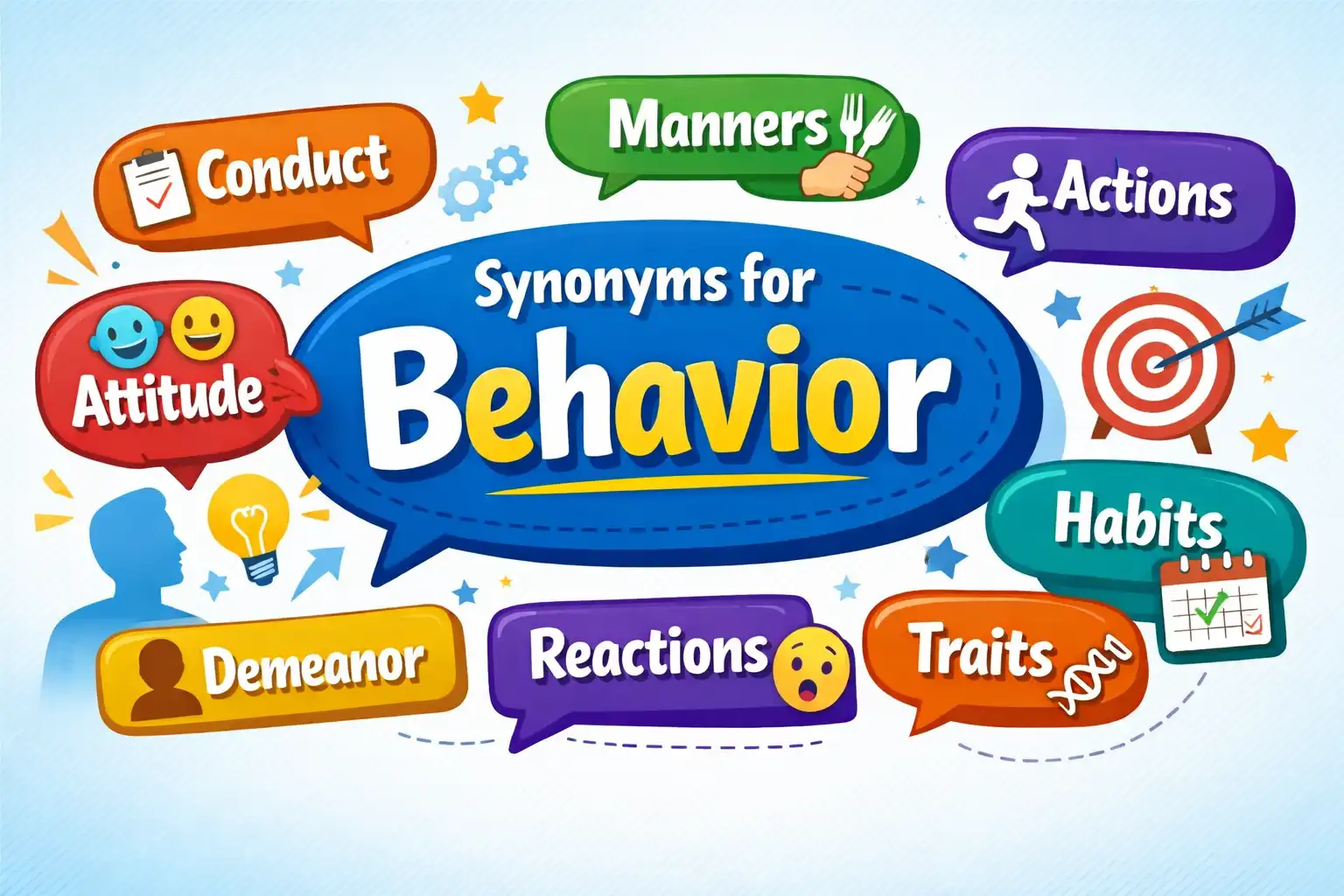
The most common synonyms for behavior include conduct, actions, demeanor, manners, habits, and reactions. Each word has a slightly different meaning and usage. In academic writing, conduct and actions are often preferred, while manners and demeanor are used in more specific contexts.
What Does “Behavior” Mean?
In academic writing, behavior refers to how a person, group, or organism acts or responds in a given situation.
It can include:
- Observable actions
- Reactions to stimuli
- Patterns of conduct over time
According to academic writing conventions, behavior is commonly used in psychology, sociology, and education essays.
Example:
- “Student behavior in the classroom affects learning outcomes.”
Complete Synonyms List
Here are the most useful synonyms for behavior, especially for essays and IELTS writing:
- Conduct
- Actions
- Demeanor
- Manners
- Attitude
- Habits
- Reactions
- Performance
- Response
- Deportment
- Way of acting
- Disposition
IELTS Tip:
In Task 2 essays, replacing behavior with conduct or actions can help increase your lexical resource score (Band 7+ requires flexible vocabulary use).
Comparison Table
| Word | Simple Meaning | Best Used When | Avoid When |
| Behavior | General way of acting | Neutral or broad contexts | Repetition in essays |
| Conduct | Formal behavior | Academic or professional writing | Casual conversation |
| Actions | Specific things done | Describing events or decisions | Talking about personality traits |
| Demeanor | Outward behavior | Describing appearance or attitude | Scientific writing |
| Manners | Politeness and etiquette | Social situations | Formal research papers |
| Attitude | Mental outlook | Opinions and feelings | Physical actions |
| Habits | Repeated actions | Patterns over time | One-time actions |
| Reactions | Responses to events | Cause-and-effect writing | General descriptions |
Formal vs Informal Synonyms
| Formal Synonyms | Informal Synonyms |
| Conduct | Way of acting |
| Deportment | How someone acts |
| Demeanor | Behavior (casual use) |
| Actions | Things someone does |
| Response | Reaction |
Key Insight:
According to academic standards, formal synonyms like conduct and actions are preferred in essays, while informal ones should be avoided in IELTS and university writing.
Real Example Sentences
Here are practical examples to help you understand usage:
- The teacher addressed inappropriate behavior in the classroom.
- His professional conduct impressed the interview panel.
- The child’s actions reflected a lack of supervision.
- Her calm demeanor helped resolve the conflict.
- Good manners are essential in social interactions.
- The study analyzed consumer behavior in online markets.
- Their reactions to stress varied significantly.
- Daily habits influence long-term success.
IELTS Tip:
Use different synonyms within one essay to avoid repetition and show range.
When to Use vs When NOT to Use
When to Use Synonyms for Behavior
Use alternatives when:
- You want to avoid repeating behavior
- You need more precision (e.g., reactions vs habits)
- Writing formal essays or reports
When NOT to Use Them
Avoid replacing behavior when:
- The synonym changes the meaning
- You are writing a scientific definition where behavior is standard
- The context is too general for a specific word
Example Mistake:
- Incorrect: “Animal conduct in the wild…”
- Correct: “Animal behavior in the wild…”
Common Mistakes Writers Make
Writers we work with often struggle with these issues:
1. Using the Wrong Context
- Demeanor is not suitable for scientific studies
- Manners is too informal for academic essays
2. Overusing One Synonym
Switching from behavior to only actions repeatedly doesn’t improve your writing.
3. Ignoring Nuance
- Habits = repeated actions
- Reactions = immediate responses
These are not interchangeable.
4. Using Informal Language in Essays
Words like “the way someone acts” reduce academic quality.
Tips and Best Practices
Here’s how to use synonyms for behavior effectively:
1. Match the Context
Always choose a word that fits the situation:
- Academic → conduct, actions
- Psychological → behavior, response
2. Vary Your Vocabulary
Use at least 2–3 different synonyms in longer essays.
3. Think About Meaning Depth
Ask yourself:
- Is this repeated behavior? → habits
- Is this a reaction? → response
4. Practice with Real Writing
In our experience helping writers, rewriting one paragraph with different synonyms is one of the fastest ways to improve vocabulary range.
5. Follow IELTS Band Criteria
Lexical resource accounts for 25% of your score. Using precise synonyms can push you from Band 6 to Band 7.
Frequently Asked Questions
Q1: What is the best synonym for behavior in academic writing?
A: The best synonym depends on context, but conduct and actions are widely accepted in academic writing. They sound formal and precise, making them ideal for essays, reports, and IELTS responses where clarity and tone matter.
Q2: Can I always replace behavior with conduct?
A: No, you cannot always replace it. Conduct is more formal and often used for human actions in professional or ethical contexts. It does not work well in scientific or biological discussions where behavior is the standard term.
Q3: What is the difference between behavior and attitude?
A: Behavior refers to observable actions, while attitude refers to internal thoughts or feelings. In academic writing, mixing them can cause confusion, so use behavior for actions and attitude for opinions or beliefs.
Q4: Are synonyms for behavior important in IELTS?
A: Yes, they are very important. IELTS examiners assess your vocabulary range under lexical resource. Using accurate synonyms shows flexibility and can help you achieve a Band 7 or higher score.
Q5: Is demeanor a good synonym for behavior?
A: Demeanor is useful but limited. It describes outward appearance or behavior, especially in social situations. It is not suitable for scientific or general academic contexts where broader terms are needed.
Q6: What is a formal word for behavior?
A: Conduct and deportment are formal alternatives. However, deportment is less common in modern academic writing, so conduct is usually the safer choice.
Q7: Can habits replace behavior in essays?
A: Only when referring to repeated actions. Habits implies consistency over time, while behavior can describe a single action or general pattern. Using them interchangeably can change your meaning.
Q8: Why should I avoid repeating behavior in writing?
A: Repetition reduces the quality of your writing and makes it sound basic. Using varied vocabulary improves readability and demonstrates language proficiency, which is essential for academic success.
Conclusion
Mastering synonyms for behavior is a simple but powerful way to improve your academic writing. You’ve learned how to choose the right word, avoid common mistakes, and use vocabulary more precisely.
Remember, not all synonyms are interchangeable. Context matters. In academic essays, words like conduct and actions will serve you well, while others should be used carefully.
You might also want to read our guide on synonyms for attitude to further expand your vocabulary.
Keep practicing, stay consistent, and your writing will steadily improve.

Andrew Collins is an academic English educator with over 12 years of experience helping university students, IELTS candidates, and ESL learners improve their writing vocabulary.