Do you keep using core again and again in your essays, IELTS tasks, or university assignments? That repetition can make your writing sound limited, even when your ideas are strong. Many students search for synonyms for core because they want more variety, but the real challenge is choosing the right alternative for the sentence, tone, and academic purpose.
In academic writing, core usually refers to the central, essential, or most important part of an idea, argument, issue, or subject. But not every synonym carries the same meaning. Some words sound more formal. Some fit analysis better. Others work in speaking but feel weak in an essay.
This guide gives you a complete, practical answer. You will learn what core means, which synonyms work best in formal writing, how to avoid common mistakes, and how to use each option in real sentences. If you want clearer, higher-level vocabulary for essays and IELTS writing, this article will help you choose with confidence.
Quick Answer:
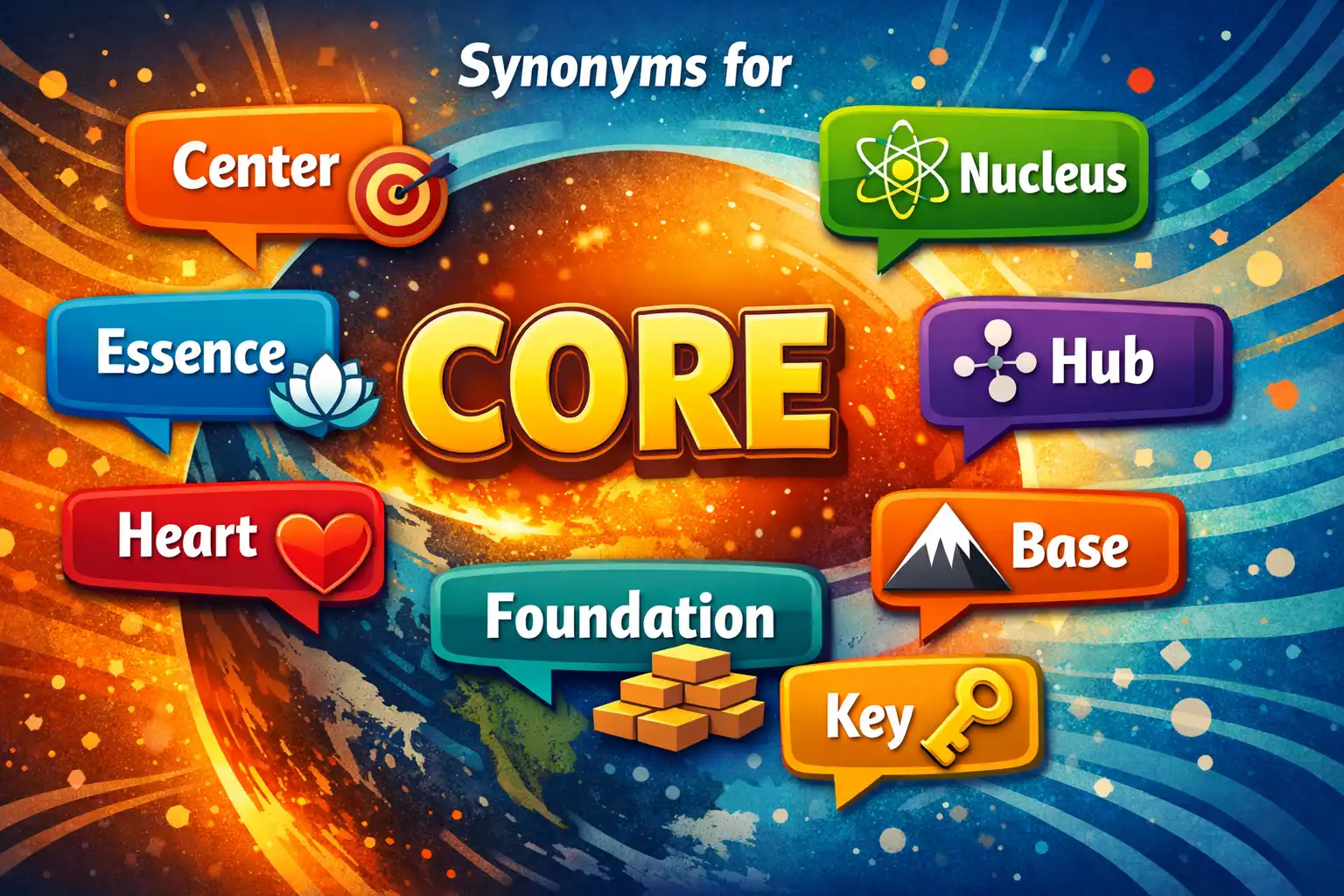
The best synonyms for core are central, essential, fundamental, primary, main, principal, key, and underlying. Use central for the main focus of an argument, essential for something necessary, and fundamental for basic principles. In academic writing, the best choice depends on meaning, not just variety.
What Does Core Mean?
In academic English, core usually means the most important, central, or basic part of something. You often see it in phrases such as core argument, core issue, core concept, or core principle.
Core as a meaning in academic writing
When you use core, you usually point to one of three ideas:
- the center of a topic or argument
- the most important part
- the basic foundation something depends on
For example, in the sentence “Trust is a core element of effective leadership,” the word means essential. In “The essay examines the core of the debate,” it means the central point.
This distinction matters in academic writing. According to academic writing conventions, precise vocabulary improves clarity. In IELTS Writing, lexical resource is judged not only by range, but by accuracy. If you replace core with the wrong synonym, your sentence becomes less precise, not more advanced.
IELTS Tip: Do not replace core just to sound clever. Examiners reward accurate word choice more than forced variation.
Complete Synonyms List
Here are the most useful synonyms for core in essays, reports, and formal writing:
- Central – at the center of the topic or argument
- Essential – absolutely necessary
- Fundamental – basic and deeply important
- Primary – first in importance
- Main – chief or most important
- Principal – main, especially in formal writing
- Key – very important for understanding or success
- Underlying – existing beneath the surface idea
- Basic – simple and foundational
- Crucial – extremely important
- Integral – necessary as part of a whole
- Pivotal – important because it causes change or direction
Which ones are strongest for academic writing?
The best academic choices are usually:
- central
- fundamental
- essential
- principal
- underlying
These words sound natural in essays and research-based writing. By contrast, main and key are clear and useful, but they are slightly less formal. That does not make them wrong. It simply means you should match the word to the context.
In our experience helping writers, students often overuse important when central or fundamental would express the idea more precisely.
Comparison Table
| Word | Simple Meaning | Best Used When | Avoid When |
| Central | in the middle; main focus | discussing the main idea in an argument | talking about something physically necessary |
| Essential | necessary | something cannot work without it | you only mean “important,” not required |
| Fundamental | basic and foundational | theories, values, principles, rights | minor points or short-term details |
| Primary | first in importance | ranking causes, aims, or concerns | you mean “basic structure” |
| Main | most important | clear student writing and timed exams | highly formal or technical analysis |
| Principal | chief or main | formal reports and academic essays | casual writing or speaking |
| Key | very important | factors, reasons, findings, stages | highly formal writing that needs more precision |
| Underlying | below the surface | root causes, hidden assumptions, themes | visible, direct, obvious points |
| Basic | simple and foundational | introductory concepts | advanced or sophisticated theories |
| Crucial | extremely important | emphasis on urgency or strong effect | neutral analysis with no strong emphasis |
| Integral | necessary as part of a whole | systems, structures, processes | when you mean “center” rather than “part of a whole” |
| Pivotal | turning-point important | moments of change or decision | ordinary background ideas |
Formal vs Informal Synonyms
Knowing register is just as important as knowing meaning.
| Formal / Academic | Less Formal / Neutral | Best Note |
| fundamental | basic | Use fundamental for theory; basic for simple explanation |
| principal | main | Principal suits essays; main suits general writing |
| essential | key | Essential sounds stricter and more precise |
| underlying | main | Underlying is better for hidden causes or assumptions |
| integral | important | Integral means necessary within a whole, not just valuable |
| central | core | Both work well, but central often reads more naturally in essays |
How register changes your sentence
A sentence such as “The main reason is economic pressure” is clear and correct. But in a university essay, “The principal reason is economic pressure” or “The central cause is economic pressure” often sounds stronger.
IELTS Tip: In Task 2, central, essential, and fundamental usually sound more academic than main or key.
Real Example Sentences
Here are real-style examples you can model in your own writing:
- Critical thinking is a central skill in higher education.
- Trust remains an essential element of successful teamwork.
- Freedom of expression is a fundamental principle in democratic societies.
- The primary aim of the study was to measure student motivation.
- Climate change is now the main concern in many environmental debates.
- One underlying cause of inequality is unequal access to education.
- Time management is integral to academic success at university level.
- Parental support plays a pivotal role during early childhood development.
- The principal argument of the essay focuses on social mobility.
- Vocabulary range is a key factor in strong IELTS writing performance.
These examples show an important pattern: the best alternative depends on what core means in that sentence. If you mean “hidden cause,” choose underlying. If you mean “basic principle,” choose fundamental.
When to Use vs When NOT to Use
When to use these synonyms
Use a synonym for core when you want to:
- avoid repetition in essays
- make your meaning more precise
- sound more academic
- match the tone of formal writing
- show stronger vocabulary control in IELTS or university work
For example:
- use central for a main idea
- use essential for something necessary
- use fundamental for a basic principle
- use underlying for hidden causes
When not to use them
Do not change core if the replacement changes the meaning.
For example:
- crucial is not always the same as core
- basic can sound too simple
- primary suggests ranking, not foundation
- integral means part of a whole, not center
If your sentence is about the literal center, such as the core of the Earth, many academic synonyms above will not fit well. Also, if you are writing for a general audience, very formal options like principal may sound stiff.
Writers we work with often lose marks because they chase variety and ignore nuance. Good vocabulary is accurate vocabulary.
Common Mistakes Writers Make
1. Treating every synonym as interchangeable
This is the biggest mistake. Essential, central, and fundamental are close, but they are not identical. A central argument is the main focus. A fundamental principle is a basic truth. An essential step is necessary.
2. Using a formal word in the wrong context
Some students write sentences like “The principal of health is exercise.” That is incorrect. The better choice is principle, not principal. These words sound similar but have different meanings.
3. Overusing strong emphasis words
Words like crucial and pivotal add force. If you use them in every paragraph, your writing starts to sound exaggerated. Academic style values control.
4. Choosing simplicity when precision is needed
Main is fine, but it is not always the best choice. In analytical writing, central, underlying, or fundamental often express the idea more exactly.
5. Forgetting collocations
Certain words naturally pair with certain nouns:
- fundamental principle
- central argument
- underlying cause
- essential requirement
- primary objective
Learning these patterns will improve your writing faster than memorizing random synonym lists.
Tips and Best Practices
1. Match the synonym to the function
Ask yourself: do you mean center, necessity, basis, or rank? That one question helps you choose the right word quickly.
2. Learn common academic collocations
Do not study words alone. Study them in phrases. For example:
- central issue
- fundamental change
- primary concern
- underlying assumption
This is how advanced vocabulary works in real essays.
3. Keep a personal synonym bank
When I teach university and IELTS writers, I always recommend building a small vocabulary bank by meaning group, not alphabetically. Put central, essential, fundamental, and underlying under one heading, then add one sentence for each.
4. Read your sentence aloud
If the sentence sounds too heavy or unnatural, the synonym is probably wrong. This simple check catches many awkward choices.
5. Use stronger words only when the meaning is stronger
Do not choose crucial when main is enough. Precision is a sign of advanced writing.
IELTS Tip: For Band 7+ style vocabulary, use fewer advanced words, but use them correctly. Accuracy always beats decoration.
Frequently Asked Questions
Q: What are the best synonyms for core in an essay?
A: The best choices are central, essential, fundamental, principal, and underlying. These words fit academic writing well because they sound formal and precise. The right option depends on your meaning. Use central for focus, essential for necessity, and fundamental for basic principles.
Q: Is central the same as core?
A: They are very close, but not always identical. Central usually emphasizes the main focus or position in an argument, while core can also suggest the inner or basic part of something. In essays, central is often the safest formal replacement.
Q: Which synonym for core is best for IELTS Writing Task 2?
A: Central, essential, and fundamental are the strongest choices for most IELTS essays. They sound academic without becoming unnatural. Choose one only when it truly fits the sentence. Replacing every simple word with a harder one does not improve your lexical resource score.
Q: Can I use main instead of core in academic writing?
A: Yes, you can. Main is clear and correct, and it works well in timed writing or when you want simple expression. However, in more formal academic contexts, central or principal often sounds more polished and precise.
Q: What is the difference between fundamental and essential?
A: Fundamental refers to something basic or foundational, such as a principle or theory. Essential means necessary for something to happen or work. A right can be fundamental. A condition for success can be essential. They are related, but not interchangeable in every sentence.
Q: Is key too informal as a synonym for core?
A: Key is not too informal, but it is less formal than essential or fundamental. It works well in many essays, especially in phrases like key factor or key reason. Still, for a very academic tone, a more precise alternative may be better.
Conclusion
Choosing the best synonyms for core is not about using the most advanced word. It is about using the most accurate one. In academic and IELTS writing, central, essential, fundamental, principal, and underlying are especially useful because each adds a slightly different meaning.
When you understand that nuance, your writing becomes clearer, stronger, and more natural. You might also want to read our guide on synonyms for important. Keep building your vocabulary one precise word at a time, and your writing will improve steadily.

Andrew Collins is an academic English educator with over 12 years of experience helping university students, IELTS candidates, and ESL learners improve their writing vocabulary.