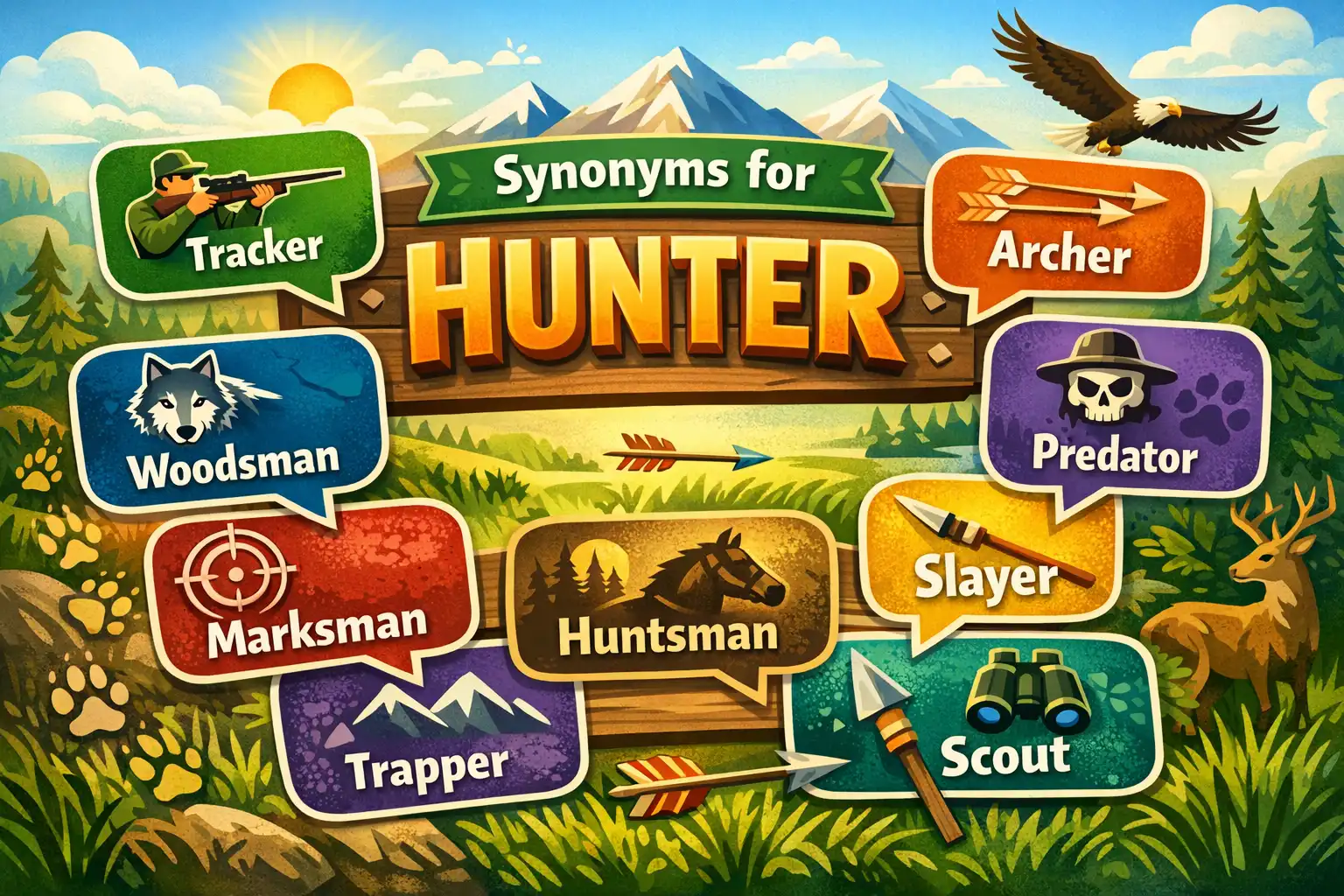
Have you ever sat in front of your computer screen, staring at a blank document, trying to find the perfect word? You want to describe someone tracking down a goal or chasing wild game, but using the same word over and over feels boring. For instance, if you are writing a story about an eagle catching its prey, calling it a “hunter” three times in a row ruins the magic.
A hunter is a person or animal that searches for, chases, and catches wild animals for food or sport. In a broader sense, it is also anyone tracking down a specific goal or object. Knowing different synonyms for hunter is incredibly useful. Students can make their essays shine, bloggers can grab more clicks, content writers can avoid repetitive phrases, and daily English users can express themselves with much more flavor.
1. Predator
Meaning: An animal that hunts and eats other animals to survive.
Examples:
- The lion is a top predator in the African savanna.
- Owls are quiet predators that fly at night.
2. Stalker
Meaning: Someone who follows a target very quietly and slowly.
Examples:
- The leopard is an expert stalker in the tall grass.
- The stealthy stalker watched the deer from behind a tree.
3. Sportsman
Meaning: A person who loves outdoor activities like chasing wild game or fishing.
Examples:
- My uncle is a true sportsman who spends every weekend in the woods.
- The local sportsman won an award for safe tracking practices.
4. Trapper
Meaning: Someone who catches wild animals using special cages or traps.
Examples:
- The old trapper gathered thick furs during the cold winter.
- A clever trapper knows exactly where to hide a cage.
5. Huntsman
Meaning: A man who manages a chase, especially one using tracking dogs.
Examples:
- The royal huntsman led the group into the deep forest.
- A skilled huntsman can read animal tracks in the mud easily.
6. Tracker
Meaning: A person who follows clues and footprints to find something.
Examples:
- Our guide is a brilliant tracker who can find any animal.
- The police hired a local tracker to find the lost hikers.
7. Pursuer
Meaning: Someone who runs after or chases a target to catch it.
Examples:
- The rabbit ran fast to escape its swift pursuer.
- He looked back to see if his pursuer was still close.
8. Chaser
Meaning: A person or animal that runs after things that move quickly.
Examples:
- Our dog is a funny storm chaser when it rains.
- The fast chaser finally caught up with the runaway horse.
9. Carnivore
Meaning: An animal that sustains itself by eating only meat.
Examples:
- Wolves are carnivores that rely on big game for food.
- A sharp-toothed carnivore easily caught the small rodent.
10. Forager
Meaning: A person or animal that wanders around searching for wild food.
Examples:
- The busy squirrel is a great forager for nuts.
- A wild forager can find delicious berries in the woods.
11. Scavenger
Meaning: An animal that searches for and eats dead animals or left-behind scraps.
Examples:
- The vulture is a helpful scavenger that cleans up nature.
- A raccoon is a clever scavenger in city neighborhoods.
12. Nimrod
Meaning: A traditional or classic term used to describe a great shooter.
Examples:
- The old storybooks called the brave archer a true nimrod.
- He considers himself quite a nimrod when it comes to duck season.
13. Fowler
Meaning: A person who specializes in chasing wild birds for food.
Examples:
- The fowler woke up early to catch ducks by the lake.
- An experienced fowler uses clever calls to attract wild geese.
14. Falconer
Meaning: Someone who trains large birds of prey to chase down targets.
Examples:
- The falconer raised his arm to let the hawk fly free.
- A patient falconer spends years training a young eagle.
15. Gamekeeper
Meaning: A person whose job is to care for and protect wild animals on large land.
Examples:
- The friendly gamekeeper pointed out the best trails.
- Our local gamekeeper makes sure nobody breaks the woodland laws.
16. Poacher
Meaning: Someone who catches wild animals illegally on protected land.
Examples:
- The park rangers caught a dangerous poacher near the elephants.
- A sneaky poacher tried to set traps in the dark forest.
17. Woodman
Meaning: A person who lives or works in the forest and knows its wildlife.
Examples:
- The wise woodman taught us how to track deer safely.
- A solitary woodman gathered firewood and scouted the trails.
18. Woodsman
Meaning: An expert at living in the forest and tracking wild game.
Examples:
- This skilled woodsman can survive in the wilderness for months.
- The young woodsman learned to mimic bird sounds perfectly.
19. Frontiersman
Meaning: A person who lives on the edge of wild, unexplored land.
Examples:
- The brave frontiersman relied on his rifle to feed his family.
- Every early frontiersman knew how to track game across mountains.
20. Pathfinder
Meaning: Someone who discovers a clear way through wild or unknown places.
Examples:
- The pathfinder discovered a hidden trail through the steep valley.
- An adventurous pathfinder guided the team safely to the river.
21. Scout
Meaning: A person sent ahead to search for information or track targets.
Examples:
- The military scout looked for signs of activity across the plains.
- A sharp scout noticed broken branches on the animal trail.
22. Searcher
Meaning: A person who looks carefully to find a hidden object or animal.
Examples:
- The determined searcher found a rare bird in the trees.
- Each searcher carried a flashlight into the dark cave.
23. Seeker
Meaning: Someone who spends time looking for a specific prize or goal.
Examples:
- The treasure seeker dug deep into the warm desert sand.
- As a truth seeker, she asked many excellent questions.
24. Ferreter
Meaning: A person who clears out or searches thoroughly for hidden targets.
Examples:
- The expert ferreter cleared the old barn of pests.
- An unstoppable ferreter will find the facts hidden in old books.
25. Fisher
Meaning: A person or animal that catches fish for food or sport.
Examples:
- The patient fisher waited all morning for a big bite.
- A hungry bear is a wonderful fisher in shallow rivers.
26. Angler
Meaning: A person who catches fish using a rod, line, and hook.
Examples:
- The quiet angler cast his line into the calm lake.
- Every local angler knows that mornings are best for fishing.
27. Harpooner
Meaning: Someone who uses a large spear to catch big sea creatures.
Examples:
- The brave harpooner stood at the front of the boat.
- An ancient harpooner carved spears from strong whale bones.
28. Whaler
Meaning: A person or ship that searches for and catches whales.
Examples:
- The historic whaler sailed across the cold northern seas.
- An old whaler told exciting stories about giant sea waves.
29. Shikari
Meaning: A big-game tracker or guide, especially in southern Asia.
Examples:
- The legendary shikari guided travelers safely through the deep jungle.
- A local shikari pointed out fresh tiger footprints in the mud.
30. Marksman
Meaning: A person who is incredibly skilled at shooting targets accurately.
Examples:
- The talented marksman hit the tiny target from far away.
- A disciplined marksman practices shooting every single day.
31. Sharpshooter
Meaning: Someone who can shoot a target perfectly from a long distance.
Examples:
- The police sharpshooter kept watch from the high rooftop.
- An expert sharpshooter won the grand prize at the tournament.
32. Bowman
Meaning: A person who shoots with a bow and arrows to catch game.
Examples:
- The silent bowman pulled back his string in the brush.
- A skilled bowman hit the target right in the center.
33. Archer
Meaning: A person who uses a bow to shoot arrows at targets.
Examples:
- The elven archer moved swiftly through the green woods.
- A competitive archer must hold their breath before firing.
34. Spearman
Meaning: A person who uses a long, sharp stick to catch wild prey.
Examples:
- The tribal spearman stood completely still in the shallow river.
- An ancient spearman threw his weapon with incredible force.
35. Beast-slayer
Meaning: A heroic person who defeats large, dangerous monsters or animals.
Examples:
- The old legends praised the brave beast-slayer of the village.
- A young beast-slayer set out to protect his family’s farm.
36. Venator
Meaning: A formal or ancient Latin word used to describe a tracker.
Examples:
- The scholar read a story about a roman venator in the arena.
- Scientists use the term venator to describe ancient fossils.
37. Safari-goer
Meaning: A traveler who journeys into the wild to view or chase big game.
Examples:
- The excited safari-goer took wonderful pictures of the rhinos.
- Every safari-goer wore tan clothing to blend into the grass.
38. Falconer
Meaning: A specialist who flies large hawks to catch small rodents.
Examples:
- The royal falconer carried a golden eagle on his glove.
- Our local falconer gave a fascinating speech at the school.
39. Fishermann
Meaning: A person who makes a living catching sea life from boats.
Examples:
- The tired fisherman brought in a massive net full of crabs.
- A seasoned fisherman knows when a big storm is coming.
40. Foothunter
Meaning: Someone tracking down targets or wild paths on their own feet.
Examples:
- The swift foothunter chased the wild goat up the rocky cliff.
- A determined foothunter does not need a horse to travel.
41. Bounty-hunter
Meaning: Someone who catches criminals or outlaws for a cash reward.
Examples:
- The mysterious bounty-hunter tracked the thief across three states.
- A tough bounty-hunter always gets his target in the end.
42. Headhunter
Meaning: A recruiter who searches for top employees to join a company.
Examples:
- A corporate headhunter called her with an amazing job offer.
- The smart headhunter looks for creative people on the internet.
43. Collector
Meaning: A person who searches for and gathers rare items or specimens.
Examples:
- The bug collector found a beautiful green beetle in the park.
- A serious art collector will pay millions for a rare painting.
44. Gatherer
Meaning: Someone who searches for and picks wild plants, berries, or wood.
Examples:
- The ancient gatherer brought sweet fruits back to the camp.
- A busy gatherer searched the forest floor for dry twigs.
45. Scouter
Meaning: A person who goes out ahead to find the best spots or paths.
Examples:
- The lead scouter found an excellent place to build our camp.
- A clever scouter reports back as soon as they spot a trail.
46. Ferret
Meaning: An animal or person used to drive out targets from hiding places.
Examples:
- The hunting ferret chased rabbits out of their underground holes.
- She used a trained ferret to clear pests from the fields.
47. Carnivore
Meaning: A meat-eating creature that hunts other living animals for food.
Examples:
- A fierce carnivore stalked the herd of wild deer quietly.
- The forest is home to more than one large carnivore.
48. Exterminator
Meaning: A professional who hunts down and gets rid of harmful pests.
Examples:
- We called an exterminator to get the mice out of the attic.
- The helpful exterminator sprayed the house for giant spiders.
49. Falconer
Meaning: A handler who uses trained raptors to pursue wild game.
Examples:
- The gentle falconer fed his hawk a small piece of meat.
- Watching a falconer work with a wild bird is truly amazing.
50. Game-stalker
Meaning: A person who quietly trails large wild animals in their habitat.
Examples:
- The quiet game-stalker hid in the bushes for three hours.
- An experienced game-stalker never makes a sound on the dry leaves.
Conclusion
Expanding your vocabulary by learning synonyms for hunter is a brilliant way to supercharge your English skills. When you swap out repetitive words, your writing becomes much more exciting to read. Bloggers will keep readers on their pages longer, students will write better essays, and your everyday conversations will sound much more professional. Try using a few of these new terms today in your emails, school essays, and daily chats to see your communication skills grow!

Andrew Collins is an academic English educator with over 12 years of experience helping university students, IELTS candidates, and ESL learners improve their writing vocabulary.