Have you ever watched a movie where the bad guy completely steals the show? Think about classic stories like Cinderella or Star Wars. The main character is great, but the story gets exciting because of the bad guy. However, using the word “bad guy” or “villain” over and over again makes your writing sound boring.
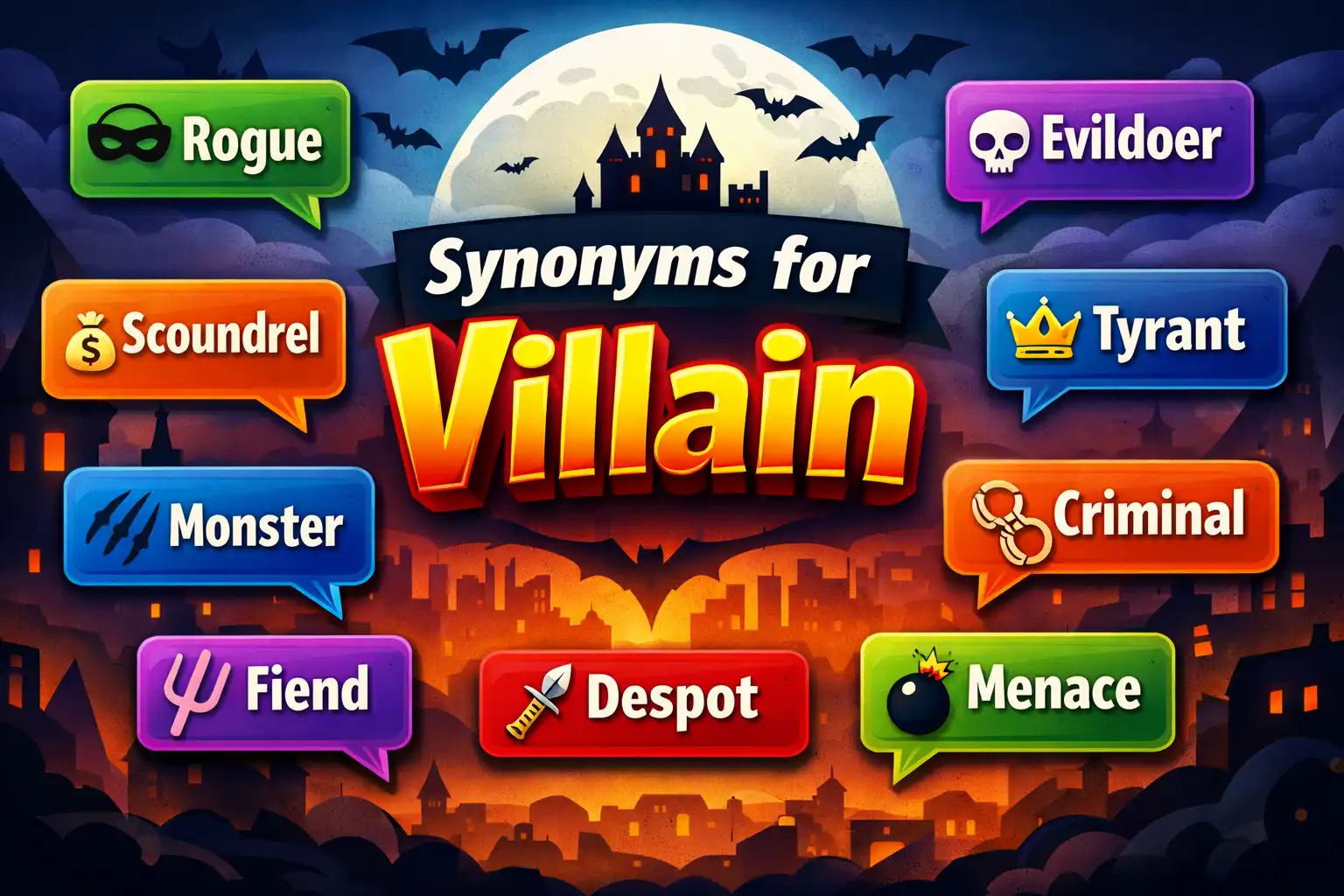
A villain is a bad person in a story or real life who harms others. Finding fresh synonyms for villain is incredibly useful. Students can get better grades on essays. Bloggers and content writers can keep readers hooked. Daily English users can sound more expressive. Let’s look at 50 great synonyms for villain that you can start using today.
1. Antagonist
Meaning: An antagonist is a person who struggles against or competes with the hero.
Examples:
- The dark wizard acts as the main antagonist in this fantasy book.
- In the movie, the rival runner is the hero’s chief antagonist.
2. Scoundrel
Meaning: A scoundrel is a dishonest or unprincipled person who cheats others.
Examples:
- That scoundrel took my money and ran away into the crowd.
- He played the role of a charming scoundrel in the play.
3. Rogue
Meaning: A rogue is a dishonest or unprincipled person who is often playful.
Examples:
- The little rogue hid his sister’s favorite doll behind the couch.
- He is a lovable rogue who always gets into minor trouble.
4. Rascal
Meaning: A rascal is a mischievous person or a cheeky scoundrel.
Examples:
- That little rascal ate all the cookies before dinner time.
- The old rascal smiled as he played a trick on us.
5. Miscreant
Meaning: A miscreant is a person who behaves badly or breaks the law.
Examples:
- The police caught the miscreant spray-painting the brick wall.
- School rules are made to stop any miscreant from causing trouble.
6. Reprobate
Meaning: A reprobate is an unprincipled person who does not care about rules.
Examples:
- Everyone knew him as a lazy reprobate who avoided hard work.
- The old novel features a wealthy reprobate as the main bad guy.
7. Wretch
Meaning: A wretch is a very bad, unhappy, or despicable person.
Examples:
- The cruel wretch left the poor puppy out in the cold rain.
- I cannot believe that miserable wretch lied to us again.
8. Criminal
Meaning: A criminal is a person who breaks the law and commits a crime.
Examples:
- The bank criminal hid the stolen money in a dark cave.
- Police officers work hard to catch every dangerous criminal.
9. Evildoer
Meaning: An evildoer is a person who does evil or wicked things to others.
Examples:
- The superhero vowed to protect the city from every evildoer.
- In ancient myths, the evildoer always loses at the very end.
10. Malefactor
Meaning: A malefactor is a person who commits a crime or does something wrong.
Examples:
- The judge sent the dangerous malefactor to prison for five years.
- Legends tell stories of heroes who defeat the local malefactor.
11. Wrongdoer
Meaning: A wrongdoer is a person who does something dishonest, illegal, or immoral.
Examples:
- The teacher asked the wrongdoer to apologize to the class.
- It is important to punish the wrongdoer to keep people safe.
12. Monster
Meaning: A monster is a cruel, wicked, or terrifying person.
Examples:
- The dictator behaved like a heartless monster toward his citizens.
- Only a monster would steal food from a hungry child.
13. Fiend
Meaning: A fiend is an evil spirit or a very wicked and cruel person.
Examples:
- The cruel fiend laughed when he ruined our beautiful garden.
- He portrays a dangerous fiend in the new horror movie.
14. Brute
Meaning: A brute is a savagely cruel, rough, or violent person.
Examples:
- The big brute pushed the smaller kids off the playground slide.
- I refuse to speak to a loud brute who yells all the time.
15. Bully
Meaning: A bully is a person who hurts or frightens weaker people.
Examples:
- The school bully took away my lunch money yesterday.
- We must stand up to any bully who picks on others.
16. Outlaw
Meaning: An outlaw is a lawbreaker who is hiding from the police.
Examples:
- The famous outlaw rode his horse fast across the desert.
- Western movies often show an outlaw robbing a steam train.
17. Bandit
Meaning: A bandit is a robber who attacks travelers in wild places.
Examples:
- A masked bandit stopped the stagecoach in the mountains.
- The local bandit stole the valuable gold from the miners.
18. Thug
Meaning: A thug is a violent person or criminal who hurts others.
Examples:
- A street thug tried to steal my gold watch last night.
- The boss hired a tough thug to guard the secret door.
19. Ruffian
Meaning: A ruffian is a violent, lawless, or brutal person.
Examples:
- A wild ruffian started a big fight inside the noisy restaurant.
- The police arrested the ruffian for breaking the glass window.
20. Hoodlum
Meaning: A hoodlum is a young bully, gangster, or violent criminal.
Examples:
- A teenage hoodlum broke the streetlights with a heavy rock.
- The neighborhood became safer after that hoodlum moved away.
21. Gangster
Meaning: A gangster is a member of an organized group of criminals.
Examples:
- The wealthy gangster wore a fancy suit and drove a black car.
- Movie directors love to make action films about a clever gangster.
22. Desperado
Meaning: A desperado is a desperate and dangerous criminal who risks everything.
Examples:
- The brave sheriff chased the lone desperado across the state line.
- That wild desperado was wanted by the law dead or alive.
23. Lawbreaker
Meaning: A lawbreaker is any person who violates the law of the land.
Examples:
- The traffic lawbreaker received a heavy fine for speeding.
- A consistent lawbreaker will eventually end up in a jail cell.
24. Felon
Meaning: A felon is a person who has been convicted of a serious crime.
Examples:
- The escaped felon hid in the deep woods for three days.
- A convicted felon cannot work at certain high-level jobs.
25. Sinner
Meaning: A sinner is a person who breaks a religious or moral law.
Examples:
- The old preacher told the sinner to change his bad ways.
- He admitted he was a sinner and asked for true forgiveness.
26. Vandal
Meaning: A vandal is a person who deliberately destroys or damages property.
Examples:
- A reckless vandal smashed the glass at the city bus stop.
- The park camera caught the young vandal painting the statues.
27. Thief
Meaning: A thief is a person who steals another person’s property.
Examples:
- A sneaky thief slipped into the house through the open window.
- The jewelry thief ran away with a bag full of diamonds.
28. Swindler
Meaning: A swindler is a person who uses deception to steal money.
Examples:
- That greedy swindler sold fake investment plans to old people.
- The online swindler deleted his website after taking our cash.
29. Charlatan
Meaning: A charlatan is a person falsely claiming to have special knowledge or skill.
Examples:
- The traveling charlatan sold fake medicine that tasted like water.
- Do not trust that charlatan who claims he can read minds.
30. Impostor
Meaning: An impostor is a person who pretends to be someone else to deceive.
Examples:
- The clever impostor wore a doctor’s coat to enter the room.
- We discovered the royal guard was actually a dangerous impostor.
31. Traitor
Meaning: A traitor is a person who betrays their country or friends.
Examples:
- The army traitor gave secret war maps to the enemy forces.
- I felt hurt when my trusted friend turned out to be a traitor.
32. Oppressor
Meaning: An oppressor is a person who treats people with cruelty and injustice.
Examples:
- The rebel soldiers fought hard to overthrow the cruel oppressor.
- A true hero defends weak citizens against a powerful oppressor.
33. Tyrant
Meaning: A tyrant is a cruel and oppressive ruler with absolute power.
Examples:
- The ancient tyrant forced the villagers to work without pay.
- Nobody dared to speak against the orders of the angry tyrant.
34. Dictator
Meaning: A dictator is a ruler with total power over a country.
Examples:
- The military dictator banned all free newspapers in the country.
- History classes teach us how the brutal dictator lost his power.
35. Savage
Meaning: A savage is a brutal, fierce, or cruel person.
Examples:
- The savage attacked the peaceful travelers without any warning.
- He acted like a wild savage during the playground game.
36. Beast
Meaning: A beast is a person who is exceptionally cruel, brutal, or filthy.
Examples:
- The angry beast slammed his heavy fist against the wooden door.
- That heartless beast laughed while hurting the small birds.
37. Demon
Meaning: A demon is an evil spirit or a very cruel person.
Examples:
- The villain in the comic book is a green-skinned demon.
- He can be a real demon when he loses his temper.
38. Devil
Meaning: A devil is a supreme spirit of evil or a wicked person.
Examples:
- That clever devil managed to trick the guards and escape prison.
- She called the lying salesman a greedy little devil.
39. Snake
Meaning: A snake is a treacherous, untrustworthy, or deceitful person.
Examples:
- Do not tell him your secrets because he is a real snake.
- That corporate snake stole my bright idea and told the boss.
40. Monster
Meaning: A monster is a large, ugly, and frightening imaginary creature or cruel person.
Examples:
- The scary monster hid under the bed in the children’s story.
- The movie villain was a mad scientist turned into a monster.
41. Blackguard
Meaning: A blackguard is a person, particularly a man, who behaves dishonorably.
Examples:
- The honest captain called the lying sailor a low down blackguard.
- That old blackguard cheated at cards to win the prize money.
42. Cad
Meaning: A cad is a man who behaves dishonorably or dishonestly.
Examples:
- He proved to be a total cad when he left without paying.
- The young lady refused to marry such an ungentlemanly cad.
43. Hound
Meaning: A hound is a despicable or mean person who treats others poorly.
Examples:
- You are a miserable hound for treating your family this way.
- The greedy hound kept all the prize money for himself.
44. Cur
Meaning: A cur is a contemptible, cowardly, or bad-tempered person.
Examples:
- The angry villager called the thief a low, cowardly cur.
- That cur ran away as soon as the real fight started.
45. Pest
Meaning: A pest is an annoying or troublesome person who causes problems.
Examples:
- The little pest keeps knocking on my door and running away.
- Stop being a pest and let me finish my homework quietly.
46. Menace
Meaning: A menace is a person whose actions or ideas are dangerous.
Examples:
- The drunk driver is a serious menace to everyone on the road.
- That wild dog is a menace to the kids in the neighborhood.
47. Heavy
Meaning: A heavy is a coarse or violent character in a play or film.
Examples:
- The director hired a tall actor to play the main heavy.
- The mob boss always sends his top heavy to collect money.
48. Opponent
Meaning: An opponent is someone who competes against or fights another person.
Examples:
- My tennis opponent played a very tough game this afternoon.
- The political opponent gave a long speech against the new tax law.
49. Adversary
Meaning: An adversary is one’s opponent in a contest, conflict, or dispute.
Examples:
- He defeated his old adversary in the final round of chess.
- The heroic knight faced a fierce adversary on the battlefield.
50. Rival
Meaning: A rival is a person competing with another for the same objective.
Examples:
- The business rival opened a cheaper coffee shop across the street.
- She practiced hard to beat her main rival in the race.
Conclusion
Learning synonyms for villain is a fantastic way to upgrade your English skills. It helps you avoid repeating the same words in your writing and blogging. Using varied vocabulary makes your speaking sound natural and mature. Dynamic word choices instantly improve how you handle professional emails, school essays, and daily conversations. Pick a few of your favorite terms from this list and practice adding them to your vocabulary today!

Andrew Collins is an academic English educator with over 12 years of experience helping university students, IELTS candidates, and ESL learners improve their writing vocabulary.