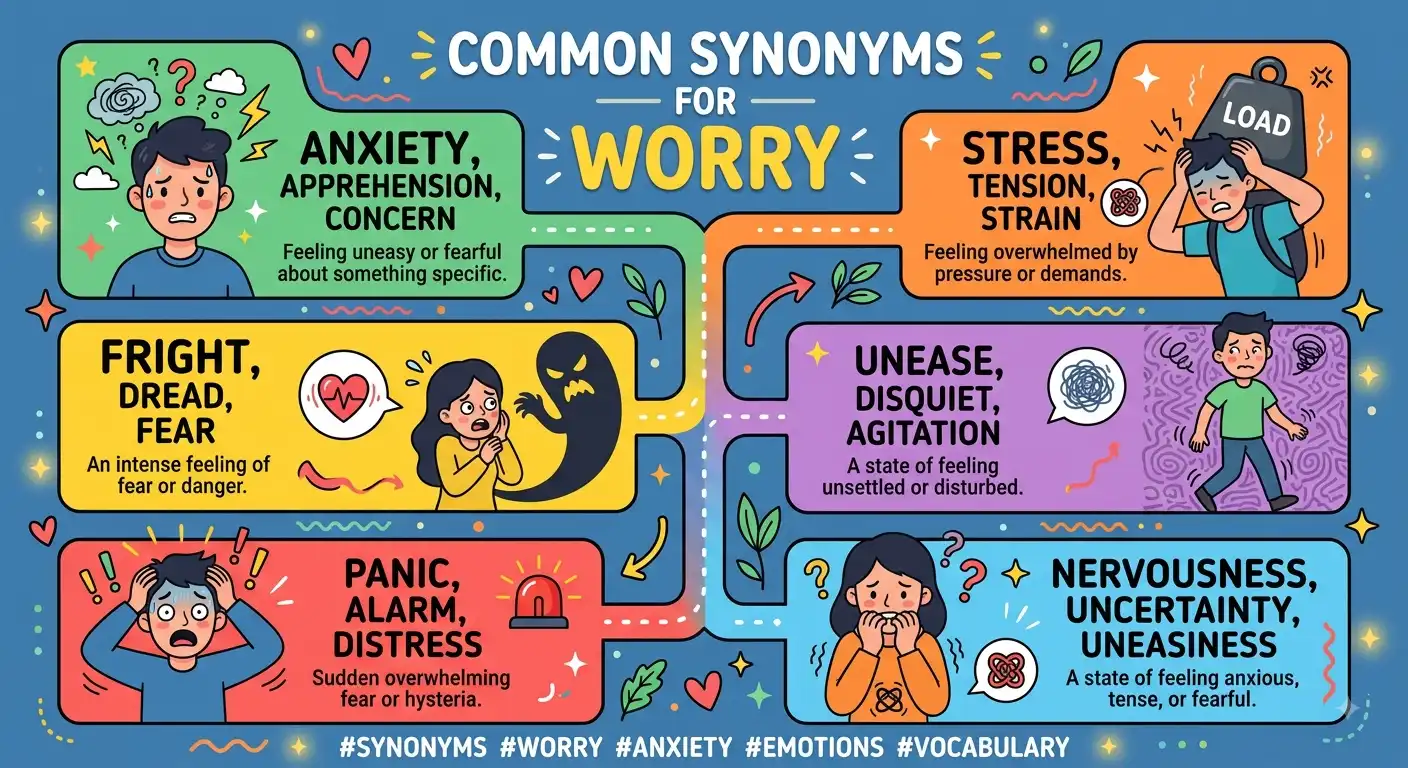
Exploring synonyms for worry helps you express fear, anxiety, and mental stress with accurate clarity. Finding varied synonyms for worry allows you to replace overused words and make your sentences more engaging. When you use exact synonyms for worry, your writing becomes vivid, clear, and easy for readers to follow.
Picture a student sitting at a quiet desk late at night before a big exam. Tapping a pencil against the wooden table, the student feels a knot in the stomach. That uneasy feeling of fear about what might happen next is what we call worry. You can describe this exact emotion using words like anxiety, concern, dread, or tension.
Using fresh words for worry is very helpful for:
- Students: Express complex feelings in essays and earn higher grades.
- Bloggers: Keep readers hooked with emotional and vivid stories.
- Content Writers: Write sharp headlines and strong empathetic copy.
- Daily English Users: Speak naturally and share your thoughts with ease.
“Worry does not empty tomorrow of its sorrow, it empties today of its strength.” — Corrie ten Boom
“Worrying is like paying a debt you don’t owe.” — Mark Twain
Word Profile: Worry
Connotative Meaning
The word worry carries a tense, uneasy, and uncomfortable feeling. It describes a restless mind that focuses on trouble, danger, or unwanted outcomes in the future.
Etymology (Origin)
- Old English Root: Wyrgan (meaning “to strangle, choke, or bite”)
- Middle English: Evolved into worien (meaning “to harass, attack, or cause distress”)
- Original Meaning: “To strangle or seize by the throat”
- Modern Shift: Shifted in the 19th century to mean “mental choking or anxiety.”
Pronunciation
- US IPA: /ˈwɝ.i/
- UK IPA: /ˈwʌr.i/
Syllables & Affixation
- Syllables: wor-ry (2 syllables)
- Root: Worry (uneasy mental state)
- Suffix: Base noun/verb (can take suffixes like -ing, -ied, -ier)
Comparison Table: Popular Synonyms for Worry
| Keyword | Meaning | Usage Type | Context |
| Worry | Feeling uneasy or troubled about potential problems. | Neutral / Everyday | Family, health, school, work |
| Anxiety | Strong feeling of nervousness and fear about the future. | Medical / Emotional | Tests, speeches, health, safety |
| Concern | Caring thought mixed with mild unease about something. | Professional / Polite | Work projects, friends, rules |
| Dread | Deep fear of something terrible that is coming soon. | Dramatic / Serious | Doctor visits, bad news, storms |
| Stress | Mental pressure caused by difficult situations. | Practical / Workplace | Deadlines, money, hard tasks |
| Panic | Sudden, uncontrollable fear that leads to quick action. | Intense / Urgent | Fires, emergencies, lost items |
| Misgiving | A quiet feeling of doubt about a choice or plan. | Thoughtful / Formal | Business choices, travel, deals |
50 Best Synonyms for Worry
1. Anxiety
- Pronunciation: US: /æŋˈzaɪ.ə.t̬i/ | UK: /æŋˈzaɪ.ə.ti/
- Meaning: A strong feeling of fear and nervousness about what might happen.
- Examples:
- She felt deep anxiety before speaking on stage.
- Loud thunder gave the young child anxiety.
2. Concern
- Pronunciation: US: /kənˈsɝːn/ | UK: /kənˈsɜːn/
- Meaning: A caring thought mixed with worry about a person or task.
- Examples:
- The doctor showed genuine concern for his patient.
- Dark clouds raised concern among the farmers.
3. Fear
- Pronunciation: US: /fɪr/ | UK: /fɪə/
- Meaning: An unpleasant feeling caused by real or imagined danger.
- Examples:
- He conquered his fear of swimming in deep water.
- She looked down from the bridge with fear.
4. Stress
- Pronunciation: US: /strɛs/ | UK: /stres/
- Meaning: Mental or physical tension caused by difficult life problems.
- Examples:
- Daily yoga helps lower mental stress after work.
- Too many tasks caused him a lot of stress.
5. Unease
- Pronunciation: US: /ʌnˈiːz/ | UK: /ʌnˈiːz/
- Meaning: A quiet feeling that something is not right or safe.
- Examples:
- She felt a sudden sense of unease in the dark room.
- Strange noises caused unease among the campers.
6. Apprehension
- Pronunciation: US: /ˌæp.rəˈhɛn.ʃən/ | UK: /ˌæp.rɪˈhen.ʃən/
- Meaning: Nervous feeling about something bad that might happen soon.
- Examples:
- He stepped into the test room with apprehension.
- She waited for her final grades with apprehension.
7. Nervousness
- Pronunciation: US: /ˈnɝː.vəs.nəs/ | UK: /ˈnɜː.vəs.nəs/
- Meaning: The restless state of feeling easily scared or excited.
- Examples:
- Her trembling hands showed her inner nervousness.
- A warm cup of tea helped soothe his nervousness.
8. Dread
- Pronunciation: US: /drɛd/ | UK: /dred/
- Meaning: Great fear of facing a future bad event.
- Examples:
- He filled with dread at the thought of visiting the dentist.
- She faced the cold winter morning with dread.
9. Distress
- Pronunciation: US: /dɪˈstrɛs/ | UK: /dɪˈstres/
- Meaning: Great pain, sadness, or mental suffering caused by hardship.
- Examples:
- The lost puppy was in clear distress.
- She sent a fast message to report her distress.
10. Alarm
- Pronunciation: US: /əˈlɑːrm/ | UK: /əˈlɑːm/
- Meaning: Sudden fear caused by realizing danger is near.
- Examples:
- The loud siren caused sudden alarm in the street.
- She looked at the rising smoke with alarm.
11. Agony
- Pronunciation: US: /ˈæɡ.ə.ni/ | UK: /ˈæɡ.ə.ni/
- Meaning: Extreme physical pain or deep mental suffering.
- Examples:
- Waiting for bad news put him in mental agony.
- She suffered great agony from her broken leg.
12. Anguish
- Pronunciation: US: /ˈæŋ.ɡwɪʃ/ | UK: /ˈæŋ.ɡwɪʃ/
- Meaning: Severe mental pain and deep sorrow over a loss.
- Examples:
- The crying mother felt deep anguish over her lost ring.
- He expressed his anguish through a sad poem.
13. Agitation
- Pronunciation: US: /ˌædʒ.əˈteɪ.ʃən/ | UK: /ˌædʒ.ɪˈteɪ.ʃən/
- Meaning: A restless, excited state of mental confusion and trouble.
- Examples:
- He paced across the floor in deep agitation.
- Loud voices caused great agitation in the crowd.
14. Disquiet
- Pronunciation: US: /dɪsˈkwaɪ.ət/ | UK: /dɪsˈkwaɪ.ət/
- Meaning: A calm feeling of mental worry that will not go away.
- Examples:
- Strange news created disquiet across the quiet town.
- She felt a deep disquiet about the new plan.
15. Panic
- Pronunciation: US: /ˈpæn.ɪk/ | UK: /ˈpæn.ɪk/
- Meaning: Sudden wild fear that prevents calm and sensible thought.
- Examples:
- The crowd ran in panic when the fire alarm sounded.
- Stay calm and do not let panic guide your choices.
16. Restlessness
- Pronunciation: US: /ˈrɛst.ləs.nəs/ | UK: /ˈrest.ləs.nəs/
- Meaning: The inability to stay still or calm due to worry.
- Examples:
- Her restlessness kept her awake all night long.
- He walked around the garden to cure his restlessness.
17. Tension
- Pronunciation: US: /ˈtɛn.ʃən/ | UK: /ˈten.ʃən/
- Meaning: A strained mental or emotional state built up between people.
- Examples:
- You could feel the heavy tension in the silent room.
- Deep breathing helps ease muscle tension.
18. Misgiving
- Pronunciation: US: /ˌmɪsˈɡɪv.ɪŋ/ | UK: /ˌmɪsˈɡɪv.ɪŋ/
- Meaning: A feeling of doubt or fear about a future choice.
- Examples:
- She had strong misgivings about selling her old house.
- He ignored his misgivings and signed the contract.
19. Trepidation
- Pronunciation: US: /ˌtrɛp.əˈdeɪ.ʃən/ | UK: /ˌtrep.ɪˈdeɪ.ʃən/
- Meaning: A nervous feeling of fear about something you must do.
- Examples:
- With great trepidation, he opened the mysterious letter.
- She knocked on the boss’s door with trepidation.
20. Trouble
- Pronunciation: US: /ˈtrʌb.əl/ | UK: /ˈtrʌb.əl/
- Meaning: Problems or difficulty that bring pain and mental stress.
- Examples:
- He shared his family troubles with his best friend.
- Hard work helped them avoid money troubles.
“If you want to test your memory, try to recall what you were worrying about this time last year.” — E. Joseph Cossman
21. Perturbation
- Pronunciation: US: /ˌpɝː.t̬ɚˈbeɪ.ʃən/ | UK: /ˌpɜː.təˈbeɪ.ʃən/
- Meaning: A disturbed mental state that upsets your normal calm.
- Examples:
- Her perturbation was clear when her voice trembled.
- He hid his mental perturbation behind a faint smile.
22. Consternation
- Pronunciation: US: /ˌkɑːn.stɚˈneɪ.ʃən/ | UK: /ˌkɒn.stəˈneɪ.ʃən/
- Meaning: A feeling of shock and worry caused by unexpected bad news.
- Examples:
- To her consternation, the train had already left.
- The sudden bad weather caused consternation among guests.
23. Suspense
- Pronunciation: US: /səˈspɛns/ | UK: /səˈspens/
- Meaning: An excited and nervous state while waiting for news or events.
- Examples:
- The final movie scene kept everyone in suspense.
- Waiting for test results built up painful suspense.
24. Hesitation
- Pronunciation: US: /ˌhɛz.əˈteɪ.ʃən/ | UK: /ˌhez.ɪˈteɪ.ʃən/
- Meaning: Pausing before acting because you feel unsure or afraid.
- Examples:
- He jumped into the pool without any hesitation.
- Her brief hesitation showed she felt unsure.
25. Uneasiness
- Pronunciation: US: /ʌnˈiː.zi.nəs/ | UK: /ʌnˈiː.zi.nəs/
- Meaning: The physical or mental state of feeling worried and restless.
- Examples:
- A sense of uneasiness filled the quiet dark hallway.
- His quiet behavior caused uneasiness in his family.
26. Fretfulness
- Pronunciation: US: /ˈfrɛt.fəl.nəs/ | UK: /ˈfret.fəl.nəs/
- Meaning: Being easily unhappy, annoyed, or worried about small things.
- Examples:
- The tired baby showed fretfulness before falling asleep.
- Her fretfulness vanished after a good home meal.
27. Care
- Pronunciation: US: /kɛr/ | UK: /keə/
- Meaning: Heavy mental effort or burden caused by troubles and duties.
- Examples:
- The old man looked free from all worldly care.
- She carried the heavy care of her family on her shoulders.
28. Discomfort
- Pronunciation: US: /dɪsˈkʌm.fɚt/ | UK: /dɪsˈkʌm.fət/
- Meaning: A minor feeling of mental strain or physical awkwardness.
- Examples:
- The stiff chair caused him physical discomfort.
- She felt social discomfort at the large formal party.
29. Solicitousness
- Pronunciation: US: /səˈlɪs.ə.t̬əs.nəs/ | UK: /səˈlɪs.ɪ.təs.nəs/
- Meaning: Caring worry and eager attention paid to someone’s needs.
- Examples:
- Her mother showed loving solicitousness during her fever.
- We appreciated his solicitousness while we were sick.
30. Jitters
- Pronunciation: US: /ˈdʒɪt̬.ɚz/ | UK: /ˈdʒɪt.əz/
- Meaning: A nervous feeling that makes your body shake slightly.
- Examples:
- She drank warm water to calm her morning jitters.
- The actor had bad jitters right before opening night.
31. Nerves
- Pronunciation: US: /nɝːvz/ | UK: /nɜːvz/
- Meaning: Feelings of fear or excitement that make you worry.
- Examples:
- He tried to calm his nerves before his job interview.
- Playing music helps settle her pre-game nerves.
32. Timidity
- Pronunciation: US: /təˈmɪd.ə.t̬i/ | UK: /tɪˈmɪd.ə.ti/
- Meaning: Being shy, hesitant, and easily scared by new things.
- Examples:
- His natural timidity made it hard to make new friends.
- Overcoming timidity takes practice and steady courage.
33. Foreboding
- Pronunciation: US: /fɔːrˈboʊ.dɪŋ/ | UK: /fɔːˈbəʊ.dɪŋ/
- Meaning: A strong gut feeling that something evil is about to happen.
- Examples:
- Dark clouds gave her a strange feeling of foreboding.
- He walked down the empty lane with foreboding.
34. Despair
- Pronunciation: US: /dɪˈspɛr/ | UK: /dɪˈspeə/
- Meaning: The total loss of hope that brings heavy sadness and worry.
- Examples:
- Do not give up or fall into quiet despair.
- Her words brought hope to people in deep despair.
35. Gloom
- Pronunciation: US: /ɡluːm/ | UK: /ɡluːm/
- Meaning: A state of dark sadness, low spirits, and constant worry.
- Examples:
- The rain added to the gloom of the quiet afternoon.
- His cheerful joke broke the heavy gloom in the room.
36. Flutter
- Pronunciation: US: /ˈflʌt̬.ɚ/ | UK: /ˈflʌt.ə/
- Meaning: A quick, light feeling of nervous excitement in your chest.
- Examples:
- She felt a flutter of nervousness when her name was called.
- His heart gave a flutter when he saw the stage.
37. Tremor
- Pronunciation: US: /ˈtrɛm.ɚ/ | UK: /ˈtrem.ə/
- Meaning: A slight shaking movement in your voice or body caused by fear.
- Examples:
- There was a small tremor in her voice as she spoke.
- His hands showed a sudden tremor from cold fear.
38. Shock
- Pronunciation: US: /ʃɑːk/ | UK: /ʃɒk/
- Meaning: A sudden unpleasant surprise that leaves you feeling stunned.
- Examples:
- The sudden news came as a complete shock to us.
- She stood in silent shock after hearing the roar.
39. Strain
- Pronunciation: US: /streɪn/ | UK: /streɪn/
- Meaning: Severe pressure placed on your mind, strength, or body.
- Examples:
- Working long hours puts a heavy strain on your health.
- The family felt the financial strain of moving.
40. Doubt
- Pronunciation: US: /daʊt/ | UK: /daʊt/
- Meaning: A feeling of not being sure about facts or choices.
- Examples:
- I have no doubt that you will pass your exam.
- She cleared every doubt by asking direct questions.
41. Perplexity
- Pronunciation: US: /pɚˈplɛk.sə.t̬i/ | UK: /pəˈplek.sə.ti/
- Meaning: The state of being confused and worried about a hard problem.
- Examples:
- He looked at the hard math riddle in total perplexity.
- Her deep perplexity faded once the rule was explained.
42. Disquietude
- Pronunciation: US: /dɪsˈkwaɪ.ə.tuːd/ | UK: /dɪsˈkwaɪ.ə.tjuːd/
- Meaning: A state of lasting mental anxiety and peacefulness lost.
- Examples:
- Political news caused disquietude across the nation.
- He tried to hide his inner disquietude from his team.
43. Turmoil
- Pronunciation: US: /ˈtɝː.mɔɪl/ | UK: /ˈtɜː.mɔɪl/
- Meaning: A state of great disturbance, confusion, and mental anger.
- Examples:
- Her mind was in complete turmoil after the argument.
- Quiet walks helped calm his inner emotional turmoil.
44. Qualm
- Pronunciation: US: /kwɑːm/ | UK: /kwɑːm/
- Meaning: A sudden feeling of doubt or hesitation about an action.
- Examples:
- He had no qualms about speaking the plain truth.
- She felt a minor qualm before leaving home alone.
45. Discomposure
- Pronunciation: US: /ˌdɪs.kəmˈpoʊ.ʒɚ/ | UK: /ˌdɪs.kəmˈpəʊ.ʒə/
- Meaning: Loss of calm behavior caused by embarrassing or shocking news.
- Examples:
- Her sudden discomposure showed that she was guilty.
- He quickly hid his discomposure with a quiet smile.
46. Heavyheartedness
- Pronunciation: US: /ˌhɛv.iˈhɑːr.t̬ɪd.nəs/ | UK: /ˌhev.iˈhɑː.tɪd.nəs/
- Meaning: A heavy feeling of sadness and worry inside your chest.
- Examples:
- She packed her bags with deep heavyheartedness.
- His heavyheartedness softened when his friend arrived.
47. Suspicion
- Pronunciation: US: /səˈspɪʃ.ən/ | UK: /səˈspɪʃ.ən/
- Meaning: A feeling that something is wrong or someone is dishonest.
- Examples:
- His strange answer raised suspicion among police.
- She treated the unknown message with caution and suspicion.
48. Fluster
- Pronunciation: US: /ˈflʌs.tɚ/ | UK: /ˈflʌs.tə/
- Meaning: A confused and agitated state caused by rush or fear.
- Examples:
- Being late put her in a terrible fluster.
- Try not to let loud sounds fluster your work.
49. Suspensefulness
- Pronunciation: US: /səˈspɛns.fəl.nəs/ | UK: /səˈspens.fəl.nəs/
- Meaning: The quality of holding your interest through worry and excitement.
- Examples:
- The suspensefulness of the story kept readers reading.
- I love the dark suspensefulness of mystery novels.
50. Misery
- Pronunciation: US: /ˈmɪz.ɚ.i/ | UK: /ˈmɪz.ər.i/
- Meaning: Great suffering, discomfort, and unhappy mind.
- Examples:
- Hot soup brought relief to his winter cold misery.
- They helped rescue people from flood misery.
Antonyms of Worry
To understand worry fully, review these direct opposite words:
- Calm: Freedom from motion, noise, or mental agitation.
- Peace: A state of quiet mind and freedom from fear or war.
- Comfort: Ease from pain, trouble, or physical hardship.
- Reassurance: Words or actions that restore confidence and quiet fear.
- Tranquility: The state of being peaceful, quiet, and untroubled.
Prototype Meaning and Categorization of Worry
We can organize these 50 synonyms into 5 simple buckets to help you select the exact word you need:
- Intense Fear & Dread (Extreme Panic):
- Fear, Dread, Panic, Terror, Agony, Anguish, Shock, Despair, Foreboding, Misery.
- Nervous Body Signals (Physical Jitters):
- Jitters, Nerves, Flutter, Tremor, Restlessness, Agitation, Fluster, Tension, Discomposure, Strain.
- Mental Doubt & Confusion (Unsure Thoughts):
- Misgiving, Hesitation, Doubt, Perplexity, Qualm, Suspicion, Disquietude, Turmoil, Suspensefulness, Perturbation.
- Gentle & Caring Concern (Thoughtful Worry):
- Concern, Care, Solicitousness, Unease, Disquiet, Uneasiness, Fretfulness, Timidity, Discomfort, Heavyheartedness.
- Workplace & Daily Stress (General Tension):
- Anxiety, Stress, Apprehension, Nervousness, Distress, Alarm, Trouble, Consternation, Suspense, Gloom.
Frequently Asked Questions (FAQ)
What is the best general synonym for worry?
The best general synonym for worry is anxiety for inner emotional stress and concern for thoughtful care about a situation.
What is the difference between worry and stress?
Worry happens primarily in your thoughts when you picture bad outcomes. Stress is the physical and mental tension your body feels when facing hard tasks or heavy pressure.
What formal synonym for worry is used in business?
In formal or corporate writing, use terms like concern, misgiving, apprehension, or disquietude.
Which synonym for worry best describes physical symptoms?
When describing physical trembling or nervousness, words like jitters, nerves, tremor, or flutter work best.
How do synonyms for worry improve my writing?
Using varied synonyms keeps your writing fresh. Replacing repetitive uses of “worry” with dread, apprehension, or unease paints a clearer emotional picture for your readers.
What is the adjective form of worry?
The main adjective forms are worried (feeling worry) and worrying (causing worry).
Conclusion
Learning fresh synonyms for worry expands your daily vocabulary and lifts your writing skills. When you replace overused words with precise terms like anxiety, dread, apprehension, or solicitousness, your descriptions become much clearer and far more engaging to read.
For students, bloggers, and content writers, using varied synonyms for worry keeps your audience connected from start to finish. Good communication comes down to choosing the perfect word for every context. Start using these 50 synonyms for worry in your emails, essays, and everyday conversations today!
“Do not anticipate trouble, or worry about what may never happen. Keep in the sunlight.” — Benjamin Franklin
“Trust yourself. You’ve survived a lot, and you’ll survive whatever is coming.” — Robert Tew

Andrew Collins is an academic English educator with over 12 years of experience helping university students, IELTS candidates, and ESL learners improve their writing vocabulary.