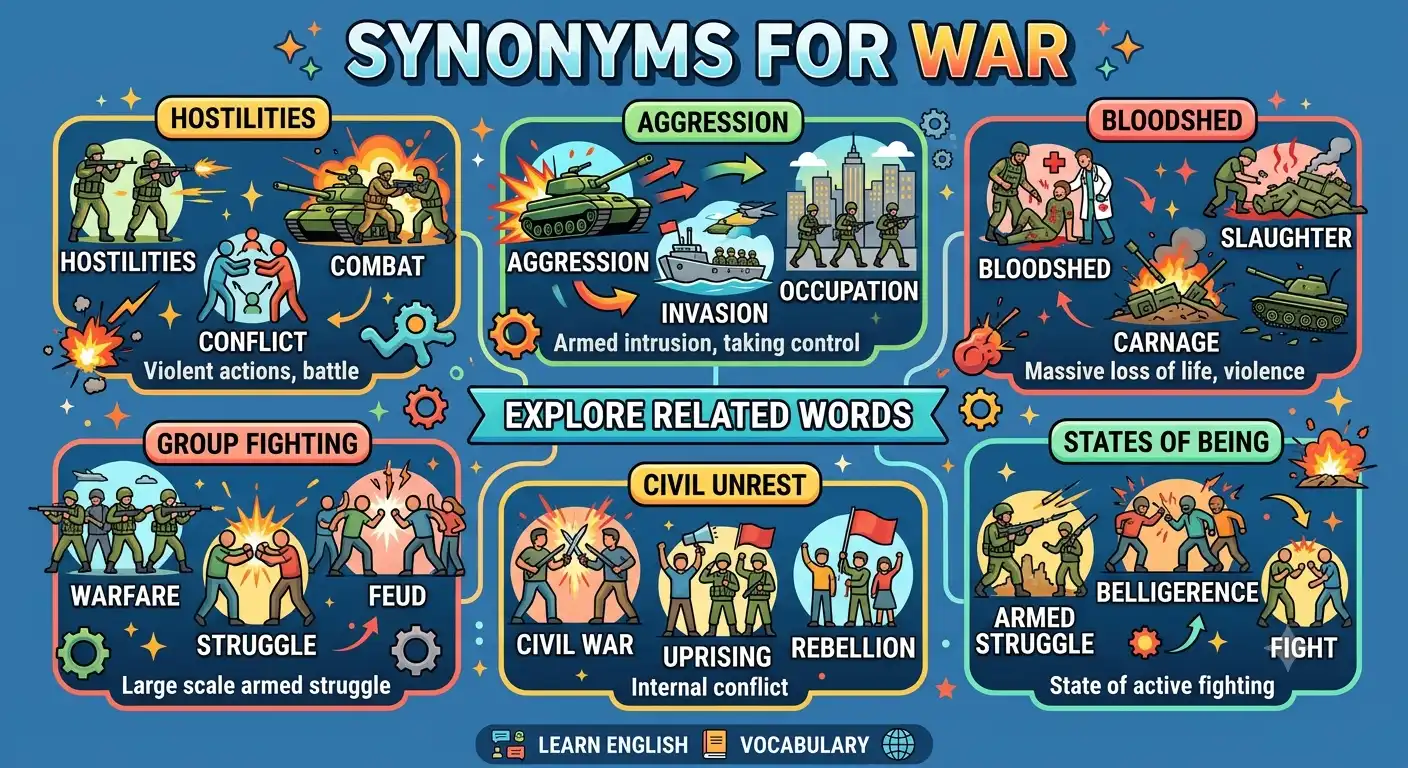
Exploring useful synonyms for war helps you accurately express violent struggles, intense conflicts, and military battles. When you learn synonyms for war, you gain the precise words needed to discuss historical events and interpersonal disputes clearly. Mastering diverse synonyms for war enriches your vocabulary and makes your spoken and written English far more expressive.
A history teacher stands before a classroom explaining the dramatic events of the mid-twentieth century. Repeating the same term dozens of times makes an important lesson feel repetitive and dull. By varying your language, you make historical accounts and storytelling far more compelling. An actual war involves organized armed conflict between armies, nations, or opposing groups.
“Peace cannot be kept by force; it can only be achieved by understanding.” — Albert Einstein
In simple Grade 3 English, war means a long, violent fight between countries, groups, or armies using weapons and force.
“The supreme art of war is to subdue the enemy without fighting.” — Sun Tzu
Building a strong collection of synonyms for war helps many types of communicators:
- Students can write engaging history papers without repeating identical words.
- Bloggers can describe intense political news, social debates, and gaming stories vividly.
- Content writers can craft sharp articles on history, strategic management, and military affairs.
- Daily English users can describe heated arguments, heavy competition, and personal struggles accurately.
Linguistic Breakdown of “War”
Connotative Meaning
The noun war carries a heavily negative emotional tone. It brings to mind images of destruction, loss, aggression, tragedy, and intense hostility between groups.
Etymology
- Prefix/Suffix: None (base root word).
- Root Word: Werre (Late Old English / Old French word meaning “strife” or “confusion”).
- Historical Path: Derived from Proto-Germanic werra (meaning “to bring into confusion” or “to mix up”), entering Middle English as werre before evolving into the modern English noun war.
Pronunciation
- US IPA: /wɔːr/
- UK IPA: /wɔː/
Syllables & Affixation Pattern
- Syllables: 1 (war)
- Root Word: War
- Affixation: None.
Comparison Table of Key Synonyms
| Keyword | Meaning | Usage Type | Context |
|---|---|---|---|
| Conflict | A serious disagreement or military fight | Formal / Analytical | Politics, personal disagreements, warfare |
| Battle | A single fight between military forces | Descriptive / Historical | Military campaigns, sports, health struggles |
| Combat | Fighting between armed forces or people | Military / Direct | Frontline action, martial arts, competition |
| Warfare | The activity or methods of fighting a war | Technical / General | Military strategy, cyber attacks, trade disputes |
| Skirmish | A short, minor fight between small groups | Casual / Descriptive | Minor military events, small arguments |
| Hostility | Unfriendly behavior or active fighting | Emotional / Formal | International relations, bad personal relations |
| Strife | Angry disagreement or trouble over time | Literary / Expressive | Social issues, family arguments, politics |
| Clash | A sudden, sharp fight or disagreement | Dynamic / News | Protests, sports matches, political debates |
Main Content – 50 Synonyms for War
“Older men declare war. But it is youth that must fight and die.” — Herbert Hoover
1. Conflict
- Pronunciation: US: /ˈkɑːn.flɪkt/ | UK: /ˈkɒn.flɪkt/
- Meaning: Conflict means a heavy fight or strong disagreement between opposing sides.
- Examples:
- The two countries resolved their long conflict peacefully.
- Neighboring teams entered a harsh conflict over field rules.
2. Battle
- Pronunciation: US: /ˈbæt̬.əl/ | UK: /ˈbæt.əl/
- Meaning: Battle means a specific fight between armies during a larger fight.
- Examples:
- Soldiers fought a hard battle on top of the steep hill.
- Our local team won the final battle for the trophy.
3. Combat
- Pronunciation: US: /ˈkɑːm.bæt/ | UK: /ˈkɒm.bæt/
- Meaning: Combat means direct physical fighting between armed forces or individuals.
- Examples:
- Troops prepared for close combat inside the ruined city.
- He learned martial arts for self-defense and hand combat.
4. Warfare
- Pronunciation: US: /ˈwɔːr.fer/ | UK: /ˈwɔː.feər/
- Meaning: Warfare means the methods and activities used in carrying out a war.
- Examples:
- Modern warfare relies heavily on computers and technology.
- Ancient armies changed their style of mountain warfare.
5. Clash
- Pronunciation: US: /klæʃ/ | UK: /klæʃ/
- Meaning: Clash means a sudden violent fight or loud disagreement.
- Examples:
- Police stopped a sharp clash between two rival groups.
- Their different ideas caused a quick clash during the meeting.
6. Hostility
- Pronunciation: US: /hɑːˈstɪl.ə.t̬i/ | UK: /hɒˈstɪl.ə.ti/
- Meaning: Hostility means active unfriendliness or open aggressive action.
- Examples:
- Both nations showed intense hostility toward each other.
- The store manager worked to reduce hostility among workers.
7. Strife
- Pronunciation: US: /straɪf/ | UK: /straɪf/
- Meaning: Strife means angry or violent disagreement over a long period.
- Examples:
- The country suffered through years of painful civil strife.
- Money problems often lead to bitter family strife.
8. Feud
- Pronunciation: US: /fjuːd/ | UK: /fjuːd/
- Meaning: Feud means a long angry fight between two families or groups.
- Examples:
- A long feud kept the neighboring farmers from talking.
- The two musicians ended their long public feud today.
9. Fight
- Pronunciation: US: /faɪt/ | UK: /faɪt/
- Meaning: Fight means using physical force or strong words against someone.
- Examples:
- The two boxers put on an exciting fight last night.
- Neighbors started a loud fight over the parking spot.
10. Struggle
- Pronunciation: US: /ˈstrʌɡ.əl/ | UK: /ˈstrʌɡ.əl/
- Meaning: Struggle means a hard effort to defeat a difficult opponent or problem.
- Examples:
- The army faced a tough struggle to protect the city borders.
- She won her long personal struggle against illness.
11. Action
- Pronunciation: US: /ˈæk.ʃən/ | UK: /ˈæk.ʃən/
- Meaning: Action means armed military fighting against an enemy force.
- Examples:
- Brave soldiers saw heavy action near the riverbank.
- The captain led his unit into action early this morning.
12. Engagement
- Pronunciation: US: /ɪnˈɡeɪdʒ.mənt/ | UK: /ɪnˈɡeɪdʒ.mənt/
- Meaning: Engagement means a formal military fight between armed forces.
- Examples:
- Naval ships entered a brief engagement near the island.
- The general planned every military engagement with great care.
13. Skirmish
- Pronunciation: US: /ˈskɝː.mɪʃ/ | UK: /ˈskɜː.mɪʃ/
- Meaning: Skirmish means a small short fight between minor groups of troops.
- Examples:
- Patrol troops engaged in a brief skirmish near the border.
- A minor skirmish broke out outside the voting center.
14. Confrontation
- Pronunciation: US: /ˌkɑːn.frənˈteɪ.ʃən/ | UK: /ˌkɒn.frʌnˈteɪ.ʃən/
- Meaning: Confrontation means a direct angry face-to-face meeting or fight.
- Examples:
- The leaders met to avoid a dangerous nuclear confrontation.
- A loud confrontation happened between the driver and police.
15. Dispute
- Pronunciation: US: /dɪˈspjuːt/ | UK: /dɪˈspjuːt/
- Meaning: Dispute means a strong argument or disagreement over an issue.
- Examples:
- The border dispute lasted for almost twenty years.
- Both companies settled their contract dispute in court.
16. Discord
- Pronunciation: US: /ˈdɪs.kɔːrd/ | UK: /ˈdɪs.kɔːd/
- Meaning: Discord means a lack of agreement or harmony between people or groups.
- Examples:
- Unfair rules created deep discord among factory workers.
- Political discord kept the council from making decisions.
17. Contention
- Pronunciation: US: /kənˈten.ʃən/ | UK: /kənˈten.ʃən/
- Meaning: Contention means angry disagreement or competing for control.
- Examples:
- The piece of land remained a point of continuous contention.
- Bitter contention arose between candidates during the debate.
18. Aggression
- Pronunciation: US: /əˈɡreʃ.ən/ | UK: /əˈɡreʃ.ən/
- Meaning: Aggression means forceful, angry, or violent action against another.
- Examples:
- The peacekeepers worked to stop foreign aggression quickly.
- The dog showed sudden aggression toward the stranger.
19. Hostilities
- Pronunciation: US: /hɑːˈstɪl.ə.t̬iːz/ | UK: /hɒˈstɪl.ə.tiːz/
- Meaning: Hostilities means active acts of war and fighting between armies.
- Examples:
- Both sides agreed to end hostilities at midnight.
- Hostilities broke out along the desert border today.
20. Bloodshed
- Pronunciation: US: /ˈblʌd.ʃed/ | UK: /ˈblʌd.ʃed/
- Meaning: Bloodshed means the killing or wounding of people during fighting.
- Examples:
- The treaty helped stop unnecessary bloodshed in the valley.
- Leaders called for peace to prevent further bloodshed.
21. Carnage
- Pronunciation: US: /ˈkɑːr.nɪdʒ/ | UK: /ˈkɑː.nɪdʒ/
- Meaning: Carnage means the killing of a large number of people.
- Examples:
- Medics ran onto the field to help after the horrific carnage.
- The horrific war left terrible carnage across the countryside.
22. Opposition
- Pronunciation: US: /ˌɑː.pəˈzɪʃ.ən/ | UK: /ˌɒp.əˈzɪʃ.ən/
- Meaning: Opposition means strong disagreement or fighting against an enemy.
- Examples:
- Soldiers faced heavy opposition while advancing up the road.
- Political opposition grew stronger after the new tax law.
23. Rivalry
- Pronunciation: US: /ˈraɪ.vəl.ri/ | UK: /ˈraɪ.vəl.ri/
- Meaning: Rivalry means a long competition for power, success, or victory.
- Examples:
- A fierce rivalry exists between the two local football teams.
- The trade rivalry between nations lasted for decades.
24. Friction
- Pronunciation: US: /ˈfrɪk.ʃən/ | UK: /ˈfrɪk.ʃən/
- Meaning: Friction means disagreement or tension between people with different views.
- Examples:
- Money problems caused continuous friction between partners.
- Diplomats met to ease the growing friction between states.
25. Row
- Pronunciation: US: /raʊ/ | UK: /raʊ/
- Meaning: Row means a noisy, angry argument between people.
- Examples:
- The neighbors got into a loud row over the tall fence.
- A public row erupted over the new city budget plan.
26. Quarrel
- Pronunciation: US: /ˈkwɔːr.əl/ | UK: /ˈkwɒr.əl/
- Meaning: Quarrel means an angry argument or disagreement about something personal.
- Examples:
- Children often have a brief quarrel over shared toys.
- They patched up their old quarrel and became friends.
27. Altercation
- Pronunciation: US: /ˌɑːl.tɚˈkeɪ.ʃən/ | UK: /ˌɒl.təˈkeɪ.ʃən/
- Meaning: Altercation means a noisy and angry public argument or fight.
- Examples:
- Guards stopped a physical altercation in the parking lot.
- A verbal altercation began after the minor car bump.
28. Scuffle
- Pronunciation: US: /ˈskʌf.əl/ | UK: /ˈskʌf.əl/
- Meaning: Scuffle means a quick, confused fight between a few people.
- Examples:
- A short scuffle broke out outside the sports stadium.
- Officers stepped in to break up the sudden crowd scuffle.
29. Melee
- Pronunciation: US: /ˈmeɪ.leɪ/ | UK: /ˈmel.eɪ/
- Meaning: Melee means a wild, confused fight involving a large crowd.
- Examples:
- Shoppers pushed into a chaotic melee during the huge sale.
- Players were caught in a sudden melee on the field.
30. Tussle
- Pronunciation: US: /ˈtʌs.əl/ | UK: /ˈtʌs.əl/
- Meaning: Tussle means a hard physical fight or struggle for control.
- Examples:
- Two players got into a tussle for the loose ball.
- The politicians faced a tough tussle over the new bill.
31. Assault
- Pronunciation: US: /əˈsɑːlt/ | UK: /əˈsɒlt/
- Meaning: Assault means a sudden and violent attack against an opponent.
- Examples:
- Armed forces launched a nighttime assault on the fortress.
- The team opened a strong offensive assault in the game.
32. Offensive
- Pronunciation: US: /əˈfen.sɪv/ | UK: /əˈfen.sɪv/
- Meaning: Offensive means a planned military attack involving large armed forces.
- Examples:
- The army started a major spring offensive across the river.
- Troops advanced rapidly during the morning offensive.
33. Siege
- Pronunciation: US: /siːdʒ/ | UK: /siːdʒ/
- Meaning: Siege means surrounding a place with an army to force surrender.
- Examples:
- The ancient castle survived a long nine-month siege.
- Enemies laid siege to the capital city during winter.
34. Crusade
- Pronunciation: US: /kruːˈseɪd/ | UK: /kruːˈseɪd/
- Meaning: Crusade means an aggressive campaign for a cause or against an idea.
- Examples:
- She led a public crusade against plastic ocean waste.
- Medieval knights joined a long crusade across foreign lands.
35. Campaign
- Pronunciation: US: /kæmˈpeɪn/ | UK: /kæmˈpeɪn/
- Meaning: Campaign means a series of planned military operations in an area.
- Examples:
- The military campaign lasted through the cold winter months.
- Generals organized a fast air campaign over the region.
36. Onslaught
- Pronunciation: US: /ˈɑːn.slɑːt/ | UK: /ˈɒn.slɔːt/
- Meaning: Onslaught means a very fierce and powerful sudden attack.
- Examples:
- Soldiers protected the wall against the heavy enemy onslaught.
- The town prepared for a sudden onslaught of bad weather.
37. Attack
- Pronunciation: US: /əˈtæk/ | UK: /əˈtæk/
- Meaning: Attack means an act of using violence to hurt an enemy.
- Examples:
- Jets carried out a surprise attack on enemy supply lines.
- The guards successfully defended the camp against an attack.
38. Encounter
- Pronunciation: US: /ɪnˈkaʊn.t̬ɚ/ | UK: /ɪnˈkaʊn.tər/
- Meaning: Encounter means an unexpected fight or meeting with an enemy force.
- Examples:
- Patrol ships had a dangerous naval encounter near the reef.
- Our unit survived a brief armed encounter in the woods.
39. Collision
- Pronunciation: US: /kəˈlɪʒ.ən/ | UK: /kəˈlɪʒ.ən/
- Meaning: Collision means a violent crash or sharp conflict between opposing forces.
- Examples:
- Political differences led to a dramatic collision of ideas.
- A violent collision occurred between opposing armies.
40. Squabble
- Pronunciation: US: /ˈskwɑː.bəl/ | UK: /ˈskwɒb.əl/
- Meaning: Squabble means a noisy argument over something small or unimportant.
- Examples:
- Siblings often squabble over who gets the last cookie.
- A petty squabble delayed the start of our team meeting.
41. Incursion
- Pronunciation: US: /ɪnˈkɝː.ʒən/ | UK: /ɪnˈkɜː.ʃən/
- Meaning: Incursion means a sudden brief attack or invasion into enemy territory.
- Examples:
- Border guards repelled an unexpected foreign armed incursion.
- Forces made a rapid night incursion behind enemy lines.
42. Invasion
- Pronunciation: US: /ɪnˈveɪ.ʒən/ | UK: /ɪnˈveɪ.ʒən/
- Meaning: Invasion means entering a country with an army to take control.
- Examples:
- The sudden military invasion shocked the entire international community.
- Historical records detail the ancient invasion of the island.
43. Insurgency
- Pronunciation: US: /ɪnˈsɝː.dʒən.si/ | UK: /ɪnˈsɜː.dʒən.si/
- Meaning: Insurgency means an active violent rebellion against an established government.
- Examples:
- Soldiers fought a prolonged insurgency in the mountain regions.
- The peace deal helped end years of painful internal insurgency.
44. Rebellion
- Pronunciation: US: /rɪˈbel.jən/ | UK: /rɪˈbel.jən/
- Meaning: Rebellion means organized violent opposition against rulers or authority.
- Examples:
- Citizens started a broad rebellion against the unfair dictator.
- The guard quickly stopped the peasant rebellion near the gates.
45. Mutiny
- Pronunciation: US: /ˈmjuː.tən.i/ | UK: /ˈmjuː.tɪ.ni/
- Meaning: Mutiny means an open rebellion of soldiers or sailors against leaders.
- Examples:
- Sailors started a daring mutiny aboard the old warships.
- The harsh commander faced a dangerous mutiny among his troops.
46. Uprising
- Pronunciation: US: /ˈʌpˌraɪ.zɪŋ/ | UK: /ˈʌpˌraɪ.zɪŋ/
- Meaning: Uprising means an act of popular resistance and violent revolt.
- Examples:
- Thousands joined the popular uprising demanding freedom and rights.
- The government crushed the armed uprising in the capital.
47. Revolution
- Pronunciation: US: /ˌrev.əˈluː.ʃən/ | UK: /ˌrev.əˈluː.ʃən/
- Meaning: Revolution means a violent overthrow of a system to create new rules.
- Examples:
- The country experienced a bloody revolution during the century.
- Citizens celebrated the anniversary of their nation’s revolution.
48. Hostile Takeover
- Pronunciation: US: /ˈhɑː.stəl ˈteɪkˌoʊ.vɚ/ | UK: /ˈhɒs.taɪl ˈteɪkˌəʊ.vər/
- Meaning: Hostile takeover means an aggressive effort to gain control of another group.
- Examples:
- The big corporation executed a hostile takeover of the firm.
- Board members fought off an unexpected hostile takeover attempt.
49. Cold War
- Pronunciation: US: /koʊld wɔːr/ | UK: /kəʊld wɔː/
- Meaning: Cold War means intense conflict between nations without direct open fighting.
- Examples:
- The long cold war created high tension across Western Europe.
- Both nations engaged in a technological cold war for dominance.
50. Total War
- Pronunciation: US: /ˈtoʊ.t̬əl wɔːr/ | UK: /ˈtəʊ.təl wɔː/
- Meaning: Total war means a fight using every resource and affecting all citizens.
- Examples:
- The nation mobilized all factories to prepare for total war.
- History books describe the catastrophic destruction caused by total war.
Antonyms of “War”
While war describes violent conflict, military combat, and hostility, these antonyms express peace, agreement, and calm:
- Peace: US: /piːs/ | UK: /piːs/ – A state of freedom from war, violence, or fighting.
- Harmony: US: /ˈhɑːr.mə.ni/ | UK: /ˈhɑː.mə.ni/ – A state of peaceful agreement and cooperation.
- Truce: US: /truːs/ | UK: /truːs/ – A temporary agreement to stop fighting or arguing.
- Concord: US: /ˈkɑːn.kɔːrd/ | UK: /ˈkɒŋ.kɔːd/ – State of agreement and peaceful relations between people.
Prototype Meaning and Categorization of “War”
- Grammatical Category: Qualitative / Abstract Noun (can also act as an intransitive verb).
- Prototype Meaning: Armed, open, and prolonged violent conflict between nations, states, or large groups of people.
- Semantic Field: Military affairs, geopolitical conflict, violence, strategy, and political power.
Frequently Asked Questions (FAQ)
1. What is the most common synonym for war?
The most frequent everyday synonyms for war are conflict, battle, combat, and warfare. These terms describe armed fights or major disagreements clearly.
2. What is the difference between “war” and “battle”?
A war refers to the entire long-term period of fighting between nations, while a battle is a single, specific fight taking place within that larger war.
3. Which synonym for war works best in academic essays?
In formal essays and academic papers, terms like armed conflict, hostilities, warfare, and military engagement provide the best analytical tone.
4. Can “war” be used in a non-military context?
Yes, war is often used metaphorically to describe strong struggles against abstract problems, such as a “war on crime,” “war on poverty,” or a “bidding war.”
5. What is the difference between “skirmish” and “war”?
A skirmish is a small, short fight involving few soldiers, whereas a war is a large-scale, widespread, and prolonged conflict.
6. Why should writers learn different synonyms for war?
Using various synonyms for war prevents repetitive phrasing, adds emotional precision, paints clear pictures for readers, and elevates overall writing quality.
Conclusion
Expanding your knowledge of synonyms for war empowers you to express ideas about conflict, competition, and history with clarity and strength. Choosing exact terms like combat, skirmish, hostilities, or strife brings precision and authority to your spoken and written language. Swapping repetitive words keeps your essays, articles, and daily speeches dynamic and interesting for every listener.
“War is what happens when language fails.” — Margaret Atwood
“Words are, in my not-so-humble opinion, our most inexhaustible source of magic.” — J.K. Rowling
Whether you are drafting academic history essays, writing engaging news posts, or taking part in everyday discussions, a rich vocabulary builds lasting confidence. Take time to practice these versatile synonyms in your daily writing habits, and watch your English skills expand naturally.

Andrew Collins is an academic English educator with over 12 years of experience helping university students, IELTS candidates, and ESL learners improve their writing vocabulary.