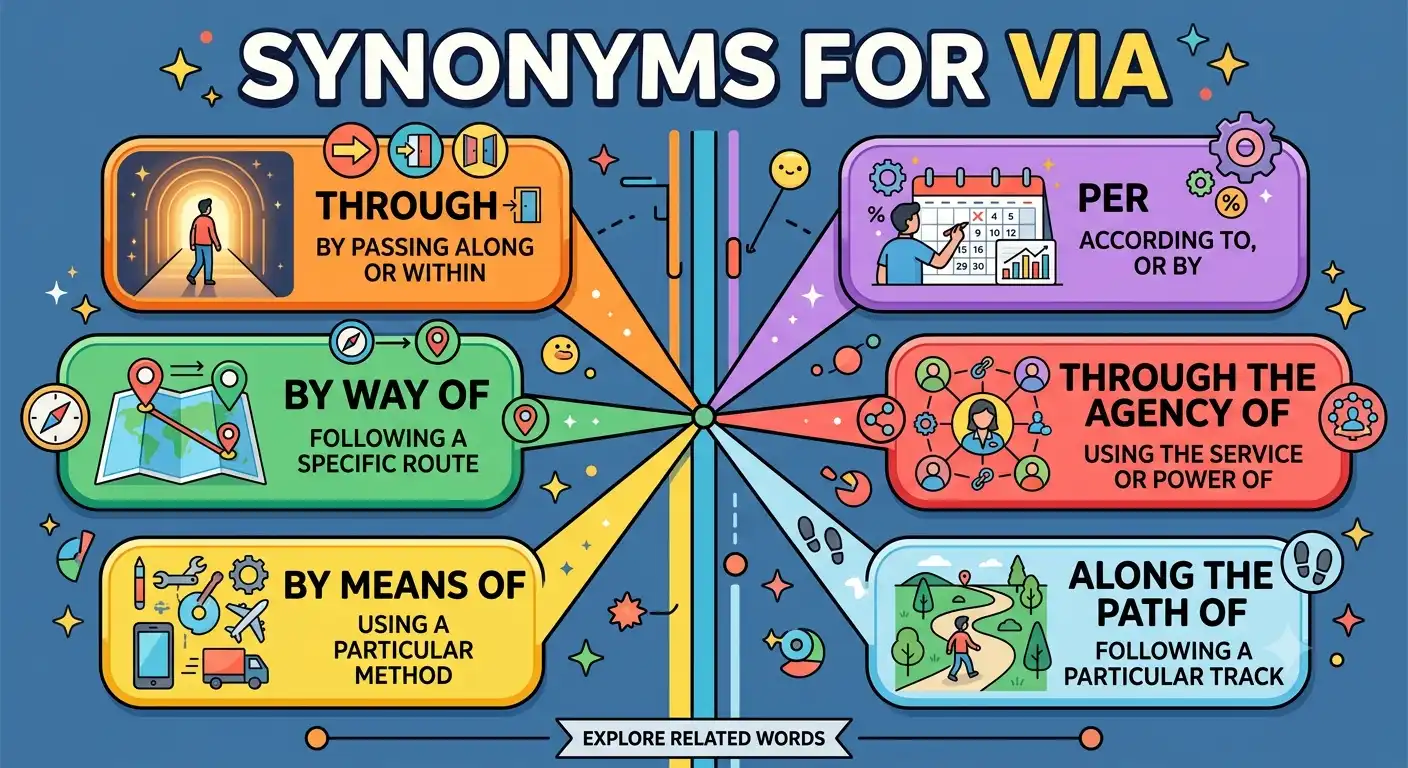
Exploring diverse synonyms for via is one of the easiest ways to make your daily communication clear, flexible, and professional. The preposition via means traveling through a place or sending something by using a specific method or person. When you master different synonyms for via, you improve your writing tone and prevent awkward repetition in your sentences.
Imagine writing a travel itinerary or a work email about sending a project file. If you write the word via five times in two paragraphs, your writing sounds repetitive and stiff. Instead of saying you sent a message “via email” that went “via London,” you can say you sent it “through email” traveling “by way of London.” This quick shift instantly makes your message sound natural and engaging.
In simple terms, via means going through a place or using a tool to do something. This versatile word helps students writing school papers, bloggers sharing travel guides, content writers drafting professional guides, and daily English speakers who want to sound clear. Choosing the right synonyms for via helps you express your exact path or method with ease.
“Language is the road map of a culture. It tells you where its people come from and where they are going.” — Rita Mae Brown
“The limits of my language mean the limits of my world.” — Ludwig Wittgenstein
Linguistic Breakdown of Via
Connotative Meaning
The word via carries a neutral, practical, and slightly formal connotation. It suggests clear direction, logical connection, intermediate steps, and effective delivery methods without emotional bias.
Etymology
- Latin Origin: Direct borrowing from the Latin ablative noun via, meaning “way,” “road,” or “path.”
- 18th Century Adoption: Entered English in the late 1700s primarily to describe travel routes (e.g., traveling to Paris via Calais).
- 20th Century Shift: Expanded beyond physical travel to describe channels of communication, tech systems, and tools (e.g., sent via email).
Pronunciation
- US IPA: /ˈvaɪ.ə/ or /ˈviː.ə/
- UK IPA: /ˈvaɪ.ə/
Syllables & Affixation
- Syllables: 2 (vi-a)
- Prefix: None
- Root: via (Latin for road/way)
- Suffix: None
Comparison Table of Key Synonyms
“Words are a lens to focus one’s mind.” — Ayn Rand
| Keyword | Meaning | Usage Type | Context |
|---|---|---|---|
| Via | By way of or by means of | Neutral / Formal | Travel routes, email delivery, systems |
| Through | From one side to the other or by using | Common / Flexible | Daily speech, work reports, stories |
| By way of | Passing through a specific location | Formal / Descriptive | Directions, itineraries, travel logs |
| By means of | Using a specific tool or method | Professional / Formal | Technical guides, legal documents |
| Using | Employing something to reach a goal | Casual / Neutral | Everyday tasks, tech instructions |
| Over | Across a network or spatial distance | Conversational | Phone calls, radio, internet chats |
| Across | From one side to another | Descriptive | Physical movement, broad networks |
| Per | Through the agency of or by | Formal / Technical | Business memos, transport schedules |
Main Content – 50 Synonyms for Via
1. Through
- Pronunciation: US: /θruː/ | UK: /θruː/
- Meaning: Passing inside something or using a system to reach the end.
- Examples:
- We drove through the long tunnel to reach the city.
- She sent the file through email this morning.
2. By way of
- Pronunciation: US: /baɪ weɪ ʌv/ | UK: /baɪ weɪ ɒv/
- Meaning: Going through a specific town or location on a trip.
- Examples:
- They traveled to Rome by way of Paris.
- The bus returns home by way of the main road.
3. By means of
- Pronunciation: US: /baɪ miːnz ʌv/ | UK: /baɪ miːnz ɒv/
- Meaning: Doing a job by using a tool, system, or plan.
- Examples:
- The door opens by means of a smart key card.
- They solved the puzzle by means of teamwork.
4. Using
- Pronunciation: US: /ˈjuː.zɪŋ/ | UK: /ˈjuː.zɪŋ/
- Meaning: Putting a tool or method into action to complete a task.
- Examples:
- He fixed the wooden chair using a simple hammer.
- You can pay for your food using your phone.
5. Over
- Pronunciation: US: /ˈoʊ.vɚ/ | UK: /ˈəʊ.və/
- Meaning: Moving across a distance or talking through a wire or network.
- Examples:
- We talked over the phone for an hour.
- Signals travel fast over satellite networks.
6. Across
- Pronunciation: US: /əˈkrɑːs/ | UK: /əˈkrɒs/
- Meaning: From one side of a place or medium to another.
- Examples:
- News spread quickly across the entire town.
- They shipped the goods across the deep ocean.
7. Per
- Pronunciation: US: /pɚ/ | UK: /pɜː/
- Meaning: By means of a formal rule, guide, or carrier.
- Examples:
- We delivered the packet per special courier.
- The update was sent per our standard policy.
8. By
- Pronunciation: US: /baɪ/ | UK: /baɪ/
- Meaning: Indicating the person, tool, or road used to do something.
- Examples:
- She likes to travel to work by train.
- The letter was delivered by hand today.
9. En route through
- Pronunciation: US: /ɑːn ruːt θruː/ | UK: /ɒn ruːt θruː/
- Meaning: Moving along a track while passing a specific stop.
- Examples:
- The plane landed en route through Dubai.
- We saw nice hills en route through the country.
10. Courtesy of
- Pronunciation: US: /ˈkɝː.t̬ə.si ʌv/ | UK: /ˈkɜː.tə.si ɒv/
- Meaning: Given or made possible by the help of someone else.
- Examples:
- We got free tickets courtesy of our local club.
- Photos appear on screen courtesy of the museum.
11. Thanks to
- Pronunciation: US: /θæŋks tuː/ | UK: /θæŋks tuː/
- Meaning: Because of the helpful effort of a person or thing.
- Examples:
- We found the museum thanks to your map.
- The crop grew well thanks to good rain.
12. With the aid of
- Pronunciation: US: /wɪð ðə eɪd ʌv/ | UK: /wɪð ðə eɪd ɒv/
- Meaning: Doing a hard task with extra help from a tool or person.
- Examples:
- He climbed the hill with the aid of a staff.
- She read the small print with the aid of glasses.
13. By route of
- Pronunciation: US: /baɪ ruːt ʌv/ | UK: /baɪ ruːt ɒv/
- Meaning: Following a set road or path to reach a final destination.
- Examples:
- The tour bus moves by route of the coast highway.
- Mail travels by route of central sorting hubs.
14. Passing through
- Pronunciation: US: /ˈpæs.ɪŋ θruː/ | UK: /ˈpɑːs.ɪŋ θruː/
- Meaning: Moving into a spot and leaving it quickly on a trip.
- Examples:
- We saw bright lakes while passing through the valley.
- The train is just passing through our small town.
15. Transiting
- Pronunciation: US: /ˈtræn.sɪ.t̬ɪŋ/ | UK: /ˈtræn.zɪ.tɪŋ/
- Meaning: Carrying people or goods across a country or zone.
- Examples:
- Cargo ships are transiting the busy canal right now.
- Passengers are transiting through terminal two today.
16. Channeling through
- Pronunciation: US: /ˈtʃæn.əl.ɪŋ θruː/ | UK: /ˈtʃæn.əl.ɪŋ θruː/
- Meaning: Directing water, money, or thoughts along a clear path.
- Examples:
- They are channeling aid through local community groups.
- Clean water is channeling through the new pipe.
17. Along
- Pronunciation: US: /əˈlɑːŋ/ | UK: /əˈlɒŋ/
- Meaning: Moving in a line parallel to a road, river, or path.
- Examples:
- We walked along the river path at sunset.
- Bright street lights stand along the busy highway.
18. Through the agency of
- Pronunciation: US: /θruː ðə ˈeɪ.dʒən.si ʌv/ | UK: /θruː ðə ˈeɪ.dʒən.si ɒv/
- Meaning: Getting an outcome because an official group acted for you.
- Examples:
- They bought the house through the agency of a broker.
- Change happened through the agency of youth groups.
19. Through the medium of
- Pronunciation: US: /θruː ðə ˈmiː.di.əm ʌv/ | UK: /θruː ðə ˈmiː.di.əm ɒv/
- Meaning: Sharing thoughts or art using a format like radio or painting.
- Examples:
- Artists express feelings through the medium of paint.
- Teachers share news through the medium of email.
20. On
- Pronunciation: US: /ɑːn/ | UK: /ɒn/
- Meaning: Using a specific electronic screen, channel, or device.
- Examples:
- I watched the live match on my television.
- She found the cooking recipe on the internet.
21. Through the help of
- Pronunciation: US: /θruː ðə help ʌv/ | UK: /θruː ðə help ɒv/
- Meaning: Completing a goal because someone assisted you kindly.
- Examples:
- He passed his test through the help of his teacher.
- We built the shed through the help of neighbors.
22. In transit through
- Pronunciation: US: /ɪn ˈtræn.sɪt θruː/ | UK: /ɪn ˈtræn.zɪt θruː/
- Meaning: Being carried from one place to another through a city.
- Examples:
- Your box is in transit through our main warehouse.
- The shipment is in transit through the harbor.
23. By virtue of
- Pronunciation: US: /baɪ ˈvɝː.tʃuː ʌv/ | UK: /baɪ ˈvɜː.tʃuː ɒv/
- Meaning: Because of a special power, position, or legal authority.
- Examples:
- She won the lead role by virtue of her talent.
- He leads the meeting by virtue of his office position.
24. With
- Pronunciation: US: /wɪð/ | UK: /wɪð/
- Meaning: Accompanied by or using a specific instrument or tool.
- Examples:
- Cut the soft bread with a sharp knife.
- She signed her name with a shiny blue pen.
25. Touching at
- Pronunciation: US: /ˈtʌtʃ.ɪŋ æt/ | UK: /ˈtʌtʃ.ɪŋ æt/
- Meaning: Stopping briefly at a sea port or airport on a long route.
- Examples:
- The cruise ship is touching at three islands.
- Our cargo boat is touching at the coastal port.
26. By channel of
- Pronunciation: US: /baɪ ˈtʃæn.əl ʌv/ | UK: /baɪ ˈtʃæn.əl ɒv/
- Meaning: Sending information through a set path or official station.
- Examples:
- Send complaints by channel of our support desk.
- News came to us by channel of state radio.
27. Intermediate to
- Pronunciation: US: /ˌɪn.t̬ɚˈmiː.di.ət tuː/ | UK: /ˌɪn.təˈmiː.di.ət tuː/
- Meaning: Situated along the middle path between two primary points.
- Examples:
- The small stop is intermediate to Rome and Naples.
- This step is intermediate to research and testing.
28. By method of
- Pronunciation: US: /baɪ ˈmeθ.əd ʌv/ | UK: /baɪ ˈmeθ.əd ɒv/
- Meaning: Accomplishing an action using a planned set of rules.
- Examples:
- Clean the floor by method of steam washing.
- They learned the song by method of repetition.
29. Guided by
- Pronunciation: US: /ˈɡaɪ.dɪd baɪ/ | UK: /ˈɡaɪ.dɪd baɪ/
- Meaning: Directed along a road or task by a leader or map.
- Examples:
- Drivers travel safely guided by clear road signs.
- The team worked well guided by their smart leader.
30. Under
- Pronunciation: US: /ˈʌn.dɚ/ | UK: /ˈʌn.də/
- Meaning: Subject to the direction, system, or leadership of another.
- Examples:
- The project grew fast under his helpful direction.
- We travel safe under the new traffic rules.
31. By mode of
- Pronunciation: US: /baɪ moʊd ʌv/ | UK: /baɪ məʊd ɒv/
- Meaning: Using a specific form of travel, like air or sea.
- Examples:
- They travel long distances by mode of air transport.
- Goods arrive daily by mode of rail service.
32. Whereby
- Pronunciation: US: /werˈbaɪ/ | UK: /weəˈbaɪ/
- Meaning: By which specific system or agreement an event takes place.
- Examples:
- We made a deal whereby both teams share profits.
- They created a rule whereby all students wear hats.
33. Thereby
- Pronunciation: US: /ˌðerˈbaɪ/ | UK: /ˌðeəˈbaɪ/
- Meaning: As a direct result of that action or method.
- Examples:
- He saved his money, thereby buying his first bike.
- She finished early, thereby gaining free rest time.
34. Hereby
- Pronunciation: US: /ˌhɪrˈbaɪ/ | UK: /ˌhɪəˈbaɪ/
- Meaning: As a result of this official statement or written document.
- Examples:
- You are hereby allowed to enter the competition.
- I hereby declare this brand new library open.
35. Across the medium of
- Pronunciation: US: /əˈkrɑːs ðə ˈmiː.di.əm ʌv/ | UK: /əˈkrɒs ðə ˈmiː.di.əm ɒv/
- Meaning: Moving an idea or file over a specific digital network.
- Examples:
- Lessons travel across the medium of online video.
- Music reaches fans across the medium of streaming.
36. Riding on
- Pronunciation: US: /ˈraɪ.dɪŋ ɑːn/ | UK: /ˈraɪ.dɪŋ ɒn/
- Meaning: Traveling while supported on top of a vehicle or animal.
- Examples:
- We crossed the green field riding on horses.
- They reached the mountain town riding on a train.
37. Driven by
- Pronunciation: US: /ˈdrɪv.ən baɪ/ | UK: /ˈdrɪv.ən baɪ/
- Meaning: Moved or pushed forward by a specific engine or force.
- Examples:
- The ocean boat is driven by strong wind sails.
- The factory machine is driven by electric power.
38. Transported by
- Pronunciation: US: /ˈtræn.spɔːr.t̬ɪd baɪ/ | UK: /ˈtræn.spɔː.tɪd baɪ/
- Meaning: Carried from one place to another inside a carrier.
- Examples:
- Fresh apples are transported by heavy blue trucks.
- Mail is transported by cargo planes overnight.
39. Carried by
- Pronunciation: US: /ˈkær.id baɪ/ | UK: /ˈkær.id baɪ/
- Meaning: Held and moved across space by a person, wind, or stream.
- Examples:
- The light scent was carried by the sea breeze.
- Water is carried by long clay pipes to farms.
40. Routing through
- Pronunciation: US: /ˈruː.t̬ɪŋ θruː/ | UK: /ˈruː.tɪŋ θruː/
- Meaning: Sending traffic or digital packets along a planned path.
- Examples:
- The map app is routing through quieter side streets.
- Internet traffic is routing through central servers.
41. Crossing
- Pronunciation: US: /ˈkrɑː.sɪŋ/ | UK: /ˈkrɒs.ɪŋ/
- Meaning: Moving over or across an area, river, or state line.
- Examples:
- They were crossing the border when the sun rose.
- We are crossing the wide river on a wooden ferry.
42. Traversing
- Pronunciation: US: /trəˈvɝː.sɪŋ/ | UK: /trəˈvɜː.sɪŋ/
- Meaning: Traveling straight across a physical landscape or region.
- Examples:
- Hikers enjoy traversing the rocky mountain path.
- The train is traversing thick forests today.
43. Through the instrument of
- Pronunciation: US: /θruː ðə ˈɪn.strə.mənt ʌv/ | UK: /θruː ðə ˈɪn.strə.mənt ɒv/
- Meaning: Achieving an official outcome through a formal legal act or tool.
- Examples:
- Peace was declared through the instrument of a treaty.
- Laws change through the instrument of public votes.
44. Facilitated by
- Pronunciation: US: /fəˈsɪl.ə.teɪ.t̬ɪd baɪ/ | UK: /fəˈsɪl.ɪ.teɪ.tɪd baɪ/
- Meaning: Made much easier to do because of a helpful tool or system.
- Examples:
- Quick chat is facilitated by fast fiber optic cables.
- Easy booking is facilitated by our new mobile app.
45. Mediated by
- Pronunciation: US: /ˈmiː.di.eɪ.t̬ɪd baɪ/ | UK: /ˈmiː.di.eɪ.tɪd baɪ/
- Meaning: Connected or settled through an independent middle party.
- Examples:
- Talks were mediated by a neutral city leader.
- Data flows were mediated by an internal router.
46. Conveyed by
- Pronunciation: US: /kənˈveɪd baɪ/ | UK: /kənˈveɪd baɪ/
- Meaning: Sent or carried from one point to another safely.
- Examples:
- Secret news was conveyed by a fast runner.
- Heavy coal is conveyed by moving belt lines.
47. Dispatched through
- Pronunciation: US: /dɪˈspætʃt θruː/ | UK: /dɪˈspætʃt θruː/
- Meaning: Sent off quickly to a destination through a postal service.
- Examples:
- Your orders are dispatched through local post offices.
- Emergency teams were dispatched through central radio.
48. Sent through
- Pronunciation: US: /sent θruː/ | UK: /sent θruː/
- Meaning: Caused to go from one place to another using a courier.
- Examples:
- The package was sent through express air mail.
- She sent her resume through the online job portal.
49. Directed through
- Pronunciation: US: /dəˈrek.tɪd θruː/ | UK: /daɪˈrek.tɪd θruː/
- Meaning: Guided down a specific channel or highway by signs or guards.
- Examples:
- All cars were directed through a single detour lane.
- Public calls are directed through our main office line.
50. In virtue of
- Pronunciation: US: /ɪn ˈvɝː.tʃuː ʌv/ | UK: /ɪn ˈvɜː.tʃuː ɒv/
- Meaning: As a direct consequence or result of a given authority.
- Examples:
- He took the seat in virtue of his senior rank.
- She holds power in virtue of her legal contract.
Antonyms of Via
To completely master a word, it helps to know its logical opposites. While via describes an indirect path through an intermediate point or method, its antonyms describe direct movement without intermediate stops:
- Directly: US: /dəˈrekt.li/ | UK: /daɪˈrekt.li/ – Without stopping or passing through intermediate points.
- Bypassing: US: /ˈbaɪ.pæs.ɪŋ/ | UK: /ˈbaɪ.pɑːs.ɪŋ/ – Going around a place rather than through it.
- Straight: US: /streɪt/ | UK: /streɪt/ – Moving in a direct line without turning or stopping.
- Nonstop: US: /ˌnɑːnˈstɑːp/ | UK: /ˌnɒnˈstɒp/ – Traveling to a destination with zero middle stops.
- Avoiding: US: /əˈvɔɪ.dɪŋ/ | UK: /əˈvɔɪ.dɪŋ/ – Keeping clear of a location or route entirely.
Prototype Meaning and Categorization of Via
- Grammatical Category: Preposition (Functional connector).
- Prototype Meaning: Connecting a starting point and an endpoint by specifying the intermediate path, location, or channel used.
- Semantic Field: Spatial movement, route navigation, communication channels, transportation modes, and instrumental methods.
Frequently Asked Questions (FAQ)
1. What does “via” mean in plain English?
“Via” means traveling through a town or place on your way somewhere, or doing something by using a specific system, tool, or person.
2. Is “via” formal or informal?
“Via” is neutral to slightly formal. It works great in work emails, travel plans, and essays, while words like “through” or “by” are more common in casual chats.
3. What is the difference between “via” and “through”?
Both words describe intermediate paths or methods. However, “via” focuses specifically on the intermediate route stop or channel, whereas “through” can also mean moving inside an enclosed 3D space, like driving through a tunnel.
4. Can “via” be used for electronic messages?
Yes! It is extremely common to say you sent a message “via email,” “via text,” or “via social media.”
5. How do you pronounce “via” correctly?
In American English, it is pronounced as either /vaɪ.ə/ (vy-uh) or /viː.ə/ (vee-uh). In British English, /vaɪ.ə/ is the most standard pronunciation.
6. What are the best daily synonyms for via?
The most practical everyday alternatives are “through,” “by way of,” “using,” and “by.”
Conclusion
Expanding your command of synonyms for via gives you the flexibility to write dynamic, varied, and professional sentences every day. Words like “through,” “by way of,” “using,” and “courtesy of” allow you to match your exact tone to any situation. For students, eliminating repetitive transitions builds stronger essays that earn better marks. For bloggers and content creators, using diverse prepositional phrases keeps readers engaged from start to finish.
When you practice these vocabulary alternatives in your routine tasks, your natural expression becomes clearer, sharper, and more persuasive. Try swapping out repetitive instances of “via” in your upcoming emails, blog posts, academic assignments, or daily conversations. Small adjustments in your vocabulary choices make a huge difference in how your writing lands with your audience.
“Words are, in my not-so-humble opinion, our most inexhaustible source of magic.” — J.K. Rowling
“Proper words in proper places, make the true definition of a style.” — Jonathan Swift

Andrew Collins is an academic English educator with over 12 years of experience helping university students, IELTS candidates, and ESL learners improve their writing vocabulary.