Finding the right synonyms for scrutinize allows you to describe deep inspection, careful study, and detailed observation with total precision. When you learn diverse synonyms for scrutinize, you can express intense focus in essays, business reports, and daily conversations without repeating the same word. Building a strong library of synonyms for scrutinize helps you highlight critical thinking and attention to detail across every piece of writing.
Imagine a detective holding a magnifying glass over a tiny piece of evidence at a crime scene. A quick glance will not solve the mystery; the detective must look at every small detail, corner, and line under bright light. That intense, careful look is what it means to scrutinize. In simple Grade 3 English, to scrutinize means to look at something very closely and carefully to find details, mistakes, or truths. It is like double-checking your test answers before handing the paper to your teacher.
“Attention to detail is not about perfection; it is about excellence and caring.” — Unknown
Mastering different synonyms for scrutinize offers immediate practical benefits to many types of communicators:
- Students can analyze literary texts and scientific data with clear academic vocabulary.
- Bloggers can write compelling product reviews that highlight deep testing and evaluation.
- Content writers can describe thorough research, auditing, and quality control effortlessly.
- Daily English users can speak confidently about checking contract details or inspecting everyday items.
“Precision in language leads to clarity in thought.” — English Proverb
Linguistic Breakdown of “Scrutinize”
Connotative Meaning
The verb scrutinize carries a sharp, analytical, and highly focused tone. It suggests deep critical thinking, thorough inspection, and careful search for hidden flaws or key details rather than a casual glance.
Etymology
- Root Word: Latin scrutari (to search, examine, or sift through trash/rubbish).
- Late Latin: Scrutinium (an inquiry or critical search).
- Middle English: Entered English in the 17th century through the noun scrutiny.
- Modern Usage: Broadened from physical searches to mental analysis, formal audits, and critical evaluations.
Pronunciation
- US IPA: /ˈskruː.t̬ən.aɪz/
- UK IPA: /ˈskruː.tɪ.naɪz/
Syllables & Affixation Pattern
- Syllables: 3 (scru-ti-nize)
- Root Word: Scrutiny / Scrutinize
- Affixation: Root word with verbal suffix -ize (meaning to make, perform, or subject to).
Comparison Table of Key Synonyms
| Keyword | Meaning | Usage Type | Context |
|---|---|---|---|
| Examine | To look at closely to learn or check | Formal / General | Doctor visits, exams, lab work |
| Inspect | To look at officially for safety or quality | Professional / Formal | Building safety, police checks |
| Analyze | To break down into parts to understand | Academic / Professional | Data reports, literary essays |
| Audit | To conduct an official financial review | Professional / Formal | Tax records, business accounts |
| Probe | To ask deep questions or dig into facts | Journalism / Informal | Investigations, news stories |
| Scan | To look over quickly or with a sensor | Casual / Practical | Reading headers, digital scans |
| Peruse | To read or examine with great care | Formal / Academic | Legal documents, rare books |
| Dissect | To cut apart or study piece by piece | Academic / Scientific | Biology class, speech analysis |
Main Content – 50 Synonyms for Scrutinize
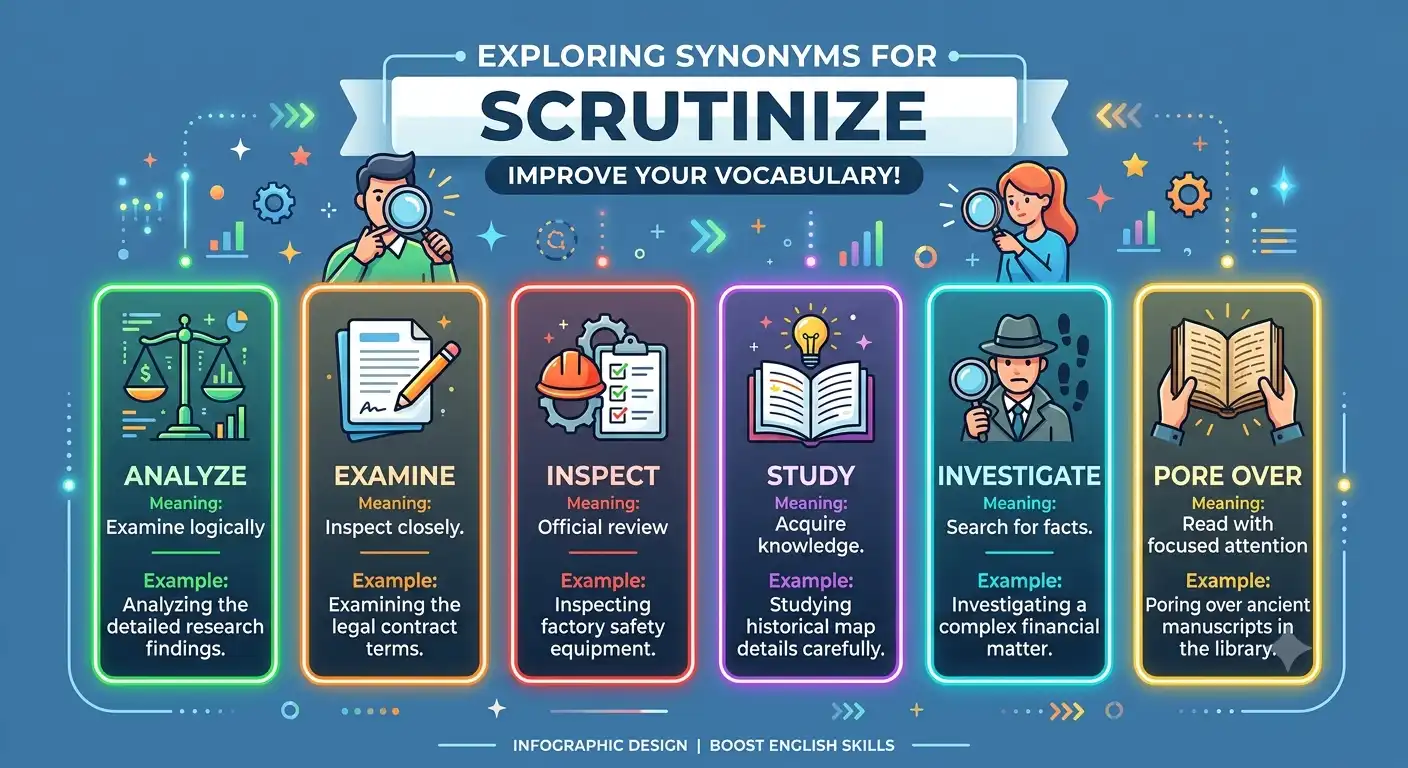
1. Examine
- Pronunciation: US: /ɪɡˈzæm.ɪn/ | UK: /ɪɡˈzæm.ɪn/
- Meaning: To look at something closely to learn about it or find problems.
- Examples:
- The doctor will examine your throat during the checkup.
- Please examine the contract before you sign your name.
2. Inspect
- Pronunciation: US: /ɪnˈspekt/ | UK: /ɪnˈspekt/
- Meaning: To look at something officially to make sure it is safe or correct.
- Examples:
- The officer will inspect the car to ensure the brakes work.
- She came to inspect our clean room before the guests arrived.
3. Analyze
- Pronunciation: US: /ˈæn.əl.aɪz/ | UK: /ˈæn.əl.aɪz/
- Meaning: To study something by breaking it down into smaller parts.
- Examples:
- Scientists analyze the water sample to test its safety.
- We need to analyze our sales figures from last month.
4. Investigate
- Pronunciation: US: /ɪnˈves.tə.ɡeɪt/ | UK: /ɪnˈves.tɪ.ɡeɪt/
- Meaning: To search for facts to find the truth about something.
- Examples:
- Police officers investigate the scene to gather evidence.
- The team decided to investigate the cause of the loud noise.
5. Study
- Pronunciation: US: /ˈstʌd.i/ | UK: /ˈstʌd.i/
- Meaning: To spend time reading and learning about a specific topic.
- Examples:
- She needs to study the map before starting the road trip.
- Researchers study how plants grow under bright green light.
6. Survey
- Pronunciation: US: /ˈsɝː.veɪ/ | UK: /ˈsɜː.veɪ/
- Meaning: To look over a large area or group carefully to get a full view.
- Examples:
- The captain climbed the hill to survey the open land.
- They will survey customers to learn about their service needs.
7. Audit
- Pronunciation: US: /ˈɑː.dɪt/ | UK: /ˈɔː.dɪt/
- Meaning: To check official financial records to make sure they are accurate.
- Examples:
- An expert came to audit the bank accounts this morning.
- The company conducts an annual audit of its equipment inventory.
8. Probe
- Pronunciation: US: /proʊb/ | UK: /prəʊb/
- Meaning: To ask deep questions or dig into something to discover hidden facts.
- Examples:
- Journalists like to probe deep into political news stories.
- He used a small stick to probe the dark cave opening.
9. Scan
- Pronunciation: US: /skæn/ | UK: /skæn/
- Meaning: To look over something rapidly or use a machine to inspect it.
- Examples:
- I will scan the newspaper page for sports scores.
- The cashier used the reader to scan every grocery item.
10. Check
- Pronunciation: US: /tʃek/ | UK: /tʃek/
- Meaning: To look at something to make sure it is safe, clean, or correct.
- Examples:
- Always check your tire pressure before a long highway drive.
- Did you check the oven to see if the bread is ready?
11. Review
- Pronunciation: US: /rɪˈvjuː/ | UK: /rɪˈvjuː/
- Meaning: To examine something again to decide if changes are needed.
- Examples:
- The manager will review your job application tomorrow afternoon.
- Let us review the safety rules before starting our science lab.
12. Dissect
- Pronunciation: US: /dɪˈsekt/ | UK: /daɪˈsekt/
- Meaning: To cut something open or take an idea apart to study every piece.
- Examples:
- Students dissect a preserved frog during their biology lab.
- Critics dissect every scene of the new popular movie.
13. Evaluate
- Pronunciation: US: /ɪˈvæl.ju.eɪt/ | UK: /ɪˈvæl.ju.eɪt/
- Meaning: To judge the quality, worth, or value of something carefully.
- Examples:
- Teachers evaluate student essays based on clear ideas.
- We must evaluate all options before buying a new home.
14. Assess
- Pronunciation: US: /əˈses/ | UK: /əˈses/
- Meaning: To calculate or judge the condition, size, or cost of something.
- Examples:
- The mechanic will assess the damage to the red car.
- We need time to assess how well the new plan works.
15. Vet
- Pronunciation: US: /vet/ | UK: /vet/
- Meaning: To check a person or plan thoroughly before giving approval.
- Examples:
- They vet all new employees before offering them a position.
- The board must vet the project proposal before funding it.
16. Sift
- Pronunciation: US: /sɪft/ | UK: /sɪft/
- Meaning: To go through a lot of things to find what is useful.
- Examples:
- She had to sift through hundreds of emails to find the key report.
- Workers sift through sand to look for smooth beach shells.
17. Explore
- Pronunciation: US: /ɪkˈsplɔːr/ | UK: /ɪkˈsplɔː/
- Meaning: To travel through or study a place to discover new things.
- Examples:
- Hikers love to explore deep mountain trails in summer.
- We should explore new ways to finish our team work faster.
18. Scope
- Pronunciation: US: /skoʊp/ | UK: /skəʊp/
- Meaning: To look at or assess an area or situation before acting.
- Examples:
- The builder came to scope out the land for the new house.
- We will scope the area to find a quiet place for lunch.
19. Eyeball
- Pronunciation: US: /ˈaɪ.bɑːl/ | UK: /ˈaɪ.bɔːl/
- Meaning: To look at or estimate something closely with your eyes.
- Examples:
- The carpenter chose to eyeball the board measurement before cutting.
- He started to eyeball the shiny watch on the glass shelf.
20. Cross-examine
- Pronunciation: US: /ˌkrɑːs.ɪɡˈzæm.ɪn/ | UK: /ˌkrɒs.ɪɡˈzæm.ɪn/
- Meaning: To question a person closely to check if their answers are true.
- Examples:
- The lawyer will cross-examine the witness during the trial.
- Parents like to cross-examine kids when household rules break.
21. Peruse
- Pronunciation: US: /pəˈruːz/ | UK: /pəˈruːz/
- Meaning: To read through something carefully and with great attention.
- Examples:
- She took her time to peruse the restaurant menu choices.
- He loves to peruse old history books at the neighborhood library.
22. Monitor
- Pronunciation: US: /ˈmɑː.nə.t me/ | UK: /ˈmɒn.ɪ.tə/
- Meaning: To watch and check a situation over time to see changes.
- Examples:
- Doctors monitor the heart rate of the sleeping patient.
- Teachers monitor the playground during afternoon recess.
23. Overhaul
- Pronunciation: US: /ˌoʊ.vɚˈhɑːl/ | UK: /ˌəʊ.vəˈhɔːl/
- Meaning: To inspect and rebuild something thoroughly to fix all flaws.
- Examples:
- Mechanics will overhaul the old airplane engine this week.
- The school decided to overhaul its entire computer network.
24. Research
- Pronunciation: US: /ˈriː.sɝːtʃ/ | UK: /rɪˈsɜːtʃ/
- Meaning: To study materials and facts to reach new, clear conclusions.
- Examples:
- Students research famous inventors for their history project.
- Scientists research new medicines to help sick people recover.
25. Observe
- Pronunciation: US: /əbˈzɝːv/ | UK: /əbˈzɜːv/
- Meaning: To watch someone or something carefully without interrupting.
- Examples:
- Scientists observe wild birds in their natural forest homes.
- Please observe how the master baker shapes the soft dough.
“To observe without evaluating is the highest form of intelligence.” — Jiddu Krishnamurti
26. Screen
- Pronunciation: US: /skriːn/ | UK: /skriːn/
- Meaning: To check people or objects to remove those that do not fit.
- Examples:
- Airport guards screen all luggage before travelers board planes.
- Clinics screen visitors to keep patients safe from colds.
27. Search
- Pronunciation: US: /sɝːtʃ/ | UK: /sɜːtʃ/
- Meaning: To look through a place carefully to find something lost or hidden.
- Examples:
- I must search my backpack to find my lost house key.
- The search party looked through the woods until night fell.
28. Scour
- Pronunciation: US: /ˈskaʊ.ɚ/ | UK: /ˈskaʊ.ər/
- Meaning: To search a wide area very thoroughly to locate something.
- Examples:
- Police will scour the neighborhood to find the missing dog.
- She had to scour the web to find cheap flight tickets.
29. Peer
- Pronunciation: US: /pɪr/ | UK: /pɪə/
- Meaning: To look closely or with difficulty at something hard to see.
- Examples:
- He had to peer through the thick fog to see the road sign.
- The child tried to peer into the wrapped gift box.
30. Appraise
- Pronunciation: US: /əˈpreɪz/ | UK: /əˈpreɪz/
- Meaning: To examine an object to set its financial or official value.
- Examples:
- An expert will appraise the gold ring before the auction sale.
- The boss will appraise our work performance at the year end.
31. Query
- Pronunciation: US: /ˈkwɪr.i/ | UK: /ˈkwɪə.ri/
- Meaning: To ask questions about something to check if it is correct.
- Examples:
- Accountants query any invoice that shows an unusual price.
- Students often query hard answers on their practice tests.
32. Question
- Pronunciation: US: /ˈkwes.tʃən/ | UK: /ˈkwes.tʃən/
- Meaning: To express doubt or ask for details about a statement or fact.
- Examples:
- Do not hesitate to question facts that seem incorrect.
- The officer had to question the driver after the minor accident.
33. Gauge
- Pronunciation: US: /ɡeɪdʒ/ | UK: /ɡeɪdʒ/
- Meaning: To measure or make a judgment about a feeling or quantity.
- Examples:
- Use a ruler to gauge the exact length of the paper strip.
- The speaker tried to gauge how happy the audience felt.
34. Test
- Pronunciation: US: /test/ | UK: /test/
- Meaning: To try something out to see how well it works under use.
- Examples:
- Engineers test the new bridge design with heavy weights.
- Always test the bath water temperature before stepping inside.
35. Double-check
- Pronunciation: US: /ˌdʌb.əlˈtʃek/ | UK: /ˌdʌb.əlˈtʃek/
- Meaning: To look at something a second time to ensure no mistakes exist.
- Examples:
- I always double-check my front door lock before going to sleep.
- Double-check your math answers before turning in your paper.
36. Trace
- Pronunciation: US: /treɪs/ | UK: /treɪs/
- Meaning: To follow the history, path, or signs of something step by step.
- Examples:
- Investigators trace the path of the storm across the map.
- You can trace your family history using online records.
37. Weigh
- Pronunciation: US: /weɪ/ | UK: /weɪ/
- Meaning: To think about different options carefully before making a choice.
- Examples:
- You should weigh the pros and cons before buying a new car.
- The judge will weigh all arguments before giving a ruling.
38. Cross-check
- Pronunciation: US: /ˌkrɑːsˈtʃek/ | UK: /ˌkrɒsˈtʃek/
- Meaning: To confirm information by using a second independent source.
- Examples:
- Scientists cross-check their results with other global labs.
- Always cross-check dates with your calendar before booking flights.
39. Eye
- Pronunciation: US: /aɪ/ | UK: /aɪ/
- Meaning: To watch or look at someone or something with special interest.
- Examples:
- The hungry cat started to eye the fish swimming in the bowl.
- Shoppers eye the bright red coats on the sales rack.
40. Canvass
- Pronunciation: US: /ˈkæn.vəs/ | UK: /ˈkæn.vəs/
- Meaning: To go through an area asking people for opinions or votes.
- Examples:
- Volunteers canvass the town to gather support for the new park.
- The team will canvass local residents about traffic concerns.
41. Size up
- Pronunciation: US: /saɪz ʌp/ | UK: /saɪz ʌp/
- Meaning: To form a quick judgment about a person or situation.
- Examples:
- Players size up their opponents before starting the game.
- The manager took a minute to size up the job applicant.
42. Filter
- Pronunciation: US: /ˈfɪl.t̬ɚ/ | UK: /ˈfɪl.tə/
- Meaning: To remove unwanted items so only good or correct ones remain.
- Examples:
- Spam settings filter bad emails out of your main inbox.
- We filter water to remove small dirt particles before drinking.
43. Regard
- Pronunciation: US: /rɪˈɡɑːrd/ | UK: /rɪˈɡɑːd/
- Meaning: To look at someone or something in a steady, thoughtful way.
- Examples:
- She began to regard his offer with serious interest.
- The quiet dog would regard strangers with calm curiosity.
44. Measure
- Pronunciation: US: /ˈmeʒ.ɚ/ | UK: /ˈmeʒ.ər/
- Meaning: To find the exact size, weight, amount, or value of something.
- Examples:
- Tailors measure your arms before sewing a custom suit jacket.
- Tests help teachers measure student progress over the school year.
45. Unpack
- Pronunciation: US: /ʌnˈpæk/ | UK: /ʌnˈpæk/
- Meaning: To analyze a complex idea step by step so it is easy to understand.
- Examples:
- The professor will unpack the difficult poem in class today.
- Let us unpack the main points of this new business plan.
46. Verify
- Pronunciation: US: /ˈver.ə.faɪ/ | UK: /ˈver.ɪ.faɪ/
- Meaning: To prove that a fact or statement is true and accurate.
- Examples:
- Please verify your email address to active your account.
- The bank must verify your signature before cashing the check.
47. Cross-question
- Pronunciation: US: /ˌkrɑːsˈkwes.tʃən/ | UK: /ˌkrɒsˈkwes.tʃən/
- Meaning: To ask someone detailed questions repeatedly to test their truth.
- Examples:
- Detectives cross-question suspects to find holes in their stories.
- The panel will cross-question finalists for the top scholarship.
48. Deep-dive
- Pronunciation: US: /diːp daɪv/ | UK: /diːp daɪv/
- Meaning: To conduct a very thorough, complete examination of a single topic.
- Examples:
- Our team will do a deep-dive into market trends next week.
- The podcast offers a deep-dive into historical mysteries.
49. Benchmark
- Pronunciation: US: /ˈbentʃ.mɑːrk/ | UK: /ˈbentʃ.mɑːk/
- Meaning: To measure quality by comparing against an established standard.
- Examples:
- Companies benchmark their services against top industry leaders.
- Schools benchmark student test scores against national averages.
50. Rummage
- Pronunciation: US: /ˈrʌm.ɪdʒ/ | UK: /ˈrʌm.ɪdʒ/
- Meaning: To search through a space messy way to find a specific object.
- Examples:
- He had to rummage through the drawer to find a working pen.
- She had to rummage in her purse for loose coins.
Antonyms of “Scrutinize”
While scrutinize means to inspect something with extreme care and detail, its antonyms describe careless, quick, or indifferent observation:
- Glance: US: /ɡlæns/ | UK: /ɡlɑːns/ – To look at something very quickly without paying attention to details.
- Ignore: US: /ɪɡˈnɔːr/ | UK: /ɪɡˈnɔː/ – To pay no attention to someone or something on purpose.
- Overlook: US: /ˌoʊ.vɚˈlʊk/ | UK: /ˌəʊ.vəˈlʊk/ – To fail to notice or miss seeing a flaw or detail.
- Disregard: US: /ˌdɪs.rɪˈɡɑːrd/ | UK: /ˌdɪs.rɪˈɡɑːd/ – To treat something as unimportant and pay no attention to it.
Prototype Meaning and Categorization of “Scrutinize”
- Grammatical Category: Transitive Verb (requires a direct object, e.g., “scrutinize the report”).
- Prototype Meaning: A high-intensity mental or visual inspection performed to find hidden details, flaws, truths, or errors.
- Semantic Field: Cognitive processing, visual inspection, analysis, evaluation, and investigation.
Frequently Asked Questions (FAQ)
1. What is the most common synonym for scrutinize?
The most common everyday synonyms for scrutinize are examine, inspect, analyze, and check. These options work well in school essays, business emails, and daily speech.
2. Is “peruse” the exact same as “scrutinize”?
While both mean reading or examining with care, scrutinize focuses heavily on finding errors, details, or truths, whereas peruse emphasizes reading thoroughly from start to finish.
3. Can I use “scrutinize” in casual, everyday speech?
Yes, but it sounds somewhat formal. In casual conversation, people often say “look closely at,” “check over,” or “double-check” instead of scrutinize.
4. What is the difference between “inspect” and “scrutinize”?
Inspect often refers to official or physical checks (like building codes or machinery), while scrutinize implies deeper critical analysis of details, documents, or motives.
5. What prepositions pair best with “scrutinize”?
The verb scrutinize is transitive, so it directly takes an object (e.g., “scrutinize the data”) without needing a preposition. However, its noun form (scrutiny) often pairs with under (e.g., “under close scrutiny”).
6. Does “scrutinize” always have a negative tone?
Not necessarily! While it can imply looking for mistakes or suspicious details, it also describes thorough research, scientific care, and high-quality work.
Conclusion
Expanding your vocabulary with varied synonyms for scrutinize completely transforms your ability to express attention, critical thinking, and observation. By replacing repetitive words with precise terms like analyze, audit, peruse, or probe, you bring sharp clarity and professional strength to every piece of content you produce. Masterful word selection elevates your voice, ensuring your ideas command respect and interest.
“The difference between the almost right word and the right word is the difference between the lightning bug and the lightning.” — Mark Twain
“Words are, in my not-so-humble opinion, our most inexhaustible source of magic.” — J.K. Rowling
Take time to practice these 50 synonyms in your daily emails, academic essays, blog headers, and casual conversations. With regular practice, you will express critical analysis and detailed observation with natural confidence and style!

Andrew Collins is an academic English educator with over 12 years of experience helping university students, IELTS candidates, and ESL learners improve their writing vocabulary.