Finding the right synonyms for imply is a powerful way to make your writing deeper and more interesting. When you use synonyms for imply, you can share hidden messages and suggest ideas without saying them directly. Learning strong synonyms for imply helps you guide your readers smoothly toward the truth.
Imagine a close friend walking into a room. They do not say they are tired, but they slowly set their heavy bag down, sigh deeply, and look at the soft couch. They did not speak, but their actions imply that they had a very long day. In simple English, to imply means to hint at something or suggest an idea without saying it out loud.
This word is highly valuable for everyone. Students can use these terms to analyze literature or write strong essays. Bloggers can use them to write clever, engaging hooks. Content writers can build trust by subtly steering the audience. Daily English users can express their thoughts with quiet elegance and charm.
“Words can say one thing, but a quiet hint can speak a thousand truths.” — Unknown
“To speak without speaking is the true art of elegant communication.” — Unknown
Lexical Profile of “Imply”
- Connotative Meaning: Subtlety, indirectness, logical consequence, soft suggestion, or secret message. In formal logic, when one statement leads directly to another, we can represent this logical implication ($P \implies Q$) using a conditional math formula:
$$P \implies Q$$
Where the truth of $P$ guarantees the truth of $Q$ without $P$ explicitly stating the contents of $Q$. - Etymology:
- Origins: Derived from the Old French word impliquer, which came from the Latin implicare (meaning “to infold, involve, or entangle”).
- Evolution: Entered English in the late 14th century to describe wrapping something up inside, later shifting to mean expressing an idea indirectly.
- Pronunciation:
- US IPA: /ɪmˈplaɪ/
- UK IPA: /ɪmˈplaɪ/
- Syllables: 2 syllables (im-ply).
- Affixation Pattern: Root verb imply combined with prefix im- (meaning “in”) and the bound root -ply (meaning “fold”). It can form the adjective implied, the noun implication, or the adverb impliedly.
Comparison Table of Key Synonyms
| Keyword | Meaning | Usage Type | Context |
| Hint | To give a quiet or indirect clue | Casual | Daily conversations, mysteries |
| Suggest | To put an idea forward gently | Casual / Professional | Advice, plans, brainstorming |
| Insinuate | To hint at something bad or unpleasant | Emotional | Rumors, arguments, drama |
| Intimate | To make something known in a very quiet way | Formal | Business letters, private talks |
| Allude | To talk about something without naming it | Formal | Literature, academic essays |
| Connote | To make you think of a secondary meaning | Professional | Branding, poetry, language study |
| Signify | To be a clear sign of a feeling or event | Professional | Data reports, cultural symbols |
| Indicate | To point out or show something clearly | Professional / Casual | Maps, medical tests, science |
“The art of writing lies in what you leave between the lines.” — Unknown
50 Synonyms for Imply
1. Hint
- Pronunciation: US: /hɪnt/ & UK: /hɪnt/
- Meaning: This word means to give a quiet or indirect clue about something.
- Examples:
- She began to hint about the surprise party.
- His dry throat seemed to hint that he needed some water.
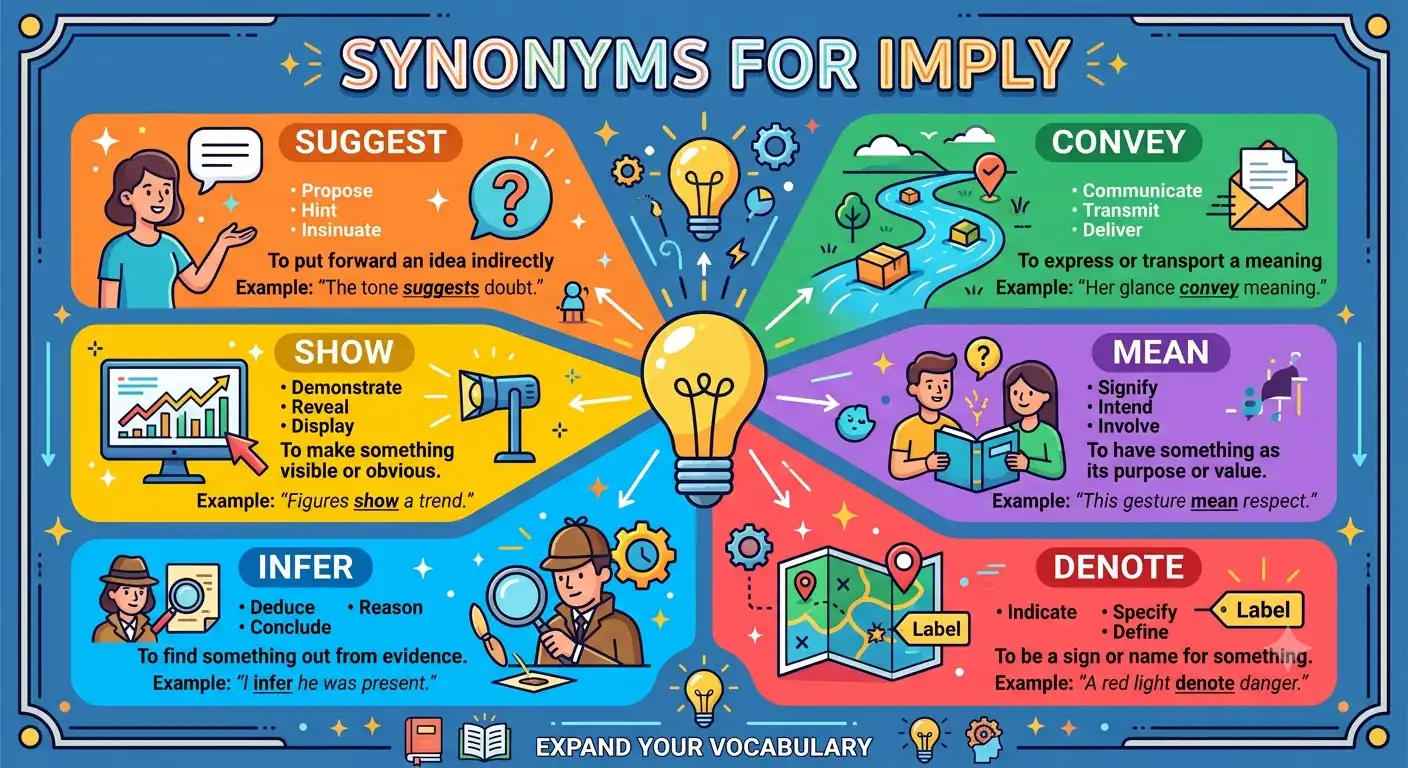
2. Suggest
- Pronunciation: US: /səɡˈdʒest/ & UK: /səˈdʒest/
- Meaning: This word means to put a quiet idea forward for people to consider.
- Examples:
- Dark gray clouds suggest that it will rain soon.
- The high price may suggest that the watch is made of gold.
3. Insinuate
- Pronunciation: US: /ɪnˈsɪn.ju.eɪt/ & UK: /ɪnˈsɪn.ju.eɪt/
- Meaning: This word means to hint at something bad or unpleasant in a sneaky way.
- Examples:
- Do not insinuate that I took your missing pen on purpose.
- She tried to insinuate that his success was just lucky.
4. Intimate
- Pronunciation: US: /ˈɪn.t̬ə.meɪt/ & UK: /ˈɪn.tɪ.meɪt/
- Meaning: This word means to state an idea in a very quiet, indirect way.
- Examples:
- The boss began to intimate that salary raises were coming soon.
- He did not say no, but his facial expression did intimate it.
5. Allude
- Pronunciation: US: /əˈluːd/ & UK: /əˈluːd/
- Meaning: This word means to talk about something briefly without mentioning it directly.
- Examples:
- The speaker chose to allude to the historic event during his speech.
- You should not allude to past mistakes during a fun dinner.
6. Connote
- Pronunciation: US: /kəˈnoʊt/ & UK: /kəˈnəʊt/
- Meaning: This word means to make you think of a secondary meaning beside the main one.
- Examples:
- For many shoppers, the color gold will connote luxury and wealth.
- The word “home” can connote warmth, safety, and delicious food.
7. Signify
- Pronunciation: US: /ˈsɪɡ.nə.faɪ/ & UK: /ˈsɪɡ.nɪ.faɪ/
- Meaning: This word means to be a clear sign of an event or feeling.
- Examples:
- A red traffic light will signify that drivers must stop.
- These high test scores signify that you studied very hard.
8. Indicate
- Pronunciation: US: /ˈɪn.də.keɪt/ & UK: /ˈɪn.dɪ.keɪt/
- Meaning: This word means to point out or show something clearly.
- Examples:
- High fever levels can indicate that a child is sick.
- The arrows on the map indicate where the hikers should walk.
9. Denote
- Pronunciation: US: /dɪˈnoʊt/ & UK: /dɪˈnəʊt/
- Meaning: This word means to be a direct name or sign for something.
- Examples:
- A red cross on the building will denote a safe hospital.
- These dark lines on the drawing denote where you should cut.
10. Mean
- Pronunciation: US: /miːn/ & UK: /miːn/
- Meaning: This word means to have a specific significance or to express an idea.
- Examples:
- A low fuel warning light will mean you need gas.
- What does this strange symbol mean on the wooden box?
11. Convey
- Pronunciation: US: /kənˈveɪ/ & UK: /kənˈveɪ/
- Meaning: This word means to pass a message or feeling to another person.
- Examples:
- Her warm tone of voice helped convey her deep love.
- The author wanted to convey a message of hope to kids.
12. Signal
- Pronunciation: US: /ˈsɪɡ.nəl/ & UK: /ˈsɪɡ.nəl/
- Meaning: This word means to show an action is about to happen.
- Examples:
- A loud school bell will signal the end of the class.
- He waved his hand to signal that we should follow him.
13. Betoken
- Pronunciation: US: /bɪˈtoʊ.kən/ & UK: /bɪˈtəʊ.kən/
- Meaning: This word means to be a physical sign of a future event.
- Examples:
- The quiet wind seemed to betoken a peaceful night ahead.
- Those dark heavy clouds betoken a very cold winter storm.
14. Portend
- Pronunciation: US: /pɔːrˈtend/ & UK: /pɔːˈtend/
- Meaning: This word means to warn that something bad is about to happen.
- Examples:
- A sudden drop in the stock market can portend trouble.
- The loud crows seemed to portend a dark day.
15. Foreshadow
- Pronunciation: US: /fɔːrˈʃæd.oʊ/ & UK: /fɔːˈʃæd.əʊ/
- Meaning: This word means to act as a warning or sign of future events.
- Examples:
- The spooky opening music will foreshadow a scary movie scene.
- Early morning rain can foreshadow a wet day at the park.
16. Presuppose
- Pronunciation: US: /ˌpriː.səˈpoʊz/ & UK: /ˌpriː.səˈpəʊz/
- Meaning: This word means to accept something as true before it is proved.
- Examples:
- Playing this game will presuppose that you know the rules.
- Hard math questions presuppose a good understanding of numbers.
17. Entail
- Pronunciation: US: /ɪnˈteɪl/ & UK: /ɪnˈteɪl/
- Meaning: This word means to have something as a necessary part or result.
- Examples:
- Buying a new dog will entail a lot of daily care.
- Building a house will entail months of hard physical labor.
18. Involve
- Pronunciation: US: /ɪnˈvɑːlv/ & UK: /ɪnˈvɒlv/
- Meaning: This word means to include something as a necessary part of an activity.
- Examples:
- This science project will involve a lot of fun teamwork.
- Preparing a big holiday dinner will involve many hours of cooking.
19. Import
- Pronunciation: US: /ˈɪm.pɔːrt/ & UK: /ˈɪm.pɔːt/
- Meaning: This word means to carry a hidden or deep meaning.
- Examples:
- The quiet words of the wise king carried great import.
- His serious look seemed to import some very bad news.
20. Shadow
- Pronunciation: US: /ˈʃæd.oʊ/ & UK: /ˈʃæd.əʊ/
- Meaning: This word means to suggest a future event in a dim way.
- Examples:
- The small argument helped shadow the big break-up later.
- Let your early drawings shadow the masterpiece you will paint.
21. Whisper
- Pronunciation: US: /ˈwɪs.pɚ/ & UK: /ˈwɪs.pə/
- Meaning: This word means to suggest a secret or quiet idea softly.
- Examples:
- The gentle rustle of leaves seemed to whisper of autumn.
- Her quiet actions whisper that she is deeply in love.
22. Point
- Pronunciation: US: /pɔɪnt/ & UK: /pɔɪnt/
- Meaning: This word means to direct attention toward a specific fact or truth.
- Examples:
- All the clues point to the young detective being right.
- The wet footprints point directly to the kitchen sink.
23. Gesture
- Pronunciation: US: /ˈdʒes.tʃɚ/ & UK: /ˈdʒes.tʃə/
- Meaning: This word means to make a physical sign to show your thoughts.
- Examples:
- He began to gesture toward the door so we would leave.
- She used her hands to gesture that she was very cold.
24. Symbolize
- Pronunciation: US: /ˈsɪm.bə.laɪz/ & UK: /ˈsɪm.bə.laɪz/
- Meaning: This word means to be a physical representation of an idea.
- Examples:
- A white dove will symbolize peace across the entire world.
- The red heart shape can symbolize deep love and friendship.
25. Represent
- Pronunciation: US: /ˌrep.rɪˈzent/ & UK: /ˌrep.rɪˈzent/
- Meaning: This word means to stand in place of someone or something else.
- Examples:
- The blue lines on this map represent cold mountain rivers.
- We need a strong leader to represent us at school.
26. Reveal
- Pronunciation: US: /rɪˈviːl/ & UK: /rɪˈviːl/
- Meaning: This word means to make a secret fact known to other people.
- Examples:
- Opening the wooden box will reveal a beautiful gold ring.
- His nervous eyes reveal that he is hiding the truth.
27. Show
- Pronunciation: US: /ʃoʊ/ & UK: /ʃəʊ/
- Meaning: This word means to let someone see a feeling, fact, or object.
- Examples:
- Please show me how to solve this hard math question.
- Your bright smile will show everyone that you are happy.
28. Disclose
- Pronunciation: US: /dɪˈskloʊz/ & UK: /dɪˈskləʊz/
- Meaning: This word means to share private or secret information with others.
- Examples:
- The company decided to disclose the new phone design today.
- You should not disclose your secret computer password to anyone.
29. Manifest
- Pronunciation: US: /ˈmæn.ə.fest/ & UK: /ˈmæn.ɪ.fest/
- Meaning: This word means to show a feeling or quality very clearly.
- Examples:
- He began to manifest signs of extreme worry before the test.
- Her deep artistic talents manifest in her beautiful clay sculptures.
30. Evince
- Pronunciation: US: /ɪˈvɪns/ & UK: /ɪˈvɪns/
- Meaning: This word means to show a feeling or quality clearly through action.
- Examples:
- The young students evince great excitement for the field trip.
- He did not evince any fear when entering the cave.
31. Typify
- Pronunciation: US: /ˈtɪp.ə.faɪ/ & UK: /ˈtɪp.ɪ.faɪ/
- Meaning: This word means to be a perfect example of a specific group.
- Examples:
- Warm sunny days typify the beautiful summer weather here.
- These cute brick houses typify the old style of the town.
32. Embody
- Pronunciation: US: /ɪmˈbɑː.di/ & UK: /ɪmˈbɒd.i/
- Meaning: This word means to represent an idea in a physical form.
- Examples:
- The brave soldier tried to embody courage on the battlefield.
- Our school rules embody the spirit of kindness and respect.
33. Characterize
- Pronunciation: US: /ˈkær.ək.tə.raɪz/ & UK: /ˈkær.ək.tə.raɪz/
- Meaning: This word means to describe the most important qualities of something.
- Examples:
- Loud trumpets and heavy drums characterize this style of music.
- High mountains and deep green valleys characterize the beautiful region.
34. Reflect
- Pronunciation: US: /rɪˈflekt/ & UK: /rɪˈflekt/
- Meaning: This word means to show a clear picture or sign of something.
- Examples:
- Your neat homework sheets reflect your excellent work habits.
- The calm water will reflect the bright summer sky.
35. Express
- Pronunciation: US: /ɪkˈspres/ & UK: /ɪkˈspres/
- Meaning: This word means to show a feeling or thought using clear words.
- Examples:
- He tried to express his warm gratitude with a nice card.
- It is important to express your feelings to your family.
36. Herald
- Pronunciation: US: /ˈher.əld/ & UK: /ˈher.əld/
- Meaning: This word means to be a sign that a major event is starting.
- Examples:
- Golden yellow leaves herald the arrival of beautiful autumn days.
- The loud morning birds herald the start of a sunny day.
37. Predict
- Pronunciation: US: /prɪˈdɪkt/ & UK: /prɪˈdɪkt/
- Meaning: This word means to say what will happen in the future.
- Examples:
- The weather reporter tried to predict if it would snow tomorrow.
- It is hard to predict which team will win the game.
38. Presage
- Pronunciation: US: /ˈpres.ɪdʒ/ & UK: /ˈpres.ɪdʒ/
- Meaning: This word means to be an early warning sign of a future event.
- Examples:
- The cold heavy winds presage the arrival of a massive storm.
- Small early arguments can presage a serious business fight.
39. Prefigure
- Pronunciation: US: /priːˈfɪɡ.jɚ/ & UK: /priːˈfɪɡ.ə/
- Meaning: This word means to show or represent a future event beforehand.
- Examples:
- These early drawings prefigure the final grand painting design.
- The quiet early scenes prefigure the fast action of the play.
40. Adumbrate
- Pronunciation: US: /ˈæd.əm.breɪt/ & UK: /ˈæd.əm.breɪt/
- Meaning: This word means to give a very rough outline of an idea.
- Examples:
- The teacher chose to adumbrate the major goals of the course.
- The quick report will adumbrate our basic plan for the year.
41. Glimmer
- Pronunciation: US: /ˈɡlɪm.ɚ/ & UK: /ˈɡlɪm.ə/
- Meaning: This word means to show a tiny, weak sign of an idea or light.
- Examples:
- His happy eyes show a tiny glimmer of sweet hope.
- The distant house lights glimmer softly through the thick trees.
42. Warn
- Pronunciation: US: /wɔːrn/ & UK: /wɔːn/
- Meaning: This word means to tell someone about a future danger or problem.
- Examples:
- The tall yellow sign will warn drivers about wet roads.
- Please warn your little sister not to touch the hot stove.
43. Threaten
- Pronunciation: US: /ˈθret.ən/ & UK: /ˈθret.ən/
- Meaning: This word means to show signs of a future danger or threat.
- Examples:
- The dark gray skies threaten to ruin our outdoor picnic plans.
- Bad grades can threaten your chances of joining the sports team.
44. Promise
- Pronunciation: US: /ˈprɑː.mɪs/ & UK: /ˈprɒm.ɪs/
- Meaning: This word means to show a strong sign of future success or growth.
- Examples:
- These green tomato plants promise a very large crop this year.
- Her excellent voice skills promise a bright future in music.
45. Mirror
- Pronunciation: US: /ˈmɪr.ɚ/ & UK: /ˈmɪr.ə/
- Meaning: This word means to show an exact copy of a feeling or situation.
- Examples:
- The child’s actions mirror the daily habits of his parents.
- The local news stories mirror the general worries of the town.
46. Evoke
- Pronunciation: US: /ɪˈvoʊk/ & UK: /ɪˈvəʊk/
- Meaning: This word means to bring a memory, feeling, or image to mind.
- Examples:
- The old family photos evoke sweet memories of our youth.
- Smelling fresh pine needles will evoke a happy winter holiday feeling.
47. Spark
- Pronunciation: US: /spɑːrk/ & UK: /spɑːk/
- Meaning: This word means to cause a sudden feeling or action to start.
- Examples:
- A funny joke can spark a lot of loud laughter.
- The new science book will spark her interest in stars.
48. Prompt
- Pronunciation: US: /prɑːmpt/ & UK: /prɒmpt/
- Meaning: This word means to encourage someone to take a quick action.
- Examples:
- The high price tag may prompt shoppers to wait for a sale.
- A polite text message will prompt a fast reply from him.
49. Guide
- Pronunciation: US: /ɡaɪd/ & UK: /ɡaɪd/
- Meaning: This word means to show someone the right direction or choice.
- Examples:
- Let your good values guide you when making tough choices.
- The bright lighthouse will guide the safe ships to shore.
50. Tell
- Pronunciation: US: /tel/ & UK: /tel/
- Meaning: This word means to give information or show a truth clearly.
- Examples:
- Your tired red eyes tell me that you need sleep.
- The rings inside a tree trunk tell how old it is.
Antonyms of “Imply”
To completely master this vocabulary concept, you should also learn its opposite terms:
- State: To say or write an idea in a very direct, clear way.
- Declare: To announce a fact formally and openly to everyone.
- Express: To show thoughts or feelings clearly using spoken words.
- Proclaim: To announce something publically with great pride or force.
- Announce: To make a public statement about a plan or event.
Prototype Meaning and Categorization of “Imply”
The prototype meaning of “imply” is to suggest, hint, or express an idea indirectly without stating it directly. We can group these 50 synonyms into four clear categories:
- Indirect Hinting and Soft Suggestion: Words that focus on giving quiet, gentle, or subtle clues (e.g., hint, suggest, insinuate, intimate, allude, whisper, glimmer, prompt).
- Signs, Symbols, and Logical Connections: Words showing how objects, words, or patterns connect to a deeper meaning (e.g., signify, indicate, denote, mean, convey, signal, symbolize, represent, presuppose, entail, involve, import, express, guide, tell).
- Revealing, Showing, and Mirroring: Words describing how feelings or hidden truths show themselves physically (e.g., reveal, show, disclose, manifest, evince, typify, embody, characterize, reflect, mirror, evoke, spark).
- Warnings, Future Signs, and Predictions: Words representing signs of events that have not happened yet (e.g., betoken, portend, foreshadow, shadow, point, gesture, herald, predict, presage, prefigure, adumbrate, warn, threaten, promise).
FAQ About Synonyms for Imply
1. What is the difference between “imply” and “infer”?
While they seem similar, imply and infer are opposites in communication. The speaker or writer is the one who will imply (gives the hint). The listener or reader is the one who will infer (takes or guesses the hint).
2. Is “insinuate” always used in a negative way?
Yes. In daily speech, insinuate almost always carries a negative tone. It is used when someone is hinting at something bad, rude, or dishonest about another person.
3. Can “denote” be used instead of “imply”?
No. Denote refers to the literal, direct meaning of a word or symbol (like a dictionary definition). Imply refers to the indirect, suggested meaning (the ideas hidden behind the scenes).
4. What does the common term “implied consent” mean?
In legal and medical contexts, implied consent is agreement that is shown through a person’s physical actions rather than spoken words or signed papers. For example, extending your arm for a flu shot shows implied consent.
5. When should I use “connote” instead of “imply”?
Use connote when talking about word choices, colors, or symbols that bring secondary feelings or ideas to mind. Use imply when describing how a person suggests a secret message through their speech or physical behavior.
6. Is “adumbrate” too formal for daily English?
Yes. Adumbrate is a highly formal, academic term. In casual conversations, it is much better to use simple, friendly terms like outline, suggest, or sketch.
Conclusion
Expanding your English vocabulary by studying synonyms for imply is an excellent way to elevate your communication. When you learn to use these diverse, descriptive terms, your creative writing becomes more engaging, your blogging becomes more colorful, and your professional presentations sound far more authoritative. Instead of relying on the same simple words, you can paint clear pictures in the minds of your audience by selecting the exact right word for the situation.
Try to practice these fresh terms starting today! Use them when you draft an email to a coworker, write a descriptive essay for class, or talk with your friends about your weekend activities. The more you use them in casual settings, the more natural they will feel in your active vocabulary. Keep practicing, keep learning, and watch your communication skills flourish!
“Speech is a mirror of the soul; as a man speaks, so is he.” — Publilius Syrus
“To use the exact word is to shine a bright light on a quiet truth.” — Unknown

Andrew Collins is an academic English educator with over 12 years of experience helping university students, IELTS candidates, and ESL learners improve their writing vocabulary.