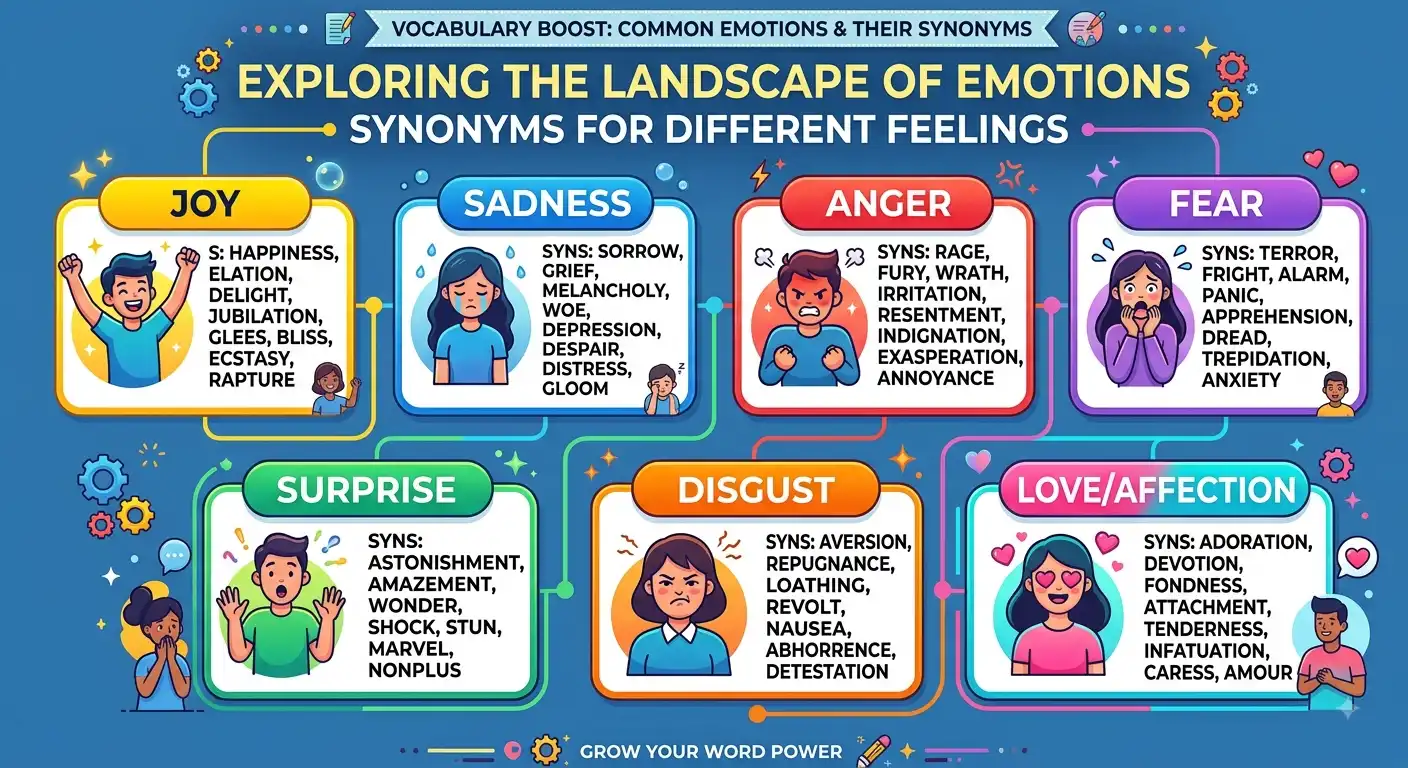
When you search for synonyms for emotions, you look for words that express deep human feelings clearly. Finding the best synonyms for emotions helps you share joy, sadness, anger, and love with accuracy. Using varied synonyms for emotions makes your essays, blog posts, and daily stories much more powerful and engaging.
A young girl sits by a window on a rainy afternoon. She watches raindrops slide down the glass and feels a quiet, gentle sadness inside her heart. That inner feeling is what we call an emotion. You can describe these inner states using words like feelings, sentiments, passions, or moods.
Learning new words for emotions is very helpful for:
- Students: Write powerful essays and earn higher grades in school.
- Bloggers: Connect with readers through deep and moving stories.
- Content Writers: Craft vivid marketing copy that touches people’s hearts.
- Daily English Users: Express your personal inner feelings clearly every day.
“Unexpressed emotions will never die. They are buried alive and will come forth later in uglier ways.” — Sigmund Freud
“Emotion is the chief source of all becoming-conscious. There can be no transforming of darkness into light and of apathy into movement without emotion.” — Carl Jung
Word Profile: Emotion
Connotative Meaning
The word emotion carries a strong, active, and personal meaning. It refers to the deep mental and physical feelings that arise from your circumstances, mood, or relationships with others.
Etymology (Origin)
- Latin Root: Emovere (meaning “to move out, remove, or agitate”)
- Latin Prefix: E- (meaning “out”)
- Latin Root: Movere (meaning “to move”)
- French Origin: Adopted into Middle French as émotion in the 16th century.
- Original Meaning: “A physical movement or commotion,” later shifting to “a mental agitation or feeling.”
Pronunciation
- US IPA: /ɪˈmoʊ.ʃən/
- UK IPA: /ɪˈməʊ.ʃən/
Syllables & Affixation
- Syllables: e-mo-tion (3 syllables)
- Prefix: E- (out)
- Root: Mo / Mot (move)
- Suffix: -tion (state or condition)
Comparison Table: Popular Synonyms for Emotions
| Keyword | Meaning | Usage Type | Context |
| Emotions | Deep reactions and feelings inside a person. | Neutral / General | Psychology, stories, personal life |
| Feelings | Physical or emotional awareness of a state. | Everyday / Casual | Relationships, health, daily chat |
| Sentiments | Thoughts driven by delicate or gentle feelings. | Formal / Thoughtful | Cards, speeches, opinions |
| Passions | Powerful, intense, or burning desires and drives. | Energetic / Strong | Arts, hobbies, romance, career |
| Sensations | Physical feelings coming from the body or senses. | Physical / Direct | Nature, food, touch, excitement |
| Moods | Temporary mind states that last for a while. | General / Casual | Weather, daily routine, mental state |
| Reactions | Quick responses to something that just happened. | Active / Casual | News, sports, sudden events |
50 Best Synonyms for Emotions
1. Feelings
- Pronunciation: US: /ˈfiː.lɪŋz/ | UK: /ˈfiː.lɪŋz/
- Meaning: The personal state of awareness inside your heart and mind.
- Examples:
- She shared her true feelings with her best friend.
- He tried to hide his hurt feelings with a smile.
2. Sentiments
- Pronunciation: US: /ˈsɛn.tə.mənts/ | UK: /ˈsen.tɪ.mənts/
- Meaning: Gentle or thoughtful feelings mixed with personal opinions.
- Examples:
- The card was filled with warm holiday sentiments.
- I share your exact sentiments on this important topic.
3. Passions
- Pronunciation: US: /ˈpæʃ.ənz/ | UK: /ˈpæʃ.ənz/
- Meaning: Very strong and intense feelings about a person or activity.
- Examples:
- Her passions include painting and playing the piano.
- He spoke about his new project with deep passions.
4. Sensations
- Pronunciation: US: /sɛnˈseɪ.ʃənz/ | UK: /senˈseɪ.ʃənz/
- Meaning: Feelings caused by something touching your body or senses.
- Examples:
- The cold water gave her a sudden tingling sensation.
- Warm sunlight on your skin brings pleasant sensations.
5. Reactions
- Pronunciation: US: /riˈæk.ʃənz/ | UK: /riˈæk.ʃənz/
- Meaning: The feelings or actions caused by an event or news.
- Examples:
- His happy reactions made everyone in the room smile.
- Her quick reaction saved the falling glass cup.
6. Moods
- Pronunciation: US: /muːdz/ | UK: /muːdz/
- Meaning: The general emotional states that stay for a short time.
- Examples:
- Rainy days put him in quiet and calm moods.
- She has been in cheerful moods all week long.
7. Affects
- Pronunciation: US: /ˈæf.ɛkts/ | UK: /ˈæf.ekts/
- Meaning: The outward physical display of your inner emotional state.
- Examples:
- The doctor noticed positive affects in the patient.
- Her soft voice reflected gentle emotional affects.
8. Impressions
- Pronunciation: US: /ɪmˈprɛʃ.ənz/ | UK: /ɪmˈpreʃ.ənz/
- Meaning: The first quick feelings or thoughts you get about something.
- Examples:
- The quiet park made a deep impression on him.
- She formed good impressions during her job interview.
9. Vibes
- Pronunciation: US: /vaɪbz/ | UK: /vaɪbz/
- Meaning: The emotional energy or mood you feel from a place or person.
- Examples:
- The coffee shop has very peaceful and friendly vibes.
- I get good vibes whenever I visit my grandma.
10. Tempers
- Pronunciation: US: /ˈtɛm.pɚz/ | UK: /ˈtem.pəz/
- Meaning: Your emotional drive toward calm or sudden anger.
- Examples:
- Short walk helps cool down quick tempers.
- She kept her mild temper during the hard debate.
11. Dispositions
- Pronunciation: US: /ˌdɪs.pəˈzɪʃ.ənz/ | UK: /ˌdɪs.pəˈzɪʃ.ənz/
- Meaning: Your natural, general character and habitual emotional tone.
- Examples:
- The happy child has a sweet and bright disposition.
- He has a calm disposition even under heavy stress.
12. Spirits
- Pronunciation: US: /ˈspɪr.ɪts/ | UK: /ˈspɪr.ɪts/
- Meaning: The general level of cheerfulness and energy you feel.
- Examples:
- The victory lifted the spirits of the entire team.
- Her cheerful songs kept our spirits high today.
13. States of mind
- Pronunciation: US: /steɪts ʌv maɪnd/ | UK: /steɪts ɒv maɪnd/
- Meaning: The current condition of your thoughts and emotional health.
- Examples:
- Meditation helps you reach peaceful states of mind.
- Reading books creates relaxed states of mind.
14. Instincts
- Pronunciation: US: /ˈɪn.stɪŋkts/ | UK: /ˈɪn.stɪŋkts/
- Meaning: Natural inner urges that guide your immediate feelings.
- Examples:
- Mother birds follow strong instincts to protect babies.
- My inner instincts told me to choose the safe path.
15. Impulses
- Pronunciation: US: /ˈɪm.pʌl.sɪz/ | UK: /ˈɪm.pʌl.sɪz/
- Meaning: Sudden strong emotional pushes to do something right away.
- Examples:
- She fought the sudden impulse to eat the cake.
- He acted on a good impulse and helped the man.
16. Desires
- Pronunciation: US: /dɪˈzaɪ.ɚz/ | UK: /dɪˈzaɪ.əz/
- Meaning: Strong emotional wants or wishes for something special.
- Examples:
- Her deepest desire is to travel around the world.
- He felt a strong desire to learn new skills.
17. Urges
- Pronunciation: US: /ˈɝː.dʒɪz/ | UK: /ˈɜː.dʒɪz/
- Meaning: Strong physical or emotional drives that press for action.
- Examples:
- I had an urge to run under the warm summer rain.
- She resisted the urge to speak out of order.
18. Attachments
- Pronunciation: US: /əˈtætʃ.mənts/ | UK: /əˈtætʃ.mənts/
- Meaning: Deep emotional bonds that tie you closely to others.
- Examples:
- Children form strong attachments to their parents.
- He felt a warm attachment to his childhood house.
19. Sympathies
- Pronunciation: US: /ˈsɪm.pə.θiz/ | UK: /ˈsɪm.pə.θiz/
- Meaning: Shared feelings of sorrow or support for another person.
- Examples:
- We expressed our deep sympathies to the sad family.
- Her gentle heart felt instant sympathies for the sick cat.
20. Empathies
- Pronunciation: US: /ˈɛm.pə.θiz/ | UK: /ˈem.pə.θiz/
- Meaning: The deep emotional capacity to feel someone else’s exact pain.
- Examples:
- Good doctors show true empathies to every patient.
- Sharing stories builds strong empathies among people.
21. Sensitivities
- Pronunciation: US: /ˌsɛn.səˈtɪv.ə.tiz/ | UK: /ˌsen.sɪˈtɪv.ə.tiz/
- Meaning: Being easily touched or hurt by external emotional events.
- Examples:
- He speaks with care to respect her delicate sensitivities.
- Her artistic sensitivities help her paint grand pictures.
“The best and most beautiful things in the world cannot be seen or even touched—they must be felt with the heart.” — Helen Keller
22. Hearts
- Pronunciation: US: /hɑːrts/ | UK: /hɑːts/
- Meaning: The inner emotional centers where love and feeling live.
- Examples:
- They poured their whole hearts into the charity work.
- Her kind words touched the hearts of the listeners.
23. Souls
- Pronunciation: US: /soʊlz/ | UK: /səʊlz/
- Meaning: The deepest spiritual and emotional parts of human nature.
- Examples:
- Soft music brings peace to tired human souls.
- She felt a connection to him in her inner soul.
24. Compassions
- Pronunciation: US: /kəmˈpæʃ.ənz/ | UK: /kəmˈpæʃ.ənz/
- Meaning: Deep emotional concerns that move you to help others.
- Examples:
- Her great compassions led her to build animal homes.
- Act with compassions whenever you see people suffer.
25. Excitements
- Pronunciation: US: /ɪkˈsaɪt.mənts/ | UK: /ɪkˈsaɪt.mənts/
- Meaning: High-energy emotional feelings of eager happiness and thrill.
- Examples:
- The trip to the amusement park brought great excitements.
- Children jumped with wild excitements on Christmas morning.
26. Enthusiasms
- Pronunciation: US: /ɪnˈθuː.zi.æz.əmz/ | UK: /ɪnˈθjuː.zi.æz.əmz/
- Meaning: Eager and joyful emotional interest in doing something.
- Examples:
- She started her new job with great enthusiasms.
- His natural enthusiasms made learning history very fun.
27. Affections
- Pronunciation: US: /əˈfɛk.ʃənz/ | UK: /əˈfek.ʃənz/
- Meaning: Tender and warm feelings of liking or loving someone.
- Examples:
- The puppy showed sweet affections by licking his face.
- She held her grandmother’s hand with warm affections.
28. Tendernesses
- Pronunciation: US: /ˈtɛn.dɚ.nəs.ɪz/ | UK: /ˈten.də.nəs.ɪz/
- Meaning: Soft, gentle, and loving emotional qualities in actions.
- Examples:
- The mother held her newborn baby with tender care.
- His voice was full of gentle tendernesses.
29. Agitations
- Pronunciation: US: /ˌædʒ.əˈteɪ.ʃənz/ | UK: /ˌædʒ.ɪˈteɪ.ʃənz/
- Meaning: Disturbed, restless, or anxious emotional feelings inside.
- Examples:
- Deep breathing calms inner mental agitations fast.
- She tried to hide her rising agitations from the crowd.
30. Disturbances
- Pronunciation: US: /dɪˈstɝː.bən.sɪz/ | UK: /dɪˈstɜː.bən.sɪz/
- Meaning: Feelings that break your mental peace and quietness.
- Examples:
- Bad news can cause sudden emotional disturbances.
- Quiet walks help heal small inner disturbances.
31. Outbursts
- Pronunciation: US: /ˈaʊt.bɝːsts/ | UK: /ˈaʊt.bɜːsts/
- Meaning: Sudden and powerful releases of strong pent-up feelings.
- Examples:
- Her sudden outburst of joy surprised her friends.
- He apologized for his brief emotional outburst.
32. Thrills
- Pronunciation: US: /θrɪlz/ | UK: /θrɪlz/
- Meaning: Sudden waves of high excitement or intense feeling.
- Examples:
- Riding the roller coaster gives big thrills.
- Winning the gold medal brought endless thrills.
33. Fears
- Pronunciation: US: /fɪrz/ | UK: /fɪəz/
- Meaning: Unpleasant feelings caused by sensing real or imagined danger.
- Examples:
- Love and courage help us overcome deep fears.
- Night lights help small children conquer dark fears.
34. Joys
- Pronunciation: US: /dʒɔɪz/ | UK: /dʒɔɪz/
- Meaning: Intense feelings of great happiness and satisfaction.
- Examples:
- Family gatherings are filled with sweet joys.
- Playing with puppies brings simple daily joys.
35. Sorrows
- Pronunciation: US: /ˈsɔːr.oʊz/ | UK: /ˈsɒr.əʊz/
- Meaning: Deep feelings of sadness caused by loss or disappointment.
- Examples:
- Friends help share your heavy life sorrows.
- Time gently heals the sharpest emotional sorrows.
36. Anxieties
- Pronunciation: US: /æŋˈzaɪ.ə.tiz/ | UK: /æŋˈzaɪ.ə.tiz/
- Meaning: Worried or uneasy feelings about what might happen next.
- Examples:
- Good preparation removes test anxieties easily.
- Soft music calms restless night anxieties.
37. Calms
- Pronunciation: US: /kɑːmz/ | UK: /kɑːmz/
- Meaning: Quiet, peaceful, and balanced emotional states.
- Examples:
- Nature walks bring peaceful calms to your mind.
- Her gentle voice brought sudden calms to the room.
38. Responses
- Pronunciation: US: /rɪˈspɑːn.sɪz/ | UK: /rɪˈspɒn.sɪz/
- Meaning: Emotional answers or feelings triggered by events.
- Examples:
- Her emotional responses were always honest and sweet.
- The sad movie caused tearful responses from people.
39. Attitudes
- Pronunciation: US: /ˈæt.ə.tuːdz/ | UK: /ˈæt.ɪ.tjuːdz/
- Meaning: The emotional stance or mindset you hold toward life.
- Examples:
- A positive attitude makes every hard task easier.
- Her bright attitudes inspired the entire office.
40. Inclinations
- Pronunciation: US: /ˌɪn.kləˈneɪ.ʃənz/ | UK: /ˌɪn.klɪˈneɪ.ʃənz/
- Meaning: Natural emotional leanings toward liking something specific.
- Examples:
- He followed his natural inclinations toward music.
- She showed early inclinations toward helping animals.
41. Sentimentalities
- Pronunciation: US: /ˌsɛn.tə.mɛnˈtæl.ə.tiz/ | UK: /ˌsen.tɪ.menˈtæl.ə.tiz/
- Meaning: Soft or tender feelings about past memories and objects.
- Examples:
- Keeping old photo albums shows sweet sentimentalities.
- She saved the hand-written letter out of sentimentality.
42. Warmths
- Pronunciation: US: /wɔːrmθs/ | UK: /wɔːmθs/
- Meaning: Friendly, welcoming, and loving feelings in your behavior.
- Examples:
- We welcomed our guests with true heart warmths.
- You can feel the warmth in her loving smile.
43. Yearnings
- Pronunciation: US: /ˈjɝː.nɪŋz/ | UK: /ˈjɜː.nɪŋz/
- Meaning: Tender emotional longings for someone or something distant.
- Examples:
- He felt deep yearnings for his old home town.
- Her songs expressed soft yearnings for peace.
44. Longings
- Pronunciation: US: /ˈlɑːŋ.ɪŋz/ | UK: /ˈlɒŋ.ɪŋz/
- Meaning: Strong emotional wishes for things that are far away.
- Examples:
- Quiet evenings bring soft longings for old friends.
- Her heart was filled with longings to see the ocean.
45. Glows
- Pronunciation: US: /ɡloʊz/ | UK: /ɡləʊz/
- Meaning: Warm, comfortable feelings of pride or happy satisfaction.
- Examples:
- Helping others leaves a happy inner glow.
- She felt a warm glow after finishing her big speech.
46. Tremors
- Pronunciation: US: /ˈtrɛm.ɚz/ | UK: /ˈtrem.əz/
- Meaning: Small emotional quivers or shakes caused by strong feelings.
- Examples:
- I felt a tremor of fear before stepping on stage.
- Her voice held a small tremor of deep excitement.
47. Stirrings
- Pronunciation: US: /ˈstɝː.ɪŋz/ | UK: /ˈstɜː.ɪŋz/
- Meaning: The first weak beginnings of new emotional feelings.
- Examples:
- Spring mornings bring fresh stirrings of joy.
- He felt the first stirrings of interest in art.
48. Feels
- Pronunciation: US: /fiːlz/ | UK: /fiːlz/
- Meaning: Informal term for waves of deep or touching feelings.
- Examples:
- That happy movie ending gave me all the feels.
- Her sweet letter gave us deep feels today.
49. Moodinesses
- Pronunciation: US: /ˈmuː.di.nəs.ɪz/ | UK: /ˈmuː.di.nəs.ɪz/
- Meaning: Rapid or unpredictable shifts in emotional states.
- Examples:
- Good sleep helps reduce daily moodinesses.
- He managed his brief moodinesses with quiet exercise.
50. Heartaches
- Pronunciation: US: /ˈhɑːrt.eɪks/ | UK: /ˈhɑːt.eɪks/
- Meaning: Sharp emotional pains caused by sadness or heavy grief.
- Examples:
- True friends stand by you during severe heartaches.
- Music brings comfort during times of deep heartache.
Antonyms of Emotions
To understand emotions better, it helps to examine its opposite terms:
- Apathy: A complete lack of feeling, emotion, or interest.
- Indifference: Having no warm or cold feelings toward something.
- Coldness: Being unfeeling, hard, and emotionally distant.
- Insensitivity: Lacking awareness or care for the feelings of others.
- Numbness: An inability to feel any emotional or physical state.
Prototype Meaning and Categorization of Emotions
We can organize these 50 synonyms into clear groups to help you select the exact word you need:
- Core Feelings & Mindsets (General Feelings):
- Feelings, Sentiments, Moods, Affects, Dispositions, Spirits, States of mind, Attitudes.
- Strong Drives & Energy (High Intensity):
- Passions, Excitements, Enthusiasms, Thrills, Outbursts, Impulses, Urges, Desires.
- Loving & Caring Bonds (Warm Connections):
- Attachments, Sympathies, Empathies, Compassions, Affections, Tendernesses, Warmths, Hearts.
- Physical & Sensory Responses (Body Feelings):
- Sensations, Reactions, Impressions, Vibes, Instincts, Tremors, Stirrings, Glows.
- Inner Quiet or Disturbance (Calm & Unrest):
- Agitations, Disturbances, Fears, Joys, Sorrows, Anxieties, Calms, Yearnings, Longings, Heartaches, Feels, Tempers, Sensitivities, Souls, Inclinations, Sentimentalities, Moodinesses, Responses.
Frequently Asked Questions (FAQ)
What is the best general synonym for emotions?
The best and most common general synonym for emotions is feelings. It works well in almost every casual and formal setting.
Are feelings and emotions the exact same thing?
Not completely. Emotions are deep mental and bodily reactions to events. Feelings are the conscious physical or mental awareness of those emotions.
What is a formal synonym for emotions used in literature?
In literature and formal writing, words like sentiments, dispositions, affects, or passions work best.
How do I use synonyms for emotions in my writing?
Swap out repetitive words. Instead of writing “feelings” five times, use sentiments for opinions, passions for intense drives, and sensations for physical touch.
What is the adjective form of emotion?
The primary adjective form is emotional. For example: “She gave an emotional speech.”
What is the verb form connected to emotion?
The verb connected to emotion is emote, which means to express feelings openly or dramatically.
Conclusion
Learning fresh synonyms for emotions expands your vocabulary and lifts your communication skills. Replacing overused words with terms like sentiments, passions, sensations, or dispositions makes your writing clear, precise, and expressive.
For students, bloggers, and content writers, using varied synonyms for emotions keeps your readers interested and emotionally connected. Expressing exact feelings relies on choosing the perfect word for every situation. Start practicing these 50 synonyms for emotions in your emails, essays, and daily conversations today!
“Whatever you do, do it with passion. Think passion, feel passion, speak passion, and write with passion.” — Avijeet Das
“Words are the voice of the heart. When you choose the right words, your heart speaks clearly to the world.” — Maya Angelou

Andrew Collins is an academic English educator with over 12 years of experience helping university students, IELTS candidates, and ESL learners improve their writing vocabulary.