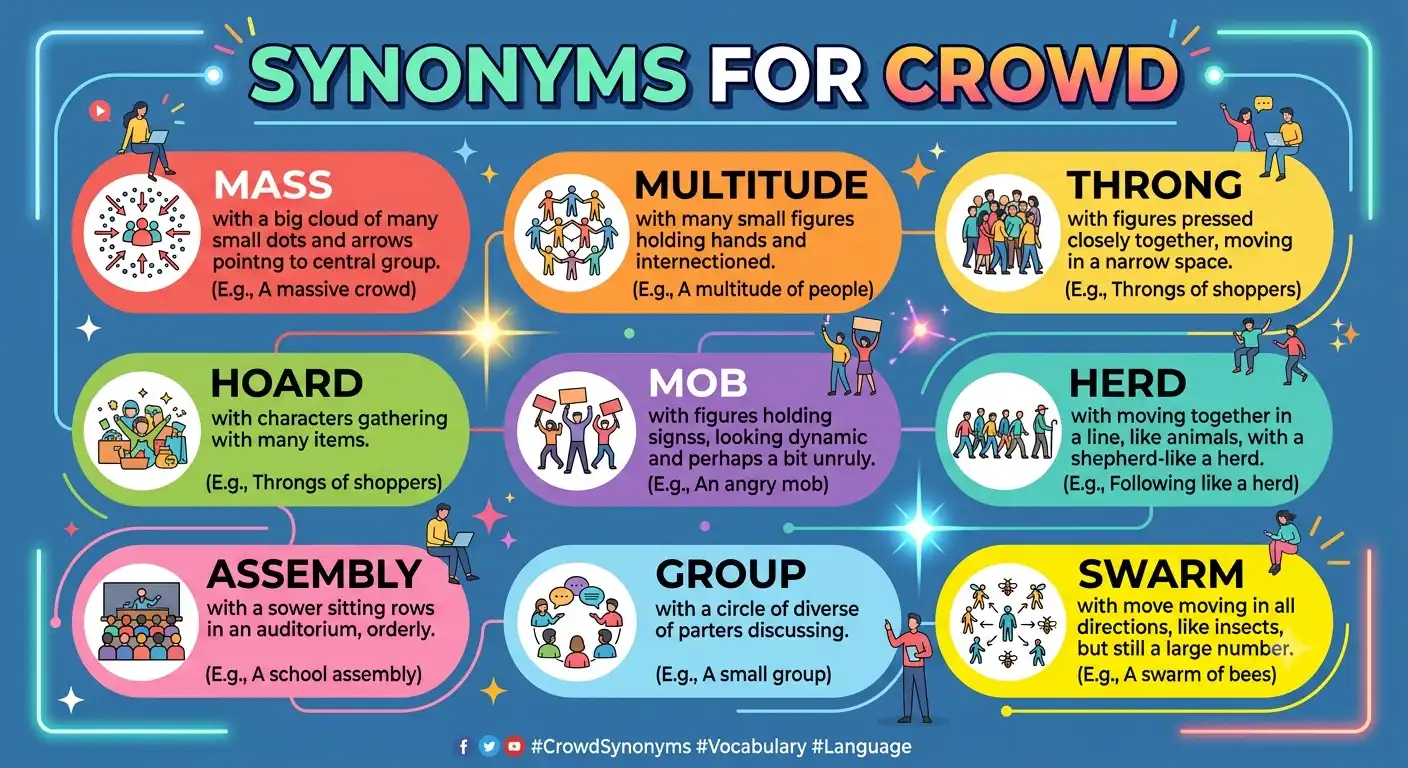
When you explore synonyms for crowd, you discover new ways to describe groups of people in everyday life. Learning synonyms for crowd helps you choose the right word for any situation, whether you are describing a busy market or a quiet concert. By expanding your vocabulary with synonyms for crowd, your descriptions become vivid, clear, and far more interesting.
Imagine walking into a stadium where thousands of excited sports fans cheer together in unison. A crowd is simply a large group of people gathered together in one place.
Understanding this word and its alternatives is immensely helpful for many readers:
- Students can write descriptive essays and creative stories without repeating basic vocabulary.
- Bloggers can keep their articles lively and engaging for readers.
- Content writers can craft clear descriptions for social media, travel guides, and marketing copy.
- Daily English users can explain scenes and events clearly in casual conversations.
“Words are, in my not-so-humble opinion, our most inexhaustible source of magic.” — J.K. Rowling
“The difference between the almost right word and the right word is the difference between lightning and a lightning bug.” — Mark Twain
Linguistic Breakdown of “Crowd”
Connotative Meaning
The word crowd usually carries a neutral to sightly energetic connotation. Depending on the context, a crowd can feel joyful (at a party), chaotic (during a rush), or tense (during a protest).
Etymology
- Old English: Derived from crūdan (meaning “to press, drive, or push”).
- Middle English: Evolved into crowden, referring to pressing together closely.
- Modern Development: Shifted from the physical action of pushing to describing a gathering of people.
Pronunciation
- US IPA: /kraʊd/
- UK IPA: /kraʊd/
Syllables & Affixation Pattern
- Syllables: 1 (crowd)
- Root: Base word without prefixes or suffixes.
Comparison Table of Key Synonyms
| Keyword | Meaning | Usage Type | Context |
|---|---|---|---|
| Throng | A very densely packed group of people | Descriptive / Expressive | Festivals, street markets, crowded venues |
| Mob | A large, unruly, or disorderly group | Emotional / Dramatic | Protests, riots, intense news reports |
| Multitude | A huge number of individuals gathered together | Formal / Literary | Speeches, classical books, essays |
| Horde | A vast, moving mass of people | Expressive / Casual | Busy shopping malls, sports grounds |
| Gathering | An informal collection of people | Casual / Friendly | Family events, casual meetings, reunions |
| Assembly | A formal group gathered for a common purpose | Professional / Formal | School halls, business conferences, courts |
| Congregation | A group gathered for religious or formal purpose | Formal / Religious | Churches, ceremonies, spiritual meetings |
| Audience | A group gathered to watch or listen | Professional / Casual | Theaters, lectures, sports games |
Main Content – 50 Synonyms for Crowd
1. Throng
- Pronunciation: US: /θrɑːŋ/ | UK: /θrɒŋ/
- Meaning: A throng is a very large and densely packed group of people.
- Examples:
- A huge throng gathered around the main stage to see the singer.
- We pushed our way through the street throng during the festival.
2. Mob
- Pronunciation: US: /mɑːb/ | UK: /mɒb/
- Meaning: A mob is an angry or wild group of people.
- Examples:
- The angry mob demanded answers from local leaders outside city hall.
- Photographers formed a loud mob around the movie star.
3. Multitude
- Pronunciation: US: /ˈmʌl.tə.tuːd/ | UK: /ˈmʌl.tɪ.tjuːd/
- Meaning: A multitude is a very large number of people or things.
- Examples:
- A multitude of fans waited outside the stadium for hours.
- The leader addressed the vast multitude with a grand speech.
4. Horde
- Pronunciation: US: /hɔːrd/ | UK: /hɔːd/
- Meaning: A horde is a very large group moving together.
- Examples:
- A horde of shoppers ran through the doors on sale morning.
- Children swept across the playground like a noisy horde.
5. Swarm
- Pronunciation: US: /swɔːrm/ | UK: /swɔːm/
- Meaning: A swarm is a busy group moving around quickly.
- Examples:
- A swarm of tourists arrived at the historic museum by bus.
- Reporters formed a busy swarm around the stadium entrance.
6. Gathering
- Pronunciation: US: /ˈɡæð.ɚ.ɪŋ/ | UK: /ˈɡæð.ər.ɪŋ/
- Meaning: A gathering is a group brought together in one place.
- Examples:
- Our family host a large gathering every summer in the park.
- The community held a quiet gathering to celebrate the holiday.
7. Assembly
- Pronunciation: US: /əˈsem.bli/ | UK: /əˈsem.bli/
- Meaning: An assembly is a group gathered for a clear purpose.
- Examples:
- All students met in the main hall for the morning assembly.
- The town assembly voted on new rules for park safety.
8. Host
- Pronunciation: US: /hoʊst/ | UK: /həʊst/
- Meaning: A host is a very large group gathered together.
- Examples:
- A host of supporters cheered loudly for the home team.
- The park was full with a host of excited visitors.
9. Mass
- Pronunciation: US: /mæs/ | UK: /mæs/
- Meaning: A mass is a large body of people in one place.
- Examples:
- A dark mass of people filled the city square during the concert.
- The runners started the race as one solid mass.
10. Congregation
- Pronunciation: US: /ˌkɑːŋ.ɡrəˈɡeɪ.ʃən/ | UK: /ˌkɒŋ.ɡrɪˈɡeɪ.ʃən/
- Meaning: A congregation is a group gathered for worship or meetings.
- Examples:
- The congregation sang hymns quietly inside the community hall.
- Members of the congregation greeted each other after the morning service.
11. Pack
- Pronunciation: US: /pæk/ | UK: /pæk/
- Meaning: A pack is a close group of people moving together.
- Examples:
- A pack of young kids ran down the sidewalk on bikes.
- Photographers followed the famous runner in a tight pack.
12. Flock
- Pronunciation: US: /flɑːk/ | UK: /flɒk/
- Meaning: A flock is a group moving together toward one spot.
- Examples:
- A large flock of visitors moved toward the park gates.
- Buyers arrived in a quick flock when the store opened.
13. Herd
- Pronunciation: US: /hɝːd/ | UK: /hɜːd/
- Meaning: A herd is a group moving together in an orderly way.
- Examples:
- The guide led the herd of tourists down the narrow hallway.
- Commuters walked like a large herd toward the train platform.
14. Drove
- Pronunciation: US: /droʊv/ | UK: /drəʊv/
- Meaning: A drove is a large group moving all at once.
- Examples:
- People arrived in droves to buy tickets for the big show.
- A drove of fans rushed past the security gates.
15. Press
- Pronunciation: US: /pres/ | UK: /pres/
- Meaning: A press is a tight group squeezing together.
- Examples:
- We stood in the warm press of people near the front stage.
- The heavy press at the gate slowed everyone down.
16. Jam
- Pronunciation: US: /dʒæm/ | UK: /dʒæm/
- Meaning: A jam is a crowded group that cannot move easily.
- Examples:
- A huge jam of commuters filled the subway station exit.
- The hallway became a tight jam after the final bell rang.
17. Crush
- Pronunciation: US: /krʌʃ/ | UK: /krʌʃ/
- Meaning: A crush is a group packed tightly together in a small space.
- Examples:
- Security helped guide people safely out of the heavy crush.
- I lost sight of my friend in the thick crush near the door.
18. Posse
- Pronunciation: US: /ˈpɑː.si/ | UK: /ˈpɒs.i/
- Meaning: A posse is a small, close group of friends or followers.
- Examples:
- She walked into the party with her usual posse of friends.
- The actor traveled with a small posse of assistants.
19. Group
- Pronunciation: US: /ɡruːp/ | UK: /ɡruːp/
- Meaning: A group is any set of people together in one place.
- Examples:
- A small group stood by the entrance chatting quietly.
- Please divide into a group of four for this quick activity.
20. Turnout
- Pronunciation: US: /ˈtɝːn.aʊt/ | UK: /ˈtɜːn.aʊt/
- Meaning: A turnout is the total group that shows up for an event.
- Examples:
- We were happy to see a huge turnout at our bake sale.
- The heavy rain did not stop the great turnout for the game.
“Language shapes our thoughts and lights up our ideas.” — Anonymous
21. Audience
- Pronunciation: US: /ˈɑː.di.əns/ | UK: /ˈɔː.di.əns/
- Meaning: An audience is a group gathered to watch or listen to something.
- Examples:
- The quiet audience listened closely to the beautiful piano music.
- Performers bowed happily as the audience clapped loudly.
22. Spectators
- Pronunciation: US: /ˈspek.teɪ.t̬ɚz/ | UK: /spekˈteɪ.təz/
- Meaning: Spectators are people watching an event like a game or show.
- Examples:
- Thousands of cheerful spectators filled the outdoor stadium seats.
- The cold weather did not scare away the enthusiastic spectators.
23. Onlookers
- Pronunciation: US: /ˈɑːn.lʊk.ɚz/ | UK: /ˈɒn.lʊk.əz/
- Meaning: Onlookers are people standing around watching an action happen.
- Examples:
- Curious onlookers gathered quickly to see the street performance.
- A group of onlookers watched the police officers direct traffic.
24. Attendance
- Pronunciation: US: /əˈten.dəns/ | UK: /əˈten.dəns/
- Meaning: Attendance means the collective group present at an event.
- Examples:
- The festival reported a record attendance on Saturday evening.
- High attendance filled every chair in the auditorium.
25. Bunch
- Pronunciation: US: /bʌntʃ/ | UK: /bʌntʃ/
- Meaning: A bunch is an informal group of people gathered together.
- Examples:
- A cheerful bunch of kids played games in the backyard.
- I met a friendly bunch of travelers at the hotel lounge.
26. Collection
- Pronunciation: US: /kəˈlek.ʃən/ | UK: /kəˈlek.ʃən/
- Meaning: A collection is a varied group gathered in one spot.
- Examples:
- A diverse collection of artists showed their work today.
- The meeting drew an interesting collection of local residents.
27. Body
- Pronunciation: US: /ˈbɑː.di/ | UK: /ˈbɒd.i/
- Meaning: A body is an organized group working or gathering together.
- Examples:
- The student body voted for a new class president yesterday.
- A large body of voters met to ask questions at the hall.
28. Array
- Pronunciation: US: /əˈreɪ/ | UK: /əˈreɪ/
- Meaning: An array is an impressive group arranged together.
- Examples:
- An impressive array of guests arrived for the charity gala.
- A colourful array of dancers lined up along the parade street.
29. Company
- Pronunciation: US: /ˈkʌm.pə.ni/ | UK: /ˈkʌm.pə.ni/
- Meaning: Company is a group gathered together to spend time.
- Examples:
- We enjoyed good company around the warm campfire tonight.
- The hostess welcomed a large company of guests to dinner.
30. Band
- Pronunciation: US: /bænd/ | UK: /bænd/
- Meaning: A band is a small group united for a common purpose.
- Examples:
- A small band of volunteers cleaned up the river bank.
- The brave band of explorers hiked up the snow mountain.
31. Troop
- Pronunciation: US: /truːp/ | UK: /truːp/
- Meaning: A troop is a group of people moving or working together.
- Examples:
- A troop of young scouts set up their tents near the trees.
- The theater troop practiced their routines all afternoon.
32. Contingent
- Pronunciation: US: /kənˈtɪn.dʒənt/ | UK: /kənˈtɪn.dʒənt/
- Meaning: A contingent is a group representing a larger organization.
- Examples:
- The Canadian contingent marched proudly during the parade opening.
- A large contingent of doctors attended the annual medical fair.
33. Huddle
- Pronunciation: US: /ˈhʌd.əl/ | UK: /ˈhʌd.əl/
- Meaning: A huddle is a close group standing near each other for warmth or privacy.
- Examples:
- Players gathered in a quick huddle before the next play.
- A small huddle of students talked quietly under the doorway.
34. Cluster
- Pronunciation: US: /ˈklʌs.tɚ/ | UK: /ˈklʌs.tər/
- Meaning: A cluster is a small group gathered closely together.
- Examples:
- A cluster of fans stood near the tour bus entrance.
- We noticed a quiet cluster of people looking at the map.
35. Concourse
- Pronunciation: US: /ˈkɑːn.kɔːrs/ | UK: /ˈkɒŋ.kɔːs/
- Meaning: A concourse is a large crowd moving through a public building.
- Examples:
- A busy concourse of travelers moved through the central airport terminal.
- The bright train station held a moving concourse of people.
36. Rabble
- Pronunciation: US: /ˈræb.əl/ | UK: /ˈræb.əl/
- Meaning: A rabble is a noisy and uncontrolled group of people.
- Examples:
- The security guards stopped the noisy rabble at the entrance door.
- The speaker tried to calm down the loud rabble in the street.
37. Rout
- Pronunciation: US: /raʊt/ | UK: /raʊt/
- Meaning: A rout is a disorderly crowd on the move.
- Examples:
- The wild rout moved quickly through the city square.
- Officers guided the disorderly rout away from traffic lanes.
38. Hive
- Pronunciation: US: /haɪv/ | UK: /haɪv/
- Meaning: A hive is a place filled with a busy group of people.
- Examples:
- The office building was a busy hive of workers all morning.
- The main kitchen became a hive of activity before dinner.
39. Convergence
- Pronunciation: US: /kənˈvɝː.dʒəns/ | UK: /kənˈvɜː.dʒəns/
- Meaning: A convergence is a group meeting at one central point.
- Examples:
- The park saw a peaceful convergence of visitors from many towns.
- We watched the gradual convergence of fans at the front stage.
40. Muster
- Pronunciation: US: /ˈmʌs.tɚ/ | UK: /ˈmʌs.tər/
- Meaning: A muster is a group gathered together for inspection or duty.
- Examples:
- The captain called a quick muster of all crew members on deck.
- A grand muster of safety teams filled the main parking area.
41. Bevy
- Pronunciation: US: /ˈbev.i/ | UK: /ˈbev.i/
- Meaning: A bevy is a large or impressive group of people.
- Examples:
- A bevy of reporters waited outside the court room door.
- The event hosted a lovely bevy of international guests.
42. Stream
- Pronunciation: US: /striːm/ | UK: /striːm/
- Meaning: A stream is a steady line of people moving continuously.
- Examples:
- A steady stream of visitors entered the art gallery all afternoon.
- We walked along the continuous stream of shoppers on the boulevard.
43. Flood
- Pronunciation: US: /flʌd/ | UK: /flʌd/
- Meaning: A flood is a huge group rushing into a space all at once.
- Examples:
- A sudden flood of fans rushed onto the field after the match.
- The store saw a flood of customers during the holiday weekend.
44. Surge
- Pronunciation: US: /sɝːdʒ/ | UK: /sɜːdʒ/
- Meaning: A surge is a group moving forward suddenly together.
- Examples:
- A powerful surge of people moved toward the opening gate.
- Security managed the sudden surge of fans at the entrance.
45. Cloud
- Pronunciation: US: /klaʊd/ | UK: /klaʊd/
- Meaning: A cloud is a large, loose group gathered in an open area.
- Examples:
- A cloud of curious kids followed the ice cream truck down the street.
- The park was filled with a cloud of festival visitors.
46. Outpouring
- Pronunciation: US: /ˈaʊtˌpɔːr.ɪŋ/ | UK: /ˈaʊtˌpɔː.rɪŋ/
- Meaning: An outpouring is a large group gathering to show emotion or support.
- Examples:
- There was a massive outpouring of supporters at the rally.
- The town saw a warm outpouring of neighbors helping at the park.
47. Gang
- Pronunciation: US: /ɡæŋ/ | UK: /ɡæŋ/
- Meaning: A gang is an informal group of friends gathered together.
- Examples:
- The whole gang went out for pizza after the long practice.
- I spent the entire weekend hanging out with my main gang.
48. Assemblage
- Pronunciation: US: /əˈsem.blɪdʒ/ | UK: /əˈsem.blɪdʒ/
- Meaning: An assemblage is a collection of people gathered in one place.
- Examples:
- A distinguished assemblage of scholars gathered for the conference.
- The mayor greeted the formal assemblage at the grand hall.
49. Sea of people
- Pronunciation: US: /siː ɑːv ˈpiː.pəl/ | UK: /siː ɒv ˈpiː.pəl/
- Meaning: A sea of people is a huge crowd stretching far out.
- Examples:
- Looking from the stage, the singer saw a massive sea of people.
- The main street looked like a bright sea of people during the parade.
50. Flash mob
- Pronunciation: US: /ˈflæʃ mɑːb/ | UK: /ˈflæʃ mɒb/
- Meaning: A flash mob is a group that gathers suddenly in public to perform.
- Examples:
- A surprise flash mob started dancing together in the shopping mall.
- Bystanders cheered as the cheerful flash mob finished their song.
Antonyms of “Crowd”
When you want to describe solitude, small numbers, or empty spaces rather than a crowded group, use these primary antonyms:
- Solitude: US: /ˈsɑː.lə.tuːd/ | UK: /ˈsɒl.ɪ.tjuːd/ – The state of being alone or away from other people.
- Individual: US: /ˌɪn.dəˈvɪdʒ.u.əl/ | UK: /ˌɪn.dɪˈvɪdʒ.u.əl/ – A single person considered separately from a group.
- Loner: US: /ˈloʊ.nɚ/ | UK: /ˈləʊ.nər/ – A person who prefers to be alone rather than in a group.
- Emptiness: US: /ˈemp.ti.nəs/ | UK: /ˈemp.ti.nəs/ – A state where no people or things are present.
Prototype Meaning and Categorization of “Crowd”
- Grammatical Category: Noun (Countable and Collective Noun), Verb (transitive/intransitive).
- Prototype Meaning: A large number of individuals gathered together closely in a single location.
- Semantic Field: Sociology, public events, journalism, everyday language, and descriptive literature.
Frequently Asked Questions (FAQ)
1. What is the most formal synonym for crowd?
Words like assembly, assemblage, and concourse are the most formal synonyms for crowd. They work very well in legal writings, business reports, and academic essays.
2. What is the difference between a “mob” and a “throng”?
A mob implies a disorderly, chaotic, or aggressive group of people. A throng simply describes a tightly packed, dense group without implying violence or bad intentions.
3. Which synonym for crowd works best for creative storytelling?
For creative stories, terms like sea of people, swarm, horde, and surge add vivid movement and emotion to your scenes.
4. Can collective animal words like “flock” or “herd” describe human crowds?
Yes, native speakers often use words like flock, herd, or swarm metaphorically to describe groups of people moving together in specific ways.
5. Why should content writers use different synonyms for crowd?
Using varied words keeps readers interested, avoids monotonous writing, improves SEO vocabulary diversity, and paints precise mental images.
Conclusion
Mastering synonyms for crowd gives you the flexibility to describe any gathering with clarity, tone, and imagery. By moving beyond the basic word “crowd,” you can capture whether a group is formal, joyful, chaotic, or calm. Choosing terms like throng, assembly, gathering, or multitude allows your precise meaning to shine through.
Expanding your vocabulary directly improves your writing, blogging, speaking, and everyday communication. Whether you are drafting a school essay, publishing a blog entry, composing a business email, or sharing a personal story, these terms help you express yourself with confidence and style.
“Proper words in proper places, make the true definition of a style.” — Jonathan Swift
“Communication works for those who work at it.” — John Powell
Keep practicing these rich vocabulary words in your everyday conversations and writing assignments to make your language natural, powerful, and captivating.

Andrew Collins is an academic English educator with over 12 years of experience helping university students, IELTS candidates, and ESL learners improve their writing vocabulary.