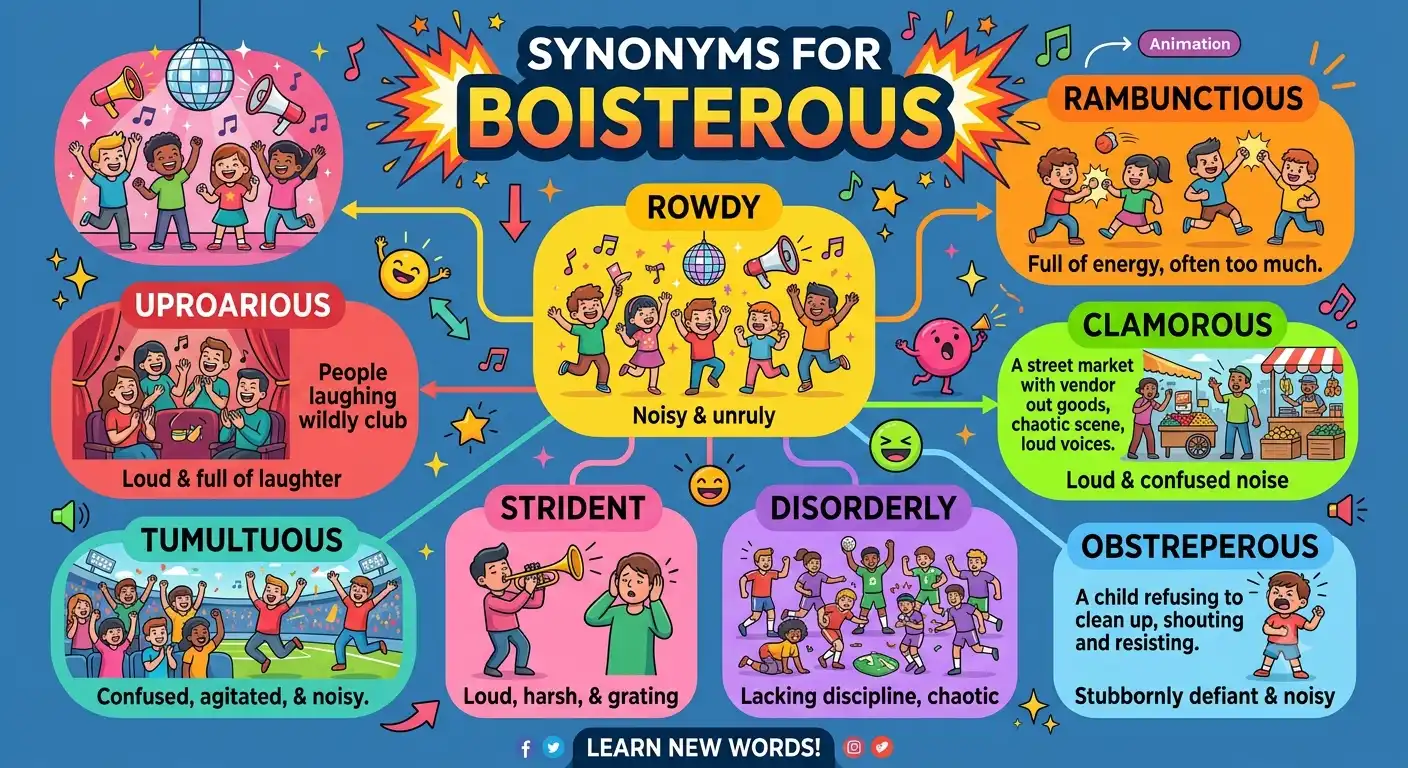
Exploring synonyms for boisterous opens up exciting new ways to describe noisy, energetic, and active scenes in everyday English. Learning synonyms for boisterous gives you the precise vocabulary you need to express wild energy, rowdy gatherings, or lively celebrations clearly. By adding these synonyms for boisterous to your personal vocabulary, your descriptive writing instantly becomes vivid, engaging, and polished.
Picture a busy playground filled with excited children laughing loudly and running around during recess. That noisy, full-of-energy behavior is exactly what boisterous means. In simple words, boisterous describes someone or something that is loud, energetic, wild, and hard to keep quiet.
Knowing a rich variety of words for loud energy helps many types of readers:
- Students can write descriptive essays and creative stories without repeating the same basic words.
- Bloggers can make their posts lively and keep readers hooked from start to finish.
- Content writers can craft dynamic descriptions for social media, event reviews, and articles.
- Daily English users can clearly describe events, pets, kids, and parties in everyday conversations.
“Words are, in my not-so-humble opinion, our most inexhaustible source of magic.” — J.K. Rowling
“The right word may be effective, but no word was ever as effective as a rightly timed pause.” — Mark Twain
Linguistic Breakdown of “Boisterous”
Connotative Meaning
The word boisterous carries a positive to slightly chaotic connotation. Most often, it describes friendly, cheerful, high-spirited behavior. However, depending on context, it can also describe noisy disorder or rough weather.
Etymology
- Middle English: Derived from boistous (meaning “rough, coarse, clumsy, or violent”).
- Anglo-Norman Influence: Connected to words describing coarse or unrefined physical strength.
- Modern Development: Shifted from meaning physical roughness to describing noisy, energetic, and high-spirited behavior.
Pronunciation
- US IPA: /ˈbɔɪ.stɚ.əs/
- UK IPA: /ˈbɔɪ.strəs/
Syllables & Affixation Pattern
- Syllables: 3 (bois-ter-ous)
- Root: Base form related to energy/roughness.
- Suffix: -ous (adjective suffix meaning “full of” or “possessing”).
Comparison Table of Key Synonyms
| Keyword | Meaning | Usage Type | Context |
|---|---|---|---|
| Rowdy | Noisy and disorderly in a rough way | Casual / Expressive | Parties, sports matches, street crowds |
| Rambunctious | Uncontrolled, playful, and full of energy | Casual / Friendly | Children, pets, family gatherings |
| Raucous | Harsh, loud, and rough in sound | Descriptive / Dramatic | Nightclubs, noisy crowds, loud laughter |
| Exuberant | Full of lively energy and excitement | Positive / Expressive | Celebrations, victories, artistic performances |
| Clamorous | Making a loud and confused noise | Formal / Descriptive | Protests, crowded markets, newsrooms |
| Obstreperous | Noisy and difficult to control | Formal / Critical | Classrooms, public debates, complaints |
| Lively | Full of life and gentle energy | General / Friendly | Casual conversations, social events, music |
| Tumultuous | Very loud, excited, or confused | Formal / Dramatic | Speeches, historical events, weather |
Main Content – 50 Synonyms for Boisterous
1. Rowdy
- Pronunciation: US: /ˈraʊ.di/ | UK: /ˈraʊ.di/
- Meaning: Rowdy means noisy, rough, and hard to control.
- Examples:
- The rowdy fans cheered loudly when their team won.
- Security asked the rowdy group to leave the quiet restaurant.
2. Rambunctious
- Pronunciation: US: /ræmˈbʌŋk.ʃəs/ | UK: /ræmˈbʌŋk.ʃəs/
- Meaning: Rambunctious means full of wild, playful energy.
- Examples:
- The rambunctious puppy ran all around the living room.
- Two rambunctious kids bounced up and down on the sofa.
3. Raucous
- Pronunciation: US: /ˈrɑː.kəs/ | UK: /ˈrɔː.kəs/
- Meaning: Raucous means very loud, harsh, and noisy.
- Examples:
- Raucous laughter echoed across the crowded party room.
- The birds made a raucous sound outside my window early this morning.
4. Clamorous
- Pronunciation: US: /ˈklæm.ɚ.əs/ | UK: /ˈklæm.ər.əs/
- Meaning: Clamorous means making a continuous, loud noise.
- Examples:
- A clamorous crowd waited outside the ticket office for hours.
- The street market was full of clamorous vendors calling out prices.
5. Vociferous
- Pronunciation: US: /vəˈsɪf.ɚ.əs/ | UK: /vəˈsɪf.ər.əs/
- Meaning: Vociferous means expressing strong feelings in a loud way.
- Examples:
- The vociferous speaker spoke passionately against the new law.
- Parents made a vociferous demand for safer pedestrian crossings.
6. Obstreperous
- Pronunciation: US: /əbˈstrep.ɚ.əs/ | UK: /əbˈstrep.ər.əs/
- Meaning: Obstreperous means noisy and stubborn when refusing to obey.
- Examples:
- The obstreperous child refused to sit down during story hour.
- An obstreperous customer shouted at the store manager near the register.
7. Lively
- Pronunciation: US: /ˈlaɪv.li/ | UK: /ˈlaɪv.li/
- Meaning: Lively means active, happy, and full of pleasant energy.
- Examples:
- We enjoyed a lively discussion about our favorite movies.
- The band played a lively song that got everyone dancing.
8. Animated
- Pronunciation: US: /ˈæn.ə.meɪ.t̬ɪd/ | UK: /ˈæn.ɪ.meɪ.tɪd/
- Meaning: Animated means full of movement, interest, and excitement.
- Examples:
- She used animated hand gestures while telling her funny story.
- The children had an animated chat about their upcoming vacation.
9. Spirited
- Pronunciation: US: /ˈspɪr.ə.t̬ɪd/ | UK: /ˈspɪr.ɪ.tɪd/
- Meaning: Spirited means showing high energy, courage, and enthusiasm.
- Examples:
- The soccer players gave a spirited performance in the final match.
- Our group had a spirited debate over which project to choose.
10. Exuberant
- Pronunciation: US: /ɪɡˈzuː.bɚ.ənt/ | UK: /ɪɡˈzjuː.bər.ənt/
- Meaning: Exuberant means filled with unrestrained happiness and vigor.
- Examples:
- The exuberant winner hugged all of her teammates tightly.
- His exuberant personality instantly cheered up the entire room.
11. Tumultuous
- Pronunciation: US: /tuːˈmʌl.tʃu.əs/ | UK: /tjʊˈmʌl.tʃu.əs/
- Meaning: Tumultuous means full of loud noise and disorder.
- Examples:
- The politician received a tumultuous welcome from the huge crowd.
- The ship sailed across tumultuous ocean waves during the storm.
12. Turbulent
- Pronunciation: US: /ˈtɝː.bjə.lənt/ | UK: /ˈtɜː.bjə.lənt/
- Meaning: Turbulent means wild, bumpy, or hard to keep calm.
- Examples:
- The plane experienced a brief turbulent ride near the mountains.
- He reflected on the turbulent times of his early career.
13. Riotous
- Pronunciation: US: /ˈraɪ.ə.t̬əs/ | UK: /ˈraɪ.ə.təs/
- Meaning: Riotous means wild, noisy, and without control.
- Examples:
- The room burst into riotous laughter at the comedian’s joke.
- Police kept watch over the riotous gathering in the town square.
14. Rollicking
- Pronunciation: US: /ˈrɑː.lɪ.kɪŋ/ | UK: /ˈrɒl.ɪ.kɪŋ/
- Meaning: Rollicking means loud, warm, and carefree.
- Examples:
- We had a rollicking good time at the summer cabin party.
- The band performed a rollicking tune that made people clap.
15. Uproarious
- Pronunciation: US: /ʌpˈrɔːr.i.əs/ | UK: /ʌpˈrɔː.ri.əs/
- Meaning: Uproarious means extremely loud and very funny.
- Examples:
- The play ended with uproarious applause from the audience.
- His speech brought uproarious laughter to the dinner table.
16. Blustery
- Pronunciation: US: /ˈblʌs.tɚ.i/ | UK: /ˈblʌs.tər.i/
- Meaning: Blustery means noisy and blowing with strong wind or speech.
- Examples:
- We pulled our coats tight on the blustery autumn morning.
- The official made a blustery speech about future city plans.
17. Wild
- Pronunciation: US: /waɪld/ | UK: /waɪld/
- Meaning: Wild means living or acting without control or rules.
- Examples:
- Wild cheers echoed through the gym when the buzzer sounded.
- The storm brought wild gusts of wind through the forest.
18. Loud
- Pronunciation: US: /laʊd/ | UK: /laʊd/
- Meaning: Loud means making a strong, intense sound.
- Examples:
- A loud thunderclap startled everyone sitting on the porch.
- Please do not talk in a loud voice inside the library.
19. Noisy
- Pronunciation: US: /ˈnɔɪ.zi/ | UK: /ˈnɔɪ.zi/
- Meaning: Noisy means making a lot of loud, unpleasant sounds.
- Examples:
- The noisy traffic kept me awake for most of the night.
- A noisy group of students walked down the hallway together.
20. High-spirited
- Pronunciation: US: /ˌhaɪˈspɪr.ə.t̬ɪd/ | UK: /ˌhaɪˈspɪr.ɪ.tɪd/
- Meaning: High-spirited means happy, energetic, and full of life.
- Examples:
- The high-spirited children ran around the backyard garden.
- A high-spirited crowd gathered to watch the local parade.
“Language shapes our thoughts and lights up our ideas.” — Anonymous
21. Unruly
- Pronunciation: US: /ʌnˈruː.li/ | UK: /ʌnˈruː.li/
- Meaning: Unruly means hard to manage or keep orderly.
- Examples:
- The teacher struggled to calm down the unruly class.
- Strong winds blew his unruly hair into his eyes.
22. Uninhibited
- Pronunciation: US: /ˌʌn.ɪnˈhɪb.ɪ.t̬ɪd/ | UK: /ˌʌn.ɪnˈhɪb.ɪ.tɪd/
- Meaning: Uninhibited means free and not worried about what others think.
- Examples:
- Her uninhibited dance moves made everyone smile at the wedding.
- They enjoyed an uninhibited chat about their favorite dreams.
23. Irrepressible
- Pronunciation: US: /ˌɪr.əˈpres.ə.bəl/ | UK: /ˌɪr.ɪˈpres.ə.bəl/
- Meaning: Irrepressible means energy or happiness that cannot be controlled.
- Examples:
- Her irrepressible humor brightened up even the hardest days.
- He showed an irrepressible enthusiasm for learning new sports.
24. Effervescent
- Pronunciation: US: /ˌef.ɚˈves.ənt/ | UK: /ˌef.əˈves.ənt/
- Meaning: Effervescent means bubbly, excited, and constantly active.
- Examples:
- Her effervescent personality made her popular among her peers.
- The host greeted every visitor with an effervescent smile.
25. Tempestuous
- Pronunciation: US: /temˈpes.tʃu.əs/ | UK: /temˈpes.tʃu.əs/
- Meaning: Tempestuous means emotional, stormy, and full of strong energy.
- Examples:
- The two friends had a tempestuous relationship that changed daily.
- Ships stayed in the harbor during the tempestuous winter storm.
26. Roisterous
- Pronunciation: US: /ˈrɔɪ.stɚ.əs/ | UK: /ˈrɔɪ.strəs/
- Meaning: Roisterous means loud, merry, and noisy during celebrations.
- Examples:
- The roisterous partygoers sang songs until late at night.
- A roisterous crowd gathered inside the cozy village inn.
27. Frisky
- Pronunciation: US: /ˈfrɪs.ki/ | UK: /ˈfrɪs.ki/
- Meaning: Frisky means playful, energetic, and active.
- Examples:
- The frisky kitten chased the red ball across the carpet.
- Cool morning air made the horses feel frisky in the field.
28. Strident
- Pronunciation: US: /ˈstraɪ.dənt/ | UK: /ˈstraɪ.dənt/
- Meaning: Strident means loud, harsh, and insistent in tone.
- Examples:
- The whistle blew with a strident sound across the field.
- She raised a strident voice to complain about the service.
29. Bouncy
- Pronunciation: US: /ˈbaʊn.si/ | UK: /ˈbaʊn.si/
- Meaning: Bouncy means full of lively, springy energy.
- Examples:
- The bouncy toddler jumped excitedly on the soft rug.
- Her bouncy step showed how happy she was about the news.
30. Vibrant
- Pronunciation: US: /ˈvaɪ.brənt/ | UK: /ˈvaɪ.brənt/
- Meaning: Vibrant means full of life, color, and active energy.
- Examples:
- The city center has a vibrant atmosphere every weekend.
- She wore a vibrant red dress to the anniversary dinner.
31. Dynamic
- Pronunciation: US: /daɪˈnæm.ɪk/ | UK: /daɪˈnæm.ɪk/
- Meaning: Dynamic means active, strong, and constantly changing.
- Examples:
- The company hired a dynamic leader to direct the team.
- They shared a dynamic partnership that achieved great results.
32. Untamed
- Pronunciation: US: /ʌnˈteɪmd/ | UK: /ʌnˈteɪmd/
- Meaning: Untamed means wild and not controlled by rules.
- Examples:
- The untamed river rushed quickly over the big rocks.
- She had an untamed spirit that loved outdoor adventure.
33. Bustling
- Pronunciation: US: /ˈbʌs.lɪŋ/ | UK: /ˈbʌs.lɪŋ/
- Meaning: Bustling means busy, active, and filled with noise.
- Examples:
- Workers filled the bustling office early on Monday morning.
- We walked through the bustling streets of downtown Tokyo.
34. Feisty
- Pronunciation: US: /ˈfaɪ.sti/ | UK: /ˈfaɪ.sti/
- Meaning: Feisty means small, energetic, and ready to fight.
- Examples:
- The feisty little dog barked bravely at the large postman.
- She gave a feisty response when someone doubted her skill.
35. Zestful
- Pronunciation: US: /ˈzest.fəl/ | UK: /ˈzest.fəl/
- Meaning: Zestful means full of deep enthusiasm and enjoyment.
- Examples:
- He greeted every morning with a zestful attitude toward work.
- The dancers gave a zestful show that thrilled the audience.
36. Disorderly
- Pronunciation: US: /dɪsˈɔːr.dɚ.li/ | UK: /dɪsˈɔː.də.li/
- Meaning: Disorderly means untidy, untamed, and lacking structure.
- Examples:
- Officers stopped the disorderly crowd before anyone got hurt.
- Papers were scattered in a disorderly pile on his desk.
37. Uncontrolled
- Pronunciation: US: /ˌʌn.kənˈtroʊld/ | UK: /ˌʌn.kənˈtrəʊld/
- Meaning: Uncontrolled means moving or acting without limits.
- Examples:
- Uncontrolled laughter made it hard for her to speak.
- The car slid on icy roads in an uncontrolled skid.
38. Brawling
- Pronunciation: US: /ˈbrɑː.lɪŋ/ | UK: /ˈbrɔː.lɪŋ/
- Meaning: Brawling means fighting or arguing in a loud, noisy way.
- Examples:
- A brawling group of fans was broken up by security guards.
- The movie featured a brawling scene inside an old tavern.
39. Out of hand
- Pronunciation: US: /aʊt ɑːv hænd/ | UK: /aʊt ɒv hænd/
- Meaning: Out of hand means impossible to control or direct.
- Examples:
- The party got out of hand when too many guests arrived.
- Things quickly went out of hand during the heated debate.
40. Vocal
- Pronunciation: US: /ˈvoʊ.kəl/ | UK: /ˈvəʊ.kəl/
- Meaning: Vocal means quick to express opinions loudly and openly.
- Examples:
- She was very vocal about protecting local forest trees.
- Vocal supporters shouted words of encouragement from the stands.
41. Rowdyish
- Pronunciation: US: /ˈraʊ.di.ɪʃ/ | UK: /ˈraʊ.di.ɪʃ/
- Meaning: Rowdyish means somewhat noisy, rough, and playful.
- Examples:
- The teenagers engaged in rowdyish games on the beach.
- A rowdyish atmosphere filled the diner late on Friday.
42. Fiery
- Pronunciation: US: /ˈfaɪ.ri/ | UK: /ˈfaɪə.ri/
- Meaning: Fiery means full of passionate, intense, and hot energy.
- Examples:
- The coach gave a fiery speech at half-time to motivate us.
- She possessed a fiery temper when people were unfair.
43. Restless
- Pronunciation: US: /ˈrest.ləs/ | UK: /ˈrest.ləs/
- Meaning: Restless means unable to sit still because of energy.
- Examples:
- The restless audience shifted in their seats during the delay.
- Long rain days make indoor children feel very restless.
44. Boistering
- Pronunciation: US: /ˈbɔɪ.stɚ.ɪŋ/ | UK: /ˈbɔɪ.strɪŋ/
- Meaning: Boistering means acting loud, rough, and full of noise.
- Examples:
- Boistering winds rattled the glass windows during the night.
- The boistering group celebrated their victory along the street.
45. Vigorous
- Pronunciation: US: /ˈvɪɡ.ɚ.əs/ | UK: /ˈvɪɡ.ər.əs/
- Meaning: Vigorous means using strong physical energy and effort.
- Examples:
- We took a vigorous walk up the mountain trail today.
- He gave a vigorous shake of the hand when we met.
46. Loud-mouthed
- Pronunciation: US: /ˈlaʊd.maʊðd/ | UK: /ˈlaʊd.maʊðd/
- Meaning: Loud-mouthed means talking in a noisy, offensive way.
- Examples:
- A loud-mouthed fan kept yelling at the game referee.
- Nobody wanted to sit next to the loud-mouthed passenger.
47. Unsubdued
- Pronunciation: US: /ˌʌn.səbˈdjuːd/ | UK: /ˌʌn.səbˈdjuːd/
- Meaning: Unsubdued means not quieted, softened, or put down.
- Examples:
- Their unsubdued joy showed on their faces after winning.
- The room stayed filled with unsubdued chatter all evening.
48. Joyous
- Pronunciation: US: /ˈdʒɔɪ.əs/ | UK: /ˈdʒɔɪ.əs/
- Meaning: Joyous means full of deep happiness and energetic celebration.
- Examples:
- Songs of joy filled the church on that joyous morning.
- The family shared a joyous reunion after years apart.
49. Playful
- Pronunciation: US: /ˈpleɪ.fəl/ | UK: /ˈpleɪ.fəl/
- Meaning: Playful means lighthearted, fun-loving, and full of games.
- Examples:
- The dog gave a playful bark to get my attention.
- They exchanged playful jokes while cooking dinner together.
50. Hysterical
- Pronunciation: US: /hɪˈster.ə.kəl/ | UK: /hɪˈster.ɪ.kəl/
- Meaning: Hysterical means wildly uncontrolled in emotion or laughter.
- Examples:
- The audience was hysterical with laughter during the comedy show.
- She let out a hysterical scream when she saw the spider.
Antonyms of “Boisterous”
When you want to describe quietness, calm, or peaceful behavior rather than loud energy, use these primary antonyms:
- Quiet: US: /ˈkwaɪ.ət/ | UK: /ˈkwaɪ.ət/ – Making very little noise or sound.
- Placid: US: /ˈplæs.ɪd/ | UK: /ˈplæs.ɪd/ – Calm, peaceful, and not easily excited.
- Sedate: US: /səˈdeɪt/ | UK: /səˈdeɪt/ – Quiet, dignified, and slow in movement.
- Subdued: US: /səbˈduːd/ | UK: /səbˈdjuːd/ – Quiet and controlled in emotion or tone.
Prototype Meaning and Categorization of “Boisterous”
- Grammatical Category: Adjective.
- Prototype Meaning: High-spirited, loud, energetic, and somewhat wild or rowdy behavior in people, animals, or weather.
- Semantic Field: Psychology, human behavior, sound descriptions, atmospheric weather, and descriptive literature.
Frequently Asked Questions (FAQ)
1. What is the most common synonym for boisterous?
The most common synonyms for boisterous are rowdy, lively, rambunctious, and noisy. These terms are widely understood in both casual and professional English contexts.
2. Is boisterous always a negative word?
No, boisterous is often positive or neutral. It frequently describes cheerful excitement, such as children playing happily, fans celebrating a victory, or a fun party atmosphere.
3. Which synonym for boisterous fits formal writing best?
Words like obstreperous, vociferous, clamorous, and tumultuous work best in formal essays, academic work, news reports, and business communications.
4. What is the difference between “boisterous” and “rowdy”?
Boisterous emphasizes high energy, excitement, and loudness, which is often friendly. Rowdy leans more toward physical disorder, roughness, or breaking rules.
5. How does learning synonyms for boisterous improve writing style?
Using different synonyms prevents repetitive vocabulary, clarifies the exact level of energy in a scene, and makes descriptive writing far more engaging for readers.
Conclusion
Expanding your vocabulary with synonyms for boisterous elevates every area of your communication. Choosing the right word allows you to capture whether a gathering is friendly, wild, chaotic, or joyful. By switching between terms like rowdy, rambunctious, exuberant, and tumultuous, your writing stays fresh, precise, and readable.
Practicing these varied terms directly improves your essays, blog entries, professional emails, and everyday conversations. Accurate vocabulary choices help readers visualize your ideas quickly while making your overall voice confident and clear.
“Proper words in proper places, make the true definition of a style.” — Jonathan Swift
“Communication works for those who work at it.” — John Powell
Make it a habit to practice these expressive synonyms in your daily writing assignments and discussions to build a strong, dynamic vocabulary.

Andrew Collins is an academic English educator with over 12 years of experience helping university students, IELTS candidates, and ESL learners improve their writing vocabulary.