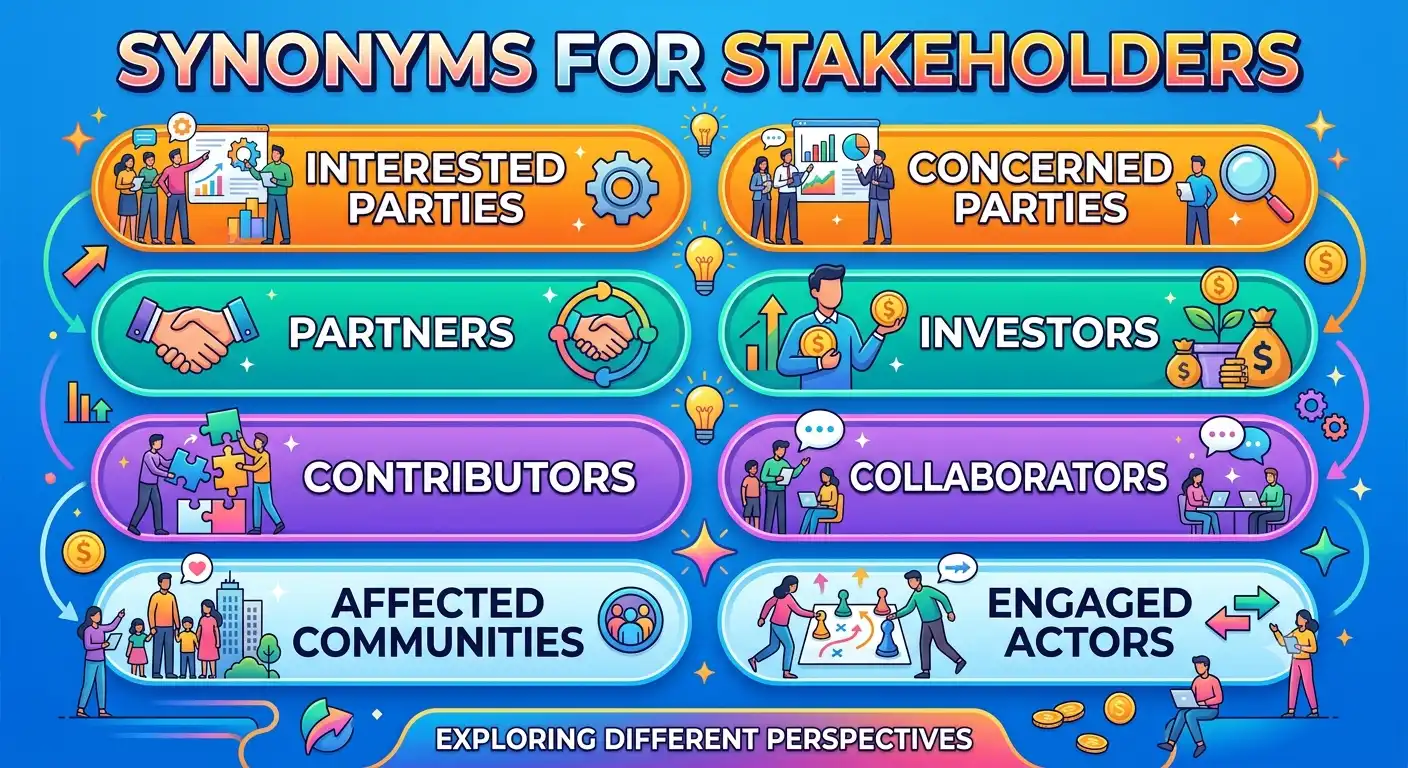
Learning the best synonyms for stakeholders will help you write about business with total confidence. When we talk about teamwork, using synonyms for stakeholders helps us describe partners and interest holders in a clear way. Knowing different synonyms for stakeholders will help you share ideas quickly in your school papers, blogs, or daily talks.
Imagine a local town planning a brand new park. The children want swings, the parents want safety, and the city managers want a low budget. All of these different people are stakeholders because they care about the result. By choosing fresh words to describe them, you keep your writing active and exciting.
“A single word can change how people view their shared goals.” — Unknown
The term synonyms for stakeholders means different words that describe people or groups who have a direct interest in a project, business, or decision.
“When we name our partners clearly, we build stronger paths together.” — Unknown
These words are very helpful for many people:
- Students can write better business reports and get high grades.
- Bloggers can keep their leadership posts exciting with simple, active words.
- Content writers can describe corporate teams and projects in a professional way.
- Daily English users can talk about group tasks with friends without using the same words.
Linguistic Analysis of “Stakeholders”
This section shows how the word “stakeholders” works in the English language.
Connotative Meaning
The word “stakeholders” brings a feeling of shared duty, focus, and collaboration. It makes us think of team meetings, mutual goals, and shared success.
Etymology
- Origin: From the words stake (meaning a share or risk) and holder (meaning one who keeps or owns).
- History: Originally used in gambling to describe a neutral person who held the bet money. Over time, it grew in business to describe anyone with an interest in a project.
Pronunciation
- US IPA: /ˈsteɪkˌhoʊl.dɚz/
- UK IPA: /ˈsteɪkˌhəʊl.dəz/
Syllables
The word has three syllables: stake-hold-ers.
Affixation Pattern
- Stakeholders: Compound word consisting of stake and holder with the plural suffix -s.
Synonym Comparison Table
This table helps you choose the exact word you need. It compares some of the most common words that mean stakeholders.
| Keyword | Meaning | Usage Type | Context |
|---|---|---|---|
| Partner | A person who shares risks and rewards | Professional | Business deals, team projects |
| Participant | A person who takes part in an activity | Casual | Public meetings, local events |
| Shareholder | A person who owns a financial part of a company | Formal | Stock market, corporate boards |
| Colleague | A person you work with in a job | Professional | Office work, school staff |
| Beneficiary | A person who gets help or gains from something | Formal | Charity work, government aids |
| Ally | A person or group that helps another | Emotional | Wars, hard tasks, friendly goals |
Master Your Vocabulary Today (Search Intent Hub)
- Informational: Read our complete list of $N = 50$ synonyms below to find the exact word you need for your next project.
- Commercial: To check your writing style and flow, we highly recommend using tools like the Hemingway Editor or Grammarly to compare word choices.
- Navigational: To find deep academic definitions, you can visit the official Merriam-Webster Thesaurus or the Oxford English Dictionary.
- Transactional: Ready to boost your communication skills instantly?$$Download our Free Stakeholder Synonyms Cheat Sheet PDF$$or subscribe to our free weekly vocabulary email newsletter below!
“True progress happens when every voice has a seat at the table.” — Unknown
50 Synonyms for “Stakeholders”
Here is your complete list of 50 synonyms to use in your writing and speech.
1. Partner
Pronunciation: of partner (US: /ˈpɑːrt.nɚ/ & UK: /ˈpɑːt.nə/ – IPA).
Meaning: This is a person who shares the work and profits of a business.
Examples:
- My business partner agreed to sign the contract.
- She is a great partner in our school science project.
2. Associate
Pronunciation: of associate (US: /əˈsoʊ.ʃi.eɪt/ & UK: /əˈsəʊ.si.eɪt/ – IPA).
Meaning: This is a person who is connected to you through work.
Examples:
- I met a business associate at the hotel lobby.
- He is an associate at the local law firm.
3. Collaborator
Pronunciation: of collaborator (US: /kəˈlæb.ə.reɪ.t̬ɚ/ & UK: /kəˈlæb.ə.reɪ.tə/ – IPA).
Meaning: This is a person who works with others to make something.
Examples:
- The writer thanked her collaborator for the help.
- Our team needs a creative collaborator for this video.
4. Shareholder
Pronunciation: of shareholder (US: /ˈʃerˌhoʊl.dɚ/ & UK: /ˈeəˌhəʊl.də/ – IPA).
Meaning: This is a person who owns stock in a big company.
Examples:
- Every shareholder voted on the new company rules.
- The shareholder wants to see the profit report.
5. Stockholder
Pronunciation: of stockholder (US: /ˈstɑːkˌhoʊl.dɚ/ & UK: /ˈstɒkˌhəʊl.də/ – IPA).
Meaning: This is another word for a person who owns shares.
Examples:
- A wealthy stockholder bought more parts of the brand.
- The stockholder meeting starts at nine in the morning.
6. Participant
Pronunciation: of participant (US: /pɑːrˈtɪs.ə.pənt/ & UK: /pɑːˈtɪs.ɪ.pənt/ – IPA).
Meaning: This is a person who takes part in a group activity.
Examples:
- Each participant received a free blue pen today.
- The active participant asked three good questions.
7. Member
Pronunciation: of member (US: /ˈmem.bɚ/ & UK: /ˈmem.bə/ – IPA).
Meaning: This is a person who belongs to a specific group.
Examples:
- She is a proud member of the chess club.
- Every member must pay a small fee each year.
8. Contributor
Pronunciation: of contributor (US: /kənˈtrɪb.jə.t̬ɚ/ & UK: /kənˈtrɪb.juː.tə/ – IPA).
Meaning: This is a person who gives money or ideas to help.
Examples:
- He is a regular contributor to our local food bank.
- The lead contributor wrote the main code for us.
9. Ally
Pronunciation: of ally (US: /ˈæl.aɪ/ & UK: /ˈæl.aɪ/ – IPA).
Meaning: This is a friend or group that helps you win.
Examples:
- The small nation found a strong ally in the war.
- She is a loyal ally when you face hard work.
10. Supporter
Pronunciation: of supporter (US: /səˈpɔːr.t̬ɚ/ & UK: /səˈpɔː.tə/ – IPA).
Meaning: This is a person who wants a project or team to succeed.
Examples:
- A kind supporter donated money to repair our school.
- The crowd had many a supporter for the home team.
11. Colleague
Pronunciation: of colleague (US: /ˈmæn.ə.dʒɚ/ & UK: /ˈmæn.ɪ.dʒə/ – IPA).
Meaning: This is a person you work with inside an office.
Examples:
- My colleague helped me carry the heavy paper boxes.
- We sat with a friendly colleague during our lunch hour.
12. Constituent
Pronunciation: of constituent (US: /kənˈstɪtʃ.u.ənt/ & UK: /kənˈstɪtʃ.u.ənt/ – IPA).
Meaning: This is a voter who lives in a politician’s area.
Examples:
- The leader listened to a worried constituent talk today.
- Every constituent wants safer streets in our sweet town.
13. Beneficiary
Pronunciation: of beneficiary (US: /ˌben.əˈfɪʃ.i.er.i/ & UK: /ˌben.ɪˈfɪʃ.ər.i/ – IPA).
Meaning: This is a person who gets money or help from a plan.
Examples:
- The poor student was the main beneficiary of the prize.
- A lucky beneficiary received a free house from the city.
14. Interested party
Pronunciation: of interested party (US: /ˈɪn.trə.stɪd ˈpɑːr.ṭi/ & UK: /ˈɪn.tres.tɪd ˈpɑː.ti/ – IPA).
Meaning: This is any person who cares about a certain deal.
Examples:
- An interested party called the bank to buy the land.
- The lawyer spoke to each interested party in the room.
15. Key player
Pronunciation: of key player (US: /kiː ˈpleɪ.ɚ/ & UK: /kiː ˈpleɪ.ə/ – IPA).
Meaning: This is a very important person in a business plan.
Examples:
- Our head chef is the key player in this restaurant.
- The team lost their key player before the big game.
16. Investor
Pronunciation: of investor (US: /ɪnˈves.t̬ɚ/ & UK: /ɪnˈves.tə/ – IPA).
Meaning: This is a person who puts money into a business.
Examples:
- A smart investor bought the old hotel near the beach.
- The tech investor hopes the new app will make money.
17. Funder
Pronunciation: of funder (US: /ˈfʌn.dɚ/ & UK: /ˈfʌn.də/ – IPA).
Meaning: This is a person or group that provides the cash.
Examples:
- The main funder stopped giving money to the museum.
- We need a reliable funder to build this bridge.
18. Sponsor
Pronunciation: of sponsor (US: /ˈspɑːn.sɚ/ & UK: /ˈspɒn.sə/ – IPA).
Meaning: This is a business that pays for an event for ads.
Examples:
- A big shoe brand is the sponsor of the race.
- The local sponsor paid for our team jerseys.
19. Client
Pronunciation: of client (US: /ˈklaɪ.ənt/ & UK: /ˈklaɪ.ənt/ – IPA).
Meaning: This is a person who pays a professional for services.
Examples:
- The kind lawyer met with a new client at noon.
- We must keep our main client happy to grow.
20. Customer
Pronunciation: of customer (US: /ˈkʌs.tə.mɚ/ & UK: /ˈkʌs.tə.mə/ – IPA).
Meaning: This is a person who buys goods from a store.
Examples:
- A happy customer bought five sweet red apples.
- The shop owner smiled at his regular customer.
21. Consumer
Pronunciation: of consumer (US: /kənˈsuː.mɚ/ & UK: /kənˈsuː.mə/ – IPA).
Meaning: This is a person who uses up goods or services.
Examples:
- The modern consumer wants fast shipping for online orders.
- High food prices affect every single consumer today.
22. Team member
Pronunciation: of team member (US: /tiːm ˈmem.bɚ/ & UK: /tiːm ˈmem.bə/ – IPA).
Meaning: This is a person who works on the same squad.
Examples:
- Our newest team member is very good at art.
- Every team member must help wash the soccer shirts.
23. Decision-maker
Pronunciation: of decision-maker (US: /dɪˈsɪʒ.ənˌmeɪ.kɚ/ & UK: /dɪˈsɪʒ.ənˌmeɪ.kə/ – IPA).
Meaning: This is the person who has the power to choose.
Examples:
- The main decision-maker stopped the project last night.
- You need to talk directly to the decision-maker.
24. Representative
Pronunciation: of representative (US: /ˌrep.rɪˈzen.t̬ə.t̬ɪv/ & UK: /ˌrep.rɪˈzen.tə.tɪv/ – IPA).
Meaning: This is a person who speaks for a larger group.
Examples:
- A student representative spoke to the school principal.
- The sales representative showed us the new car models.
25. Policy-maker
Pronunciation: of policy-maker (US: /ˈpɑː.lə.siˌmeɪ.kɚ/ & UK: /ˈpɒl.ə.siˌmeɪ.kə/ – IPA).
Meaning: This is a leader who writes official rules and laws.
Examples:
- The local policy-maker changed the speed limit laws.
- A wise policy-maker thinks about the poor people first.
26. Affiliate
Pronunciation: of affiliate (US: /əˈfɪl.i.eɪt/ & UK: /əˈfɪl.i.eɪt/ – IPA).
Meaning: This is a person or club joined to a main group.
Examples:
- Our local gym is an affiliate of a big brand.
- An affiliate partner helped us sell the new books.
27. Shareowner
Pronunciation: of shareowner (US: /ˈʃerˌoʊ.nɚ/ & UK: /ˈʃeəˌəʊ.nə/ – IPA).
Meaning: This is a person who owns stock shares in a firm.
Examples:
- A private shareowner sold his stakes to the bank.
- The shareowner wants to elect a new director.
28. Co-owner
Pronunciation: of co-owner (US: /ˌkoʊˈoʊ.nɚ/ & UK: /ˌkəʊˈəʊ.nə/ – IPA).
Meaning: This is a person who owns a business with someone else.
Examples:
- She is the co-owner of the sweet cake bakery.
- The co-owner signed the rent paper for the shop.
29. Interest-holder
Pronunciation: of interest-holder (US: /ˈɪn.trəstˌhoʊl.dɚ/ & UK: /ˈɪn.trestˌhəʊl.də/ – IPA).
Meaning: This is any person who has a claim or share.
Examples:
- The land interest-holder refused to sell the green field.
- Each interest-holder wants to protect their personal cash.
30. Vested party
Pronunciation: of vested party (US: /ˈves.tɪd ˈpɑːr.ṭi/ & UK: /ˈves.tɪd ˈpɑː.ti/ – IPA).
Meaning: This is a group that has a strong personal right.
Examples:
- A vested party will fight to keep the forest safe.
- The firm must consult with every vested party first.
31. Helper
Pronunciation: of helper (US: /ˈhel.pɚ/ & UK: /ˈhel.pə/ – IPA).
Meaning: This is a person who assists with a job or task.
Examples:
- The little helper put the books back on the shelf.
- We hired a kitchen helper to wash the dirty plates.
32. Agent
Pronunciation: of agent (US: /ˈeɪ.dʒənt/ & UK: /ˈeɪ.dʒənt/ – IPA).
Meaning: This is a person who acts on behalf of another.
Examples:
- Our real estate agent found a beautiful blue house.
- The talent agent got the young actor a movie role.
33. Promoter
Pronunciation: of promoter (US: /prəˈmoʊ.t̬ɚ/ & UK: /prəˈməʊ.tə/ – IPA).
Meaning: This is a person who helps organize and advertise events.
Examples:
- The concert promoter sold all the music show tickets.
- A local promoter talked about the boxing match on TV.
34. Backer
Pronunciation: of backer (US: /ˈbæk.ɚ/ & UK: /ˈbæk.ə/ – IPA).
Meaning: This is a person who gives financial or verbal support.
Examples:
- The film backer gave millions to start the movie.
- Our plan has a powerful backer in the city office.
35. Trustee
Pronunciation: of trustee (US: /trʌsˈtiː/ & UK: /trʌsˈtiː/ – IPA).
Meaning: This is a person who manages money or property for others.
Examples:
- The school trustee voted to buy more modern computers.
- A family trustee keeps the money safe for the kids.
36. Organizer
Pronunciation: of organizer (US: /ˈɔːr.ɡə.naɪ.zɚ/ & UK: /ˈɔː.ɡə.naɪ.zə/ – IPA).
Meaning: This is a person who plans a meeting or event.
Examples:
- The party organizer ordered a huge chocolate cake.
- Our lead organizer sent the event map to everyone.
37. Endorser
Pronunciation: of endorser (US: /ɪnˈdɔːr.sɚ/ & UK: /ɪnˈdɔː.sə/ – IPA).
Meaning: This is a famous person who publicly supports a product.
Examples:
- The athlete is a major endorser of the sports drink.
- A top fashion endorser wore the new gold watch.
38. Executive
Pronunciation: of executive (US: /ɪɡˈzek.jə.t̬ɪv/ & UK: /ɪɡˈzek.jʊ.tɪv/ – IPA).
Meaning: This is a high-level manager in a company.
Examples:
- A busy executive called for an urgent morning meeting.
- The creative executive approved the new toy design.
39. Supervisor
Pronunciation: of supervisor (US: /ˈsuː.pɚ.vaɪ.zɚ/ & UK: /ˈsuː.pə.vaɪ.zə/ – IPA).
Meaning: This is a boss who watches and directs your work.
Examples:
- My supervisor showed me how to use the printer.
- Ask the supervisor if you can leave the shop early.
40. Manager
Pronunciation: of manager (US: /ˈmæn.ə.dʒɚ/ & UK: /ˈmæn.ɪ.dʒə/ – IPA).
Meaning: This is a person in charge of a department or store.
Examples:
- The hotel manager gave us a very clean room.
- Our office manager orders the paper and pens.
41. Director
Pronunciation: of director (US: /daɪˈrek.tɚ/ & UK: /daɪˈrek.tə/ – IPA).
Meaning: This is a person who leads a project or company board.
Examples:
- The movie director told the actors where to stand.
- Our art director chose bright colors for the book cover.
42. Leader
Pronunciation: of leader (US: /ˈliː.dɚ/ & UK: /ˈliː.də/ – IPA).
Meaning: This is a person who guides or commands a group.
Examples:
- A brave leader led the group through the dark woods.
- The club leader spoke about our upcoming yard sale.
43. Overseer
Pronunciation: of overseer (US: /ˈoʊ.vɚˌsiː.ɚ/ & UK: /ˈəʊ.vəˌsiː.ə/ – IPA).
Meaning: This is a person who checks that work is done right.
Examples:
- The farm overseer checked the tall corn fields.
- A strict overseer made sure the stone wall was straight.
44. Recipient
Pronunciation: of recipient (US: /rɪˈsɪp.i.ənt/ & UK: /rɪˈsɪp.i.ənt/ – IPA).
Meaning: This is a person who receives something.
Examples:
- The award recipient smiled and thanked his family.
- She was the happy recipient of a beautiful red rose.
45. User
Pronunciation: of user (US: /ˈjuː.zɚ/ & UK: /ˈjuː.zə/ – IPA).
Meaning: This is a person who operates or uses a product.
Examples:
- The app user complained about a slow loading screen.
- Each computer user must log in with a secret code.
46. Patron
Pronunciation: of patron (US: /ˈpeɪ.trən/ & UK: /ˈpeɪ.trən/ – IPA).
Meaning: This is a customer who gives regular money or support.
Examples:
- A rich patron paid for the new painting in the library.
- The library patron borrowed three old history books.
47. Staffer
Pronunciation: of staffer (US: /ˈstæf.ɚ/ & UK: /ˈstæf.ə/ – IPA).
Meaning: This is a person who works as a member of a staff.
Examples:
- A political staffer wrote the speech for the mayor.
- The office staffer answered the ringing phone quickly.
48. Employee
Pronunciation: of employee (US: /ɪmˈplɔɪ.iː/ & UK: /ɪmˈplɔɪ.iː/ – IPA).
Meaning: This is a person paid to work for a company.
Examples:
- Every factory employee wears a hard safety hat.
- The best employee won a free trip to the beach.
49. Crew member
Pronunciation: of crew member (US: /kruː ˈmem.bɚ/ & UK: /kruː ˈmem.bə/ – IPA).
Meaning: This is a worker on a ship, plane, or project team.
Examples:
- A friendly crew member showed us to our plane seats.
- The ship crew member pulled the heavy dock rope.
50. Co-worker
Pronunciation: of co-worker (US: /ˌkoʊˈwɝː.kɚ/ & UK: /ˌkəʊˈwɜː.kə/ – IPA).
Meaning: This is a person who works alongside you at your job.
Examples:
- My co-worker made hot coffee for the whole team.
- She sat next to her favorite co-worker at the desk.
Antonyms of “Stakeholders”
When we talk about things outside of project planning, we use these antonyms:
- Outsider: A person who is not part of a group or project.
- Bystander: A person who stands near but does not take part.
- Opponent: A person who is actively against a decision or plan.
- Stranger: A person whom you do not know and has no link to your business.
- Non-participant: A person who chooses not to join the group task.
Prototype Meaning and Categorization of “Stakeholders”
In cognitive linguistics, words group together in our minds. The main class for “stakeholders” is “Key Players and Interest Holders.”
Key Players and Interest Holders (Main Class)
   |
   +-- Corporate Owners (e.g., Shareholder, Stockholder, Shareowner, Co-owner)
   |
   +-- Work Partners (e.g., Partner, Associate, Collaborator, Colleague, Co-worker)
   |
   +-- Financial Backers (e.g., Investor, Funder, Sponsor, Backer, Trustee)
   |
   +-- Users and Receivers (e.g., Client, Customer, Consumer, Recipient, User, Patron)
By sorting these words into groups, you can easily choose the right word for your sentence.
Frequently Asked Questions
What is the difference between a stakeholder and a shareholder?
A stakeholder is anyone who cares about a project, like workers, customers, or neighbors. A shareholder is a specific person who owns a financial part of a company stock.
Can “colleague” be used as a synonym for stakeholder?
Yes. In daily office work, your colleague is often a key stakeholder because your projects affect their jobs too.
Is “opponent” a natural synonym for stakeholder?
No. An opponent is an antonym because they work against your plan. A stakeholder usually has a direct interest in seeing a project run smoothly.
Why do writers use synonyms for stakeholders in resumes?
They use these words to sound smart. Words like collaborator or key player show your skills much better than using the same word ten times.
What is the most formal synonym for stakeholders?
The most formal terms are interested party, constituent, or vested party, which sound highly professional in legal documents.
Is a “bystander” the same thing as a “stakeholder”?
No. A bystander just watches from the side without caring about the result. A stakeholder is actively linked to the success or failure of the project.
Conclusion
Learning synonyms for stakeholders is a great way to grow your English writing skills today. When you know more words, your business letters and essays become beautiful. Your blog posts will keep your readers excited and moving. Your spoken stories about office work and local plans will sound clear, warm, and highly powerful to everyone who listens.
“Speak with clarity, and your team will walk with confidence.” — Unknown
We encourage you to practice these terms as much as you can. Try to use them when you write daily emails to colleagues about your group goals. Use them in your school essays to get better grades on social studies projects. Use them in your everyday conversations to share your thoughts about your work tasks.
“The right word at the right time is like a map for the mind.” — Unknown
Choosing the right word shows that you are a smart communicator. Start using these new words today, and watch your business English skills soar!

Andrew Collins is an academic English educator with over 12 years of experience helping university students, IELTS candidates, and ESL learners improve their writing vocabulary.