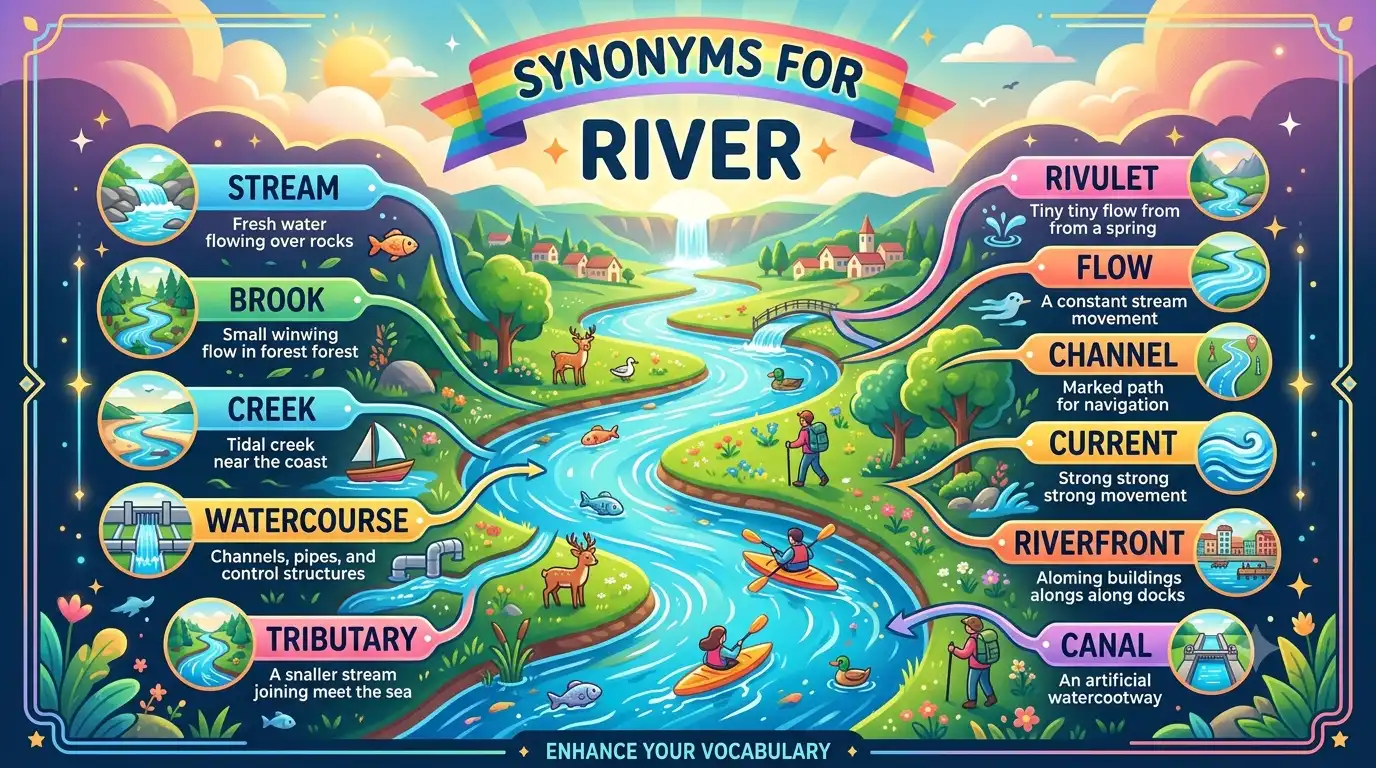
Learning the best synonyms for river will help you describe flowing water with ease. When you write about nature, using synonyms for river makes your sentences clear and exciting. Knowing these synonyms for river will help you share ideas quickly in school papers, blogs, or daily talks.
Imagine a young girl named Maya. Maya is writing a fun story about a brave little fish. She does not want to use the word “river” ten times in her book. By using fresh words, Maya makes her story sound colorful and lively. This simple change keeps her friends and teacher reading until the very end.
“A river cuts through rock, not because of its power, but because of its persistence.” — Jim Watkins
The term synonyms for river means different words that describe flowing water, small streams, deep channels, and paths on our beautiful earth.
“Rivers know this: there is no hurry. We shall get there some day.” — A.A. Milne
These words are very helpful for many people:
- Students can write better science reports and get high grades.
- Bloggers can keep their travel posts exciting with simple, active words.
- Content writers can describe local parks and nature paths in a professional way.
- Daily English users can talk about trips with friends without using the same words.
Linguistic Analysis of “River”
This section shows how the word “river” works in the English language.
Connotative Meaning
The word “river” brings a feeling of life, continuous movement, and deep peace. It makes us think of cool water, green trees, jumping fish, and long journeys to the sea.
Etymology
- Origin: From the Middle English word rivere (meaning “riverbank”).
- History: Came from the Vulgar Latin word riparia (meaning “shore” or “bank”), which grew into modern English to describe the moving water itself.
Pronunciation
- US IPA: /ˈrɪv.ɚ/
- UK IPA: /ˈrɪv.ə/
Syllables
The word has two syllables: riv-er.
Affixation Pattern
- River: Base root noun with no active prefixes or suffixes.
Synonym Comparison Table
This table helps you choose the exact word you need. It compares some of the most common words that mean river.
| Keyword | Meaning | Usage Type | Context |
|---|---|---|---|
| Stream | A small, continuous flow of water | Casual | Parks, hills, forests |
| Creek | A tiny, shallow flow of water | Casual | Backyards, camping sites |
| Brook | A very small, quiet stream of water | Emotional | Poetry, calm nature walks |
| Waterway | A deep path of water used by boats | Professional | Trade ports, shipping routes |
| Torrent | A fast and violent flow of water | Emotional | Storms, heavy rain, floods |
| Canal | A man-made path for water | Professional | Cities, farms, cargo boats |
Master Your Vocabulary Today (Search Intent Hub)
- Informational: Read our complete list of 50 synonyms below to find the exact word you need for your next project.
- Commercial: To check your writing style and flow, we highly recommend using tools like the Hemingway Editor or Grammarly to compare word choices.
- Navigational: To find deep academic definitions, you can visit the official Merriam-Webster Thesaurus or the Oxford English Dictionary.
- Transactional: Ready to boost your communication skills instantly? $$Download our Free River Synonyms Cheat Sheet PDF$$ or subscribe to our free weekly vocabulary email newsletter below!
“No man ever steps in the same river twice, for it’s not the same river and he’s not the same man.” — Heraclitus
50 Synonyms for “River”
Here is your complete list of 50 synonyms to use in your writing and speech.
1. Stream
Pronunciation: of stream (US: /striːm/ & UK: /striːm/ – IPA).
Meaning: This is a small, narrow body of water that flows in a channel.
Examples:
- The cold water of the stream ran over the smooth stones.
- We built a small toy bridge across the narrow stream.
2. Creek
Pronunciation: of creek (US: /kriːk/ & UK: /kriːk/ – IPA).
Meaning: This is a tiny, shallow flow of water that is smaller than a river.
Examples:
- The kids splashed each other in the shallow creek.
- We found green frogs near the muddy edge of the creek.
3. Brook
Pronunciation: of brook (US: /brʊk/ & UK: /brʊk/ – IPA).
Meaning: This is a very small, natural stream of clean water.
Examples:
- A quiet brook flows behind my grandmother’s old house.
- The birds drank water from the sweet mountain brook.
4. Waterway
Pronunciation: of waterway (US: /ˈwɔː.t̬ɚ.weɪ/ & UK: /ˈwɔː.tə.weɪ/ – IPA).
Meaning: This is a deep path of water that boats can travel on.
Examples:
- The large ship moved slowly down the busy city waterway.
- They cleaned the local waterway to protect the wild ducks.
5. Watercourse
Pronunciation: of watercourse (US: /ˈwɔː.t̬ɚ.kɔːrs/ & UK: /ˈwɔː.tə.kɔːs/ – IPA).
Meaning: This is the natural path or channel where water flows.
Examples:
- Heavy rain filled the dry watercourse with fresh water.
- The map shows a long watercourse running through the valley.
6. Tributary
Pronunciation: of tributary (US: /ˈtrɪb.jə.ter.i/ & UK: /ˈtrɪb.jə.tər.i/ – IPA).
Meaning: This is a small stream that flows into a larger river.
Examples:
- This cold stream is a tributary of the big Mississippi.
- We followed the tributary to see where it met the river.
7. Rivulet
Pronunciation: of rivulet (US: /ˈrɪv.jə.lət/ & UK: /ˈrɪv.jʊ.lət/ – IPA).
Meaning: This is a very small, thin trickle of flowing water.
Examples:
- A tiny rivulet of rain ran down the window glass.
- Melting ice made a clean rivulet on the dark rock.
8. Channel
Pronunciation: of channel (US: /ˈtʃæn.əl/ & UK: /ˈtʃæn.əl/ – IPA).
Meaning: This is the deep bed where a stream of water flows.
Examples:
- The boat stayed in the deep channel to avoid the sand.
- The river cut a new channel through the soft dirt.
9. Flow
Pronunciation: of flow (US: /floʊ/ & UK: /fləʊ/ – IPA).
Meaning: This is the steady movement of a stream of liquid.
Examples:
- The strong flow of the water pushed the leaves away.
- We watched the peaceful flow of the river at sunset.
10. Torrent
Pronunciation: of torrent (US: /ˈtɔːr.ənt/ & UK: /ˈtɒr.ənt/ – IPA).
Meaning: This is a fast, wild, and violent flow of water.
Examples:
- The storm turned the quiet stream into a dangerous torrent.
- Mud and rocks fell into the rushing water torrent.
11. Canal
Pronunciation: of canal (US: /kəˈnæl/ & UK: /kəˈnæl/ – IPA).
Meaning: This is a man-made water path built for boats or farming.
Examples:
- Small boats float along the beautiful canals of Venice.
- The farmers used the canal to water their dry corn fields.
12. Estuary
Pronunciation: of estuary (US: /ˈes.tʃuː.er.i/ & UK: /ˈes.tʃu.ə.ri/ – IPA).
Meaning: This is the wide area where a river meets the sea.
Examples:
- Many birds lay their eggs in the salty river estuary.
- The ocean tides push saltwater into the wide estuary.
13. Bayou
Pronunciation: of bayou (US: /ˈbaɪ.uː/ & UK: /ˈbaɪ.uː/ – IPA).
Meaning: This is a slow, marshy water path found in flat lands.
Examples:
- We rode a flat boat through the quiet green bayou.
- Big trees grow out of the water in the southern bayou.
14. Rill
Pronunciation: of rill (US: /rɪl/ & UK: /rɪl/ – IPA).
Meaning: This is a very small brook or tiny stream of water.
Examples:
- The hikers found a clear rill high up the mountain.
- Small flowers grew along the bank of the tiny rill.
15. Runnel
Pronunciation: of runnel (US: /ˈrʌn.əl/ & UK: /ˈrʌn.əl/ – IPA).
Meaning: This is a small channel or narrow stream of water.
Examples:
- Water dripped down the hill and made a neat runnel.
- The kids dug a runnel in the wet beach sand.
16. Beck
Pronunciation: of beck (US: /bek/ & UK: /bek/ – IPA).
Meaning: This is a fast-flowing mountain stream with stony banks.
Examples:
- We crossed a cold beck while hiking in northern England.
- The water in the beck was bright and very clean.
17. Burn
Pronunciation: of burn (US: /bɜːrn/ & UK: /bɜːn/ – IPA).
Meaning: This is a small stream or brook found in Scotland.
Examples:
- A sweet Scottish burn ran past the old stone cottage.
- The sheep walked down to the burn to drink water.
18. Current
Pronunciation: of current (US: /ˈkɝː.ənt/ & UK: /ˈkʌr.ənt/ – IPA).
Meaning: This is the strong movement of water in one direction.
Examples:
- Do not swim here because the water current is too fast.
- The wood floated away on the strong river current.
19. Streamlet
Pronunciation: of streamlet (US: /ˈstriːm.lət/ & UK: /ˈstriːm.lət/ – IPA).
Meaning: This is a tiny, narrow stream of fresh water.
Examples:
- The spring water made a fresh streamlet in the grass.
- We followed the streamlet to see where it started.
20. Creeklet
Pronunciation: of creeklet (US: /ˈkriːk.lət/ & UK: /ˈkriːk.lət/ – IPA).
Meaning: This is an extremely small creek or stream.
Examples:
- A tiny creeklet ran through our backyard garden.
- The birds gathered to bathe in the shallow creeklet.
21. Brooklet
Pronunciation: of brooklet (US: /ˈbrʊk.lət/ & UK: /ˈbrʊk.lət/ – IPA).
Meaning: This is a very tiny brook or gentle trickle of water.
Examples:
- The grass was wet near the edge of the quiet brooklet.
- We sat by the brooklet and listened to the soft sound.
22. Gully
Pronunciation: of gully (US: /ˈɡʌl.i/ & UK: /ˈɡʌl.i/ – IPA).
Meaning: This is a water channel made by rain in the dirt.
Examples:
- Heavy rain washed away the soil and made a deep gully.
- The dry gully quickly filled with water during the storm.
23. Inlet
Pronunciation: of inlet (US: /ˈɪn.let/ & UK: /ˈɪn.let/ – IPA).
Meaning: This is a small, narrow body of water leading inland.
Examples:
- The sailors hid their boat in a quiet, safe inlet.
- We saw small fish swimming near the edge of the inlet.
24. Outlet
Pronunciation: of outlet (US: /ˈaʊt.let/ & UK: /ˈaʊt.let/ – IPA).
Meaning: This is a stream or channel where water flows out.
Examples:
- This narrow stream is the main outlet of the big lake.
- They built a new concrete outlet to stop the flooding.
25. Delta
Pronunciation: of delta (US: /ˈdel.tə/ & UK: /ˈdel.tə/ – IPA).
Meaning: This is the flat, wet land where a river splits before the sea.
Examples:
- The river splits into many paths in the green delta.
- Farmers grow rice in the rich soil of the river delta.
26. Branch
Pronunciation: of branch (US: /bræntʃ/ & UK: /brɑːntʃ/ – IPA).
Meaning: This is a part of a river that splits from the main flow.
Examples:
- The left branch of the river goes toward the mountains.
- We set up our camp on the bank of the small branch.
27. Run
Pronunciation: of run (US: /rʌn/ & UK: /rʌn/ – IPA).
Meaning: This is a small, fast-flowing stream of water.
Examples:
- The clear run was full of small shiny stones.
- Deer came to drink from the cold forest run.
28. Sluice
Pronunciation: of sluice (US: /sluːs/ & UK: /sluːs/ – IPA).
Meaning: This is a man-made channel for water with a gate.
Examples:
- They opened the wood sluice to let water into the field.
- Water rushed fast through the narrow metal sluice.
29. Flume
Pronunciation: of flume (US: /fluːm/ & UK: /fluːm/ – IPA).
Meaning: This is a narrow, sloped channel built to carry water.
Examples:
- The water rushed down the wooden flume to the old mill.
- We watched logs float down the long mountain flume.
30. Spillway
Pronunciation: of spillway (US: /ˈspɪl.weɪ/ & UK: /ˈspɪl.weɪ/ – IPA).
Meaning: This is a path made to carry extra water away from a dam.
Examples:
- The dam operators opened the spillway to stop the flood.
- Water roared as it fell down the concrete spillway.
31. Headwaters
Pronunciation: of headwaters (US: /ˈhedˌwɔ.t̬ɚz/ & UK: /ˈhedˌwɔː.təz/ – IPA).
Meaning: These are the small streams that start a river.
Examples:
- The headwaters of the river are high up in the snow.
- We traveled to the mountains to find the cold headwaters.
32. Rapids
Pronunciation: of rapids (US: /ˈræp.ɪdz/ & UK: /ˈræp.ɪdz/ – IPA).
Meaning: This is a fast part of a river where water runs over rocks.
Examples:
- The wild river rapids shook our yellow rubber boat.
- White water splashed over the rocks in the fast rapids.
33. Race
Pronunciation: of race (US: /reɪs/ & UK: /reɪs/ – IPA).
Meaning: This is a fast, strong current of water in a channel.
Examples:
- The heavy rainfall created a swift race down the ditch.
- A fast race of water turned the wheel of the mill.
34. Tideway
Pronunciation: of tideway (US: /ˈtaɪd.weɪ/ & UK: /ˈtaɪd.weɪ/ – IPA).
Meaning: This is a water channel where the ocean tide flows.
Examples:
- The boat struggled to move against the strong tideway.
- High water filled the tideway with ocean salt.
35. Backwater
Pronunciation: of backwater (US: /ˈbæk.wɔː.t̬ɚ/ & UK: /ˈbæk.wɔː.tə/ – IPA).
Meaning: This is a quiet, still part of a river with no current.
Examples:
- We paddled our boat into the quiet river backwater.
- Green leaves floated slowly in the calm backwater.
36. Slough
Pronunciation: of slough (US: /sluː/ & UK: /slaʊ/ – IPA).
Meaning: This is a muddy, swampy water path or inlet.
Examples:
- The frogs made a lot of noise in the dark slough.
- Tall grass grew around the edges of the wet slough.
37. Billabong
Pronunciation: of billabong (US: /ˈbɪl.ə.bɒŋ/ & UK: /ˈbɪl.ə.bɒŋ/ – IPA).
Meaning: This is a curved pool of water left behind when a river path changes.
Examples:
- We camped next to a quiet billabong in Australia.
- Wild birds gathered to drink at the shady billabong.
38. Course
Pronunciation: of course (US: /kɔːrs/ & UK: /kɔːs/ – IPA).
Meaning: This is the path or route that a river takes.
Examples:
- The river changed its course after the big earthquake.
- We followed the winding course of the water on our map.
39. Swash
Pronunciation: of swash (US: /swɒʃ/ & UK: /swɒʃ/ – IPA).
Meaning: This is a shallow, rushing channel of water.
Examples:
- The sea waves made a quick swash across the sand.
- We stepped over the small swash on the wet beach.
40. Freshet
Pronunciation: of freshet (US: /ˈfreʃ.ɪt/ & UK: /ˈfreʃ.ɪt/ – IPA).
Meaning: This is a sudden rise in river water caused by melting snow.
Examples:
- The spring freshet filled the dry riverbanks with water.
- Fish swam up the stream during the cold freshet.
41. Reach
Pronunciation: of reach (US: /riːtʃ/ & UK: /riːtʃ/ – IPA).
Meaning: This is a long, straight stretch of water in a river.
Examples:
- The boat sailed easily down the wide reach of the river.
- No rocks blocked our path in this quiet river reach.
42. Millstream
Pronunciation: of millstream (US: /ˈmɪl.striːm/ & UK: /ˈmɪl.striːm/ – IPA).
Meaning: This is a fast stream of water that turns a mill wheel.
Examples:
- The old millstream ran quickly past the wooden house.
- We watched bubbles form in the fast-moving millstream.
43. Bourn
Pronunciation: of bourn (US: /bɔːrn/ & UK: /bʊən/ – IPA).
Meaning: This is a small stream or brook that flows in winter.
Examples:
- Winter rains made a cold bourn run through the valley.
- The bourn dried up completely during the hot summer.
44. Gill
Pronunciation: of gill (US: /ɡɪl/ & UK: /ɡɪl/ – IPA).
Meaning: This is a very small stream in a deep valley.
Examples:
- A cold mountain gill ran between the high steep rocks.
- We heard the quiet sound of the gill in the woods.
45. Drainage
Pronunciation: of drainage (US: /ˈdreɪ.nɪdʒ/ & UK: /ˈreɪ.nɪdʒ/ – IPA).
Meaning: This is a system of channels that lets water flow away.
Examples:
- The city built a big drainage channel to stop floods.
- Rain water ran down the stone drainage ditch quickly.
46. Chute
Pronunciation: of chute (US: /ʃuːt/ & UK: /ʃuːt/ – IPA).
Meaning: This is a narrow, fast channel of water.
Examples:
- The river water rushed through a narrow rock chute.
- Loggers sent wood down the steep water chute.
47. Arterial
Pronunciation: of arterial (US: /ɑːrˈtɪr.i.əl/ & UK: /ɑːˈtɪə.ri.əl/ – IPA).
Meaning: This is a main water channel that has many small branches.
Examples:
- This big river is the main arterial flow of the region.
- Boats carry goods down the deep arterial water path.
48. Feeder
Pronunciation: of feeder (US: /ˈfiː.dɚ/ & UK: /ˈfiː.də/ – IPA).
Meaning: This is a small stream that feeds a larger lake or river.
Examples:
- A clean feeder stream runs directly into the deep lake.
- We caught small fish near the mouth of the feeder.
49. Flood
Pronunciation: of flood (US: /flʌd/ & UK: /flʌd/ – IPA).
Meaning: This is a very large amount of water covering dry land.
Examples:
- The river rose high and made a big flood in the fields.
- Heavy rain caused a sudden water flood in the town streets.
50. Spate
Pronunciation: of spate (US: /speɪt/ & UK: /speɪt/ – IPA).
Meaning: This is a sudden, fast flow or rise in a river.
Examples:
- The river went into spate after three days of heavy rain.
- A sudden spate of water swept the dry leaves away.
Antonyms of “River”
When we talk about things outside the physical study of moving water, we use these antonyms:
- Desert: A very dry area of land with little to no water.
- Ocean: A massive body of salt water that does not flow like a stream.
- Pond: A small body of still water that does not move or flow.
- Drought: A long period of time with no rain and dry ground.
- Void: An empty space with no water or land features.
Prototype Meaning and Categorization of “River”
In cognitive linguistics, words group together in our minds. The main class for “river” is “Water Flow and Channels.”
Water Flow and Channels (Main Class)
   |
   +-- Small Water Flows (e.g., Stream, Creek, Brook, Rivulet, Rill, Beck, Burn)
   |
   +-- Large Waterways (e.g., River, Watercourse, Waterway, Channel, Branch)
   |
   +-- Fast and Heavy Flows (e.g., Torrent, Rapids, Flood, Spate, Cascade)
   |
   +-- Coastal and Joint Areas (e.g., Estuary, Delta, Inlet, Outlet, Bayou, Slough)
By sorting these words into groups, you can easily choose the right word for your sentence.
Frequently Asked Questions
What is the difference between a river and a stream?
A river is a very large natural flow of water that travels a long way. A stream is much smaller, shallower, and easier to cross.
Can “creek” be used as a formal synonym for river?
No. Creek is a casual word used for small, shallow water flows. It is not suitable for formal reports about large global waterways.
Is “canal” a natural synonym for river?
No. A canal is man-made, built by people for travel or farming. A river forms naturally over thousands of years on the earth.
Why do writers use synonyms for river in travel blogs?
They use these words to make their descriptions exciting. Words like torrent, bayou, or brook paint beautiful pictures for readers.
What is the most scientific synonym for river?
Some of the most scientific terms are watercourse, tributary, or estuary, which describe precise natural water systems.
Is a “delta” the same thing as a “river”?
No. A delta is the flat, rich land area at the end of a river where it splits into small paths before meeting the ocean.
Conclusion
Learning synonyms for river is a great way to grow your English skills today. When you know more words, your writing becomes beautiful. Your blog posts will keep your readers excited. Your spoken stories about travel and nature will sound clear, warm, and highly powerful.
“The river has great wisdom and whispers its secrets to those who listen.” — Unknown
We encourage you to practice these terms as much as you can. Try to use them when you write daily emails to colleagues about trip plans. Use them in your school essays to get better grades on science projects. Use them in your everyday conversations to share your thoughts about your neighborhood.
“Words flow like water, and a rich vocabulary keeps the mind moving forward.” — Unknown
Choosing the right word shows that you are a smart communicator. Start using these new words today, and watch your English skills soar!

Andrew Collins is an academic English educator with over 12 years of experience helping university students, IELTS candidates, and ESL learners improve their writing vocabulary.