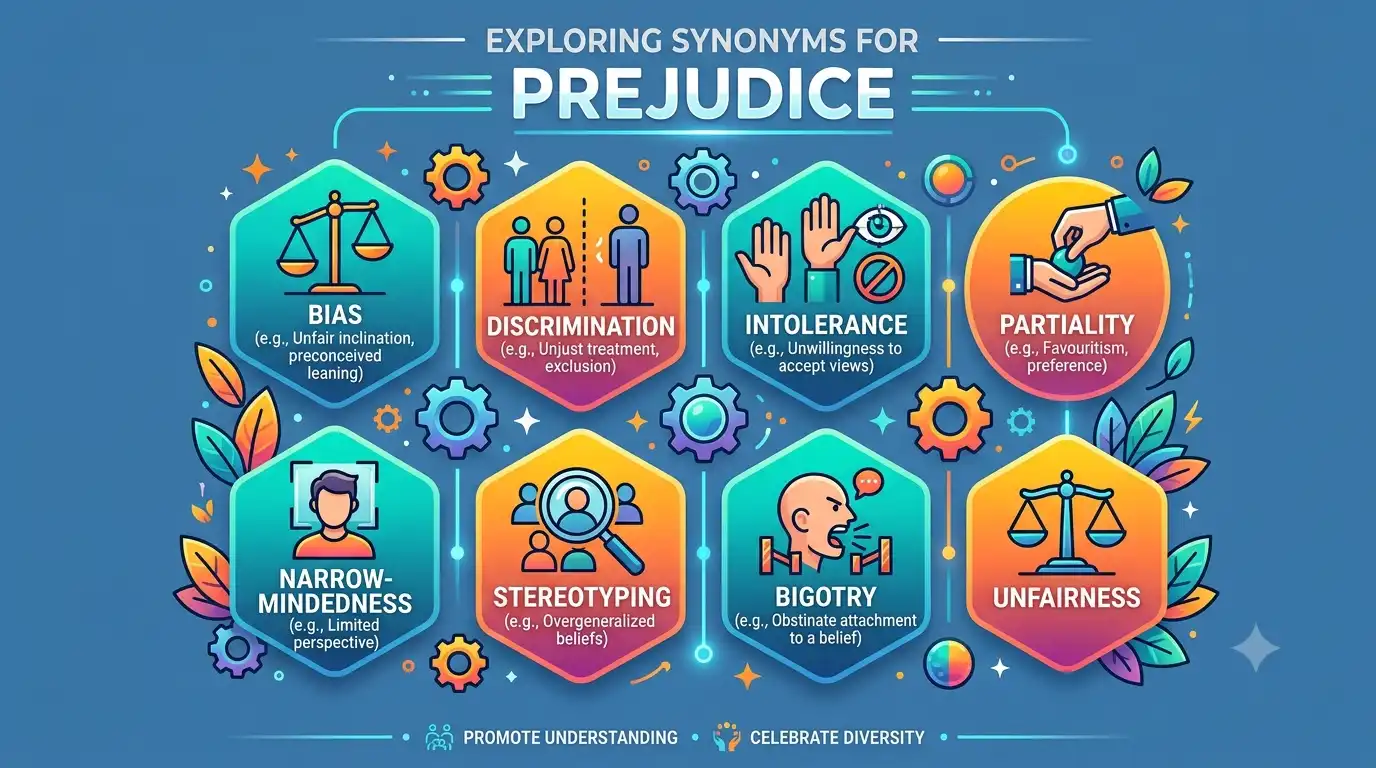
When you search for synonyms for prejudice, you look for words that mean judging someone unfairly before knowing them. Finding good synonyms for prejudice helps you describe unfair ideas, bias, and hurt feelings accurately. Learning different synonyms for prejudice gives you the right tools to express truth and fairness in your writing.
Imagine a new student entering a classroom wearing unusual clothes. Before he even speaks, a classmate decides he cannot join the soccer game. That quick, unfair decision is prejudice. You can describe this hurtful behavior using words like bias, bigotry, intolerance, or unfairness.
Using varied words for prejudice is very helpful for:
- Students: Write strong social studies essays and earn better grades.
- Bloggers: Talk about fairness and social issues with clear vocabulary.
- Content Writers: Craft powerful articles that build empathy and trust.
- Daily English Users: Speak against unfairness and express thoughts clearly.
“Prejudice is a burden that confuses the past, threatens the future and renders the present inaccessible.” — Maya Angelou
“It is never too late to give up our prejudices.” — Henry David Thoreau
Word Profile: Prejudice
Connotative Meaning
The word prejudice carries a strong, negative, and hurtful feeling. It describes an opinion formed without reason, facts, or personal experience, usually leading to unfair treatment of others.
Etymology (Origin)
- Latin Prefix: Prae- (meaning “before”)
- Latin Root: Judicium (meaning “judgment”)
- Latin Compound: Praejudicium (meaning “prejudgment or prior harm”)
- Old French: Passed into Middle English as prejudice during the 14th century.
Pronunciation
- US IPA: /ˈprɛdʒ.ə.dɪs/
- UK IPA: /ˈpredʒ.ə.dɪs/
Syllables & Affixation
- Syllables: pre-ju-dice (3 syllables)
- Prefix: Pre- (before)
- Root: Judice (judgment)
Comparison Table: Popular Synonyms for Prejudice
| Keyword | Meaning | Usage Type | Context |
| Prejudice | Unfair opinion formed before knowing the real facts. | Formal / Negative | Law, history, social issues |
| Bias | Favoring one side over another without fair cause. | Professional / Neutral | News, sports, workplace |
| Bigotry | Strong hatred toward people with different views. | Intense / Emotional | Debates, politics, personal beliefs |
| Intolerance | Refusal to accept people who think differently. | General / Social | Schools, communities, teams |
| Unfairness | Lack of equal treatment for everyone involved. | Everyday / Casual | Games, classrooms, family life |
| Injustice | An action or situation that violates equal rights. | Formal / Serious | Courts, laws, global human rights |
| Favoritism | Giving special perks to one person over others. | Relatable / Everyday | Office, home, sports selection |
50 Best Synonyms for Prejudice
1. Bias
- Pronunciation: US: /ˈbaɪ.əs/ | UK: /ˈbaɪ.əs/
- Meaning: Preferring one person or group over another in an unfair way.
- Examples:
- The referee showed bias toward the home team.
- She tried to make a decision without any bias.
2. Discrimination
- Pronunciation: US: /dɪˌskrɪm.əˈneɪ.ʃən/ | UK: /dɪˌskrɪm.ɪˈneɪ.ʃən/
- Meaning: Treating people poorly because of who they are.
- Examples:
- The company has strict rules against age discrimination.
- Everyone deserves equal work without discrimination.
3. Bigotry
- Pronunciation: US: /ˈbɪɡ.ə.tri/ | UK: /ˈbɪɡ.ə.tri/
- Meaning: Strong hatred and unwillingness to listen to other views.
- Examples:
- Education helps defeat bigotry in small towns.
- He spoke out against bigotry in the community.
4. Intolerance
- Pronunciation: US: /ɪnˈtɑː.lɚ.əns/ | UK: /ɪnˈtɒl.ər.əns/
- Meaning: Refusal to accept people who have different ideas or backgrounds.
- Examples:
- The school does not allow intolerance among students.
- Kindness helps overcome cultural intolerance.
5. Unfairness
- Pronunciation: US: /ʌnˈfɛr.nəs/ | UK: /ʌnˈfeə.nəs/
- Meaning: The quality of not treating people equally or right.
- Examples:
- Kids quickly notice any unfairness in a game.
- She complained about the unfairness of the rule.
6. Injustice
- Pronunciation: US: /ɪnˈdʒʌs.tɪs/ | UK: /ɪnˈdʒʌs.tɪs/
- Meaning: An action that is not fair or right.
- Examples:
- The crowd marched to protest against social injustice.
- He fought hard to correct a past injustice.
7. Favoritism
- Pronunciation: US: /ˈfeɪ.vɚ.ə.tɪ.zəm/ | UK: /ˈfeɪ.vər.ɪ.tɪ.zəm/
- Meaning: Giving special treatment to one person over others.
- Examples:
- The teacher avoided favoritism in the classroom.
- Favoritism at work can hurt team spirit.
8. Partiality
- Pronunciation: US: /ˌpɑːr.ʃiˈæl.ə.ti/ | UK: /ˌpɑː.ʃiˈæl.ə.ti/
- Meaning: A strong liking for one thing over another without reason.
- Examples:
- The judge showed no partiality during the trial.
- He admitted his partiality for chocolate cake.
9. Preconception
- Pronunciation: US: /ˌpriː.kənˈsɛp.ʃən/ | UK: /ˌpriː.kənˈsep.ʃən/
- Meaning: An idea formed before you have full information.
- Examples:
- She arrived in the city with no preconceptions.
- Travel helps shatter false preconceptions about people.
10. Prejudgment
- Pronunciation: US: /ˌpriːˈdʒʌdʒ.mənt/ | UK: /ˌpriːˈdʒʌdʒ.mənt/
- Meaning: Judging a situation before knowing all the facts.
- Examples:
- Prejudgment can ruin a good working relationship.
- Listen to the full story to avoid prejudgment.
11. One-sidedness
- Pronunciation: US: /ˌwʌnˈsaɪ.dɪd.nəs/ | UK: /ˌwʌnˈsaɪ.dɪd.nəs/
- Meaning: Looking at a topic from only one point of view.
- Examples:
- The news report suffered from clear one-sidedness.
- Good debates prevent one-sidedness in discussions.
12. Subjectivity
- Pronunciation: US: /ˌsʌb.dʒɛkˈtɪv.ə.ti/ | UK: /ˌsʌb.dʒekˈtɪv.ə.ti/
- Meaning: Making judgments based on personal feelings instead of facts.
- Examples:
- Art reviews often involve personal subjectivity.
- Grading tests requires lowering personal subjectivity.
13. Narrow-mindedness
- Pronunciation: US: /ˌnær.oʊˈmaɪn.dɪd.nəs/ | UK: /ˌnær.əʊˈmaɪn.dɪd.nəs/
- Meaning: Refusing to consider new ideas or different opinions.
- Examples:
- Reading books helps cure narrow-mindedness.
- His narrow-mindedness made discussions very hard.
14. Chauvinism
- Pronunciation: US: /ˈʃoʊ.vɪ.nɪ.zəm/ | UK: /ˈʃəʊ.vɪ.nɪ.zəm/
- Meaning: An unreasonable belief that your group is superior.
- Examples:
- Male chauvinism has no place in modern offices.
- National chauvinism can close off friendly ties.
15. Racism
- Pronunciation: US: /ˈreɪ.sɪ.zəm/ | UK: /ˈreɪ.sɪ.zəm/
- Meaning: Unfair treatment of people based on race.
- Examples:
- Communities work together to end local racism.
- Sports leagues take a strong stand against racism.
16. Sexism
- Pronunciation: US: /ˈsɛk.sɪ.zəm/ | UK: /ˈsek.sɪ.zəm/
- Meaning: Unfair treatment of people based on gender.
- Examples:
- The law protects workers from workplace sexism.
- She called out sexism in the old book.
17. Hostility
- Pronunciation: US: /hɑːˈstɪl.ə.ti/ | UK: /hɒˈstɪl.ə.ti/
- Meaning: Unfriendly behavior or angry feelings toward someone.
- Examples:
- He felt open hostility when he walked into the room.
- They resolved their hostility with a long chat.
18. Antagonism
- Pronunciation: US: /ænˈtæɡ.ə.nɪ.zəm/ | UK: /ænˈtæɡ.ə.nɪ.zəm/
- Meaning: Active opposition or anger toward another person.
- Examples:
- There was deep antagonism between the two rivals.
- Her calm words reduced the rising antagonism.
19. Dislike
- Pronunciation: US: /dɪsˈlaɪk/ | UK: /dɪsˈlaɪk/
- Meaning: A feeling of not liking someone or something.
- Examples:
- He has a strong dislike for dishonest behavior.
- She tried to hide her dislike for the cold weather.
20. Antipathy
- Pronunciation: US: /ænˈtɪp.ə.θi/ | UK: /ænˈtɪp.ə.θi/
- Meaning: A strong, natural feeling of dislike or opposition.
- Examples:
- She felt an instant antipathy toward the rude salesman.
- His antipathy for crowds kept him at home.
21. Animosity
- Pronunciation: US: /ˌæn.əˈmɑː.sə.ti/ | UK: /ˌæn.ɪˈmɒs.ə.ti/
- Meaning: Deep-seated anger or ill feeling between people.
- Examples:
- The former business partners showed no animosity today.
- We should clear away old animosity and move forward.
22. Animus
- Pronunciation: US: /ˈæn.ə.məs/ | UK: /ˈæn.ɪ.məs/
- Meaning: A strong feeling of ill will or dislike.
- Examples:
- He spoke without any animus toward his opponents.
- The article revealed a personal animus against the leader.
23. Enmity
- Pronunciation: US: /ˈɛn.mə.ti/ | UK: /ˈen.mɪ.ti/
- Meaning: A state of active hatred between enemies.
- Examples:
- Years of enmity ended with a friendly handshake.
- They put aside their enmity to help the town.
24. Ill will
- Pronunciation: US: /ˌɪl ˈwɪl/ | UK: /ˌɪl ˈwɪl/
- Meaning: Bad feelings or harmful intent toward another person.
- Examples:
- I hold no ill will toward anyone on the team.
- She left the meeting without any ill will.
“Angry people are not always wise.” — Jane Austen
25. Xenophobia
- Pronunciation: US: /ˌzɛn.əˈfoʊ.bi.ə/ | UK: /ˌzen.əˈfəʊ.bi.ə/
- Meaning: Fear or hatred of people from other countries.
- Examples:
- Travel helps eliminate senseless xenophobia in society.
- The group raised awareness to stop xenophobia.
26. Partisanship
- Pronunciation: US: /ˈpɑːr.t̬ə.zən.ʃɪp/ | UK: /ˌpɑː.tɪˈzæn.ʃɪp/
- Meaning: Strong support for one political party without flexibility.
- Examples:
- Heavy partisanship slowed down the new law.
- Leaders called for less partisanship during the crisis.
27. Sectarianism
- Pronunciation: US: /sɛkˈtɛr.i.ə.nɪ.zəm/ | UK: /sekˈteə.ri.ə.nɪ.zəm/
- Meaning: Rigid loyalty to a specific religious or political subgroup.
- Examples:
- The region suffered from years of religious sectarianism.
- Peace talks aimed to stop local sectarianism.
28. Provincialism
- Pronunciation: US: /prəˈvɪn.ʃəl.ɪ.zəm/ | UK: /prəˈvɪn.ʃəl.ɪ.zəm/
- Meaning: Narrow thinking limited to your local area.
- Examples:
- Moving to a big city broadens regional provincialism.
- Her views showed a surprising amount of provincialism.
29. Parochialism
- Pronunciation: US: /pəˈroʊ.ki.əl.ɪ.zəm/ | UK: /pəˈrəʊ.ki.əl.ɪ.zəm/
- Meaning: A narrow outlook focused only on small, local matters.
- Examples:
- The board urged members to avoid parochialism.
- Global problems require us to look past parochialism.
30. Dogmatism
- Pronunciation: US: /ˈdɑːɡ.mə.tɪ.zəm/ | UK: /ˈdɒɡ.mə.tɪ.zəm/
- Meaning: Stating beliefs as facts without considering other views.
- Examples:
- Scientific study rejects rigid dogmatism.
- His dogmatism made compromise almost impossible.
31. Fanaticism
- Pronunciation: US: /fəˈnæt.ə.sɪ.zəm/ | UK: /fəˈnæt.ɪ.sɪ.zəm/
- Meaning: Extreme, unreasonable enthusiasm or belief.
- Examples:
- Fanaticism can blind people to obvious facts.
- The officer warned against political fanaticism.
32. Ignorance
- Pronunciation: US: /ˈɪɡ.nɚ.əns/ | UK: /ˈɪɡ.nər.əns/
- Meaning: A lack of knowledge, understanding, or information.
- Examples:
- Prejudice is often born out of pure ignorance.
- Education is the best cure for general ignorance.
33. Preconceived notion
- Pronunciation: US: /ˌpriː.kənˈsiːvd ˈnoʊ.ʃən/ | UK: /ˌpriː.kənˈsiːvd ˈnəʊ.ʃən/
- Meaning: An opinion formed before having actual experience.
- Examples:
- She abandoned every preconceived notion after her trip.
- Facts quickly disproved his preconceived notion.
34. Predisposition
- Pronunciation: US: /ˌpriː.dɪs.pəˈzɪʃ.ən/ | UK: /ˌpriː.dɪs.pəˈzɪʃ.ən/
- Meaning: A natural tendency to think or act a certain way.
- Examples:
- He has a natural predisposition toward optimism.
- Her predisposition made her trust new ideas.
35. Inclination
- Pronunciation: US: /ˌɪn.kləˈneɪ.ʃən/ | UK: /ˌɪn.klɪˈneɪ.ʃən/
- Meaning: A feeling that makes you want to do something.
- Examples:
- My first inclination was to say yes right away.
- She followed her inclination to help the stray dog.
36. Leaning
- Pronunciation: US: /ˈliː.nɪŋ/ | UK: /ˈliː.nɪŋ/
- Meaning: A slight preference or tendency toward one belief.
- Examples:
- The newspaper has a clear political leaning.
- He noticed a personal leaning toward science courses.
37. Bent
- Pronunciation: US: /bɛnt/ | UK: /bent/
- Meaning: A natural talent or tendency toward a subject.
- Examples:
- She has an artistic bent and loves drawing.
- His practical bent helped fix the broken engine.
38. Slant
- Pronunciation: US: /slænt/ | UK: /slɑːnt/
- Meaning: A specific point of view or bias in writing.
- Examples:
- The article had a clear commercial slant.
- He presented the story with a positive slant.
39. Warp
- Pronunciation: US: /wɔːrp/ | UK: /wɔːp/
- Meaning: A twist or bend in judgment away from truth.
- Examples:
- Anger caused a warp in his logical thinking.
- Jealousy created a warp in her perspective.
40. Mindset
- Pronunciation: US: /ˈmaɪnd.sɛt/ | UK: /ˈmaɪnd.set/
- Meaning: A fixed way of thinking or set of opinions.
- Examples:
- A growth mindset helps you learn new skills.
- Changing an old mindset takes time and effort.
41. Jaundiced eye
- Pronunciation: US: /ˈdʒɑːn.dɪst aɪ/ | UK: /ˈdʒɔːn.dɪst aɪ/
- Meaning: Looking at things with suspicion, jealousy, or bias.
- Examples:
- He viewed the new proposal with a jaundiced eye.
- Past failures made her look at promises with a jaundiced eye.
42. Bad feeling
- Pronunciation: US: /bæd ˈfiː.lɪŋ/ | UK: bæd ˈfiː.lɪŋ/
- Meaning: An uncomfortable sense of dislike or mistrust.
- Examples:
- There was bad feeling between the neighbors after the argument.
- She wanted to settle the issue and remove all bad feeling.
43. Resentment
- Pronunciation: US: /rɪˈzɛnt.mənt/ | UK: /rɪˈzent.mənt/
- Meaning: Bitter anger caused by unfair treatment.
- Examples:
- Unfair rules cause deep resentment among workers.
- She let go of her resentment and felt peace.
44. Non-acceptance
- Pronunciation: US: /ˌnɑːn.ækˈsɛp.təns/ | UK: /ˌnɒn.ækˈsep.təns/
- Meaning: Refusing to welcome or approve of someone or something.
- Examples:
- His non-acceptance of the new rules was clear.
- Social non-acceptance can make people feel isolated.
45. Exclusion
- Pronunciation: US: /ɪkˈskluː.ʒən/ | UK: /ɪkˈskluː.ʒən/
- Meaning: Leaving someone out of a group on purpose.
- Examples:
- The school policy prevents the exclusion of any child.
- Social exclusion causes pain to young children.
46. Inequality
- Pronunciation: US: /ˌɪn.ɪˈkwɑː.lə.ti/ | UK: /ˌɪn.ɪˈkwɒl.ə.ti/
- Meaning: An unfair situation where people do not have equal rights.
- Examples:
- Leaders work hard to lower income inequality.
- Education is vital to ending social inequality.
47. Disparagement
- Pronunciation: US: /dɪˈspær.ɪdʒ.mənt/ | UK: /dɪˈspær.ɪdʒ.mənt/
- Meaning: Speaking about someone in a critical and hurtful way.
- Examples:
- Constant disparagement ruins a person’s confidence.
- He treated everyone with respect and avoided disparagement.
48. Hatefulness
- Pronunciation: US: /ˈheɪt.fəl.nəs/ | UK: /ˈheɪt.fəl.nəs/
- Meaning: The quality of showing deep hate or bad intent.
- Examples:
- The letter was filled with shocking hatefulness.
- Love and care are the best response to hatefulness.
49. Unfair judgment
- Pronunciation: US: /ʌnˈfɛr ˈdʒʌdʒ.mənt/ | UK: /ʌnˈfeə ˈdʒʌdʒ.mənt/
- Meaning: Deciding something about a person without fair proof.
- Examples:
- She suffered from unfair judgment at her old job.
- Unfair judgment hurts team unity.
50. Pre-opinion
- Pronunciation: US: /priː əˈpɪn.jən/ | UK: /priː əˈpɪn.jən/
- Meaning: An opinion formed ahead of time without facts.
- Examples:
- Try not to hold a pre-opinion before reading the report.
- Her pre-opinion changed once she met the team.
Antonyms of Prejudice
To understand prejudice better, it helps to review its opposite terms:
- Fairness: Treating everyone equally and according to rules.
- Impartiality: Making choices without favoring one person.
- Tolerance: Willingness to accept feelings or beliefs different from your own.
- Acceptance: Welcoming people as they are without judgment.
- Open-mindedness: Willingness to consider new ideas and points of view.
Prototype Meaning and Categorization of Prejudice
We can organize these 50 synonyms into 5 clear categories to help you select the exact word you need:
- Unfair Judgments & Bias (Pre-thought):
- Bias, Favoritism, Partiality, Preconception, Prejudgment, One-sidedness, Subjectivity, Preconceived notion, Pre-opinion, Jaundiced eye, Slant, Warp.
- Hatred & Hostility (Negative Emotion):
- Hostility, Antagonism, Dislike, Antipathy, Animosity, Animus, Enmity, Ill will, Bad feeling, Resentment, Hatefulness.
- Social Division & Discrimination (Unfair Action):
- Discrimination, Bigotry, Intolerance, Chauvinism, Racism, Sexism, Xenophobia, Exclusion, Inequality, Disparagement, Unfairness, Injustice, Unfair judgment.
- Narrow Thinking & Dogma (Fixed Mindset):
- Narrow-mindedness, Partisanship, Sectarianism, Provincialism, Parochialism, Dogmatism, Fanaticism, Ignorance, Mindset.
- Natural Tendency & Leaning (Slight Preference):
- Predisposition, Inclination, Leaning, Bent.
Frequently Asked Questions (FAQ)
What is the most common synonym for prejudice?
The most common general synonym for prejudice is bias. Use bias when referring to an unfair preference or slant in everyday life, news, or work.
What is the difference between prejudice and discrimination?
Prejudice is an internal feeling or opinion formed without facts. Discrimination is the actual action or behavior that treats someone unfairly based on that prejudice.
Is “bias” always negative like prejudice?
Not always. While prejudice is almost always negative, bias can sometimes be neutral, such as having a personal bias toward quiet coffee shops.
How do synonyms for prejudice improve essay writing?
Using varied synonyms prevents repetitive writing. Instead of repeating “prejudice,” you can use bias for views, intolerance for social behavior, and injustice for law.
What is the adjective form of prejudice?
The adjective form of prejudice is prejudiced. For example: “It is wrong to make prejudiced decisions.”
What is a formal legal term for prejudice?
In legal settings, terms like partiality, bias, or prejudgment are commonly used to describe an unfair lack of neutrality.
Conclusion
Learning fresh synonyms for prejudice expands your active vocabulary and builds strong confidence in your communication. When you swap overused words for vivid terms like bias, intolerance, partiality, or injustice, your writing becomes far more precise, engaging, and powerful.
For students, bloggers, and content writers, using a rich variety of synonyms for prejudice keeps your readers connected and helps you explain complex ideas clearly. Good communication depends on picking the exact word for every situation. Start using these 50 synonyms for prejudice in your essays, emails, and daily conversations today!
“Travel is fatal to prejudice, bigotry, and narrow-mindedness.” — Mark Twain
“Darkness cannot drive out darkness; only light can do that. Hate cannot drive out hate; only love can do that.” — Martin Luther King Jr.

Andrew Collins is an academic English educator with over 12 years of experience helping university students, IELTS candidates, and ESL learners improve their writing vocabulary.