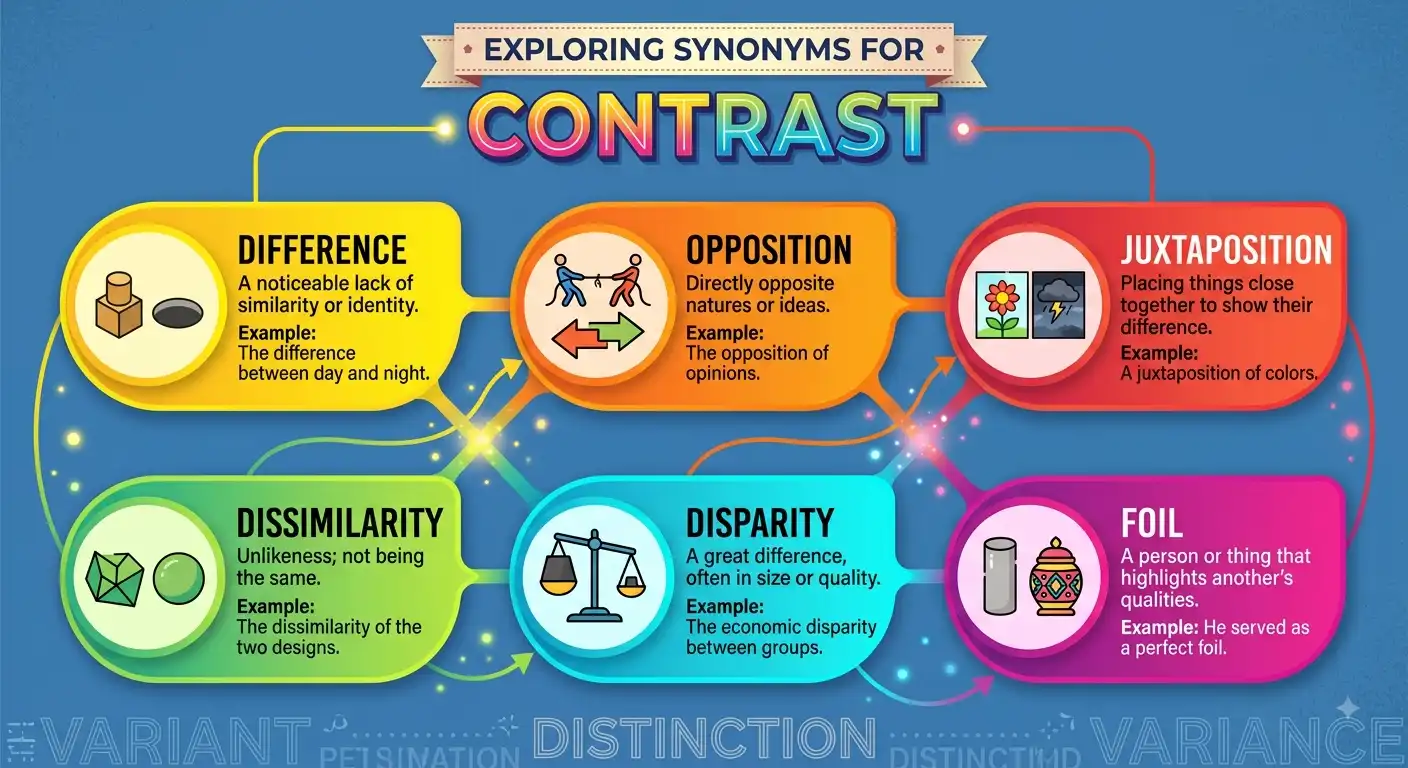
When you search for synonyms for contrast, you look for words that show clear differences between two things. Learning fresh synonyms for contrast helps you explain how items, ideas, or people stand apart from each other. Using varied synonyms for contrast makes your essays, blog posts, and daily talks much more interesting.
Imagine sitting in a cozy room while white snow falls quietly outside a dark wood window. The light snow stands out sharply against the dark frame. That clear difference is what we call contrast. You can describe this striking relationship using words like difference, distinction, disparity, or opposition.
Using different words for contrast is very helpful for:
- Students: Write sharper essay comparisons and earn higher marks.
- Bloggers: Keep your readers interested with fresh and lively vocabulary.
- Content Writers: Compare products and ideas with clear, strong language.
- Daily English Users: Share your thoughts clearly and speak with confidence.
“Contrast is the key to clarity; without difference, nothing stands out.” — Anonymous
“Words create pictures in the mind, and contrast gives those pictures their sharpest edges.” — Visual Arts Journal
Word Profile: Contrast
Connotative Meaning
The word contrast carries a neutral to dramatic feeling. It highlights striking differences that make things easier to see, understand, or evaluate when placed side by side.
Etymology (Origin)
- Latin Root: Contra- (meaning “against”)
- Latin Root: Stare (meaning “to stand”)
- Original Meaning: “To stand against or opposite”
- French Origin: Entered French as contraster before coming into Middle English in the 17th century.
Pronunciation
- US IPA: /ˈkɑːn.træst/ (Noun) | /kənˈtræst/ (Verb)
- UK IPA: /ˈkɒn.trɑːst/ (Noun) | /kənˈtrɑːst/ (Verb)
Syllables & Affixation
- Syllables: con-trast (2 syllables)
- Prefix: Con- / Contra- (against / opposite)
- Root: Trast / Stare (stand)
Comparison Table: Popular Synonyms for Contrast
| Keyword | Meaning | Usage Type | Context |
| Contrast | A clear difference seen when two things are compared. | Neutral / Academic | Essays, art, product comparisons |
| Difference | The state of not being the same. | Casual / Everyday | Daily life, general conversation |
| Distinction | A special mark or feature that sets something apart. | Formal / Professional | Awards, career accomplishments, analysis |
| Disparity | A great and often unfair difference between things. | Serious / Social | Income, health care, social issues |
| Antithesis | The exact opposite of something else. | Literary / Deep | Books, speeches, philosophy |
| Foil | A person or thing that highlights another’s qualities. | Creative / Analytical | Storytelling, drama, character design |
| Variation | A slight change or difference in condition or amount. | Technical / Casual | Weather, music, statistics |
50 Best Synonyms for Contrast
1. Difference
- Pronunciation: US: /ˈdɪf.ɚ.əns/ | UK: /ˈdɪf.ər.əns/
- Meaning: The way in which two or more things are not the same.
- Examples:
- There is a big difference between the two coats.
- Can you spot the difference in these two pictures?
2. Distinction
- Pronunciation: US: /dɪˈstɪŋk.ʃən/ | UK: /dɪˈstɪŋk.ʃən/
- Meaning: A clear difference that sets one thing apart from others.
- Examples:
- She makes a clear distinction between work and rest.
- The award gives high distinction to her artwork.
3. Disparity
- Pronunciation: US: /dɪˈspær.ə.t̬i/ | UK: /dɪˈspær.ə.ti/
- Meaning: A large and noticeable difference, often regarding fairness or size.
- Examples:
- There is a disparity between the two test scores.
- The group works to reduce the economic disparity.
4. Variation
- Pronunciation: US: /ˌvɛr.iˈeɪ.ʃən/ | UK: /ˌveə.riˈeɪ.ʃən/
- Meaning: A slight change or difference in amount, style, or form.
- Examples:
- We saw a variation in prices across stores.
- Her new song is a nice variation of the old tune.
5. Divergence
- Pronunciation: US: /daɪˈvɝː.dʒəns/ | UK: /daɪˈvɜː.dʒəns/
- Meaning: A process where two things move apart or become different.
- Examples:
- A divergence in opinion led to a peaceful debate.
- We noticed a divergence between their two paths.
6. Discrepancy
- Pronunciation: US: /dɪˈskrɛp.ən.si/ | UK: /dɪˈskrep.ən.si/
- Meaning: An unexpected difference between two facts that should be the same.
- Examples:
- The bank found a discrepancy in the daily report.
- There was a small discrepancy in the sales numbers.
7. Contrastment
- Pronunciation: US: /kənˈtræst.mənt/ | UK: /kənˈtrɑːst.mənt/
- Meaning: The act or state of placing things together to show difference.
- Examples:
- The contrastment of red and white made the logo pop.
- Her soft voice provided contrastment to his loud tone.
8. Opposition
- Pronunciation: US: /ˌɑː.pəˈzɪʃ.ən/ | UK: /ˌɒp.əˈzɪʃ.ən/
- Meaning: A strong state of contrast or disagreement between two ideas.
- Examples:
- The two leaders stood in total opposition on the rule.
- His peaceful views are in opposition to war.
9. Polarity
- Pronunciation: US: /poʊˈlær.ə.t̬i/ | UK: /pəʊˈlær.ə.ti/
- Meaning: The presence of two completely opposite qualities or sides.
- Examples:
- The polarity between hot and cold weather was clear.
- Their views showed a strong polarity during the talk.
10. Duality
- Pronunciation: US: /duːˈæl.ə.t̬i/ | UK: /dʒuːˈæl.ə.ti/
- Meaning: The state of having two different parts or contrasting sides.
- Examples:
- The book explores the duality of good and evil.
- She manages the duality of her twin roles with grace.
11. Antithesis
- Pronunciation: US: /ænˈtɪθ.ə.sɪs/ | UK: /ænˈtɪθ.ə.sɪs/
- Meaning: The exact direct opposite of a person, idea, or thing.
- Examples:
- Cruelty is the exact antithesis of true kindness.
- His lazy behavior was the antithesis of his sister’s hard work.
12. Counterpart
- Pronunciation: US: /ˈkaʊn.t̬ɚ.pɑːrt/ | UK: /ˈkaʊn.tə.pɑːt/
- Meaning: A person or thing that completes or contrasts with another.
- Examples:
- The manager met with her foreign counterpart.
- The right glove is the matching counterpart to the left.
13. Counterpoint
- Pronunciation: US: /ˈkaʊn.t̬ɚ.pɔɪnt/ | UK: /ˈkaʊn.tə.pɔɪnt/
- Meaning: An contrasting element used to add balance or interest.
- Examples:
- The quiet violin gave a sweet counterpoint to the drums.
- Her calm words offered a cool counterpoint to his anger.
14. Foil
- Pronunciation: US: /fɔɪl/ | UK: /fɔɪl/
- Meaning: A person or thing that makes another look better by contrast.
- Examples:
- The silly friend acts as a funny foil to the serious hero.
- White walls serve as a great foil for bright art.
15. Unlikeness
- Pronunciation: US: /ʌnˈlaɪk.nəs/ | UK: /ʌnˈlaɪk.nəs/
- Meaning: The state of not looking or being like something else.
- Examples:
- The unlikeness of the twins surprised everyone.
- They discussed the unlikeness of the two plans.
16. Dissimilarity
- Pronunciation: US: /ˌdɪs.sɪm.əˈlær.ə.t̬i/ | UK: /ˌdɪs.sɪm.ɪˈlær.ə.ti/
- Meaning: A specific difference or point of unlikeness between items.
- Examples:
- We noted the dissimilarity in their handwriting.
- The dissimilarity between the two cars was clear.
17. Gap
- Pronunciation: US: /ɡæp/ | UK: /ɡæp/
- Meaning: A clear space or wide difference separating two things.
- Examples:
- There is a wide age gap between the brothers.
- Bridge the gap with simple and clear communication.
18. Divergency
- Pronunciation: US: /daɪˈvɝː.dʒən.si/ | UK: /daɪˈvɜː.dʒən.si/
- Meaning: The state of turning away from a common point.
- Examples:
- The divergency in their goals led to separate paths.
- We tracked the divergency of the two rivers.
19. Variance
- Pronunciation: US: /ˈvɛr.i.əns/ | UK: /ˈveə.ri.əns/
- Meaning: An amount of difference or change from a standard rule.
- Examples:
- His results showed a slight variance from the norm.
- There was no variance in her daily routine.
20. Incongruity
- Pronunciation: US: /ˌɪn.kəŋˈɡruː.ə.t̬i/ | UK: /ˌɪn.kəŋˈɡruː.ə.ti/
- Meaning: The state of not fitting together or matching well.
- Examples:
- The incongruity of wearing snow boots to the beach made us laugh.
- She noticed the incongruity between his words and actions.
21. Conflict
- Pronunciation: US: /ˈkɑːn.flɪkt/ | UK: /ˈkɒn.flɪkt/
- Meaning: A strong disagreement or clash between contrasting ideas.
- Examples:
- Their conflict of interest was solved by the board.
- Color conflict occurs when bright shades clash.
22. Clashing
- Pronunciation: US: /ˈklæʃ.ɪŋ/ | UK: /ˈklæʃ.ɪŋ/
- Meaning: Coming together in sharp and unpleasant contrast.
- Examples:
- She wore clashing colors that grabbed attention.
- Their clashing schedules made meeting difficult.
“By contrasting light and dark, artists reveal the hidden depth in simple shapes.” — Art Studies Handbook
23. Division
- Pronunciation: US: /dɪˈvɪʒ.ən/ | UK: /dɪˈvɪʒ.ən/
- Meaning: A separation created by a difference in opinion or nature.
- Examples:
- A deep division split the two voting groups.
- Clear lines of division kept the teams organized.
24. Separation
- Pronunciation: US: /ˌsɛp.əˈreɪ.ʃən/ | UK: /ˌsep.ərˈeɪ.ʃən/
- Meaning: Keeping two contrasting things apart from one another.
- Examples:
- The fence creates a physical separation of the yards.
- Good boundaries maintain a healthy separation of work and home.
25. Deviation
- Pronunciation: US: /ˌdiː.viˈeɪ.ʃən/ | UK: /ˌdiː.viˈeɪ.ʃən/
- Meaning: A move away from an expected standard or direction.
- Examples:
- Any deviation from the plan must be approved.
- Taking a shortcut was a fun deviation from our regular walk.
26. Mismatch
- Pronunciation: US: /ˈmɪs.mætʃ/ | UK: /ˈmɪs.mætʃ/
- Meaning: A poor match between two things that do not suit each other.
- Examples:
- His shoes were a hilarious mismatch with his suit.
- There was an obvious mismatch in player skill levels.
27. Asymmetry
- Pronunciation: US: /eɪˈsɪm.ə.tri/ | UK: /eɪˈsɪm.ə.tri/
- Meaning: A lack of equality or balance between two sides.
- Examples:
- Modern art often uses asymmetry to catch the eye.
- The tree had a pleasing natural asymmetry.
28. Contradiction
- Pronunciation: US: /ˌkɑːn.trəˈdɪk.ʃən/ | UK: /ˌkɒn.trəˈdɪk.ʃən/
- Meaning: A combination of statements that oppose each other directly.
- Examples:
- Saying you are full while eating cake is a contradiction.
- The news story contained a clear contradiction.
29. Reverse
- Pronunciation: US: /rɪˈvɝːs/ | UK: /rɪˈvɜːs/
- Meaning: The opposite side or rear aspect of something.
- Examples:
- The coin has a eagle on the reverse side.
- His second story was the exact reverse of his first.
30. Opposite
- Pronunciation: US: /ˈɑː.pə.zɪt/ | UK: /ˈɒp.ə.zɪt/
- Meaning: Completely different in nature, direction, or quality.
- Examples:
- Hot is the direct opposite of cold.
- They sat at opposite ends of the long table.
31. Inverse
- Pronunciation: US: /ˌɪnˈvɝːs/ | UK: /ˌɪnˈvɜːs/
- Meaning: Something that is inverted or opposite in position or order.
- Examples:
- Speed has an inverse relation to travel time.
- Her reaction was the inverse of what we expected.
32. Flipside
- Pronunciation: US: /ˈflɪp.saɪd/ | UK: /ˈflɪp.saɪd/
- Meaning: The opposite or contrasting aspect of a situation.
- Examples:
- Fame is nice, but the flipside is a loss of privacy.
- On the flipside of the card was a cute drawing.
33. Contrastiveness
- Pronunciation: US: /kənˈtræs.tɪv.nəs/ | UK: /kənˈtrɑːs.tɪv.nəs/
- Meaning: The quality of standing out clearly through difference.
- Examples:
- Linguists study the contrastiveness of speech sounds.
- The contrastiveness of black ink on paper improves reading.
34. Imbalance
- Pronunciation: US: /ɪmˈbæl.əns/ | UK: /ɪmˈbæl.əns/
- Meaning: A state where two contrasting sides are not equal.
- Examples:
- Eating only sweets creates a nutritional imbalance.
- The score showed a big imbalance in team power.
35. Irregularity
- Pronunciation: US: /ɪˌrɛɡ.jəˈlær.ə.t̬i/ | UK: /ɪˌreɡ.jəˈlær.ə.ti/
- Meaning: A difference from the regular pattern or smooth form.
- Examples:
- The doctor checked the pulse for any irregularity.
- Hand-made tiles show natural surface irregularity.
36. Distinction mark
- Pronunciation: US: /dɪˈstɪŋk.ʃən mɑːrk/ | UK: /dɪˈstɪŋk.ʃən mɑːk/
- Meaning: A noticeable sign that shows a difference.
- Examples:
- The bright badge is a distinction mark of her rank.
- White feathers on the wing act as a distinction mark.
37. Comparison
- Pronunciation: US: /kəmˈpær.ə.sən/ | UK: /kəmˈpær.ɪ.sən/
- Meaning: Examining two items to note similarities and contrasts.
- Examples:
- A side-by-side comparison shows which phone is faster.
- Making a direct comparison helps us choose wisely.
38. Juxtaposition
- Pronunciation: US: /ˌdʒʌk.stə.pəˈzɪʃ.ən/ | UK: /ˌdʒʌk.stə.pəˈzɪʃ.ən/
- Meaning: Placing two things close together to emphasize their contrast.
- Examples:
- The museum placed an old sword next to a laser in a fun juxtaposition.
- The poem uses the juxtaposition of life and death.
39. Offset
- Pronunciation: US: /ˈɑːf.sɛt/ | UK: /ˈɒf.set/
- Meaning: Something that balances or contrasts against another thing.
- Examples:
- Her bright scarf was a nice offset to her dark coat.
- High gains offset the small losses made early on.
40. Difference mark
- Pronunciation: US: /ˈdɪf.ɚ.əns mɑːrk/ | UK: /ˈdɪf.ər.əns mɑːk/
- Meaning: A visible trait that points out how things differ.
- Examples:
- The stripe on the tail is a clear difference mark.
- His tall frame was a difference mark in the crowd.
41. Divergent point
- Pronunciation: US: /daɪˈvɝː.dʒənt pɔɪnt/ | UK: /daɪˈvɜː.dʒənt pɔɪnt/
- Meaning: A specific place or moment where two ideas split apart.
- Examples:
- Money became the divergent point in their business talks.
- The divergent point on the trail was clearly marked.
42. Alteration
- Pronunciation: US: /ˌɑːl.təˈreɪ.ʃən/ | UK: /ˌɔːl.təˈreɪ.ʃən/
- Meaning: A small change that creates a noticeable difference.
- Examples:
- The tailor made a quick alteration to the jacket sleeves.
- A minor alteration in tone changed the whole message.
43. Distinctness
- Pronunciation: US: /dɪˈstɪŋkt.nəs/ | UK: /dɪˈstɪŋkt.nəs/
- Meaning: The quality of being clear, sharp, and easy to separate.
- Examples:
- The distinctness of her voice made her famous.
- We loved the crisp distinctness of the photo.
44. Disagreement
- Pronunciation: US: /ˌdɪs.əˈɡriː.mənt/ | UK: /ˌdɪs.əˈɡriː.mənt/
- Meaning: A contrast of opinions or failure to agree.
- Examples:
- They settled their disagreement with a quiet chat.
- There was some disagreement on where to eat lunch.
45. Disproportion
- Pronunciation: US: /ˌdɪs.prəˈpɔːr.ʃən/ | UK: /ˌdɪs.prəˈpɔː.ʃən/
- Meaning: A lack of proper balance or symmetry between parts.
- Examples:
- The disproportion between building height and lawn size was huge.
- We saw a disproportion in how time was spent.
46. Shadowing
- Pronunciation: US: /ˈʃæd.oʊ.ɪŋ/ | UK: /ˈʃæd.əʊ.ɪŋ/
- Meaning: The artistic use of dark areas to contrast with light spots.
- Examples:
- Strong shadowing made the mountain drawing look real.
- The soft shadowing under his chin added depth.
47. Highlight
- Pronunciation: US: /ˈhaɪ.laɪt/ | UK: /ˈhaɪ.laɪt/
- Meaning: A bright area or outstanding feature that contrasts with the rest.
- Examples:
- The golden sunrise was the highlight of our trip.
- She added a bright highlight to the painted eyes.
48. Variance point
- Pronunciation: US: /ˈvɛr.i.əns pɔɪnt/ | UK: /ˈveə.ri.əns pɔɪnt/
- Meaning: A specific detail where two things fail to align.
- Examples:
- Price remained the main variance point in negotiations.
- We marked every variance point on the comparison chart.
49. Distinctness trait
- Pronunciation: US: /dɪˈstɪŋkt.nəs treɪt/ | UK: /dɪˈstɪŋkt.nəs treɪt/
- Meaning: A personal characteristic that makes someone stand out.
- Examples:
- Her bright red hair was her key distinctness trait.
- Honesty is a great distinctness trait in a leader.
50. Divergency mark
- Pronunciation: US: /daɪˈvɝː.dʒən.si mɑːrk/ | UK: /daɪˈvɜː.dʒən.si mɑːk/
- Meaning: A physical or conceptual signal indicating separation.
- Examples:
- The sign served as a divergency mark along the border.
- A new policy acted as a divergency mark for the company.
Antonyms of Contrast
To understand contrast fully, it helps to look at its opposite words:
- Similarity: The state of looking or being almost the same.
- Resemblance: A clear likeness between two people or things.
- Uniformity: The quality of staying equal and identical throughout.
- Agreement: Being in complete harmony or having the same opinion.
- Sameness: A lack of change, difference, or variety over time.
Prototype Meaning and Categorization of Contrast
We can organize these 50 synonyms into clear groups to help you choose the right word:
- Direct Opposites (Extreme Difference):
- Antithesis, Opposite, Inverse, Contradiction, Reverse, Polarity, Counterpoint, Flipside.
- Noticeable Differences (General Unlikeness):
- Difference, Distinction, Unlikeness, Dissimilarity, Variation, Distinctness, Contrastment, Contrastiveness.
- Gaps and Clashes (Unequal or Unmatched States):
- Disparity, Discrepancy, Incongruity, Mismatch, Imbalance, Asymmetry, Disproportion, Clashing, Conflict.
- Visual & Artistic Elements (Art and Design Context):
- Juxtaposition, Highlight, Shadowing, Foil, Offset, Counterpart.
- Separation and Changes (Points of Turning):
- Divergence, Divergency, Gap, Variance, Deviation, Division, Separation, Divergent point, Irregularity, Alteration.
Frequently Asked Questions (FAQ)
What is the best synonym for contrast in academic writing?
The best academic synonyms for contrast are distinction, divergence, juxtaposition, or disparity. These terms sound professional and show clear analysis.
Is “difference” the exact same thing as “contrast”?
Not always. Difference simply means two things are not identical. Contrast usually refers to dynamic or striking differences brought out when two things are compared side by side.
What synonym for contrast works best in visual art and design?
Words like juxtaposition, highlight, shadowing, foil, and offset work best in art and design contexts.
What is a formal term for a big difference between rich and poor?
In social or economic discussions, the word disparity (or economic gap) is the best formal word to use.
How do I use synonyms for contrast in my comparative essays?
Instead of repeating “contrast” over and over, cycle through words like distinction, counterpoint, juxtaposition, and divergence to keep your writing engaging.
What is the verb form of contrast?
The verb form is also contrast. For example: “The author contrasts winter with spring.”
Conclusion
Building your collection of synonyms for contrast expands your writing tools and lifts your everyday communication skills. When you swap out repetitive words for precise choices like distinction, disparity, juxtaposition, or counterpoint, your prose becomes far more lively, clear, and persuasive.
For bloggers, students, and content creators, using varied synonyms for contrast keeps readers engaged from the first line to the final sentence. Masterful communication relies on selecting the perfect word for every context. Start using these 50 synonyms for contrast in your emails, essays, and daily chats today!
“Great writers do not just tell stories; they use contrast to make every detail unforgettable.” — Literary Crafts Quarterly
“In every field of thought, recognizing contrast is the first step toward true understanding.” — Educational Insights

Andrew Collins is an academic English educator with over 12 years of experience helping university students, IELTS candidates, and ESL learners improve their writing vocabulary.