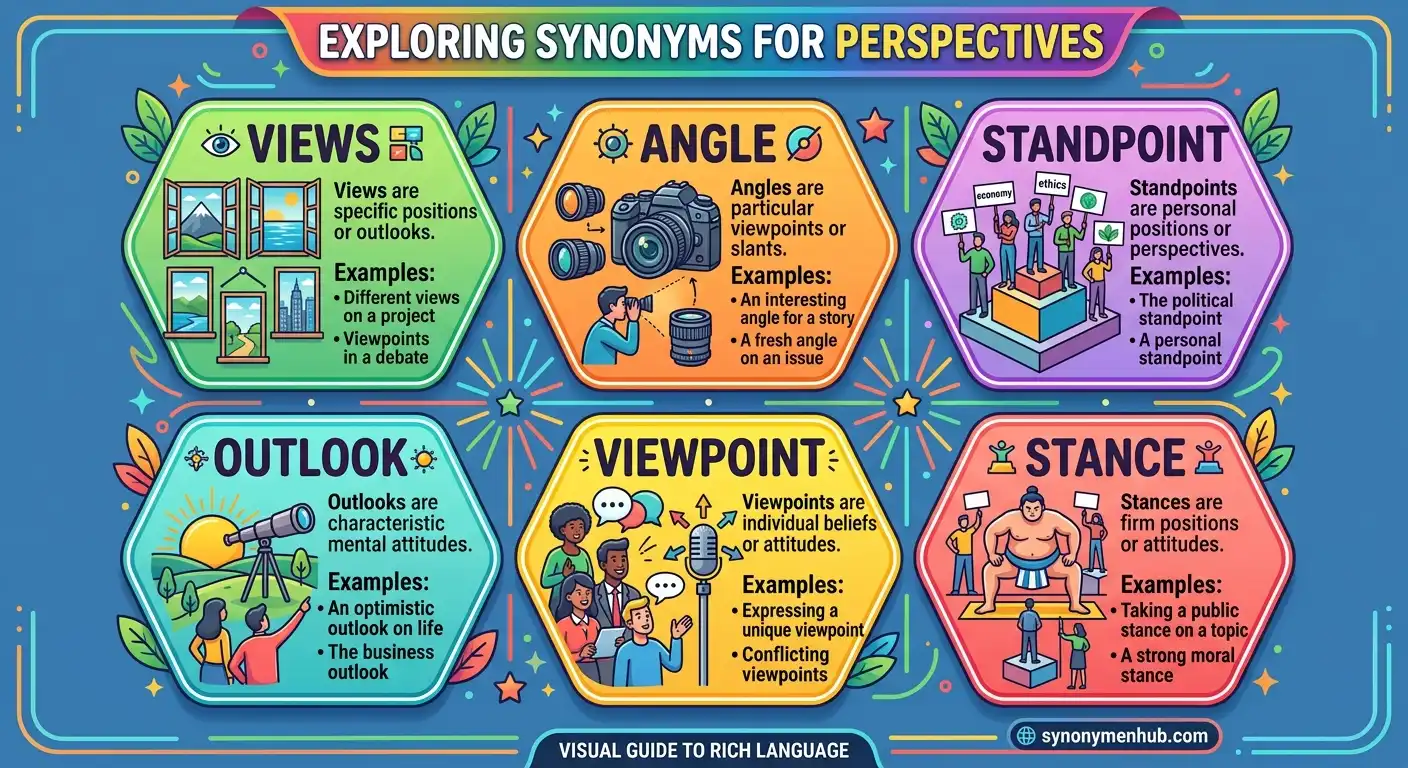
When you search for synonyms for perspectives, you want words that describe different ways of seeing the world. Learning fresh synonyms for perspectives helps you share your personal views clearly and understand how other people think. Using diverse synonyms for perspectives makes your essays, blog posts, business reports, and everyday conversations far more engaging.
Two people can look at the exact same picture and see two completely different stories. One person sees a bright sunrise, while the other sees a quiet morning end. That unique way of seeing things is what we call a perspective. You can express this idea using words like viewpoints, angles, outlooks, and standpoints.
Using different words for perspectives is very helpful for:
- Students: Express complex ideas in essays and earn better grades.
- Bloggers: Share fresh views to keep readers coming back for more.
- Content Writers: Craft rich, persuasive copy that connects with every audience.
- Daily English Users: Speak clearly and build stronger relationships in daily life.
“We do not see things as they are, we see them as we are.” — Anaïs Nin
“It is a narrow mind that cannot look at a subject from various points of view.” — George Eliot
Word Profile: Perspectives
Connotative Meaning
The word perspectives carries an open-minded, thoughtful, and analytical tone. It refers to the physical or mental position from which a person looks at a situation, problem, or artwork.
Etymology (Origin)
- Latin Root: Perspectivus (meaning “of sight / looking through”)
- Latin Root: Perspicere (meaning “to look through closely”)
- Medieval Latin: Perspectiva (meaning “the science of optics”)
- Middle English: Adopted into English in the late 14th century to describe visual art depth, later expanding to mean mental viewpoints.
Pronunciation
- US IPA: /pɚˈspɛk.tɪvz/
- UK IPA: /pəˈspek.tɪvz/
Syllables & Affixation
- Syllables: per-spec-tives (3 syllables)
- Prefix: Per- (through / thoroughly)
- Root: Spect (look / see)
- Suffix: -ives (plural noun suffix forming state or condition)
Comparison Table: Popular Synonyms for Perspectives
| Keyword | Meaning | Usage Type | Context |
| Perspectives | Particular ways of considering something. | Neutral / Academic | Debates, literature, team discussions |
| Viewpoints | Places or angles from which things are viewed. | General / Clear | Daily chats, news articles, essays |
| Angles | Specific ways of looking at a problem or topic. | Professional / Media | Journalism, business strategy, problem-solving |
| Outlooks | General attitudes toward life or the future. | Emotional / Personal | Mental health, career planning, personal growth |
| Standpoints | Positions from which things are judged or understood. | Formal / Argumentative | Philosophy, law, academic research |
| Stances | Public opinions or physical positions taken on issues. | Formal / Political | Politics, debates, corporate strategy |
| Vantage Points | Places that afford a good view of something. | Literary / Descriptive | Photography, military, narrative storytelling |
50 Best Synonyms for Perspectives
1. Viewpoints
- Pronunciation: US: /ˈvjuː.pɔɪnts/ | UK: /ˈvjuː.pɔɪnts/
- Meaning: The specific positions or angles from which people look at things.
- Examples:
- We listened to many different viewpoints during the class meeting.
- Her unique viewpoint helped us solve the hard problem quickly.
2. Angles
- Pronunciation: US: /ˈæŋ.ɡəlz/ | UK: /ˈæŋ.ɡəlz/
- Meaning: Particular ways of approaching or thinking about a topic.
- Examples:
- The reporter looked at the news story from three new angles.
- Try looking at the problem from a fresh angle today.
3. Standpoints
- Pronunciation: US: /ˈstænd.pɔɪnts/ | UK: /ˈstænd.pɔɪnts/
- Meaning: The personal beliefs or positions from which you judge things.
- Examples:
- From an economic standpoint, this new shop makes great sense.
- She explained her decision from the standpoint of a mother.
4. Outlooks
- Pronunciation: US: /ˈaʊt.lʊks/ | UK: /ˈaʊt.lʊks/
- Meaning: Your general attitudes toward life and what will happen next.
- Examples:
- Regular exercise gave him a much happier outlook on life.
- The weather forecast shows a positive outlook for tomorrow.
5. Opinions
- Pronunciation: US: /əˈpɪn.jənz/ | UK: /əˈpɪn.jənz/
- Meaning: What you think or feel about something without proven facts.
- Examples:
- Everyone is welcome to share their honest opinions here.
- In my opinion, this book is the best one yet.
6. Positions
- Pronunciation: US: /pəˈzɪʃ.ənz/ | UK: /pəˈzɪʃ.ənz/
- Meaning: Your official thoughts or stances during a discussion.
- Examples:
- The manager stated his position on the new company rules.
- They held firm positions throughout the long meeting.
7. Perceptions
- Pronunciation: US: /pɚˈsɛp.ʃənz/ | UK: /pəˈsep.ʃənz/
- Meaning: The ways you notice, understand, and interpret things around you.
- Examples:
- Public perceptions of the new park are very positive.
- His perception of the event changed after talking to us.
8. Stances
- Pronunciation: US: /ˈstæn.sɪz/ | UK: /ˈstɑːn.sɪz/
- Meaning: Public opinions that people take on clear issues.
- Examples:
- The leader took a strong stance against unfair prices.
- What is your stance on the new community project?
9. Mindsets
- Pronunciation: US: /ˈmaɪnd.sɛts/ | UK: /ˈmaɪnd.sets/
- Meaning: Established sets of attitudes held by people.
- Examples:
- A growth mindset helps you learn from small mistakes.
- She entered the race with a winning mindset.
10. Views
- Pronunciation: US: /vjuːz/ | UK: /vjuːz/
- Meaning: Personal thoughts or opinions on a subject.
- Examples:
- He expressed his political views during the friendly chat.
- Our views on music are very similar.
11. Points of view
- Pronunciation: US: /pɔɪnts ʌv vjuː/ | UK: /pɔɪnts ɒv vjuː/
- Meaning: The personal ways people consider situations or facts.
- Examples:
- The book is written from two different points of view.
- Try to understand the story from her point of view.
12. Approaches
- Pronunciation: US: /əˈproʊ.tʃɪz/ | UK: /əˈprəʊ.tʃɪz/
- Meaning: Ways of dealing with or thinking about something.
- Examples:
- We need new approaches to finish this project on time.
- Her gentle approach made the scared cat feel safe.
13. Interpretations
- Pronunciation: US: /ɪnˌtɝː.prəˈteɪ.ʃənz/ | UK: /ɪnˌtɜː.prɪˈteɪ.ʃənz/
- Meaning: Explanations of the meaning of something.
- Examples:
- The art gallery had many interpretations of one painting.
- His interpretation of the poem was very creative.
14. Slants
- Pronunciation: US: /slænts/ | UK: /slɑːnts/
- Meaning: Personal biases or specific ways of presenting information.
- Examples:
- The newspaper article had a strong positive slant.
- She gave the old story a funny new slant.
15. Insights
- Pronunciation: US: /ˈɪn.saɪts/ | UK: /ˈɪn.saɪts/
- Meaning: Deep understandings of complex people or situations.
- Examples:
- The guest speaker shared helpful insights about business.
- Her book gives rich insights into human nature.
16. Attitudes
- Pronunciation: US: /ˈæt.ə.tuːdz/ | UK: /ˈæt.ɪ.tjuːdz/
- Meaning: The feelings or ways of thinking that affect your behavior.
- Examples:
- Positive attitudes make hard work much easier.
- His bad attitude ruined the fun game for everyone.
17. Beliefs
- Pronunciation: US: /bɪˈliːfs/ | UK: /bɪˈliːfs/
- Meaning: Things that you accept as true or real.
- Examples:
- She holds strong beliefs about saving wild animals.
- Respecting different beliefs brings peace to communities.
18. Visions
- Pronunciation: US: /ˈvɪʒ.ənz/ | UK: /ˈvɪʒ.ənz/
- Meaning: Ideas or pictures in your mind of what could happen.
- Examples:
- The mayor shared his vision for a cleaner city.
- She had clear visions for her new company.
19. Impressions
- Pronunciation: US: /ɪmˈprɛʃ.ənz/ | UK: /ɪmˈpreʃ.ənz/
- Meaning: Ideas or feelings about someone or something formed quickly.
- Examples:
- First impressions are very important during job interviews.
- He gave me the impression that he was happy.
20. Judgments
- Pronunciation: US: /ˈdʒʌdʒ.mənts/ | UK: /ˈdʒʌdʒ.mənts/
- Meaning: Decisions or opinions formed after careful thought.
- Examples:
- Use your good judgment when making big choices.
- She passed no judgments on his past mistakes.
21. Thoughts
- Pronunciation: US: /θɑːts/ | UK: /θɔːts/
- Meaning: Ideas produced by thinking in your mind.
- Examples:
- Thank you for sharing your thoughts on this topic.
- I wrote down my secret thoughts in my diary.
22. Sentiments
- Pronunciation: US: /ˈsɛn.tə.mənts/ | UK: /ˈsen.tɪ.mənts/
- Meaning: General feelings or opinions held by a group.
- Examples:
- Public sentiment favored building a new public library.
- She expressed warm sentiments toward her old school.
23. Convictions
- Pronunciation: US: /kənˈvɪk.ʃənz/ | UK: /kənˈvɪk.ʃənz/
- Meaning: Firmly held beliefs or opinions.
- Examples:
- He is a man of strong moral convictions.
- She spoke with deep conviction about her project.
24. Orientations
- Pronunciation: US: /ˌɔːr.i.ənˈteɪ.ʃənz/ | UK: /ˌɔː.ri.enˈteɪ.ʃənz/
- Meaning: Particular interests, goals, or ways of thinking.
- Examples:
- The school has a strong career orientation for students.
- His business orientation helped the company grow.
25. Worldviews
- Pronunciation: US: /ˈwɝːld.vjuːz/ | UK: /ˈwɜːld.vjuːz/
- Meaning: Overall philosophies or conceptions of the world.
- Examples:
- Travel opens your heart to new worldviews.
- Her worldview was shaped by her kind family.
“The real voyage of discovery consists not in seeking new landscapes, but in having new eyes.” — Marcel Proust
26. Vantage points
- Pronunciation: US: /ˈvæn.t̬ɪdʒ pɔɪnts/ | UK: /ˈvɑːn.tɪdʒ pɔɪnts/
- Meaning: Places or positions that afford a good view.
- Examples:
- From our hilltop vantage point, we saw the whole town.
- History gives us a great vantage point to learn.
27. Postures
- Pronunciation: US: /ˈpɑːs.tʃɚz/ | UK: /ˈpɒs.tʃəz/
- Meaning: Particular approaches or attitudes toward an issue.
- Examples:
- The company adopted a cautious posture regarding spending.
- His defensive posture made it hard to talk.
28. Leanings
- Pronunciation: US: /ˈliː.nɪŋz/ | UK: /ˈliː.nɪŋz/
- Meaning: Tendencies or preferences toward particular ideas.
- Examples:
- He has artistic leanings and loves to paint.
- Her political leanings were clear from her speech.
29. Mentalities
- Pronunciation: US: /mɛnˈtæl.ə.t̬iz/ | UK: /menˈtæl.ə.tiːz/
- Meaning: Characteristic ways of thinking that belong to people.
- Examples:
- Teamwork requires an unselfish mentality from everyone.
- The old town kept its friendly mentality over time.
30. Observations
- Pronunciation: US: /ˌɑːb.zɚˈveɪ.ʃənz/ | UK: /ˌɒb.zəˈveɪ.ʃənz/
- Meaning: Remarks or statements based on what you notice.
- Examples:
- She made smart observations during the science class.
- His observations about the weather were correct.
31. Dispositions
- Pronunciation: US: /ˌdɪs.pəˈzɪʃ.ənz/ | UK: /ˌdɪs.pəˈzɪʃ.ənz/
- Meaning: Natural qualities of character or mind set.
- Examples:
- She has a sunny disposition and smiles often.
- His quiet disposition made him a good listener.
32. Takes
- Pronunciation: US: /teɪks/ | UK: /teɪks/
- Meaning: Personal opinions or interpretations of events.
- Examples:
- What is your take on the final movie scene?
- He offered a fresh take on the classic song.
33. Understandings
- Pronunciation: US: /ˌʌn.dɚˈstæn.dɪŋz/ | UK: /ˌʌn.dəˈstæn.dɪŋz/
- Meaning: Personal comprehensions or agreements about facts.
- Examples:
- They reached clear understandings after talking all night.
- My understanding of the rule is slightly different.
34. Readings
- Pronunciation: US: /ˈriː.dɪŋz/ | UK: /ˈriː.dɪŋz/
- Meaning: Personal interpretations of books, events, or facts.
- Examples:
- The professor gave two readings of the famous poem.
- Her reading of the situation was spot on.
35. Reflections
- Pronunciation: US: /rɪˈflɛk.ʃənz/ | UK: /rɪˈflek.ʃənz/
- Meaning: Serious thoughts or quiet considerations of the past.
- Examples:
- He shared his reflections on his long career.
- Quiet reflections help you grow as a person.
36. Concepts
- Pronunciation: US: /ˈkɑːn.sɛpts/ | UK: /ˈkɒn.septs/
- Meaning: General notions or abstract ideas in your mind.
- Examples:
- She understands math concepts very quickly.
- The designer showed us new concepts for the house.
37. Notions
- Pronunciation: US: /ˈnoʊ.ʃənz/ | UK: /ˈnəʊ.ʃənz/
- Meaning: Beliefs or ideas about something that may be vague.
- Examples:
- He had silly notions about living in a forest.
- She rejected the notion that hard work fails.
38. Assessments
- Pronunciation: US: /əˈsɛs.mənts/ | UK: /əˈses.mənts/
- Meaning: Judgments about the quality or value of something.
- Examples:
- The teacher gave fair assessments of our essays.
- Their assessment of the situation was accurate.
39. Frames of mind
- Pronunciation: US: /freɪmz ʌv maɪnd/ | UK: /freɪmz ɒv maɪnd/
- Meaning: Moods or mental states at a specific time.
- Examples:
- You need a relaxed frame of mind to study well.
- She was in a happy frame of mind all day.
40. Conclusions
- Pronunciation: US: /kənˈkluː.ʒənz/ | UK: /kənˈkluː.ʒənz/
- Meaning: Decisions reached by reasoning and evidence.
- Examples:
- We came to the same conclusion after the test.
- Her conclusions were based on strong facts.
41. Lenses
- Pronunciation: US: /lɛnz.ɪz/ | UK: /lenz.ɪz/
- Meaning: Specific ways of viewing and evaluating topics.
- Examples:
- Look at history through the lens of ordinary people.
- She views life through a cheerful lens.
42. Sides
- Pronunciation: US: /saɪdz/ | UK: /saɪdz/
- Meaning: Positions taken by one group in an argument.
- Examples:
- There are always two sides to every story.
- He chose to listen to both sides before judging.
43. Feelings
- Pronunciation: US: /ˈfiː.lɪŋz/ | UK: /ˈfiː.lɪŋz/
- Meaning: Emotional responses or beliefs about situations.
- Examples:
- She shared her true feelings with her best friend.
- My feelings on this matter have not changed.
44. Frames
- Pronunciation: US: /freɪmz/ | UK: /freɪmz/
- Meaning: Structures of concepts that shape your understanding.
- Examples:
- The news presented the story in a new frame.
- Use simple frames to organize your thoughts.
45. Eyes
- Pronunciation: US: /aɪz/ | UK: /aɪz/
- Meaning: Individual ways of seeing or evaluating the world.
- Examples:
- Through the eyes of a child, magic is everywhere.
- In the eyes of the law, all people are equal.
46. Biases
- Pronunciation: US: /ˈbaɪ.ə.sɪz/ | UK: /ˈbaɪ.ə.sɪz/
- Meaning: Personal inclinations or preferences that sway view points.
- Examples:
- We must recognize our personal biases when reading.
- The judge remained neutral with no biases.
47. Speculations
- Pronunciation: US: /ˌspɛk.jəˈleɪ.ʃənz/ | UK: /ˌspek.jəˈleɪ.ʃənz/
- Meaning: Guesses formed without full or firm evidence.
- Examples:
- There are many speculations about the mystery.
- He avoided wild speculations and stuck to facts.
48. Points of vision
- Pronunciation: US: /pɔɪnts ʌv ˈvɪʒ.ən/ | UK: /pɔɪnts ɒv ˈvɪʒ.ən/
- Meaning: Specific focal areas from which you observe things.
- Examples:
- Different points of vision make the artwork interesting.
- Choose good points of vision for your camera shots.
49. Angles of view
- Pronunciation: US: /ˈæŋ.ɡəlz ʌv vjuː/ | UK: /ˈæŋ.ɡəlz ɒv vjuː/
- Meaning: Specific directions or positions for viewing objects.
- Examples:
- Wide angles of view show the entire mountain valley.
- Consider all angles of view before deciding.
50. Evaluative eyes
- Pronunciation: US: /ɪˈvæl.ju.ə.t̬ɪv aɪz/ | UK: /ɪˈvæl.ju.ə.tɪv aɪz/
- Meaning: Critical ways of observing and judging details closely.
- Examples:
- The inspector looked at the house with evaluative eyes.
- She examined the artwork with trained, evaluative eyes.
Antonyms of Perspectives
To understand perspectives completely, it helps to know its opposite concepts:
- Blindness: Refusing to notice or accept other points of view.
- Narrow-mindedness: Unwillingness to accept new ideas or opinions.
- Dogma: Holding fixed principles without considering other views.
- Ignorance: Lack of knowledge or awareness regarding a topic.
- Rigidity: Being unable or unwilling to change your mind.
Prototype Meaning and Categorization of Perspectives
We can organize these 50 synonyms into clear groups to help you choose the right word:
- Direct Views & Angles (Visual & Physical):
- Viewpoints, Angles, Standpoints, Points of view, Vantage points, Lenses, Eyes, Angles of view, Points of vision, Evaluative eyes.
- Personal Beliefs & Opinions (Internal Thoughts):
- Opinions, Outloooks, Positions, Mindsets, Views, Attitudes, Beliefs, Sentiments, Convictions, Worldviews, Mentalities, Dispositions, Leanings.
- Analysis & Understanding (Mental Evaluation):
- Perceptions, Approaches, Interpretations, Insights, Impressions, Judgments, Thoughts, Observations, Takes, Understandings, Readings, Reflections, Assessments, Conclusions.
- Public Stances & Frameworks (External Positions):
- Stances, Slants, Visions, Orientations, Postures, Concepts, Notions, Frames of mind, Frames, Sides, Feelings, Biases, Speculations.
Frequently Asked Questions (FAQ)
What is the best synonym for perspectives in academic writing?
The best synonyms for perspectives in academic papers are viewpoints, standpoints, interpretations, or lenses. These words carry an objective and analytical tone.
How do “outlooks” and “perspectives” differ?
A perspective is a specific angle or way you view a topic. An outlook refers to your general attitude toward life and future expectations.
Can I use “angles” instead of “perspectives” in business?
Yes! Angles works exceptionally well in business and media settings when discussing creative approaches to marketing or problem-solving.
What is a formal synonym for a individual’s perspective?
Formal synonyms include standpoint, evaluative lens, or conceptual framework.
How do I use synonyms for perspectives in my essays?
Instead of repeating “perspective” in every paragraph, rotate terms like viewpoint, angle, approach, and understanding to make your prose engaging.
What is the singular form of perspectives?
The singular form is perspective. For example: “She brought a fresh perspective to our creative team.”
Conclusion
Learning useful synonyms for perspectives expands your vocabulary and builds confidence in communication. When you replace overused terms with words like viewpoints, angles, outlooks, or standpoints, your writing becomes more expressive, precise, and enjoyable for readers.
For students, bloggers, and content writers, using a rich variety of synonyms for perspectives keeps your audience engaged from start to finish. Clear communication comes down to choosing the exact word for every context. Start practicing these 50 synonyms for perspectives in your emails, essays, and everyday conversations today!
“The difference between peak performance and poor performance is not initial ability but the perspective you hold.” — Tony Robbins
“If you change the way you look at things, the things you look at change.” — Wayne Dyer

Andrew Collins is an academic English educator with over 12 years of experience helping university students, IELTS candidates, and ESL learners improve their writing vocabulary.