Introduction
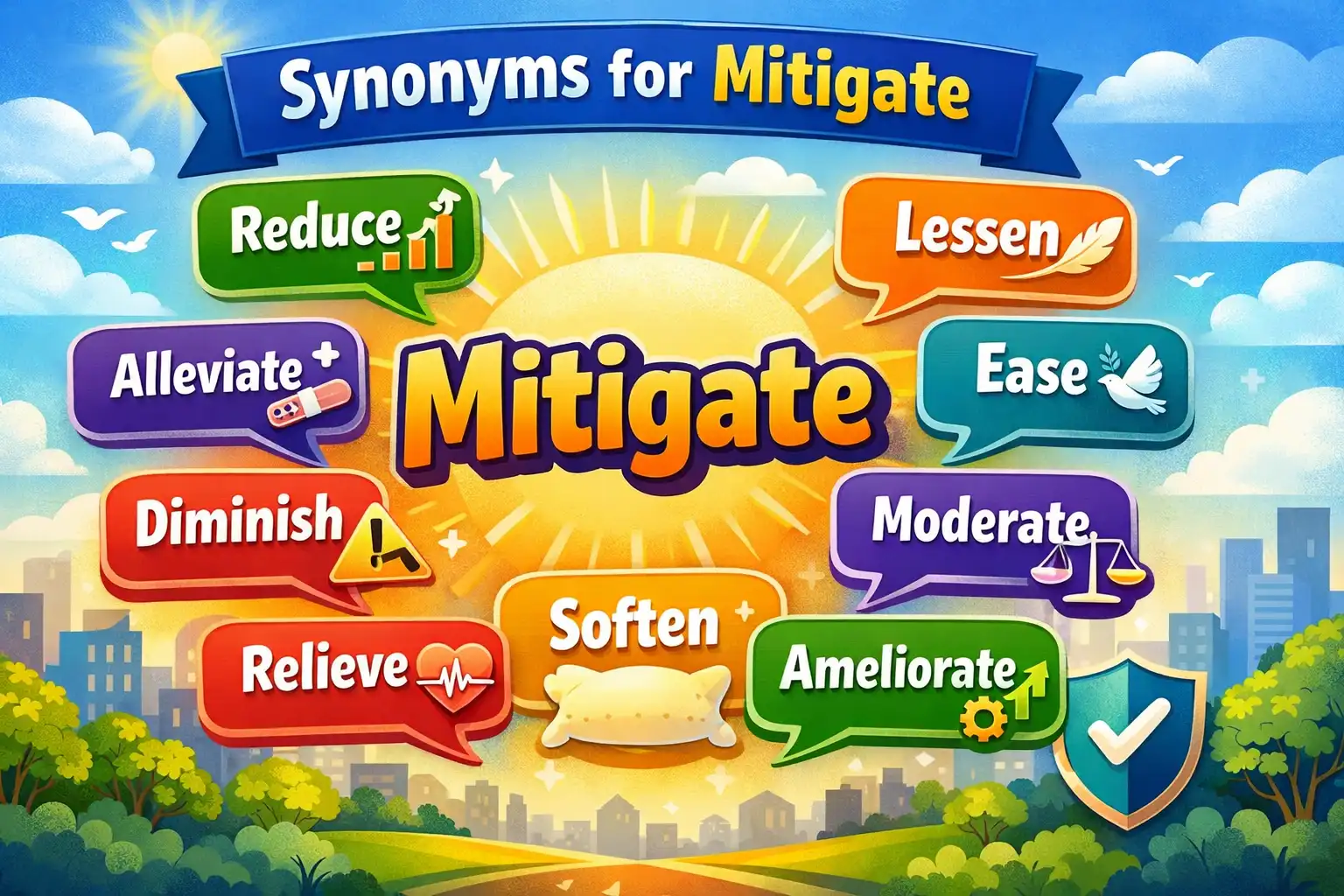
Mitigate means to make something less severe, harmful, or painful. When you mitigate a problem, you reduce its damage or soften its impact. To mitigate something is to take action that lessens how bad it feels or how much harm it causes. It is a powerful word used in law, business, science, writing, and daily conversation. Knowing synonyms for mitigate helps you express the same idea in different, stronger, and more precise ways.
Think about this: a doctor tells a patient that a new treatment will help mitigate the side effects of a strong medication. The treatment will not cure the disease, but it will make the suffering smaller. That is exactly what mitigate means — not full elimination, but meaningful reduction.
“The art of communication is the language of leadership.” — James Humes
Students need this word in essays. Bloggers need it for articles. Content writers need it for professional copy. And everyday English users need it to speak and write with more confidence. When you know synonyms for mitigate, your vocabulary grows, your writing becomes richer, and your communication sounds smarter.
“To improve is to change; to be perfect is to change often.” — Winston Churchill
Connotative Meaning of “Mitigate”
Mitigate carries a neutral-to-positive connotation. It suggests responsible action, care, and effort to reduce harm, It feels formal, intelligent, and professional. It does not suggest full removal — just softening or lessening.
Etymology of “Mitigate”
- Origin: Latin mitigare — “to soften, make mild”
- Root words: mitis (mild, soft) + agere (to do, to act)
- First used in English: 15th century
- Old French influence: mitigier
- Evolution: From legal and medical Latin into modern English
Pronunciation of “Mitigate”
- US English (IPA): /ˈmɪt.ɪ.ɡeɪt/
- UK English (IPA): /ˈmɪt.ɪ.ɡeɪt/
- Syllables: mit · i · gate (3 syllables)
- Stress: First syllable — MIT-i-gate
Affixation Pattern of “Mitigate”
| Form | Word |
|---|---|
| Verb | mitigate |
| Noun | mitigation |
| Adjective | mitigating |
| Adverb | mitigatingly |
| Negative form | unmitigated |
Comparison Table: Synonyms for Mitigate at a Glance
| Keyword | Meaning | Usage Type | Context |
|---|---|---|---|
| Mitigate | Reduce severity of harm | Formal | Law, medicine, business |
| Alleviate | Ease pain or burden | Formal/Emotional | Healthcare, daily life |
| Lessen | Make smaller or weaker | Casual | Everyday conversation |
| Reduce | Make smaller in size or degree | Neutral | Work, science, daily use |
| Soften | Make less harsh or hard | Casual/Emotional | Relationships, writing |
| Ease | Make more comfortable | Casual | Daily life, emotions |
| Diminish | Cause to become smaller | Formal | Academic, professional |
| Moderate | Keep within limits | Formal | Work, debate, policy |
| Temper | Soften or tone down | Formal/Emotional | Relationships, workplace |
| Relieve | Remove or reduce suffering | Emotional | Healthcare, personal |
| Cushion | Reduce the shock of impact | Casual | Finance, relationships |
| Palliate | Reduce without curing | Formal/Medical | Healthcare, law |
| Attenuate | Weaken gradually | Technical/Formal | Science, engineering |
| Abate | Reduce in intensity | Formal | Law, weather, business |
| Minimize | Reduce to the smallest amount | Neutral | Business, daily use |
Main Content: 50 Synonyms for Mitigate
1. Alleviate
Pronunciation: US: /əˈliː.vi.eɪt/ | UK: /əˈliː.vi.eɪt/
Meaning: To make pain, suffering, or difficulty less severe or easier to deal with.
Examples:
- The new policy helped alleviate the financial pressure on small business owners.
- She took a warm bath to alleviate the muscle pain after her long run.
2. Lessen
Pronunciation: US: /ˈles.ən/ | UK: /ˈles.ən/
Meaning: To make something smaller, weaker, or not as strong as before.
Examples:
- Regular exercise can lessen the risk of heart disease over time.
- He tried to lessen the tension in the room with a light-hearted joke.
3. Reduce
Pronunciation: US: /rɪˈduːs/ | UK: /rɪˈdjuːs/
Meaning: To make something smaller in size, amount, or degree.
Examples:
- The company found smart ways to reduce its carbon footprint this year.
- Drinking more water can reduce headaches for many people.
4. Ease
Pronunciation: US: /iːz/ | UK: /iːz/
Meaning: To make something less painful, difficult, or serious.
Examples:
- The mentor worked hard to ease the new student’s fear of public speaking.
- A gentle massage can ease tension in your neck and shoulders.
5. Soften
Pronunciation: US: /ˈsɔː.fən/ | UK: /ˈsɒf.ən/
Meaning: To make something less harsh, hard, or severe.
Examples:
- She chose softer words to soften the impact of her honest feedback.
- Adding a warm color to the walls helped soften the look of the office.
6. Temper
Pronunciation: US: /ˈtem.pɚ/ | UK: /ˈtem.pə/
Meaning: To make something less extreme or intense by balancing it with something else.
Examples:
- He learned to temper his strong opinions with patience and understanding.
- A good leader knows how to temper bold decisions with careful thinking.
7. Diminish
Pronunciation: US: /dɪˈmɪn.ɪʃ/ | UK: /dɪˈmɪn.ɪʃ/
Meaning: To make something smaller, weaker, or less important.
Examples:
- Regular practice helps diminish the feeling of fear before a performance.
- The new road safety rules helped diminish accidents on the highway.
8. Moderate
Pronunciation: US: /ˈmɒd.ər.ɪt/ (adj) / /ˈmɒd.ə.reɪt/ (verb) | UK: same
Meaning: To reduce something to a more reasonable or acceptable level.
Examples:
- She worked with her doctor to moderate her salt intake for better health.
- The team leader helped moderate the heated debate between departments.
9. Relieve
Pronunciation: US: /rɪˈliːv/ | UK: /rɪˈliːv/
Meaning: To remove or reduce pain, discomfort, or a burden.
Examples:
- The pain reliever helped relieve her severe headache within 30 minutes.
- Talking to a close friend can relieve the stress of a difficult week.
10. Cushion
Pronunciation: US: /ˈkʊʃ.ən/ | UK: /ˈkʊʃ.ən/
Meaning: To reduce the harmful effect of something, like a shock or blow.
Examples:
- Saving money regularly helps cushion the impact of unexpected expenses.
- The coach offered kind words to cushion the blow of the player’s poor game.
11. Palliate
Pronunciation: US: /ˈpæl.i.eɪt/ | UK: /ˈpæl.i.eɪt/
Meaning: To make a disease or problem less severe without fully solving it.
Examples:
- The doctor used palliative treatment to palliate the patient’s chronic pain.
- His apology helped palliate the anger in the room, though tensions remained.
12. Attenuate
Pronunciation: US: /əˈten.ju.eɪt/ | UK: /əˈten.ju.eɪt/
Meaning: To reduce the force, strength, or effect of something gradually.
Examples:
- Noise-canceling headphones help attenuate loud background sounds effectively.
- Time can attenuate grief, making it more bearable with each passing month.
13. Abate
Pronunciation: US: /əˈbeɪt/ | UK: /əˈbeɪt/
Meaning: To become less strong, severe, or extreme.
Examples:
- The storm began to abate by late evening, and the streets grew calm again.
- His anger started to abate once he heard the full explanation of the situation.
14. Minimize
Pronunciation: US: /ˈmɪn.ɪ.maɪz/ | UK: /ˈmɪn.ɪ.maɪz/
Meaning: To reduce something to the lowest possible level or amount.
Examples:
- The safety team worked hard to minimize the risk of injury on the factory floor.
- She tried to minimize distractions while studying for her final exams.
15. Subdue
Pronunciation: US: /səbˈduː/ | UK: /səbˈdjuː/
Meaning: To bring something under control or make it less intense.
Examples:
- The firefighters worked quickly to subdue the flames before they spread further.
- Soft music can help subdue anxiety before a stressful presentation.
16. Curb
Pronunciation: US: /kɜːrb/ | UK: /kɜːb/
Meaning: To keep something under control or prevent it from getting worse.
Examples:
- New laws were introduced to curb the rising rates of air pollution in the city.
- She found healthy habits to help curb her habit of late-night snacking.
17. Contain
Pronunciation: US: /kənˈteɪn/ | UK: /kənˈteɪn/
Meaning: To keep something within certain limits so it does not spread or grow.
Examples:
- Health workers moved fast to contain the outbreak before it affected more people.
- He struggled to contain his excitement when he heard the great news.
18. Limit
Pronunciation: US: /ˈlɪm.ɪt/ | UK: /ˈlɪm.ɪt/
Meaning: To set a boundary on how far something can go or how much it can grow.
Examples:
- The government decided to limit the number of cars allowed in the city center.
- She chose to limit her screen time to two hours per day to sleep better.
19. Quell
Pronunciation: US: /kwel/ | UK: /kwel/
Meaning: To put an end to something by making it calm or controlled.
Examples:
- The manager acted quickly to quell the rising panic among team members.
- A glass of warm milk helped quell her restlessness before bedtime.
20. Soothe
Pronunciation: US: /suːð/ | UK: /suːð/
Meaning: To bring calm, comfort, or relief to a person or situation.
Examples:
- A kind word from her teacher helped soothe her nerves before the exam.
- Lavender oil is known to soothe feelings of stress and anxiety naturally.
21. Dull
Pronunciation: US: /dʌl/ | UK: /dʌl/
Meaning: To reduce the sharpness, intensity, or brightness of something.
Examples:
- Pain medication can help dull the sharp ache after a dental procedure.
- Heavy clouds began to dull the bright sunshine across the afternoon sky.
22. Check
Pronunciation: US: /tʃek/ | UK: /tʃek/
Meaning: To stop or slow the growth of something harmful.
Examples:
- Early action helped check the spread of misinformation on social media.
- The fence was built to check the movement of stray animals on the road.
23. Tone Down
Pronunciation: US: /toʊn daʊn/ | UK: /təʊn daʊn/
Meaning: To make something less extreme, loud, or intense.
Examples:
- His advisor suggested he tone down the aggressive language in his speech.
- The designer chose to tone down the bright colors for a more professional look.
24. Blunt
Pronunciation: US: /blʌnt/ | UK: /blʌnt/
Meaning: To weaken the force or sharpness of something.
Examples:
- Her encouraging words helped blunt the sting of the critical review he received.
- Years of repetition can blunt the emotional impact of a difficult memory.
25. Dampen
Pronunciation: US: /ˈdæm.pən/ | UK: /ˈdæm.pən/
Meaning: To make something less strong, lively, or enthusiastic.
Examples:
- The bad weather did not dampen the crowd’s excitement at the outdoor festival.
- News of the delay began to dampen the team’s high spirits before the launch.
26. Lighten
Pronunciation: US: /ˈlaɪ.tən/ | UK: /ˈlaɪ.tən/
Meaning: To make a load, burden, or feeling less heavy or serious.
Examples:
- Sharing the workload helped lighten the pressure on the project manager.
- A funny story can lighten the mood during a long and stressful meeting.
27. Neutralize
Pronunciation: US: /ˈnjuː.trə.laɪz/ | UK: /ˈnjuː.trə.laɪz/
Meaning: To cancel out the effect of something harmful or dangerous.
Examples:
- Baking soda can neutralize the acid in your stomach and reduce discomfort.
- The security team worked to neutralize the threat before it became a crisis.
28. Counteract
Pronunciation: US: /ˌkaʊn.tərˈækt/ | UK: /ˌkaʊn.tərˈækt/
Meaning: To take action that reduces or cancels a harmful effect.
Examples:
- Vitamin C supplements can help counteract the effects of a poor diet.
- She introduced humor to counteract the growing tension in the negotiation.
29. Rectify
Pronunciation: US: /ˈrek.tɪ.faɪ/ | UK: /ˈrek.tɪ.faɪ/
Meaning: To fix or correct something that is wrong or harmful.
Examples:
- The team worked overnight to rectify the errors in the financial report.
- A sincere apology can help rectify a misunderstanding between friends.
30. Weaken
Pronunciation: US: /ˈwiː.kən/ | UK: /ˈwiː.kən/
Meaning: To make something less strong or powerful.
Examples:
- Years of drought began to weaken the region’s agricultural productivity.
- Stress can slowly weaken your immune system if left without proper care.
31. Ameliorate
Pronunciation: US: /əˈmiː.li.ə.reɪt/ | UK: /əˈmiː.li.ə.reɪt/
Meaning: To make a bad situation better or more bearable.
Examples:
- New community programs helped ameliorate poverty in the urban neighborhoods.
- The counselor worked patiently to ameliorate the student’s learning challenges.
32. Calm
Pronunciation: US: /kɑːm/ | UK: /kɑːm/
Meaning: To reduce excitement, anxiety, or disturbance.
Examples:
- Deep breathing exercises can calm racing thoughts during a panic attack.
- She spoke slowly and gently to calm the upset customer on the phone.
33. Assuage
Pronunciation: US: /əˈsweɪdʒ/ | UK: /əˈsweɪdʒ/
Meaning: To make an unpleasant feeling less intense or easier to handle.
Examples:
- A heartfelt apology helped assuage the guilt he felt after the argument.
- The government’s statement helped assuage public fears about the new policy.
34. Pacify
Pronunciation: US: /ˈpæs.ɪ.faɪ/ | UK: /ˈpæs.ɪ.faɪ/
Meaning: To bring someone or something to a state of peace and calm.
Examples:
- The manager found a creative solution to pacify the unhappy clients.
- She used storytelling to pacify the frightened child during the thunderstorm.
35. Restrict
Pronunciation: US: /rɪˈstrɪkt/ | UK: /rɪˈstrɪkt/
Meaning: To put limits on something so it cannot grow or spread freely.
Examples:
- The new rules will restrict the use of plastic bags in grocery stores.
- Doctors advised him to restrict his caffeine intake for a better sleep cycle.
36. Control
Pronunciation: US: /kənˈtroʊl/ | UK: /kənˈtrəʊl/
Meaning: To manage or direct something so it stays within safe limits.
Examples:
- She learned mindfulness techniques to control her anxiety in social settings.
- The government took strong steps to control the rising inflation rates.
37. Suppress
Pronunciation: US: /səˈpres/ | UK: /səˈpres/
Meaning: To prevent something from growing, spreading, or being expressed.
Examples:
- Certain medications are designed to suppress the overactive immune response.
- He chose to suppress his frustration and listen calmly to his colleague’s point.
38. Tame
Pronunciation: US: /teɪm/ | UK: /teɪm/
Meaning: To bring something wild, strong, or difficult under control.
Examples:
- New irrigation methods helped tame the effects of seasonal flooding in the valley.
- With practice, she was able to tame her fear of public speaking completely.
39. Deaden
Pronunciation: US: /ˈded.ən/ | UK: /ˈded.ən/
Meaning: To make a feeling, sound, or sensation less sharp or intense.
Examples:
- Local anesthesia is used to deaden the pain during a minor surgical procedure.
- Heavy curtains help deaden the noise from busy traffic outside the window.
40. Offset
Pronunciation: US: /ˈɔː.fset/ | UK: /ˈɒf.set/
Meaning: To balance out or compensate for a negative effect.
Examples:
- Planting trees can help offset the carbon emissions produced by factories.
- A bonus helped offset the disappointment of missing out on the promotion.
41. Improve
Pronunciation: US: /ɪmˈpruːv/ | UK: /ɪmˈpruːv/
Meaning: To make something better than it was before.
Examples:
- Consistent feedback helped improve the quality of the student’s writing significantly.
- Regular exercise and sleep can greatly improve your mental health and mood.
42. Dilute
Pronunciation: US: /daɪˈluːt/ | UK: /daɪˈljuːt/
Meaning: To make something weaker by mixing it with something else.
Examples:
- You can dilute the strong cleaning solution with water to make it safer to use.
- Too many opinions can dilute the core message of a creative campaign.
43. Damp Down
Pronunciation: US: /dæmp daʊn/ | UK: /dæmp daʊn/
Meaning: To reduce the intensity or strength of something.
Examples:
- The manager tried to damp down the rivalry between the two competing teams.
- Proper ventilation helps damp down the heat buildup inside a factory.
44. Slacken
Pronunciation: US: /ˈslæk.ən/ | UK: /ˈslæk.ən/
Meaning: To become or make something less tight, fast, or intense.
Examples:
- Production began to slacken during the summer months when demand dropped.
- She started to slacken her strict diet on weekends to keep herself motivated.
45. Relax
Pronunciation: US: /rɪˈlæks/ | UK: /rɪˈlæks/
Meaning: To make rules, restrictions, or tension less strict or severe.
Examples:
- The school decided to relax its dress code policy for the summer semester.
- A short walk in the park helped him relax the tight grip of work stress.
46. Defuse
Pronunciation: US: /ˌdiːˈfjuːz/ | UK: /ˌdiːˈfjuːz/
Meaning: To make a dangerous or tense situation less likely to cause harm.
Examples:
- A skilled negotiator was brought in to defuse the conflict between the two firms.
- He used humor to defuse the awkward silence during the team meeting.
47. Stifle
Pronunciation: US: /ˈstaɪ.fəl/ | UK: /ˈstaɪ.fəl/
Meaning: To suppress or hold back something from growing or spreading.
Examples:
- Poor management can stifle the creativity and motivation of a talented team.
- She did her best to stifle a laugh during the very serious board meeting.
48. Deter
Pronunciation: US: /dɪˈtɜːr/ | UK: /dɪˈtɜː/
Meaning: To discourage or prevent something from happening through fear or doubt.
Examples:
- Strong penalties help deter people from breaking traffic laws in the city.
- Clear warning labels on packaging can deter children from unsafe products.
49. Arrest
Pronunciation: US: /əˈrest/ | UK: /əˈrest/
Meaning: To stop something from continuing or growing any further.
Examples:
- Early treatment can help arrest the progression of certain chronic diseases.
- Quick action by the team helped arrest the decline in quarterly sales figures.
50. Remedy
Pronunciation: US: /ˈrem.ɪ.di/ | UK: /ˈrem.ɪ.di/
Meaning: To solve or fix a problem or bad situation.
Examples:
- The manager proposed a clear plan to remedy the communication breakdowns on the team.
- Fresh air and rest are simple ways to remedy fatigue after a long day of work.
Antonyms of Mitigate
Understanding opposites helps you use a word more accurately:
| Antonym | Meaning |
|---|---|
| Aggravate | To make something worse |
| Intensify | To make something stronger or more severe |
| Exacerbate | To increase the seriousness of a problem |
| Worsen | To become or make something more serious |
| Amplify | To make something louder or greater |
| Heighten | To increase the level or strength of something |
| Compound | To make a problem worse by adding more issues |
Prototype Meaning and Categorization of “Mitigate”
Prototype Meaning: The most typical and central use of mitigate is in situations where someone actively works to reduce harm that cannot be fully stopped. Think of a flood barrier — it does not stop the flood, but it reduces the damage. That is the prototype of mitigation.
Categories of Use:
| Category | Example Use |
|---|---|
| Legal | Mitigating circumstances in court (reduce sentence) |
| Medical | Treatments that mitigate symptoms without curing |
| Environmental | Policies to mitigate climate change effects |
| Business | Risk mitigation strategies |
| Personal/Emotional | Words that mitigate hurt feelings |
| Technical/Scientific | Engineering systems that mitigate structural damage |
“Words mean more than what is set down on paper. It takes the human voice to infuse them with deeper meaning.” — Maya Angelou
Frequently Asked Questions (FAQ) About “Mitigate”
Q1. What does mitigate mean in simple words? Mitigate means to make something less bad, less harmful, or less severe. It is about reducing — not fully removing — the impact of a problem.
Q2. What are the most common synonyms for mitigate? The most used synonyms for mitigate include alleviate, lessen, reduce, ease, soften, diminish, and relieve. These words all carry the sense of making something less severe.
Q3. Is mitigate formal or informal? Mitigate is mostly a formal word. You will see it in legal documents, business reports, academic papers, and professional writing. Casual conversations might use ease or reduce instead.
Q4. What is the difference between mitigate and alleviate? Both words mean to make something less severe. However, alleviate often focuses on emotional or physical pain, while mitigate is more broadly used for risks, problems, damage, and legal situations.
Q5. Can I use mitigate in everyday writing? Yes, absolutely. While mitigate sounds formal, it fits naturally in blog posts, essays, emails, and reports. Using synonyms for mitigate will help your writing feel more varied and natural.
Q6. What is an example of mitigate in a sentence? “The city council introduced new measures to mitigate the effects of air pollution on residents.” This shows a real-world use of the word in a professional context.
Q7. What does “unmitigated” mean? Unmitigated means something that is complete and total — with no reduction at all. Example: “The project was an unmitigated disaster.” This is the negative form of mitigate.
Conclusion
Words are tools. The richer your vocabulary, the more precisely you can express your thoughts. Learning synonyms for mitigate is not just a language exercise — it is an investment in your communication power. When you know that alleviate, ease, soften, diminish, and reduce all carry similar ideas, you can choose the right word for every situation. That is the difference between basic writing and truly strong writing.
For students, using varied vocabulary makes essays more impressive and arguments more convincing. For bloggers, it keeps content fresh and engaging, so readers stay till the end, For content writers, precision in word choice shows professionalism and builds trust with readers, For everyday English users, a wider vocabulary makes you more confident in conversations, emails, and presentations.
Start small. Pick five words from this list and use them in your writing this week. Write them in your journal. Drop them into a work email. Try them in a casual conversation with a friend. Practice is the only way words move from a list into your natural vocabulary.
“The limits of my language mean the limits of my world.” — Ludwig Wittgenstein
Every new word you learn opens a new window in your mind. Keep your vocabulary growing, keep your writing sharp, and never underestimate the power of choosing the right word at the right moment.
“One word frees us of all the weight and pain of life: that word is love.” — Sophocles
“You can have brilliant ideas, but if you can’t get them across, your ideas won’t get you anywhere.” — Lee Iacocca
This article was written to help students, bloggers, content writers, and everyday English users discover and use the best synonyms for mitigate with confidence, clarity, and creativity.

Andrew Collins is an academic English educator with over 12 years of experience helping university students, IELTS candidates, and ESL learners improve their writing vocabulary.