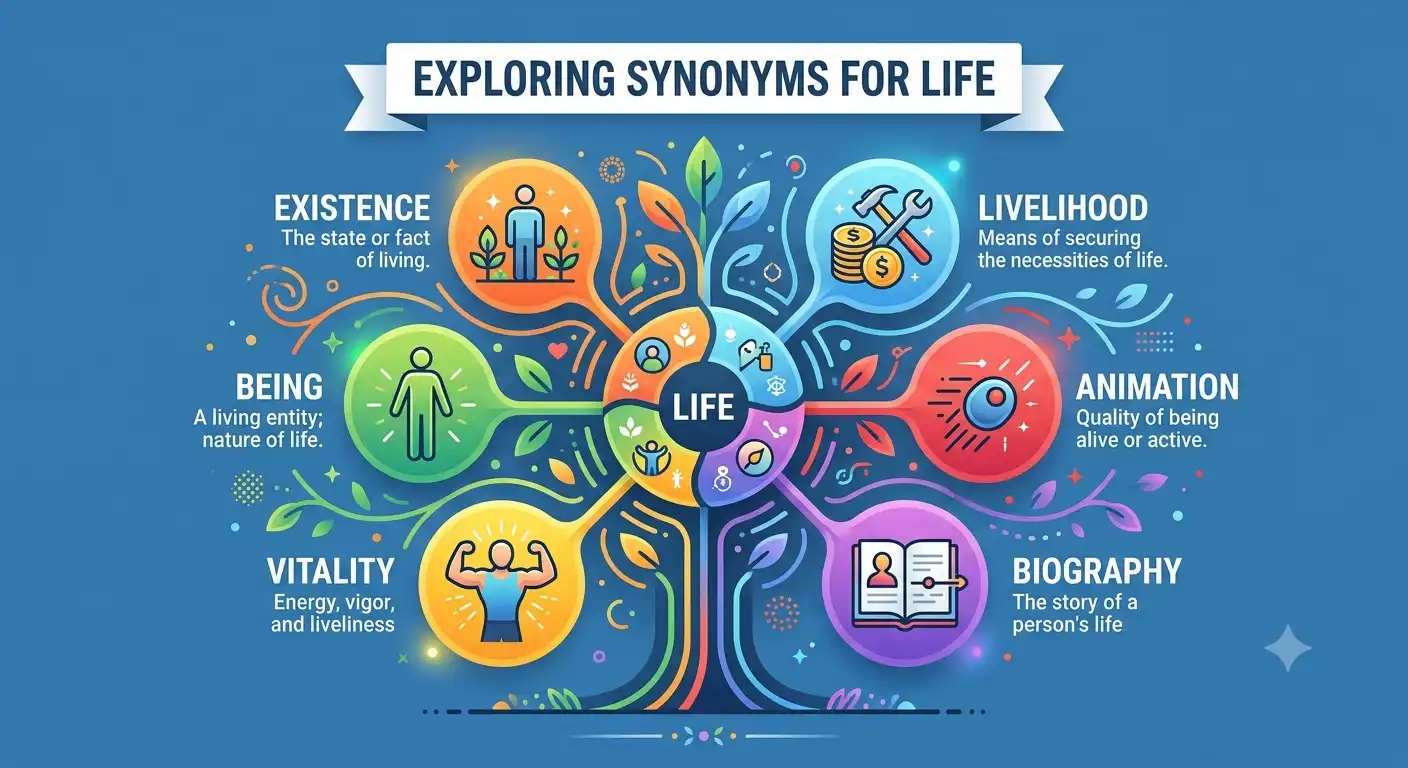
Exploring the top synonyms for life gives you the vocabulary needed to describe human existence, vibrant energy, and daily personal journeys. Utilizing diverse synonyms for life helps you avoid repetitive phrasing whether you are discussing biological growth, personal experience, or energetic spirit. Mastering these synonyms for life adds richness, depth, and precision to your essays, stories, and conversations.
Imagine walking through a bustling weekend farmers’ market on a bright morning. You see blooming flowers, hear children laughing, and feel the warm sunshine on your skin. That feeling of warmth, movement, and ongoing breath represents the word “life.” The word “life” refers to the state of being alive, the period between birth and death, or the energy that makes a person active and dynamic. For example, a gardener watches a tiny seed grow into a healthy green plant full of life.
“Words give shape to our experiences and help us share the wonder of being alive.” — Practical Linguistics Review
Understanding a wide range of synonyms for life benefits many different communicators:
- Students can write deeper essays, creative stories, and literature analysis papers without repeating basic words.
- Bloggers can create engaging, heart-warming stories that capture reader attention from start to finish.
- Content writers can craft compelling health, lifestyle, and inspirational copy that connects with target audiences.
- Daily English users can express emotions, share personal stories, and describe feelings with confidence and flair.
“Choosing dynamic vocabulary brings clarity to our thoughts and vitality to our speech.” — The Modern Wordsmith Journal
Linguistic Breakdown of “Life”
Connotative Meaning
The word life carries overwhelmingly positive and warm connotations. It evokes ideas of vitality, growth, hope, warmth, consciousness, and continuous activity. In literary contexts, it can also reflect vulnerability or the temporary nature of earthly existence.
Etymology
- Root Compound: Derived from Old English līf (meaning “life, body, period of existence”).
- Historical Origin: Traces back to Proto-Germanic *lībam (“life, body”), originating from the root *lib-, which means “to remain, endure, or continue.”
- Modern Usage: Functions as a noun in modern English to describe biological existence, physical vitality, lifetime, or animated energy.
Pronunciation
- US IPA: /laɪf/
- UK IPA: /laɪf/
Syllables & Affixation Pattern
- Syllables: 1 (life)
- Root Word: Life
- Affixation: Base unsegmented monosyllabic noun; accepts suffixes such as -less (lifeless) or -like (lifelike).
Comparison Table of Key Synonyms
| Keyword | Meaning | Usage Type | Context |
|---|---|---|---|
| Existence | The state of living or being real | Formal / Academic | Philosophy, science, essays |
| Vitality | High energy and physical strength | Emotional / Expressive | Health, fitness, personal traits |
| Lifetime | The period during which a person lives | Practical / Descriptive | Biographies, stories, personal milestones |
| Being | The nature or state of an individual entity | Formal / Philosophical | Literature, spiritual discussions |
| Spirit | Inner energy, mood, or animating force | Emotional / Casual | Team motivation, personal character |
| Journey | Life viewed as an ongoing process | Creative / Expressive | Inspirational blogs, personal reflection |
| Duration | The total length of time something lasts | Technical / Formal | Science, timelines, official records |
| Living | The condition of maintaining physical life | Everyday / Functional | Biology, daily conversations, careers |
Main Content – 50 Synonyms for Life
1. Existence
- Pronunciation: US: /ɪɡˈzɪs.təns/ | UK: /ɪɡˈzɪs.təns/
- Meaning: The state of living or being present in the world.
- Examples:
- Plants need sunlight to support their existence.
- The scientist studied the existence of tiny water bugs.
2. Being
- Pronunciation: US: /ˈbiː.ɪŋ/ | UK: /ˈbiː.ɪŋ/
- Meaning: The state of existing as a living person or creature.
- Examples:
- Every living being needs fresh water to stay healthy.
- She felt peaceful in her whole being after a good rest.
3. Living
- Pronunciation: US: /ˈlɪv.ɪŋ/ | UK: /ˈlɪv.ɪŋ/
- Meaning: The condition of being alive and active.
- Examples:
- The ocean is full of beautiful living creatures.
- He earns an honest living by repairing old bicycles.
4. Lifetime
- Pronunciation: US: /ˈlaɪf.taɪm/ | UK: /ˈlaɪf.taɪm/
- Meaning: The whole time that a person stays alive.
- Examples:
- She traveled across three continents in her lifetime.
- Learning new things is a lifetime goal for him.
5. Soul
- Pronunciation: US: /soʊl/ | UK: /səʊl/
- Meaning: The deep inner spirit or life within a human.
- Examples:
- Music brings happiness deep inside her soul.
- He put his whole soul into painting the quiet lake.
6. Energy
- Pronunciation: US: /ˈen.ɚ.dʒi/ | UK: /ˈen.ə.dʒi/
- Meaning: Active power and physical force to do work or move.
- Examples:
- Children have so much energy when playing outdoors.
- A morning walk gives me energy for the entire day.
7. Vitality
- Pronunciation: US: /vaɪˈtæl.ə.t̬i/ | UK: /vaɪˈtæl.ə.ti/
- Meaning: Strong physical energy and healthy lively spirit.
- Examples:
- Good food and daily sleep give her bright vitality.
- The young puppy showed great vitality in the park.
8. Spirit
- Pronunciation: US: /ˈspɪr.ət/ | UK: /ˈspɪr.ɪt/
- Meaning: The lively mood or active energy inside a person.
- Examples:
- The team played with strong spirit during the game.
- Her cheerful spirit brightened the entire room.
9. Experience
- Pronunciation: US: /ɪkˈspɪr.i.əns/ | UK: /ɪkˈspɪə.ri.əns/
- Meaning: Knowledge gained by living through real events.
- Examples:
- Travel gives people rich experience and new friends.
- Working outdoors was a memorable experience for him.
10. Reality
- Pronunciation: US: /riˈæl.ə.t̬i/ | UK: /riˈæl.ə.ti/
- Meaning: The real state of things as they actually exist.
- Examples:
- She faced the reality of moving to a new city.
- The painter showed the beauty of rural reality.
“Language comes alive when we choose words that capture the true heartbeat of human experience.” — Global Expression Review
11. Duration
- Pronunciation: US: /dʊˈreɪ.ʃən/ | UK: /djʊəˈreɪ.ʃən/
- Meaning: The total period of time during which something continues.
- Examples:
- He stayed calm for the duration of the long flight.
- The contract covers the duration of the school year.
12. Presence
- Pronunciation: US: /ˈprez.əns/ | UK: /ˈprez.əns/
- Meaning: The state of being present in a place.
- Examples:
- Her warm presence made everyone feel comfortable.
- We felt the quiet presence of nature in the forest.
13. Animation
- Pronunciation: US: /ˌæn.əˈmeɪ.ʃən/ | UK: /ˌæn.ɪˈmeɪ.ʃən/
- Meaning: Liveliness and energetic movement in a living thing.
- Examples:
- He spoke with great animation about his new book.
- The puppet show filled the room with bright animation.
14. Liveliness
- Pronunciation: US: /ˈlaɪv.li.nəs/ | UK: /ˈlaɪv.li.nəs/
- Meaning: The state of being full of active energy and fun.
- Examples:
- The children brought endless liveliness to the yard.
- The market was famous for its color and liveliness.
15. Journey
- Pronunciation: US: /ˈdʒɝː.ni/ | UK: /ˈdʒɜː.ni/
- Meaning: The continuous process of growing and moving through time.
- Examples:
- Learning a second language is a long personal journey.
- They shared stories about their life journey over tea.
16. Creation
- Pronunciation: US: /kriˈeɪ.ʃən/ | UK: /kriˈeɪ.ʃən/
- Meaning: All living things and the natural world together.
- Examples:
- The mountain valley is a beautiful part of creation.
- Respecting all creation makes the world a better place.
17. Entity
- Pronunciation: US: /ˈen.t̬ə.t̬i/ | UK: /ˈen.tɪ.ti/
- Meaning: Something that exists as a single separate living thing.
- Examples:
- Every small insect is an independent living entity.
- The new business operates as an independent entity.
18. World
- Pronunciation: US: /wɝːld/ | UK: /wɜːld/
- Meaning: The entire sphere of living activity and human society.
- Examples:
- She wants to travel and see the whole wide world.
- He created a cheerful world inside his storybook.
19. Vigor
- Pronunciation: US: /ˈvɪɡ.ɚ/ | UK: /ˈvɪɡ.ər/
- Meaning: High health, physical energy, and strong enthusiasm.
- Examples:
- The runner finished the race with remarkable vigor.
- Fresh air and good sleep filled him with new vigor.
20. Days
- Pronunciation: US: /deɪz/ | UK: /deɪz/
- Meaning: The period of time that someone lives or stays active.
- Examples:
- He spent his early days growing up near the ocean.
- She remembers those happy summer days with her family.
21. Humanity
- Pronunciation: US: /hjuːˈmæn.ə.t̬i/ | UK: /hjuːˈmæn.ə.ti/
- Meaning: All human beings living together on the earth.
- Examples:
- Kindness brings peace and comfort to all humanity.
- The invention helped humanity communicate much faster.
22. Worldliness
- Pronunciation: US: /ˈwɝːld.li.nəs/ | UK: /ˈwɜːld.li.nəs/
- Meaning: Practical knowledge and experience of practical human affairs.
- Examples:
- Her quiet worldliness helped her solve complex problems.
- He gained broad worldliness through years of travel.
23. Survival
- Pronunciation: US: /sɚˈvaɪ.vəl/ | UK: /səˈvaɪ.vəl/
- Meaning: The state of continuing to stay alive through difficulty.
- Examples:
- Basic shelter is essential for human survival in winter.
- The small plant fought for survival in the dry soil.
24. Biota
- Pronunciation: US: /baɪˈoʊ.t̬ə/ | UK: /baɪˈəʊ.tə/
- Meaning: The plant and animal life living in a specific area.
- Examples:
- The forest biota includes deer, birds, and tall pines.
- Scientists studied the marine biota near the coast.
25. Essence
- Pronunciation: US: /ˈes.əns/ | UK: /ˈes.əns/
- Meaning: The most important inner quality of a living thing.
- Examples:
- Love and kindness are the core essence of family.
- The artist captured the quiet essence of the woods.
26. Lifeblood
- Pronunciation: US: /ˈlaɪf.blʌd/ | UK: /ˈlaɪf.blʌd/
- Meaning: The indispensable thing that keeps something active and alive.
- Examples:
- Clean water is the essential lifeblood of any village.
- Creative ideas are the lifeblood of successful art.
27. Spark
- Pronunciation: US: /spɑːrk/ | UK: /spɑːk/
- Meaning: A small glowing force that starts energy or feeling.
- Examples:
- A bright spark of hope remained in her heart.
- His funny joke ignited a spark of joy in the room.
28. Breath
- Pronunciation: US: /breθ/ | UK: /breθ/
- Meaning: Air taken into the lungs that maintains physical living.
- Examples:
- Take a slow breath of fresh mountain air today.
- Every breath of clean air keeps our bodies strong.
29. Continuance
- Pronunciation: US: /kənˈtɪn.ju.əns/ | UK: /kənˈtɪn.ju.əns/
- Meaning: The act of keeping something going without stopping.
- Examples:
- Daily exercise supports the continuance of good health.
- We pray for the peaceful continuance of our community.
30. Generation
- Pronunciation: US: /ˌdʒen.əˈreɪ.ʃən/ | UK: /ˌdʒen.əˈreɪ.ʃən/
- Meaning: All the people born and living at about the same time.
- Examples:
- The younger generation cares deeply about nature conservation.
- My grandmother shares wisdom with our entire generation.
31. Career
- Pronunciation: US: /kəˈrɪr/ | UK: /kəˈrɪər/
- Meaning: The ongoing progress of a person’s working time.
- Examples:
- She built a successful career in teaching science.
- He enjoyed a long career as an artist and sculptor.
32. Age
- Pronunciation: US: /eɪdʒ/ | UK: /eɪdʒ/
- Meaning: The length of time that a person has lived.
- Examples:
- She learned to play the violin at a young age.
- Wisdom often grows greater as we advance in age.
33. Sprightliness
- Pronunciation: US: /ˈspraɪt.li.nəs/ | UK: /ˈspraɪt.li.nəs/
- Meaning: Being active, lively, and light in movement.
- Examples:
- The old grandfather walked with surprising sprightliness today.
- Her sprightliness brought cheerful laughter to the group.
34. Vivacity
- Pronunciation: US: /vɪˈvæs.ə.t̬i/ | UK: /vɪˈvæs.ə.ti/
- Meaning: High energy, attractive charm, and lively spirit.
- Examples:
- Her natural vivacity made her a delightful dinner guest.
- The dancer moved across the stage with great vivacity.
35. Zest
- Pronunciation: US: /zest/ | UK: /zest/
- Meaning: Great enthusiasm, joy, and eagerness for living.
- Examples:
- He approaches every morning with a healthy zest for learning.
- Her zest for outdoor adventure inspired all her friends.
36. Active State
- Pronunciation: US: /ˈæk.tɪv steɪt/ | UK: /ˈæk.tɪv steɪt/
- Meaning: A condition of being moving, functional, and operating.
- Examples:
- The plant remains in an active state during warm spring.
- Healthy exercise keeps your heart in an active state.
37. Heartbeat
- Pronunciation: US: /ˈhɑːrt.biːt/ | UK: /ˈhɑːt.biːt/
- Meaning: The regular pulsing motion that signals physical existence.
- Examples:
- The nurse checked the steady heartbeat of the baby.
- Kindness is the quiet heartbeat of a loving home.
38. Consciousness
- Pronunciation: US: /ˈkɑːn.ʃəs.nəs/ | UK: /ˈkɒn.ʃəs.nəs/
- Meaning: The state of being awake and aware of surroundings.
- Examples:
- The patient regained full consciousness after resting quietly.
- Human consciousness allows us to think and create.
39. Way of Living
- Pronunciation: US: /weɪ ɑːv ˈlɪv.ɪŋ/ | UK: /weɪ ɒv ˈlɪv.ɪŋ/
- Meaning: The manner and habits in which a person lives.
- Examples:
- Farming is a peaceful way of living for rural families.
- Eating healthy food supports a long, happy way of living.
40. Way of Life
- Pronunciation: US: /weɪ ɑːv laɪf/ | UK: /weɪ ɒv laɪf/
- Meaning: The behavior, customs, and daily style of a group.
- Examples:
- Fishing has been their traditional way of life for centuries.
- Respecting nature is an important way of life here.
41. Time on Earth
- Pronunciation: US: /taɪm ɑːn ɝːθ/ | UK: /taɪm ɒn ɜːθ/
- Meaning: The total duration a person spends alive in this world.
- Examples:
- He wanted to make his time on earth meaningful and kind.
- Spend your time on earth doing things you truly love.
42. Mortals
- Pronunciation: US: /ˈmɔːr.t̬əlz/ | UK: /ˈmɔː.təlz/
- Meaning: Human beings who live and eventually die.
- Examples:
- All mortals need food, rest, and love to thrive.
- The old story told tales of brave mortals and kings.
43. Organism
- Pronunciation: US: /ˈɔːr.ɡən.ɪ.zəm/ | UK: /ˈɔː.ɡən.ɪ.zəm/
- Meaning: An individual living animal, plant, or single-celled life form.
- Examples:
- A tiny tree seedling is a growing plant organism.
- Every organism plays a key role in the forest.
44. Living Things
- Pronunciation: US: /ˈlɪv.ɪŋ θɪŋz/ | UK: /ˈlɪv.ɪŋ θɪŋz/
- Meaning: Biological entities that grow, breathe, and reproduce.
- Examples:
- Sunlight and fresh rain help all living things grow well.
- Children love learning about living things in science class.
45. Sensation
- Pronunciation: US: /senˈseɪ.ʃən/ | UK: /senˈseɪ.ʃən/
- Meaning: The physical feeling resulting from living awareness.
- Examples:
- Walking barefoot on soft grass gives a pleasant sensation.
- The warm sun brought a peaceful sensation to her skin.
46. Sentience
- Pronunciation: US: /ˈsen.ʃəns/ | UK: /ˈsen.ti.əns/
- Meaning: The ability to feel, perceive, and experience physical sensations.
- Examples:
- Animal sentience means creatures experience feelings and pain.
- Scientists study the sentience of ocean mammals like dolphins.
47. Growth
- Pronunciation: US: /ɡroʊθ/ | UK: /ɡrəʊθ/
- Meaning: The natural process of developing and expanding over time.
- Examples:
- Regular watering helps the growth of your garden plants.
- Personal reading encourages continuous mental growth in adults.
48. Dynamism
- Pronunciation: US: /ˈdaɪ.nə.mɪ.zəm/ | UK: /ˈdaɪ.nə.mɪ.zəm/
- Meaning: Great energy, force, and active progress in a person.
- Examples:
- Her dynamism transformed the quiet office into an active workspace.
- The city is famous for its cultural growth and dynamism.
49. Verve
- Pronunciation: US: /vɝːv/ | UK: /vɜːv/
- Meaning: Great vigor, spirit, and enthusiasm in action or art.
- Examples:
- The musician played the fast melody with impressive verve.
- She plans every school event with joyful creative verve.
50. Life Force
- Pronunciation: US: /laɪf fɔːrs/ | UK: /laɪf fɔːs/
- Meaning: The natural energy or power that gives life to things.
- Examples:
- Spring rain activates the inner life force of dormant trees.
- Love and hope are the true life force of human spirit.
Antonyms of “Life”
While life focuses on existence, energy, growth, and continuous breath, its direct antonyms describe the absence, cessation, or lack of vitality:
- Death: US: /deθ/ | UK: /deθ/ – The permanent end of all biological functions in a living entity.
- Inanimateness: US: /ɪnˈæn.ə.mət.nəs/ | UK: /ɪnˈæn.ɪ.mət.nəs/ – The quality of lacking life or physical movement.
- Extinction: US: /ɪkˈstɪŋk.ʃən/ | UK: /ɪkˈstɪŋk.ʃən/ – The state or situation of a species ceasing to exist.
- Nonexistence: US: /ˌnɑːn.ɪɡˈzɪs.təns/ | UK: /ˌnɒn.ɪɡˈzɪs.təns/ – The state of not existing or being real.
Prototype Meaning and Categorization of “Life”
- Grammatical Category: Noun (countable and uncountable).
- Prototype Meaning: The state or condition that distinguishes active, growing organisms from inorganic matter or dead organisms.
- Semantic Field: Biology, philosophy, existence, human experience, vitality, and time sequence.
Frequently Asked Questions (FAQ)
1. What is the most common synonym for “life” in daily speech?
The most common synonyms for life in casual daily speech are existence, living, being, and spirit. These simple terms fit naturally into everyday conversations, personal emails, and beginner writing.
2. How do “life” and “existence” differ in context?
Life usually implies organic growth, feelings, personal experience, and energy. Existence is a broader, more formal term that simply means being real or present, which can apply to non-living objects or ideas as well.
3. Which synonym for “life” works best when describing energy?
When you want to describe a person’s active energy or enthusiasm, terms like vitality, vigor, verve, zest, and spirit work best.
4. Is “lifetime” interchangeable with “life”?
Not always. Lifetime specifically refers to the entire duration of time that a person is alive (e.g., a lifetime of hard work), whereas life can mean physical vitality, daily experiences, or biological existence itself.
5. Why should writers use varied synonyms for “life”?
Using diverse synonyms for life helps writers avoid dull repetition, express subtle shades of emotion, and match the exact tone needed for essays, blog posts, and inspirational copy.
6. Can “life” be used as an adjective?
Yes. In modern English, “life” often acts as a noun adjunct in terms like life cycle, life story, life support, or life span.
Conclusion
Building a broad vocabulary of precise synonyms for life brings remarkable clarity, emotional resonance, and variety to your writing and daily speech. Swapping generic phrases for vibrant choices like vitality, existence, journey, verve, or essence ensures that your ideas connect deeply with readers and listeners alike.
“Enriching your vocabulary is the key to expressing the full depth and beauty of your human experience.” — Educational Language Digest
We encourage you to put these 50 synonyms into active practice starting today. Try incorporating them into your daily emails, academic essays, personal journal entries, and casual conversations. Expanding your lexicon unlocks new confidence, helping you share your stories clearly and shine as an articulate communicator.
“Every new word you master opens another doorway to meaningful connection and clear thinking.” — Creative Writing Quarterly

Andrew Collins is an academic English educator with over 12 years of experience helping university students, IELTS candidates, and ESL learners improve their writing vocabulary.