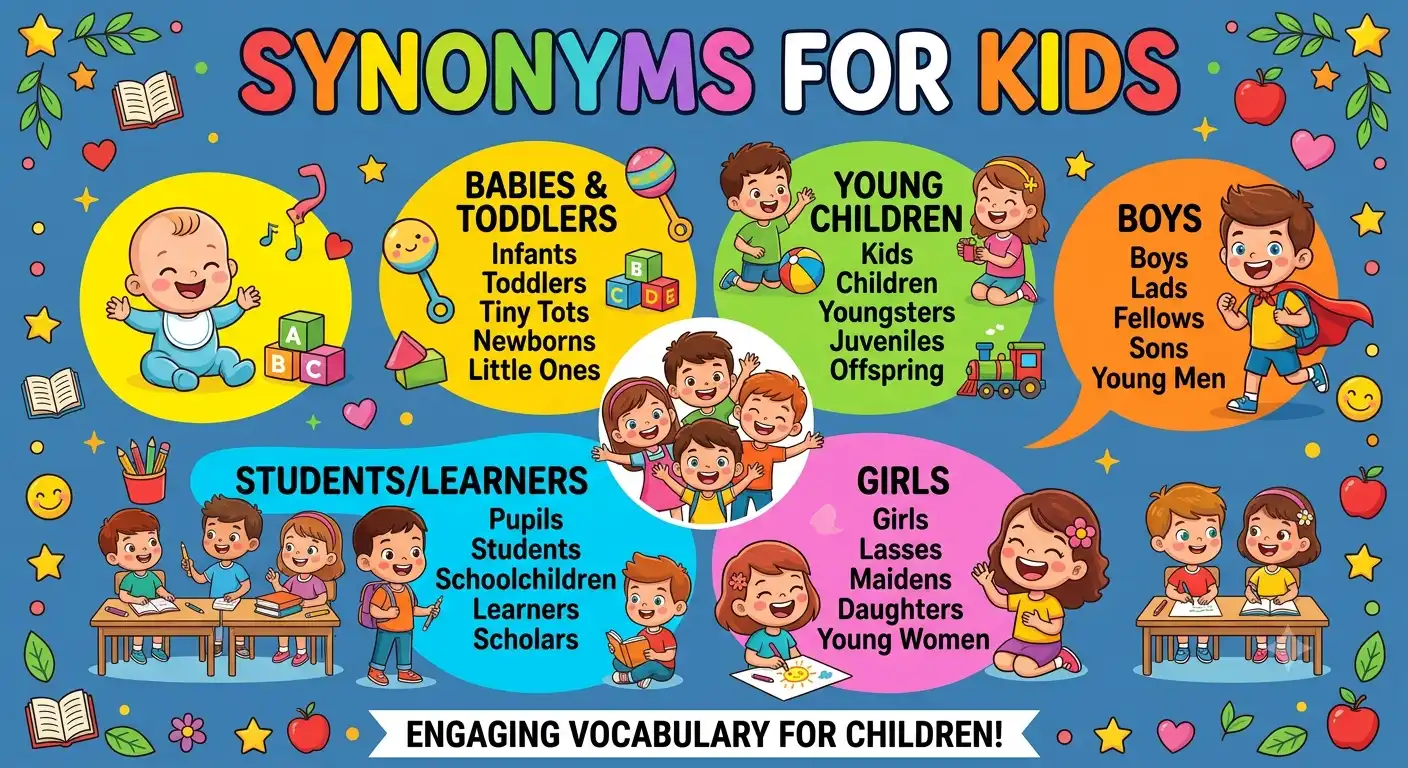
Searching for synonyms for kids helps you find clear words to talk about children, youths, and young family members. When you use different synonyms for kids, your sentences sound natural, lively, and interesting. Learning fresh synonyms for kids helps you describe young people at home, school, and work.
Imagine walking past a neighborhood park on a bright afternoon. You see group of young children playing on the swings, running after soccer balls, and laughing together. That cheerful energy of young people is what we mean when we talk about kids. You can express this idea using words like children, youngsters, tots, or offspring.
Using varied words for kids is very helpful for:
- Students: Write engaging essays and describe family life easily.
- Bloggers: Keep your readers active and interested with clear words.
- Content Writers: Craft parenting articles, school guides, and storybooks accurately.
- Daily English Users: Speak with confidence and talk about your family smoothly.
“Children are the living messages we send to a time we will not see.” — Neil Postman
“While we try to teach our children all about life, our children teach us what life is all about.” — Angela Schwindt
Word Profile: Kids
Connotative Meaning
The word kids carries a warm, casual, and playful feeling. It refers to young humans from babyhood through early teenage years, highlighting innocence, energy, and learning.
Etymology (Origin)
- Old Norse: Kið (meaning “young goat”)
- Middle English: Adopted into English as kide in the 1200s.
- Informal Shift: Used informally for human children starting in the late 1500s.
- Modern Use: Standard casual term for young people since the 19th century.
Pronunciation
- US IPA: /kɪdz/
- UK IPA: /kɪdz/
Syllables & Affixation
- Syllables: kids (1 syllable)
- Root: Kid (young person / goat)
- Suffix: -s (plural marker)
Comparison Table: Popular Synonyms for Kids
| Keyword | Meaning | Usage Type | Context |
| Kids | Young human beings or children. | Casual / Daily | Home, family talks, parks, general life |
| Children | Plural of child; young humans before adulthood. | Neutral / Standard | School, books, health forms, news |
| Youngsters | Young people, especially older children. | Friendly / Warm | Sports teams, neighborhood, events |
| Youths | Young people in their teenage or early adult years. | Formal / Social | News reports, sports, community work |
| Minors | Persons under the legal age of full responsibility. | Legal / Formal | Law courts, official forms, rules |
| Toddlers | Very young children who are learning to walk. | Specific / Care | Daycare, home, playgrounds |
| Offspring | The biological children or young of a parent. | Formal / Scientific | Science articles, family trees, biology |
50 Best Synonyms for Kids
1. Children
- Pronunciation: US: /ˈtʃɪl.drən/ | UK: /ˈtʃɪl.drən/
- Meaning: Young human beings who have not reached adult age.
- Examples:
- The children played tag in the grassy park.
- Parents love reading stories to their young children.
2. Youngsters
- Pronunciation: US: /ˈjʌŋ.stɚz/ | UK: /ˈjʌŋ.stəz/
- Meaning: Lively young people or older children.
- Examples:
- The coach praised the youngsters for winning the game.
- Many youngsters enjoy playing video games on weekends.
3. Toddlers
- Pronunciation: US: /ˈtɑːd.lɚz/ | UK: /ˈtɒd.ləz/
- Meaning: Very young children who walk with short, unsteady steps.
- Examples:
- The toddlers played safely with colorful plastic blocks.
- She works at a daycare for happy toddlers.
4. Tots
- Pronunciation: US: /tɑːts/ | UK: /tɒts/
- Meaning: Small, tiny children in early childhood.
- Examples:
- The teacher handed out sweet apples to the tiny tots.
- Two little tots ran across the soft sandbox.
5. Tykes
- Pronunciation: US: /taɪks/ | UK: /taɪks/
- Meaning: Small, playful children who love to explore.
- Examples:
- The little tykes built a tall sandcastle at the beach.
- He gave juice boxes to the hungry tykes.
6. Youths
- Pronunciation: US: /juːðz/ | UK: /juːθs/
- Meaning: Young people between childhood and adult age.
- Examples:
- Local youths volunteered to help clean the town park.
- The center offers fun sports for neighborhood youths.
7. Juveniles
- Pronunciation: US: /ˈdʒuː.və.nəlza/ | UK: /ˈdʒuː.vən.aɪlz/
- Meaning: Young people who are not yet legal adults.
- Examples:
- The community center runs sports programs for juveniles.
- Special safety rules protect all juveniles at work.
8. Minors
- Pronunciation: US: /ˈmaɪ.nɚz/ | UK: /ˈmaɪ.nəz/
- Meaning: Persons who are below the legal age of adulthood.
- Examples:
- Minors must have a parent sign the permission form.
- The movie theater has clear rules for unaccompanied minors.
9. Offspring
- Pronunciation: US: /ˈɑːf.sprɪŋ/ | UK: /ˈɒf.sprɪŋ/
- Meaning: A person’s or animal’s young children or babies.
- Examples:
- She proudly introduced her offspring to her old friends.
- The mother bird fed seeds to her hungry offspring.
10. Little Ones
- Pronunciation: US: /ˈlɪt.əl wʌnz/ | UK: /ˈlɪt.əl wʌnz/
- Meaning: Gentle term for small, sweet children.
- Examples:
- Put the little ones to bed before starting the movie.
- The store sells warm shoes for your little ones.
11. Infants
- Pronunciation: US: /ˈɪn.fənts/ | UK: /ˈɪn.fənts/
- Meaning: Very young babies during their first year of life.
- Examples:
- Nurses take gentle care of newborn infants at the clinic.
- The nursery provides soft blankets for tiny infants.
12. Babies
- Pronunciation: US: /ˈbeɪ.biːz/ | UK: /ˈbeɪ.biːz/
- Meaning: Extremely young children who cannot speak or walk yet.
- Examples:
- The twin babies slept peacefully in their cribs.
- She bought small cotton socks for the newborn babies.
13. Newborns
- Pronunciation: US: /ˈnuː.bɔːrnz/ | UK: /ˈnjuː.bɔːnz/
- Meaning: Babies that were born very recently.
- Examples:
- Doctors inspect newborns carefully right after birth.
- The family welcomed twin newborns into their home.
14. Kiddies
- Pronunciation: US: /ˈkɪd.iːz/ | UK: /ˈkɪd.iːz/
- Meaning: Casual and friendly term for young children.
- Examples:
- The kiddies rode the merry-go-round at the fair.
- We packed tasty snacks for all the kiddies.
15. Rugrats
- Pronunciation: US: /ˈrʌɡ.ræts/ | UK: /ˈrʌɡ.ræts/
- Meaning: Informal name for crawl-stage or active young children.
- Examples:
- The rugrats chased the big red ball around the room.
- Uncle Jim watched the playful rugrats in the yard.
16. Whippersnappers
- Pronunciation: US: /ˈwɪp.ɚ.snæp.ɚz/ | UK: /ˈwɪp.ə.snæp.əz/
- Meaning: Playful term for young, confident, or lively kids.
- Examples:
- Grandpa smiled at the energetic whippersnappers in the garden.
- Those young whippersnappers learned the game very quickly.
17. Mites
- Pronunciation: US: /maɪts/ | UK: /maɪts/
- Meaning: Small, tiny children deserving love or care.
- Examples:
- The poor little mites needed warm coats in winter.
- She baked sweet cookies for the hungry mites.
18. Pups
- Pronunciation: US: /pʌps/ | UK: /pʌps/
- Meaning: Playful slang for young or inexperienced kids.
- Examples:
- The older players helped the young pups on the team.
- Those eager pups are ready to learn swimming today.
19. Adolescents
- Pronunciation: US: /ˌæd.əˈlɛs.ənts/ | UK: /ˌæd.əˈles.ənts/
- Meaning: Young people growing from children into adults.
- Examples:
- Adolescents undergo many physical and emotional changes.
- The library holds summer book clubs for adolescents.
20. Teenagers
- Pronunciation: US: /ˈtiːn.eɪ.dʒɚz/ | UK: /ˈtiːn.eɪ.dʒəz/
- Meaning: Young people between thirteen and nineteen years old.
- Examples:
- The teenagers worked together to paint the community wall.
- Many teenagers enjoy listening to popular music daily.
21. Preteens
- Pronunciation: US: /ˌpriːˈtiːnz/ | UK: /ˌpriːˈtiːnz/
- Meaning: Children just before their teenage years, usually aged 9 to 12.
- Examples:
- The preteens prepared for their first middle school dance.
- This fun adventure book is written for active preteens.
22. Tweens
- Pronunciation: US: /twiːnz/ | UK: /twiːnz/
- Meaning: Children aged roughly ten to twelve years old.
- Examples:
- The shop sells stylish clothes designed specifically for tweens.
- Tweens love spending time playing outdoor group games.
23. Schoolchildren
- Pronunciation: US: /ˈskuːl.tʃɪl.drən/ | UK: /ˈskuːl.tʃɪl.drən/
- Meaning: Children who attend primary or secondary school.
- Examples:
- Schoolchildren lined up quietly to board the yellow bus.
- The museum offered free admission to all local schoolchildren.
24. Students
- Pronunciation: US: /ˈstuː.dənts/ | UK: /ˈstjuː.dənts/
- Meaning: Young people who learn at school, college, or class.
- Examples:
- The students listened closely as the teacher explained math.
- Every student completed their art project on time.
25. Cubs
- Pronunciation: US: /kʌbz/ | UK: /kʌbz/
- Meaning: Affectionate term for young members of a group or team.
- Examples:
- The coach gathered the young cubs around the bench.
- Our local cubs learn helpful camping skills each summer.
“It is easier to build strong children than to repair broken men.” — Frederick Douglass
26. Cherubs
- Pronunciation: US: /ˈtʃɛr.əbz/ | UK: /ˈtʃer.əbz/
- Meaning: Sweet, beautiful, or innocent young children.
- Examples:
- The choir of little cherubs sang sweet songs.
- Her twin daughters look like two angelic cherubs.
27. Angels
- Pronunciation: US: /ˈeɪn.dʒəlz/ | UK: /ˈeɪn.dʒəlz/
- Meaning: Very well-behaved, sweet, and kind children.
- Examples:
- The children were total angels during the long flight.
- Thank you for being such helpful little angels today.
28. Rascals
- Pronunciation: US: /ˈræs.kəlz/ | UK: /ˈrɑː.skəlz/
- Meaning: Playful or mischievous children who cause gentle trouble.
- Examples:
- Those little rascals hid behind the big sofa.
- He laughed as the rascals ran across the grass.
29. Imps
- Pronunciation: US: /ɪmps/ | UK: /ɪmps/
- Meaning: Mischievous, energetic, and trick-playing small kids.
- Examples:
- The small imps giggled after hiding their sister’s shoes.
- She watched the lively imps splash in the puddle.
30. Scamps
- Pronunciation: US: /skæmps/ | UK: /skæmps/
- Meaning: Playful, mischievous young children who mean no harm.
- Examples:
- The young scamps climbed up the old oak tree.
- Those little scamps ate all the fruit cookies.
31. Urchins
- Pronunciation: US: /ˈɝː.tʃɪnz/ | UK: /ˈɜː.tʃɪnz/
- Meaning: Poorly dressed or mischievous street-playing children.
- Examples:
- Historical novels describe street urchins playing games outdoors.
- The story tells of brave urchins living in old cities.
32. Younglings
- Pronunciation: US: /ˈjʌŋ.lɪŋz/ | UK: /ˈjʌŋ.lɪŋz/
- Meaning: Young human beings, animals, or inexperienced kids.
- Examples:
- The elder storytellers gathered the younglings around the fire.
- The teacher guided the younglings through the farm.
33. Progeny
- Pronunciation: US: /ˈprɑː.dʒə.ni/ | UK: /ˈprɒdʒ.ə.ni/
- Meaning: Formal or biological term for someone’s children.
- Examples:
- The family photo shows three generations of progeny.
- He passed his farm down to his eldest progeny.
34. Dependents
- Pronunciation: US: /dɪˈpɛn.dənts/ | UK: /dɪˈpen.dənts/
- Meaning: Children who rely on parents for financial support.
- Examples:
- You must list all young dependents on insurance forms.
- Parents receive tax relief for their minor dependents.
35. Littles
- Pronunciation: US: /ˈlɪt.əlz/ | UK: /ˈlɪt.əlz/
- Meaning: Casual term for the youngest children in a family.
- Examples:
- The older siblings took care of the littles.
- We packed small juice pouches for the littles.
36. Toddlerhood
- Pronunciation: US: /ˈtɑːd.lɚ.hʊd/ | UK: /ˈtɒd.lə.hʊd/
- Meaning: Children currently in the age phase of learning to walk.
- Examples:
- Toddlerhood brings active exploration and new spoken words.
- Toys in this room match the needs of toddlerhood.
37. Nursery Children
- Pronunciation: US: /ˈnɝː.sɚ.i ˈtʃɪl.drən/ | UK: /ˈnɜː.sər.i ˈtʃɪl.drən/
- Meaning: Young children who attend preschool or daycare classes.
- Examples:
- The nursery children drew pictures using bright crayons.
- Teachers taught nursery children how to share toys.
38. Kindergarteners
- Pronunciation: US: /ˈkɪn.dɚˌɡɑːr.tən.ɚz/ | UK: /ˈkɪn.dəˌɡɑː.tən.əz/
- Meaning: Children attending their first official school grade.
- Examples:
- The kindergarteners practiced singing the alphabet song today.
- Every kindergartener sat on the soft blue rug.
39. Primary Students
- Pronunciation: US: /ˈpraɪ.mɛr.i ˈstuː.dənts/ | UK: /ˈpraɪ.mər.i ˈstjuː.dənts/
- Meaning: Young children enrolled in early elementary school grades.
- Examples:
- Primary students learn reading, writing, and basic math.
- The school organized a field trip for primary students.
40. Firstborns
- Pronunciation: US: /ˈfɝːst.bɔːrnz/ | UK: /ˈfɜːst.bɔːnz/
- Meaning: The eldest children born to a set of parents.
- Examples:
- Firstborns often take on leadership roles among siblings.
- She helped her parents care for her younger brothers as a firstborn.
41. Siblings
- Pronunciation: US: /ˈsɪb.lɪŋz/ | UK: /ˈsɪb.lɪŋz/
- Meaning: Brothers and sisters living in the same family.
- Examples:
- The three young siblings share a bright bedroom.
- Siblings often play board games together on rainy afternoons.
42. Descendants
- Pronunciation: US: /dɪˈsɛn.dənts/ | UK: /dɪˈsen.dənts/
- Meaning: People descended from a particular ancestor or parent.
- Examples:
- Her descendants gathered to celebrate her 90th birthday.
- They preserved the family estate for future descendants.
43. Issue
- Pronunciation: US: /ˈɪʃ.uː/ | UK: /ˈɪs.juː/
- Meaning: Legal or formal word meaning a person’s children.
- Examples:
- The legal document leaves property to his lawful issue.
- He died leaving no surviving direct issue behind.
44. Waifs
- Pronunciation: US: /weɪfs/ | UK: /weɪfs/
- Meaning: Small, thin, or homeless young children in need of care.
- Examples:
- The charity provided warm food to homeless waifs.
- Volunteers looked after the helpless waifs in town.
45. Strays
- Pronunciation: US: /streɪz/ | UK: /streɪz/
- Meaning: Lost or wandering children without fixed home care.
- Examples:
- The local shelter gave beds to lost young strays.
- Officers helped return the wandering strays safely home.
46. Nippers
- Pronunciation: US: /ˈnɪp.ɚz/ | UK: /ˈnɪp.əz/
- Meaning: British casual slang for small young children.
- Examples:
- The little nippers played football in the backyard.
- Mind the nippers as they run near the swimming pool.
47. Sprouts
- Pronunciation: US: /spraʊts/ | UK: /spraʊts/
- Meaning: Playful term comparing growing kids to young green plants.
- Examples:
- Look how much those little sprouts have grown this year!
- She made fresh soup for her growing little sprouts.
48. Bambinos
- Pronunciation: US: /bæmˈbiː.noʊz/ | UK: /bæmˈbiː.nəʊz/
- Meaning: Friendly term borrowed from Italian to mean babies or kids.
- Examples:
- Grandma cooked pasta for all the hungry bambinos.
- The festival had special games for the bambinos.
49. Kinder
- Pronunciation: US: /ˈkɪn.dɚ/ | UK: /ˈkɪn.də/
- Meaning: German-derived word commonly used to mean children.
- Examples:
- The teacher welcomed the kinder into the art room.
- We prepared fun games for the local kinder.
50. Heir
- Pronunciation: US: /ɛr/ | UK: /eə/
- Meaning: A child who will inherit money, title, or property.
- Examples:
- The young heir learned how to manage the family farm.
- Parents work hard to leave a good legacy for their heir.
Antonyms of Kids
To understand the full meaning of kids, it helps to look at its opposite terms:
- Adults: Fully grown human beings with mature legal status.
- Grown-ups: Informal term for adult men and women.
- Elders: Senior people with advanced age and authority.
- Seniors: Older members of society or retired individuals.
- Ancestors: Family members from past generations who lived before.
Prototype Meaning and Categorization of Kids
We can organize these 50 synonyms into clear groups to help you pick the right word:
- Standard & General Terms (Everyday Life):
- Children, Youngsters, Youths, Minors, Little Ones, Schoolchildren, Students, Siblings.
- Infants & Very Young Kids (Early Childhood):
- Toddlers, Tots, Infants, Babies, Newborns, Mites, Toddlerhood, Nursery Children, Kindergarteners.
- Casual & Playful Nicknames (Friendly Usage):
- Kids, Tykes, Kiddies, Rugrats, Whippersnappers, Pups, Littles, Nippers, Sprouts, Bambinos, Kinder.
- Older Kids & Teenagers (Growth Stages):
- Juveniles, Adolescents, Teenagers, Preteens, Tweens, Primary Students.
- Formal, Legal & Family Relationship Terms (Official Use):
- Offspring, Dependents, Progeny, Firstborns, Descendants, Issue, Heir.
- Affectionate & Character-Based Names (Behavior):
- Cubs, Cherubs, Angels, Rascals, Imps, Scamps, Urchins, Younglings, Waifs, Strays.
Frequently Asked Questions (FAQ)
What is the most common formal synonym for kids?
The most common formal synonym for kids is children. Use children in school work, medical forms, news articles, and formal writing.
Is “kids” appropriate to use in formal writing?
No. Kids is a casual word best suited for everyday speech, blogs, and personal emails. In academic or professional essays, use children, youths, or students.
What is the difference between “toddler” and “infant”?
An infant is a baby under one year old who cannot walk or talk yet. A toddler is a child aged one to three years old who is learning to walk and explore.
What are good legal synonyms for kids?
In legal, business, or tax documents, words like minors, dependents, issue, or progeny are used instead of kids.
How do synonyms for kids improve essay writing?
Using varied synonyms stops repetitive phrasing. Instead of using “kids” five times, you can use children for general statements, students for school contexts, and adolescents for older groups.
What is the singular form of kids?
The singular form of kids is kid. For example: “The kid scored a goal in soccer practice.”
Conclusion
Learning fresh synonyms for kids expands your active vocabulary and improves your daily communication skills. When you replace overused terms with precise options like children, youngsters, toddlers, or adolescents, your writing becomes far more interesting and clear to read.
For students, bloggers, and content writers, using a wide range of synonyms for kids keeps readers focused and engaged. Clear expression relies on choosing the best word for every single context. Start using these 50 synonyms for kids in your emails, essays, and everyday conversations today!
“Children are human beings to whom respect is due, superior to us by reason of their innocence and of the greater possibilities of their future.” — Maria Montessori
“There are no seven wonders of the world in the eyes of a child. There are seven million.” — Walt Streightiff

Andrew Collins is an academic English educator with over 12 years of experience helping university students, IELTS candidates, and ESL learners improve their writing vocabulary.