
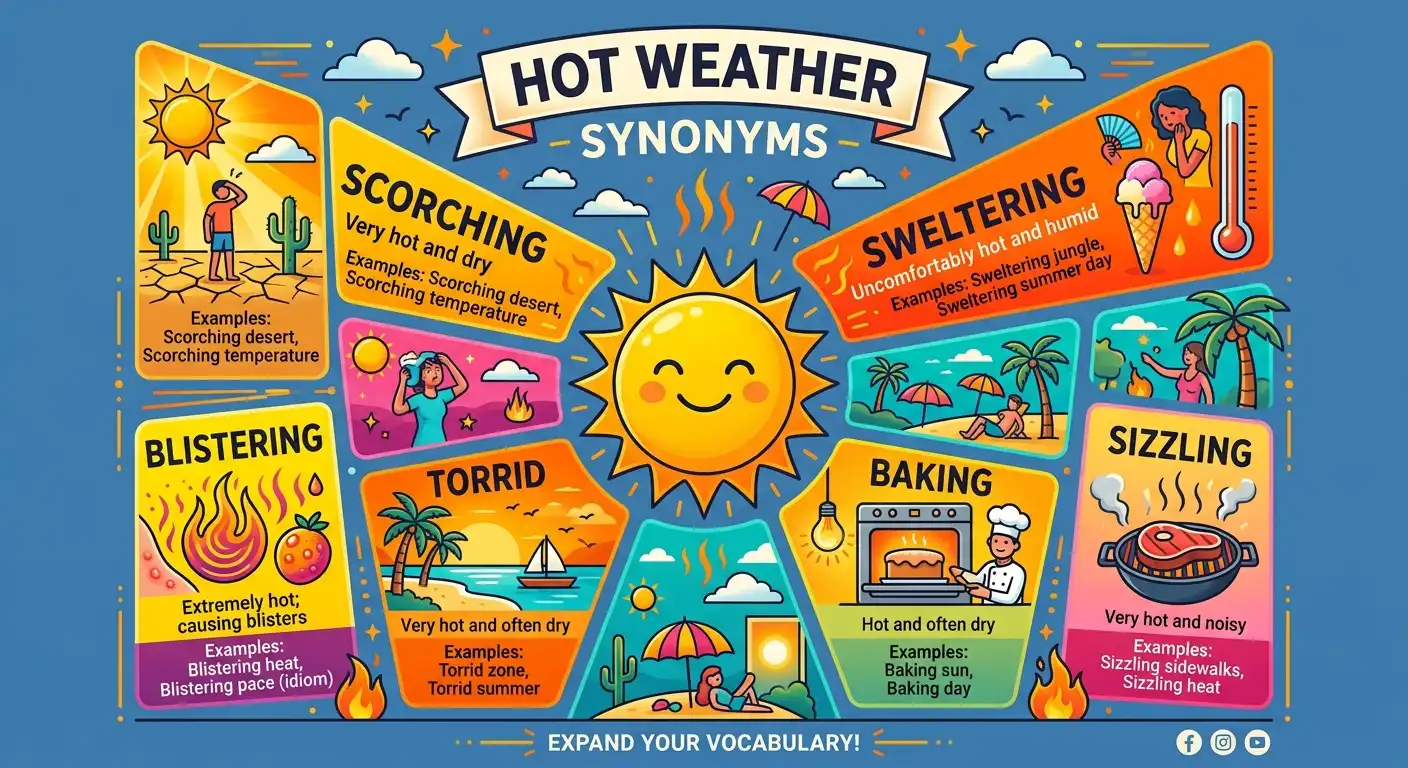
Searching for synonyms for hot weather helps you find descriptive words for warm days and high temperatures. Learning useful synonyms for hot weather allows you to describe summer heat, sunny days, and humid afternoons with exact words. Using clear synonyms for hot weather makes your daily conversations, weather reports, and creative essays far more interesting to read.
Imagine stepping outside on a summer afternoon. The bright sun shines overhead, the sidewalk feels warm under your shoes, and you instantly wish for a cool cold drink. You can describe this exact warm day using words like heatwave, sweltering weather, scorcher, or sultry day.
Using different words for hot weather helps:
- Students: Write vivid descriptive essays and earn higher grades.
- Bloggers: Keep readers engaged with colorful seasonal posts.
- Content Writers: Craft relatable articles about travel, summer, and lifestyle.
- Daily English Users: Talk about daily forecasts smoothly in conversation.
“In the depth of winter, I finally learned that within me there lay an invincible summer.” — Albert Camus
“Summer afternoon—summer afternoon; to me those have always been the two most beautiful words in the English language.” — Henry James
Word Profile: Hot Weather
Connotative Meaning
The phrase hot weather carries feelings of bright sunlight, energy, and outdoor fun, but it can also mean heavy discomfort, sweat, and dryness depending on how hot the temperature gets.
Etymology (Origin)
- Hot (Old English): Derived from hāt, meaning “heated, fierce, or eager.”
- Weather (Old English): Derived from weder, meaning “air, sky, or atmospheric conditions.”
- Combined Meaning: Air and atmospheric conditions that carry high heat.
Pronunciation
- US IPA: /hɑːt ˈwɛð.ɚ/
- UK IPA: /hɒt ˈweð.ər/
Syllables & Affixation
- Syllables: hot (1 syllable) + weath-er (2 syllables) = 3 total syllables
- Root Words: Hot (adjective) + Weather (noun)
- Affixation: Standard compound phrase without prefixes or suffixes.
Comparison Table: Popular Synonyms for Hot Weather
| Keyword | Meaning | Usage Type | Context |
| Hot Weather | High air temperature outdoors. | Neutral / General | Daily news, casual talk, forecasts |
| Heatwave | A long period of unusually high heat. | Professional / News | Climate news, safety warnings, summer |
| Sweltering Weather | Uncomfortably hot and sticky weather. | Emotional / Casual | Summer trips, daily comfort, complaints |
| Scorcher | An extremely hot day. | Informal / Casual | Casual talk, headlines, summer days |
| Sultry Weather | Hot air that feels warm, moist, and heavy. | Literary / Descriptive | Nature writing, evening air, tropics |
| Balmy Weather | Warm and pleasant air with gentle wind. | Positive / Pleasant | Vacation, evening walks, spring-summer |
| Torrid Weather | Extremely hot and dry outdoor weather. | Formal / Geographic | Desert life, geography reports, history |
50 Best Synonyms for Hot Weather
1. Heatwave
- Pronunciation: US: /ˈhiːt.weɪv/ | UK: /ˈhiːt.weɪv/
- Meaning: A long period of unusually hot weather.
- Examples:
- The heatwave kept everyone inside near fans.
- City parks were empty during the summer heatwave.
2. Sweltering weather
- Pronunciation: US: /ˈswɛl.tɚ.ɪŋ ˈwɛð.ɚ/ | UK: /ˈswel.tər.ɪŋ ˈweð.ər/
- Meaning: Very hot air that makes you sweat a lot.
- Examples:
- We ate ice cream to survive the sweltering weather.
- The children swam all day in the sweltering weather.
3. Scorcher
- Pronunciation: US: /ˈskɔːr.tʃɚ/ | UK: /ˈskɔː.tʃər/
- Meaning: A very hot day with bright sunshine.
- Examples:
- Today is a total scorcher so wear your hat.
- Yesterday was a scorcher with zero clouds in sight.
4. Sizzling weather
- Pronunciation: US: /ˈsɪz.əl.ɪŋ ˈwɛð.ɚ/ | UK: /ˈsɪz.əl.ɪŋ ˈweð.ər/
- Meaning: Extremely hot temperatures that feel like cooking heat.
- Examples:
- The beach was full during the sizzling weather.
- Drivers complained about the sizzling weather this afternoon.
5. Blistering heat
- Pronunciation: US: /ˈblɪs.tɚ.ɪŋ hiːt/ | UK: /ˈblɪs.tər.ɪŋ hiːt/
- Meaning: Strong heat from the sun that burns skin easily.
- Examples:
- Farmers rested under trees to escape the blistering heat.
- The blistering heat made the road pavement feel warm.
6. Dog days
- Pronunciation: US: /dɑːɡ deɪz/ | UK: /dɒɡ deɪz/
- Meaning: The hottest and muggiest days of late summer.
- Examples:
- We spent the dog days resting by the lake.
- Dogs slept under cold porch steps during the dog days.
7. High temperature
- Pronunciation: US: /haɪ ˈtɛm.pɚ.ə.tʃɚ/ | UK: /haɪ ˈtem.prə.tʃər/
- Meaning: Weather conditions where the thermometer reads high numbers.
- Examples:
- The news warned people about high temperature levels.
- High temperature readings lasted all week long.
8. Boiling weather
- Pronunciation: US: /ˈbɔɪ.lɪŋ ˈwɛð.ɚ/ | UK: /ˈbɔɪ.lɪŋ ˈweð.ər/
- Meaning: Informal term for extremely hot air.
- Examples:
- I dislike walking home in this boiling weather.
- The boiling weather made us drink cold water frequently.
9. Muggy weather
- Pronunciation: US: /ˈmʌɡ.i ˈwɛð.ɚ/ | UK: /ˈmʌɡ.i ˈweð.ər/
- Meaning: Warm air that contains high water moisture.
- Examples:
- Muggy weather makes clothes stick to your body.
- Rain came soon after the muggy weather lifted.
10. Sticky heat
- Pronunciation: US: /ˈstɪk.i hiːt/ | UK: /ˈstɪk.i hiːt/
- Meaning: Hot air that feels humid and damp on skin.
- Examples:
- The sticky heat made sleeping difficult without a fan.
- We felt the sticky heat as soon as we landed.
“Rest is not idleness, and to lie sometimes on the grass under trees on a summer’s day is by no means a waste of time.” — John Lubbock
11. Torrid weather
- Pronunciation: US: /ˈtɔːr.ɪd ˈwɛð.ɚ/ | UK: /ˈtɒr.ɪd ˈweð.ər/
- Meaning: Very hot and dry conditions over land.
- Examples:
- Desert animals adapt well to torrid weather.
- Plants dried out fast under the torrid weather.
12. Sultry weather
- Pronunciation: US: /ˈsʌl.tri ˈwɛð.ɚ/ | UK: /ˈsʌl.tri ˈweð.ər/
- Meaning: Hot, humid, and heavy air that stays still.
- Examples:
- A light breeze cooled the sultry weather tonight.
- Sultry weather usually brings afternoon summer storms.
13. Baking heat
- Pronunciation: US: /ˈbeɪ.kɪŋ hiːt/ | UK: /ˈbeɪ.kɪŋ hiːt/
- Meaning: Heat that feels like sitting inside a warm oven.
- Examples:
- Bread dough rises fast in baking heat.
- Tourists rested indoors to avoid the baking heat.
14. Roasting weather
- Pronunciation: US: /ˈroʊ.stɪŋ ˈwɛð.ɚ/ | UK: /ˈrəʊ.stɪŋ ˈweð.ər/
- Meaning: Very intense sunshine that makes the ground hot.
- Examples:
- Wear sunscreen during this roasting weather.
- The playground felt deserted in the roasting weather.
15. Humid weather
- Pronunciation: US: /ˈhjuː.mɪd ˈwɛð.ɚ/ | UK: /ˈhjuː.mɪd ˈweð.ər/
- Meaning: Air that holds a high amount of water vapor.
- Examples:
- Plants grow rapidly during damp humid weather.
- Humid weather often makes hair frizzy.
16. Tropical weather
- Pronunciation: US: /ˈtrɑː.pɪ.kəl ˈwɛð.ɚ/ | UK: /ˈtrɒp.ɪ.kəl ˈweð.ər/
- Meaning: Warm weather typical of areas near the equator.
- Examples:
- Palm trees thrive in tropical weather year round.
- We enjoyed the warm tropical weather on our holiday.
17. Fiery heat
- Pronunciation: US: /ˈfaɪ.ɚ.i hiːt/ | UK: /ˈfaɪə.ri hiːt/
- Meaning: Heat that feels like standing close to fire.
- Examples:
- The fiery heat of noon drove birds into trees.
- Workers took short breaks to escape fiery heat.
18. Sunny spell
- Pronunciation: US: /ˈsʌn.i spɛl/ | UK: /ˈsʌn.i spel/
- Meaning: A short period of bright sunshine and warm air.
- Examples:
- A brief sunny spell brightened the afternoon forecast.
- Families visited parks during the sunny spell.
19. Heavy heat
- Pronunciation: US: /ˈhɛv.i hiːt/ | UK: /ˈhev.i hiːt/
- Meaning: Thick hot air that feels hard to breathe in.
- Examples:
- The heavy heat settled over the valley town.
- Thunder rolled after hours of heavy heat.
20. Warm weather
- Pronunciation: US: /wɔːrm ˈwɛð.ɚ/ | UK: /wɔːm ˈweð.ər/
- Meaning: Mildly hot weather that feels comfortable outside.
- Examples:
- Spring brings warm weather and colorful garden blossoms.
- We love walking outside in warm weather.
21. Balmy weather
- Pronunciation: US: /ˈbɑː.mi ˈwɛð.ɚ/ | UK: /ˈbɑː.mi ˈweð.ər/
- Meaning: Warm, gentle, and refreshing outdoor air.
- Examples:
- Balmy weather made our night walk very pleasant.
- Guests sat on balconies enjoying the balmy weather.
22. Searing heat
- Pronunciation: US: /ˈsɪr.ɪŋ hiːt/ | UK: /ˈsɪə.rɪŋ hiːt/
- Meaning: Sudden intense heat that burns or dries quickly.
- Examples:
- The searing heat dried up small garden ponds.
- Hikers carried extra water against the searing heat.
23. Broiling heat
- Pronunciation: US: /ˈbrɔɪ.lɪŋ hiːt/ | UK: /ˈbrɔɪ.lɪŋ hiːt/
- Meaning: Strong direct sunlight that causes intense heat.
- Examples:
- Cars turned warm fast in the broiling heat.
- Shade felt heavenly away from the broiling heat.
24. Oppressive heat
- Pronunciation: US: /əˈprɛs.ɪv hiːt/ | UK: /əˈpres.ɪv hiːt/
- Meaning: Heat so strong it makes people feel tired and slow.
- Examples:
- Fans brought little relief from the oppressive heat.
- Schools closed early because of oppressive heat.
25. Summer heat
- Pronunciation: US: /ˈsʌm.ɚ hiːt/ | UK: /ˈsʌm.ər hiːt/
- Meaning: Warm air typical during summer months.
- Examples:
- I love eating cold watermelon in summer heat.
- Summer heat filled the air with buzzing cicadas.
26. Thermal wave
- Pronunciation: US: /ˈθɝː.məl weɪv/ | UK: /ˈθɜː.məl weɪv/
- Meaning: A moving mass of hot air raising local temperatures.
- Examples:
- A thermal wave spread heat across the state.
- Scientists tracked the incoming thermal wave carefully.
27. Stifling heat
- Pronunciation: US: /ˈstaɪ.fəl.ɪŋ hiːt/ | UK: /ˈstaɪ.fəl.ɪŋ hiːt/
- Meaning: Air so hot and still it feels suffocating.
- Examples:
- Opening windows let the stifling heat escape slowly.
- The attic was filled with stifling heat.
28. Mild heat
- Pronunciation: US: /maɪld hiːt/ | UK: /maɪld hiːt/
- Meaning: Gentle heat that causes no discomfort.
- Examples:
- Mild heat warmed the terrace in early morning.
- The plants bloomed well under mild heat.
29. Dry heat
- Pronunciation: US: /draɪ hiːt/ | UK: /draɪ hiːt/
- Meaning: High temperature conditions with low moisture in air.
- Examples:
- Desert towns are famous for dry heat conditions.
- Sweat dries fast in dry heat climate zones.
30. Burning heat
- Pronunciation: US: /ˈbɝː.nɪŋ hiːt/ | UK: /ˈbɜː.nɪŋ hiːt/
- Meaning: Intense heat that feels hot to touch or feel.
- Examples:
- Sand turned hot under the burning heat.
- Animals rested under rocks during burning heat hours.
31. Parching heat
- Pronunciation: US: /ˈpɑːr.tʃɪŋ hiːt/ | UK: /ˈpɑː.tʃɪŋ hiːt/
- Meaning: Heat that dries up water and earth quickly.
- Examples:
- Rivers shrank under weeks of parching heat.
- Farmers prayed for rain during parching heat.
32. Scalding heat
- Pronunciation: US: /ˈskɑːl.dɪŋ hiːt/ | UK: /ˈskɔːl.dɪŋ hiːt/
- Meaning: Extremely high heat similar to boiling water feeling.
- Examples:
- Metal playground slides hold scalding heat at noon.
- Wear shoes to protect feet from scalding heat.
33. Thermal spell
- Pronunciation: US: /ˈθɝː.məl spel/ | UK: /ˈθɜː.məl spel/
- Meaning: A short period characterized by hot temperatures.
- Examples:
- The weekend thermal spell brought crowds to beaches.
- A brief thermal spell boosted fruit crop growth.
34. Midsummer heat
- Pronunciation: US: /ˌmɪdˈsʌm.ɚ hiːt/ | UK: /ˌmɪdˈsʌm.ər hiːt/
- Meaning: Strong heat occurring during the middle of summer.
- Examples:
- Midsummer heat made ice melt in minutes.
- We stayed indoors during peak midsummer heat.
35. Desert heat
- Pronunciation: US: /ˈdɛz.ɚt hiːt/ | UK: /ˈdez.ət hiːt/
- Meaning: Extremely dry and sunny heat found in desert lands.
- Examples:
- Camels move easily through harsh desert heat.
- Travel light when heading into desert heat areas.
36. Solar heat
- Pronunciation: US: /ˈsoʊ.lɚ hiːt/ | UK: /ˈsəʊ.lər hiːt/
- Meaning: Heat coming directly from sun rays hitting land.
- Examples:
- Solar heat panels collected energy all day long.
- Shadows provided cover from direct solar heat.
37. Melting heat
- Pronunciation: US: /ˈmɛl.tɪŋ hiːt/ | UK: /ˈmel.tɪŋ hiːt/
- Meaning: Informal phrase describing heat that melts wax or soft items.
- Examples:
- Candles bent out of shape in melting heat.
- Melting heat ruined the chocolate candy bars inside.
38. Smothering heat
- Pronunciation: US: /ˈsmʌð.ɚ.ɪŋ hiːt/ | UK: /ˈsmʌð.ər.ɪŋ hiːt/
- Meaning: Heavy hot air that wraps around you tightly.
- Examples:
- Smothering heat filled the greenhouse by afternoon.
- We stepped out into smothering heat at midday.
39. Suffocating weather
- Pronunciation: US: /ˈsʌf.ə.keɪ.t̬ɪŋ ˈwɛð.ɚ/ | UK: /ˈsʌf.ə.keɪ.tɪŋ ˈweð.ər/
- Meaning: Weather so hot and airless it feels hard to breathe.
- Examples:
- Old buildings trapped suffocating weather indoors easily.
- The breeze broke the suffocating weather by dusk.
40. Intense heat
- Pronunciation: US: /ɪnˈtɛns hiːt/ | UK: /ɪnˈtens hiːt/
- Meaning: Extreme degree of heat felt across an area.
- Examples:
- Firefighters trained under conditions of intense heat.
- Glass windows reflected intense heat back outside.
41. High heat
- Pronunciation: US: /haɪ hiːt/ | UK: /haɪ hiːt/
- Meaning: Temperature levels that climb far above average.
- Examples:
- Keep pets indoors during periods of high heat.
- High heat warnings remained active all weekend.
42. Extreme heat
- Pronunciation: US: /ɪkˈstriːm hiːt/ | UK: /ɪkˈstriːm hiːt/
- Meaning: Dangerously high temperatures outdoors.
- Examples:
- Drink plenty of water during extreme heat events.
- Cities opened cooling centers during extreme heat.
43. Summer weather
- Pronunciation: US: /ˈsʌm.ɚ ˈwɛð.ɚ/ | UK: /ˈsʌm.ər ˈweð.ər/
- Meaning: Bright, warm, and sunny weather common in summer.
- Examples:
- Summer weather makes outdoor picnics enjoyable for all.
- Children love playing outside during summer weather.
44. Sunbaked day
- Pronunciation: US: /ˈsʌn.beɪkt deɪ/ | UK: /ˈsʌn.beɪkt deɪ/
- Meaning: A day where direct sun shines hot for hours.
- Examples:
- Fields rested quiet under the sunbaked day.
- We rested inside after a long sunbaked day.
45. Feverish heat
- Pronunciation: US: /ˈfiː.vɚ.ɪʃ hiːt/ | UK: /ˈfiː.vər.ɪʃ hiːt/
- Meaning: Hot weather that feels unnaturally warm and restless.
- Examples:
- The town felt quiet under feverish heat.
- Feverish heat warned of an coming thunderstorm.
46. Toasty weather
- Pronunciation: US: /ˈtoʊ.sti ˈwɛð.ɚ/ | UK: /ˈtəʊ.sti ˈweð.ər/
- Meaning: Comfortably warm weather that feels pleasant.
- Examples:
- The sweater kept me warm in toasty weather.
- We enjoyed sunny light in toasty weather.
47. Sunny heat
- Pronunciation: US: /ˈsʌn.i hiːt/ | UK: /ˈsʌn.i hiːt/
- Meaning: Heat generated directly by clear sunny skies.
- Examples:
- Sunny heat dried our wet laundry on lines fast.
- We wore sunglasses against bright sunny heat.
48. Heavy air
- Pronunciation: US: /ˈhɛv.i ɛr/ | UK: /ˈhev.i eər/
- Meaning: Weather air that feels dense from high heat and humidity.
- Examples:
- Heavy air warned us rain was on its way.
- Walking felt slow through heavy air today.
49. Warm spell
- Pronunciation: US: /wɔːrm spel/ | UK: /wɔːm spel/
- Meaning: A short time when temperatures stay above normal.
- Examples:
- A warm spell in winter melted driveway snow.
- Gardens sprouted early during the warm spell.
50. Canicular days
- Pronunciation: US: /kəˈnɪk.jə.lɚ deɪz/ | UK: /kəˈnɪk.jə.lər deɪz/
- Meaning: Formal historical phrase for the hottest period of summer.
- Examples:
- Historians wrote about survival during canicular days.
- Ancient farmers tracked stars to predict canicular days.
Antonyms of Hot Weather
To understand hot weather clearly, it helps to look at opposite terms:
- Freezing weather: Extremely cold temperatures below ice levels.
- Cold spell: A short period of cold and frosty weather.
- Chilly air: Cool air that makes you wear a sweater.
- Frosty conditions: Cold weather that covers ground with ice crystals.
- Bitter cold: Harsh cold weather that hurts exposed skin.
Prototype Meaning and Categorization of Hot Weather
We can organize these 50 synonyms into clear groups to help you choose the best word:
- Extreme and Burning Heat:
- Heatwave, Scorcher, Blistering heat, Searing heat, Scalding heat, Burning heat, Fiery heat, Roasting weather, Broiling heat, Extreme heat.
- Humid and Sticky Heat:
- Sweltering weather, Muggy weather, Sticky heat, Sultry weather, Heavy heat, Humid weather, Smothering heat, Suffocating weather, Heavy air, Tropical weather.
- Pleasant and Comfortable Warmth:
- Warm weather, Balmy weather, Mild heat, Toasty weather, Sunny spell, Warm spell, Summer weather.
- Dry and Desert Heat:
- Torrid weather, Baking heat, Dry heat, Parching heat, Desert heat, Sunbaked day.
- Formal & Science Terms:
- High temperature, Thermal wave, Thermal spell, Solar heat, Canicular days, Dog days, Intense heat, High heat, Midsummer heat, Melting heat, Feverish heat.
Frequently Asked Questions (FAQ)
What is the most common synonym for hot weather?
The most common general synonym for hot weather is warm weather or heatwave. Use warm weather for pleasant days and heatwave for long periods of strong heat.
What is a formal word for hot weather?
Formal and geographical words for hot weather include torrid weather, high temperature, or thermal spell.
What word describes hot weather with lots of water in the air?
Words like muggy weather, sweltering weather, sultry weather, or humid weather describe hot air filled with water vapor.
What is the difference between a heatwave and a scorcher?
A heatwave is a official news term for many hot days in a row. A scorcher is an informal word used for one single, extremely hot day.
How do I use synonyms for hot weather in my writing?
Swap overused words in your text. Instead of repeating “hot weather” five times, use sweltering weather for uncomfortable heat, balmy weather for night walks, and scorcher for sunny afternoons.
What is the opposite of hot weather?
The opposite of hot weather is cold weather, freezing weather, or a cold spell.
Conclusion
Learning fresh synonyms for hot weather builds your vocabulary and makes your communication engaging. Swapping common terms with words like sweltering weather, balmy weather, heatwave, or scorcher adds variety to your spoken and written English.
For students, content writers, and bloggers, using distinct synonyms for hot weather keeps readers interested from start to finish. Good communication starts with picking the best word for every situation. Start using these 50 synonyms for hot weather in your essays, blog posts, emails, and daily conversations today!
“Everything good, everything magical happens between the months of June and August.” — Jenny Han
“To blossom means to grow, and summer heat makes all things bloom.” — Unknown

Andrew Collins is an academic English educator with over 12 years of experience helping university students, IELTS candidates, and ESL learners improve their writing vocabulary.