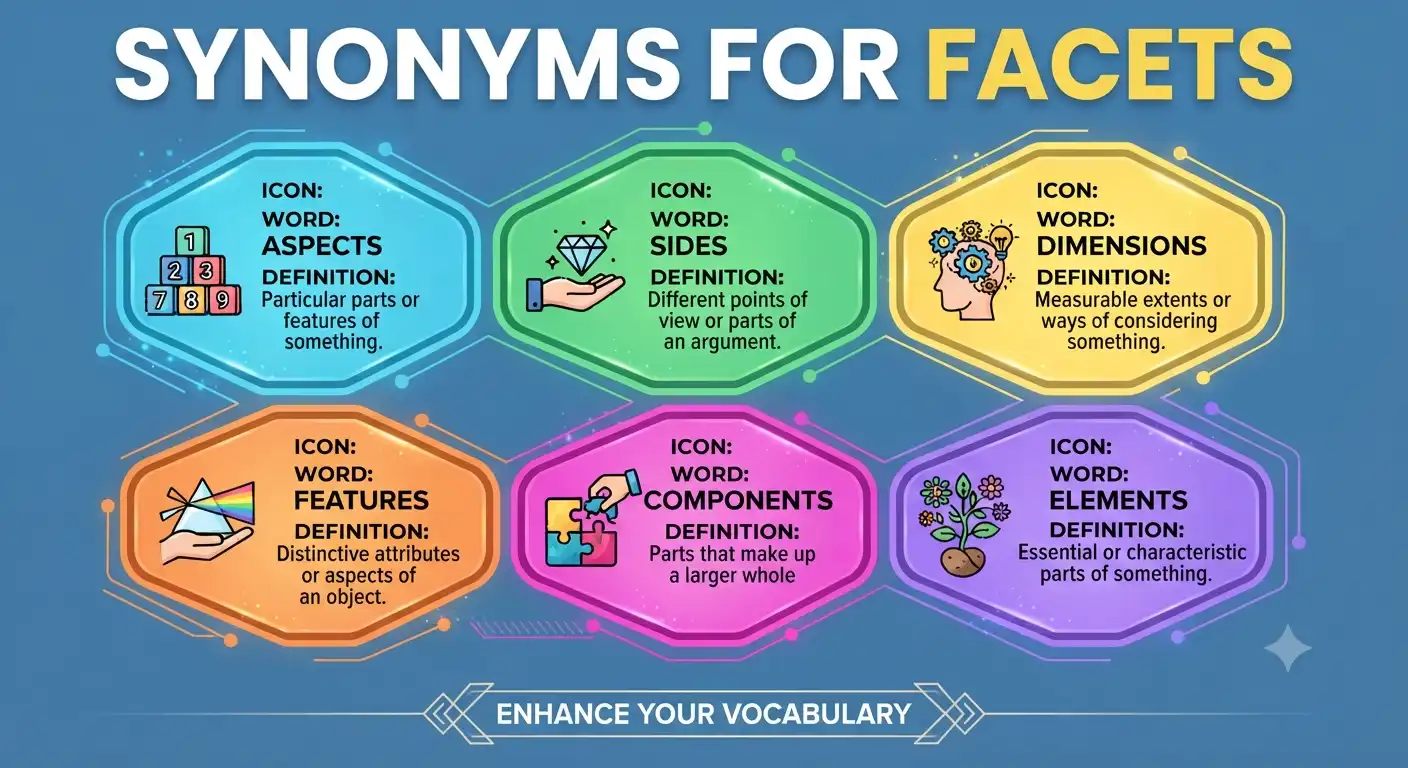
Finding the right synonyms for facets is an excellent way to grow your vocabulary and speak more clearly. When you discover these synonyms for facets, you can describe different sides of a topic, a project, or a gem without using the same old word. Knowing descriptive synonyms for facets helps you paint a vivid picture in your reader’s mind, making your sentences far more active and engaging.
Imagine holding up a beautifully cut diamond to a bright light. You watch it spark because it has many flat, polished surfaces reflecting the glare in every direction. Each of these surfaces is a facet. Now, think about a complex problem at school or work, like planning a big community event. This project also has many different sides to consider, such as budgets, safety, and entertainment. In very simple English, a facet means one flat side of a cut stone, or one part of a subject that has many parts.
This vocabulary concept is highly useful for different groups of people. Students can use these terms to write deep, analytical essays that get better grades. Bloggers can use these action-oriented words to explain complex topics clearly and keep readers on their website. Content writers can build deep professional trust by explaining every side of a product or service. Daily English users can easily share their thoughts and speak with great precision.
“Every truth has four corners: as a teacher I give you one corner, and it is for you to find the other three.” — Confucius
“There are many facets to a single spark of truth, and each one shines with its own light.” — Unknown
Lexical Profile of “Facets”
- Connotative Meaning: Complexity, depth, polished sides, diverse angles, or parts of a whole. We can model the conceptual understanding ($U$) of an idea with multiple facets using a basic set union. If each facet ($F_i$) represents a single perspective:$$U = \bigcup_{i=1}^{n} F_i$$This mathematical union shows that to understand the whole idea, you must gather and examine every individual facet.
- Etymology:
- Origins: Derived from the French word facette (which is a diminutive form of face, meaning “face” or “surface”).
- Evolution: Entered English in the 17th century to describe the small, flat faces cut on diamonds, and later evolved to describe abstract “sides” of a topic.
- Pronunciation:
- US IPA: /ˈfæs.ɪts/
- UK IPA: /ˈfæs.ɪts/ or /ˈfæs.ets/
- Syllables: 2 syllables (fac-ets).
- Affixation Pattern: Plural noun formed from the base noun facet with the plural suffix -s.
Comparison Table of Key Synonyms
| Keyword | Meaning | Usage Type | Context |
|---|---|---|---|
| Aspects | Different parts or features of a situation | Professional | Workplace plans, school essays, research |
| Angles | A specific way of looking at a subject | Casual | Daily problem-solving, casual debates |
| Sides | One of the outer surfaces or positions | Casual | Simple disputes, geometry, simple descriptions |
| Dimensions | The measurement or extent of something | Professional | Science labs, geometry, deep character traits |
| Perspectives | A particular attitude or way of regarding things | Formal / Emotional | Human relationships, art, politics |
| Elements | A basic or necessary part of a whole | Professional | Science, cooking, business plans |
| Features | A distinctive attribute or aspect | Casual / Professional | Product reviews, nature, facial traits |
| Nuances | A subtle difference in meaning or color | Formal | Art appreciation, language, human emotions |
“To look at a thing from a single angle is to miss the beauty of its entire shape.” — Unknown
50 Synonyms for Facets
1. Aspects
- Pronunciation: US: /ˈæs.pekts/ & UK: /ˈæs.pekts/
- Meaning: This word means the different parts, features, or sides of a situation.
- Examples:
- We must consider all aspects of the new school rules.
- The sunny weather is one of the best aspects of living here.
2. Angles
- Pronunciation: US: /ˈæŋ.ɡəlz/ & UK: /ˈæŋ.ɡəlz/
- Meaning: This word means a specific way of looking at a problem or shape.
- Examples:
- Let us look at this problem from different angles before we decide.
- The photographer took photos of the tall building from low angles.
3. Sides
- Pronunciation: US: /saɪdz/ & UK: /saɪdz/
- Meaning: This word means the surfaces that form the outside of an object or issue.
- Examples:
- A wooden box has six flat sides that you can paint.
- There are two sides to every argument in court.
4. Features
- Pronunciation: US: /ˈfiː.tʃɚz/ & UK: /ˈfiː.tʃəz/
- Meaning: This word means the noticeable parts or characteristics of something.
- Examples:
- The new phone has many cool features like a water-proof screen.
- We love the natural features of this rocky mountain park.
5. Phases
- Pronunciation: US: /feɪ.zɪz/ & UK: /feɪ.zɪz/
- Meaning: This word means the distinct stages in a process or development.
- Examples:
- The building project will be completed in three separate phases.
- We learned about the different phases of the moon in science class.
6. Dimensions
- Pronunciation: US: /ˌdaɪˈmen.ʃənz/ & UK: /ˌdaɪˈmen.ʃənz/
- Meaning: This word means the measurements or the deep parts of a situation.
- Examples:
- You must measure the dimensions of the room before buying a couch.
- This complex issue has physical, social, and economic dimensions.
7. Perspectives
- Pronunciation: US: /pɚˈspek.tɪvz/ & UK: /pəˈspek.tɪvz/
- Meaning: This word means particular ways of thinking about or viewing something.
- Examples:
- Travel helps you understand the perspectives of people from other countries.
- We need to hear different perspectives before we make a team choice.
8. Parts
- Pronunciation: US: /pɑːrts/ & UK: /pɑːts/
- Meaning: This word means the pieces that combine to make a whole object.
- Examples:
- He took the clock apart to clean its small metal parts.
- Reading and writing are two important parts of learning a language.
9. Portions
- Pronunciation: US: /ˈɔːr.ʃənz/ & UK: /ˈɔː.ʃənz/
- Meaning: This word means the shares or pieces of a whole thing.
- Examples:
- She divided the sweet apple pie into six equal portions.
- Large portions of the old forest were saved from the fire.
10. Elements
- Pronunciation: US: /ˈel.ə.mənts/ & UK: /ˈel.ɪ.mənts/
- Meaning: This word means the basic parts that make up a larger system.
- Examples:
- Trust and honesty are key elements of a strong friendship.
- We studied the chemical elements of water in our lab.
11. Components
- Pronunciation: US: /kəmˈpoʊ.nənts/ & UK: /kəmˈpəʊ.nənts/
- Meaning: This word means the individual parts that form a machine or system.
- Examples:
- The engineer replaced the broken electronic components of the radio.
- Fresh vegetables are major components of a healthy diet.
12. Characteristics
- Pronunciation: US: /ˌkær.ək.təˈrɪs.tɪks/ & UK: /ˌkær.ək.təˈrɪs.tɪks/
- Meaning: This word means the special qualities that make something recognizable.
- Examples:
- Bright yellow feathers are main characteristics of this small bird.
- We wrote down the unique characteristics of different rock types.
13. Details
- Pronunciation: US: /ˈdiː.teɪlz/ & UK: /ˈdiː.teɪlz/
- Meaning: This word means the small, specific facts or parts of something.
- Examples:
- Please pay close attention to the details in the safety guide.
- The detective asked for specific details about the lost keys.
14. Properties
- Pronunciation: US: /ˈprɑː.pɚ.t̬iz/ & UK: /ˈprɒp.ə.tiz/
- Meaning: This word means the special qualities or features belonging to a substance.
- Examples:
- Scientists are studying the healing properties of these forest plants.
- One of the main properties of ice is that it floats.
15. Factors
- Pronunciation: US: /ˈfæk.tɚz/ & UK: /ˈfæk.təz/
- Meaning: This word means the facts or situations that influence a final result.
- Examples:
- Hard work and luck were big factors in her business success.
- We must consider environmental factors when building new roads.
16. Viewpoints
- Pronunciation: US: /ˈvjuː.pɔɪnts/ & UK: /ˈvjuː.pɔɪnts/
- Meaning: This word means the positions or opinions from which things are seen.
- Examples:
- The news report shared different viewpoints on the local tax.
- It is good to respect the personal viewpoints of your friends.
17. Slants
- Pronunciation: US: /slænts/ & UK: /slɑːnts/
- Meaning: This word means personal opinions or biases used to show information.
- Examples:
- The article had a clear political slant that favored one leader.
- She decided to put a creative slant on her history project.
18. Faces
- Pronunciation: US: /feɪ.sɪz/ & UK: /feɪ.sɪz/
- Meaning: This word means the flat outer surfaces of a solid geometric shape.
- Examples:
- A standard game die has six flat faces numbered one to six.
- The climbers struggled to scale the steep faces of the cliff.
19. Surfaces
- Pronunciation: US: /ˈsɝː.fə.sɪz/ & UK: /ˈsɜː.fɪ.sɪz/
- Meaning: This word means the flat top or outer boundaries of an object.
- Examples:
- You should wipe down all kitchen surfaces with a clean cloth.
- Wind causes small waves on the surfaces of quiet ponds.
20. Divisions
- Pronunciation: US: /dɪˈvɪʒ.ənz/ & UK: /dɪˈvɪʒ.ənz/
- Meaning: This word means the separate parts or groups into which something is split.
- Examples:
- The company has several divisions that handle different tasks.
- We drew lines to mark the divisions of the school garden.
21. Sections
- Pronunciation: US: /ˈsek.ʃənz/ & UK: /ˈsek.ʃənz/
- Meaning: This word means the distinct parts of a book, place, or object.
- Examples:
- The Sunday newspaper has separate sections for sports and local news.
- They divided the big vegetable garden into four equal sections.
22. Segments
- Pronunciation: US: /ˈseɡ.mənts/ & UK: /ˈseɡ.mənts/
- Meaning: This word means the natural parts into which an object is divided.
- Examples:
- An orange can be easily peeled and split into sweet segments.
- The researchers studied the separate segments of the target market.
23. Categories
- Pronunciation: US: /ˈkæt̬.ə.ɡɔːr.iz/ & UK: /ˈkæt.ə.ɡər.iz/
- Meaning: This word means the groups of things that share similar qualities.
- Examples:
- The library books are sorted into different categories by subject.
- There are three categories of prizes for the school art show.
24. Attributes
- Pronunciation: US: /ˈæt.rɪ.bjuːts/ & UK: /ˈæt.rɪ.bjuːts/
- Meaning: This word means the qualities or characteristics that belong to someone.
- Examples:
- Patience and kindness are essential attributes of a good teacher.
- The designer listed the main attributes of the strong fabric.
25. Particulars
- Pronunciation: US: /pɚˈtɪk.jə.lɚz/ & UK: /pəˈtɪk.jə.ləz/
- Meaning: This word means the specific points, details, or items of information.
- Examples:
- The police officer wrote down the particulars of the car accident.
- We do not need all the minor particulars to understand the plan.
26. Traits
- Pronunciation: US: /treɪts/ & UK: /treɪts/
- Meaning: This word means the personal qualities that define a character.
- Examples:
- Shyness is one of the personality traits she inherited from her dad.
- We discussed the key survival traits of desert plants.
27. Qualities
- Pronunciation: US: /ˈkwɑː.lə.t̬iz/ & UK: /ˈkwɒl.ə.tiz/
- Meaning: This word means the distinctive attributes or characteristics of something.
- Examples:
- The judge looked for specific artistic qualities in the paintings.
- This thick wood has excellent qualities for building heavy furniture.
28. Respects
- Pronunciation: US: /rɪˈspekts/ & UK: /rɪˈspekts/
- Meaning: This word means the specific details or aspects of a matter.
- Examples:
- The two houses are very similar in many respects.
- He improved his soccer skills in several key respects.
29. Regards
- Pronunciation: US: /rɪˈɡɑːrdz/ & UK: /rɪˈɡɑːdz/
- Meaning: This word means the specific points or relations to a subject.
- Examples:
- In some regards, the old computer is better than the new one.
- The system is highly efficient with regard to saving energy.
30. Strands
- Pronunciation: US: /strændz/ & UK: /strændz/
- Meaning: This word means the individual parts or threads that make up a whole.
- Examples:
- The novel weaves together several different strands of the family story.
- She braided the three strands of thick yarn together.
31. Points
- Pronunciation: US: /pɔɪnts/ & UK: /pɔɪnts/
- Meaning: This word means the single ideas, facts, or details in an argument.
- Examples:
- The speaker raised several important points during the short meeting.
- We listed the positive and negative points of the proposal.
32. Planes
- Pronunciation: US: /pleɪnz/ & UK: /pleɪnz/
- Meaning: This word means the flat surfaces or levels of thought and existence.
- Examples:
- The crystals have flat planes that intersect at sharp angles.
- The artist works on both physical and spiritual planes.
33. Levels
- Pronunciation: US: /ˈlev.əlz/ & UK: /ˈlev.əlz/
- Meaning: This word means the different heights, stages, or positions of a system.
- Examples:
- There are three levels of difficulty in this video game.
- The water levels in the local river rose after the rain.
34. Stages
- Pronunciation: US: /steɪ.dʒɪz/ & UK: /steɪ.dʒɪz/
- Meaning: This word means the periods of time in a development process.
- Examples:
- A butterfly goes through four distinct stages of growth.
- The construction is currently in its final stages.
35. Tones
- Pronunciation: US: /toʊnz/ & UK: /təʊnz/
- Meaning: This word means the specific moods, colors, or sounds of something.
- Examples:
- The room was painted in warm tones of red and yellow.
- We noticed serious tones in his voice when he spoke.
36. Shades
- Pronunciation: US: /ʃeɪdz/ & UK: /ʃeɪdz/
- Meaning: This word means the small differences in a color or meaning.
- Examples:
- The artist used various shades of blue to paint the ocean.
- There are many shades of meaning in that complex poem.
37. Nuances
- Pronunciation: US: /ˈnuː.ɑːn.sɪz/ & UK: /ˈnjuː.ɑːn.sɪz/
- Meaning: This word means the very small and subtle differences in feeling or sound.
- Examples:
- A skilled actor understands the nuances of human emotion.
- You must listen closely to hear the nuances in the classical music.
38. Variables
- Pronunciation: US: /ˈver.i.ə.bəlz/ & UK: /ˈveə.ri.ə.bəlz/
- Meaning: This word means the elements or situations that are likely to change.
- Examples:
- Weather and track conditions are important variables in the race.
- Scientists must control all variables during a lab experiment.
39. Parameters
- Pronunciation: US: /pəˈræm.ə.t̬ɚz/ & UK: /pəˈræm.ɪ.təz/
- Meaning: This word means the limits or rules that define how something is done.
- Examples:
- The team set clear parameters for the research project.
- We must work within the parameters of our school budget.
40. Ingredients
- Pronunciation: US: /ɪnˈɡriː.di.ənts/ & UK: /ɪnˈɡriː.di.ənts/
- Meaning: This word means the food items or parts used to make a dish or mixture.
- Examples:
- Flour and sugar are the main ingredients of the sweet cake.
- Hard work and focus are key ingredients for school success.
41. Branches
- Pronunciation: US: /ˈbræn.tʃɪz/ & UK: /ˈbrɑːn.tʃɪz/
- Meaning: This word means the divisions or parts of a subject, business, or tree.
- Examples:
- Chemistry and physics are major branches of science.
- The local bank has three busy branches in our city.
42. Outlets
- Pronunciation: US: /ˈaʊt.lets/ & UK: /ˈaʊt.lets/
- Meaning: This word means the pathways or methods to release energy or goods.
- Examples:
- Painting and music are excellent outlets for creative kids.
- The company sells its products through several retail outlets.
43. Fields
- Pronunciation: US: /fiːldz/ & UK: /fiːldz/
- Meaning: This word means the specific areas of study, work, or open land.
- Examples:
- She is an expert in the fields of medicine and biology.
- The wild horses ran across the green grass fields.
44. Areas
- Pronunciation: US: /ˈer.i.əz/ & UK: /ˈeə.ri.əz/
- Meaning: This word means the parts of a place, space, or subject.
- Examples:
- There are quiet study areas on the third floor of the library.
- We need to focus on key areas of our history homework.
45. Spheres
- Pronunciation: US: /sfɪrz/ & UK: /sfɪəz/
- Meaning: This word means the areas of activity, influence, or round shapes.
- Examples:
- The two countries have different spheres of political influence.
- We studied the gas spheres of outer space in astronomy.
46. Domains
- Pronunciation: US: /doʊˈmeɪnz/ & UK: /dəʊˈmeɪnz/
- Meaning: This word means the areas of territory, knowledge, or control.
- Examples:
- The king ruled over vast domains of green valleys.
- Computing and coding are domains of modern technology.
47. Sectors
- Pronunciation: US: /ˈsek.tɚz/ & UK: /ˈsek.təz/
- Meaning: This word means the parts into which a society or economy is divided.
- Examples:
- The public and private sectors must work together on the roads.
- He works in the technology sectors of the local economy.
48. Units
- Pronunciation: US: /ˈjuː.nɪts/ & UK: /ˈjuː.nɪts/
- Meaning: This word means the single, complete parts of a larger system or textbook.
- Examples:
- The science book is divided into ten interesting units.
- The apartment building contains forty separate living units.
49. Members
- Pronunciation: US: /ˈmem.bɚz/ & UK: /ˈmem.bəz/
- Meaning: This word means the individual people or parts belonging to a group.
- Examples:
- All members of the chess club must pay a small fee.
- The limbs are active members of the human body.
50. Fractions
- Pronunciation: US: /ˈfræk.ʃənz/ & UK: /ˈfræk.ʃənz/
- Meaning: This word means the tiny parts or pieces of a whole number or situation.
- Examples:
- We learned how to add basic fractions in math class today.
- She completed the hard task in a fraction of the time.
Antonyms of “Facets”
To master this vocabulary concept completely, you should also learn its opposite terms:
- Whole: The complete amount or sum of something, with no parts missing.
- Entity: A single, complete thing that exists on its own.
- Totality: The state of being entire, complete, or total.
- Core: The basic, central, and most important part of something.
- Simplicity: The quality of being easy to understand and having only one side.
Prototype Meaning and Categorization of “Facets”
The prototype meaning of “facets” is the individual, distinct parts, sides, or features of a physical object or a complex concept. We can group these 50 synonyms into four clear categories:
- Physical Surfaces and Geometric Shapes: Words that deal with flat, outer, or physical areas (e.g., sides, faces, surfaces, planes, members).
- Abstract Perspectives and Opinions: Words that describe how people think, feel, or view a situation (e.g., aspects, angles, perspectives, viewpoints, slants, shades, nuances, tones).
- Structured Parts and Segments: Words representing physical divisions, pieces, or stages of development (e.g., parts, portions, divisions, sections, segments, units, fractions, phases, stages, levels).
- Essential Features and Variables: Words describing qualities, ingredients, or factors that define a system (e.g., features, elements, components, characteristics, properties, factors, attributes, particulars, traits, qualities, respects, regards, strands, points, variables, parameters, ingredients, branches, outlets, fields, areas, spheres, domains, sectors).
FAQ About Synonyms for Facets
1. What is the difference between “aspects” and “facets”?
While both refer to sides of a topic, facets suggests a more complex, polished structure (like a diamond with many cut faces). Aspects is a more general term for any feature of a situation.
2. Can “faces” be used to describe non-physical things?
Yes. In geography and climbing, you talk about mountain “faces.” In business, you can say you are studying the different “faces” of a complex market.
3. Is “parameters” a formal synonym for facets?
No. Parameters refers to boundaries, rules, or limits. However, because these limits define the shape and “sides” of a project, it is used in professional contexts as a related term.
4. What does the term “multi-faceted” mean?
This is a common adjective that describes something having many different sides, talents, or features, such as a multi-faceted career or a multi-faceted problem.
5. When should I use “nuances” instead of “facets”?
Use nuances when you are describing very tiny, subtle, and emotional differences that are hard to see. Use facets for clear, distinct sides of an idea or object.
6. Can “fractions” be used as a general synonym for parts?
Yes. In daily English, saying “a fraction of” is a common way to describe a very small part or piece of a whole situation.
Conclusion
Expanding your English vocabulary by studying synonyms for facets is an excellent way to elevate your communication. When you learn to use these diverse, descriptive terms, your creative writing becomes more engaging, your blogging becomes more colorful, and your professional presentations sound far more authoritative. Instead of relying on the same simple words, you can paint clear pictures in the minds of your audience by selecting the exact right word for the situation.
Try to practice these fresh terms starting today! Use them when you draft an email to a coworker, write a descriptive essay for class, or talk with your friends about your weekend activities. The more you use them in casual settings, the more natural they will feel in your active vocabulary. Keep practicing, keep learning, and watch your communication skills flourish!
“Words are the keys to the mind, and a wide vocabulary opens every single door.” — Unknown
“Speak with variety, choose your words with care, and you will always find the right side of truth.” — Unknown

Andrew Collins is an academic English educator with over 12 years of experience helping university students, IELTS candidates, and ESL learners improve their writing vocabulary.