Learning dynamic synonyms for exhibit can completely transform how you present ideas, share art, or describe human behavior. When you search for synonyms for exhibit, you look for precise words that replace overused verbs with vivid imagery. Exploring synonyms for exhibit makes your speech and writing far more captivating, clear, and persuasive.
Imagine standing inside a museum gallery where an artist displays a masterpiece, or sitting in a courtroom where a lawyer reveals vital proof. You want to describe these moments with confidence, but using the word “show” repeatedly feels plain and uninspired. To exhibit means to show something clearly so others can see, notice, or understand it. For example, a young student might exhibit great kindness by sharing their lunch with a classmate.
A deep vocabulary of action verbs empowers everyday communicators in several distinct ways:
- Students can write sharper essays by choosing precise words for evidence and presentations.
- Bloggers can create compelling headers that instantly capture reader interest.
- Content writers can describe products, traits, and features with rich variety.
- Daily English users can communicate feelings and actions with natural flair.
“To express oneself is a fundamental human need.” — Unknown
“Words are the lens through which we view our thoughts.” — Ralph Waldo Emerson
Linguistic Breakdown of “Exhibit”
Connotative Meaning
The word exhibit carries an intentional, organized, and confident tone. It suggests bringing something into view for public inspection, formal presentation, or emotional revelation.
Etymology
- Prefix: Ex- (Latin for “out” or “forth”).
- Root Word: Habere (Latin for “to hold”).
- Historical Path: Evolved from Latin exhibere (“to hold out, display”) to Middle English exhibiten, originally used in legal settings to mean presenting documents in court.
Pronunciation
- US IPA: /ɪɡˈzɪb.ɪt/
- UK IPA: /ɪɡˈzɪb.ɪt/
Syllables & Affixation Pattern
- Syllables: 3 (ex-hib-it)
- Root Word: Exhibit
- Affixation: Formed with prefix ex- attached to the root stem -hibit-.
Comparison Table of Key Synonyms
| Keyword | Meaning | Usage Type | Context |
|---|---|---|---|
| Display | To put something where people can see it easily | Neutral / General | Museums, retail stores, daily speech |
| Showcase | To feature the best qualities of something | Enthusiastic / Professional | Portfolios, talents, events |
| Demonstrate | To prove or explain something clearly by showing it | Academic / Formal | Science labs, tutorials, work tasks |
| Reveal | To make something secret or hidden known to others | Dramatic / Emotional | Storytelling, discoveries, secrets |
| Manifest | To show a feeling or quality through actions | Formal / Expressive | Behaviors, symptoms, mindsets |
| Expose | To uncover something so it is unprotected or visible | Serious / Critical | Investigations, weather, truth |
| Flaunt | To show something off in an overly proud way | Casual / Expressive | Social media, fashion, arrogance |
| Unveil | To introduce something new to the public for the first time | Formal / Promotional | Product launches, monuments, art |
Main Content – 50 Synonyms for Exhibit
1. Display
- Pronunciation: US: /dɪˈspleɪ/ | UK: /dɪˈspleɪ/
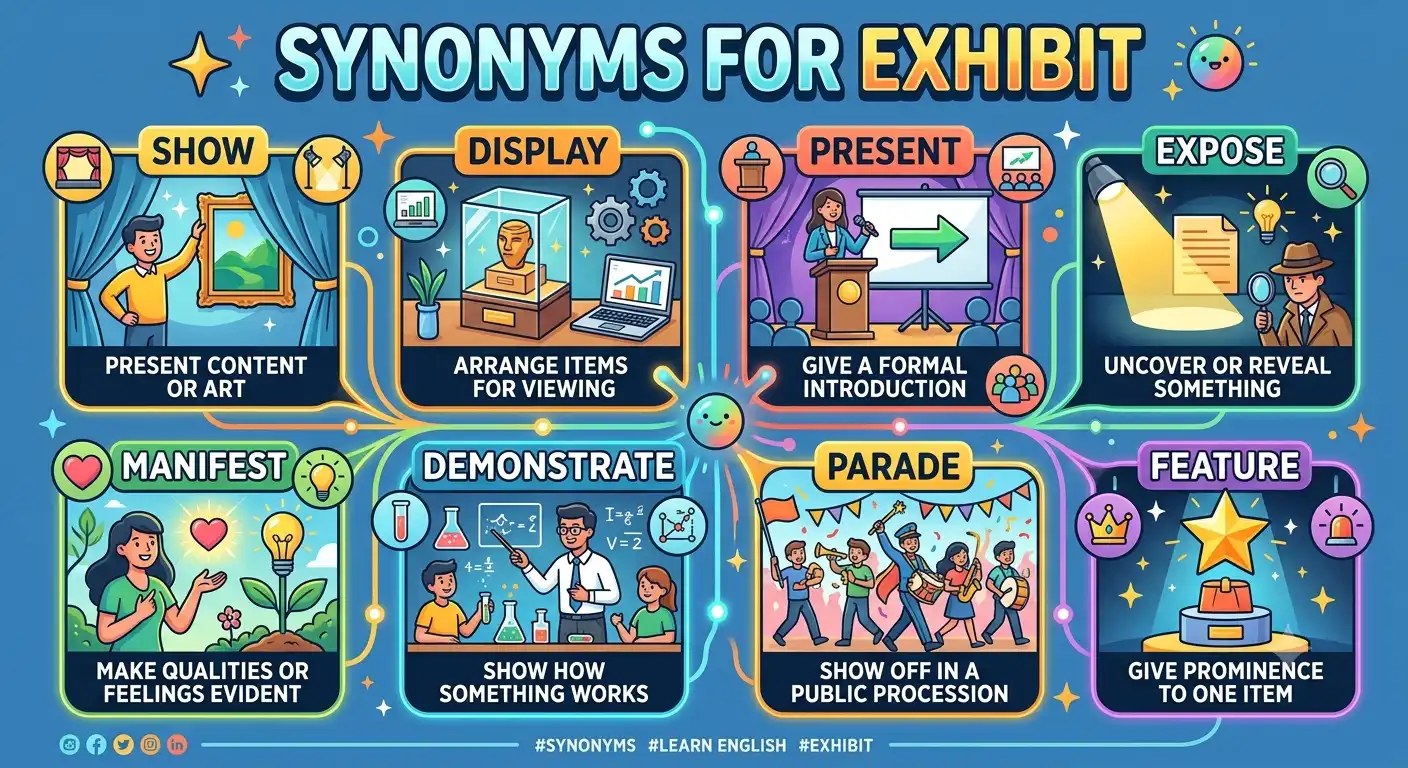
- Meaning: Display means to put something in a place where people can see it easily.
- Examples:
- The store owner will display the new shoes in the front window.
- She likes to display her drawings on the refrigerator.
2. Show
- Pronunciation: US: /ʃoʊ/ | UK: /ʃəʊ/
- Meaning: Show means to let someone see something or make it clear.
- Examples:
- Please show me your new pet puppy.
- His smile shows that he is very happy today.
3. Showcase
- Pronunciation: US: /ˈʃoʊ.keɪs/ | UK: /ˈʃəʊ.keɪs/
- Meaning: Showcase means to present the very best parts of something.
- Examples:
- The fair will showcase local art and homemade food.
- She built a portfolio to showcase her design skills.
4. Demonstrate
- Pronunciation: US: /ˈdem.ən.streɪt/ | UK: /ˈdem.ən.streɪt/
- Meaning: Demonstrate means to show how something works or prove an idea.
- Examples:
- The teacher will demonstrate how to perform the science test.
- He used a chart to demonstrate his plan for the project.
5. Present
- Pronunciation: US: /prɪˈzent/ | UK: /prɪˈzent/
- Meaning: Present means to give or show something to an audience formally.
- Examples:
- Our team will present the project report tomorrow morning.
- She was proud to present her research to the class.
6. Reveal
- Pronunciation: US: /rɪˈviːl/ | UK: /rɪˈviːl/
- Meaning: Reveal means to make something visible or known after it was hidden.
- Examples:
- The curtain lifted to reveal a beautiful stage setting.
- He opened his hand to reveal the shiny gold coin.
7. Manifest
- Pronunciation: US: /ˈmæn.ə.fest/ | UK: /ˈmæn.ɪ.fest/
- Meaning: Manifest means to show a feeling or quality clearly through action.
- Examples:
- Her kindness began to manifest in the way she helped others.
- Stress can manifest as a mild headache during busy days.
8. Express
- Pronunciation: US: /ɪkˈspres/ | UK: /ɪkˈspres/
- Meaning: Express means to share your feelings, thoughts, or ideas clearly.
- Examples:
- Artists use paint to express their deepest emotions.
- He sent a card to express his warm gratitude.
9. Feature
- Pronunciation: US: /ˈfiː.tʃɚ/ | UK: /ˈfiː.tʃər/
- Meaning: Feature means to give special prominence or attention to something.
- Examples:
- The magazine will feature an article about green energy.
- Tonight’s dinner menu features fresh local seafood.
10. Expose
- Pronunciation: US: /ɪkˈspoʊz/ | UK: /ɪkˈspəʊz/
- Meaning: Expose means to uncover something so that it can be seen clearly.
- Examples:
- Digging in the garden helped expose ancient brick pathways.
- The sun can expose sensitive skin to mild sunburn.
11. Unveil
- Pronunciation: US: /ʌnˈveɪl/ | UK: /ʌnˈveɪl/
- Meaning: Unveil means to uncover or introduce something new for the first time.
- Examples:
- The company plans to unveil its new smartphone next week.
- The Mayor arrived to unveil the new town statue.
12. Disclose
- Pronunciation: US: /dɪsˈkloʊz/ | UK: /dɪsˈkləʊz/
- Meaning: Disclose means to share secret or private information with others.
- Examples:
- The doctor cannot disclose private patient details to anyone.
- She decided to disclose the secret recipe to her daughter.
13. Indicate
- Pronunciation: US: /ˈɪn.də.keɪt/ | UK: /ˈɪn.dɪ.keɪt/
- Meaning: Indicate means to point out something or make it clear with a sign.
- Examples:
- A red light on the panel indicates that the machine is on.
- Her nod seemed to indicate that she agreed with us.
14. Evince
- Pronunciation: US: /ɪˈvɪns/ | UK: /ɪˈvɪns/
- Meaning: Evince means to show a quality or feeling clearly.
- Examples:
- The young student’s work evinced a deep passion for reading.
- He did not evince any fear during the dark thunderstorm.
15. Air
- Pronunciation: US: /er/ | UK: /eər/
- Meaning: Air means to express your opinions or broadcast something publicly.
- Examples:
- The radio station will air the interview later tonight.
- Employees met with management to air their workplace concerns.
16. Uncover
- Pronunciation: US: /ʌnˈkʌv.ɚ/ | UK: /ʌnˈkʌv.ər/
- Meaning: Uncover means to remove a cover from something so it shows.
- Examples:
- Workers uncovered old wooden floorboards under the carpet.
- The investigation helped uncover the truth behind the story.
“Art does not reproduce the visible; rather, it makes visible.” — Paul Klee
17. Broadcast
- Pronunciation: US: /ˈbrɑːd.kæst/ | UK: /ˈbrɔːd.kɑːst/
- Meaning: Broadcast means to send out news or signals to many people.
- Examples:
- The station will broadcast the football game live tonight.
- You should not broadcast your private plans to everyone.
18. Flaunt
- Pronunciation: US: /flɑːnt/ | UK: /flɔːnt/
- Meaning: Flaunt means to show something proudly so that people notice it.
- Examples:
- She likes to flaunt her bright new jacket at school.
- He tried not to flaunt his prize in front of his friends.
19. Parade
- Pronunciation: US: /pəˈreɪd/ | UK: /pəˈreɪd/
- Meaning: Parade means to walk around showing something off clearly.
- Examples:
- Children love to parade their colorful Halloween costumes outside.
- The champion walked around to parade the winning trophy.
20. Introduce
- Pronunciation: US: /ˌɪn.trəˈduːs/ | UK: /ˌɪn.trəˈdjuːs/
- Meaning: Introduce means to present a new idea, person, or object.
- Examples:
- I want to introduce my best friend to my parents.
- The teacher will introduce a new topic in class today.
21. Illustrate
- Pronunciation: US: /ˈɪl.ə.streɪt/ | UK: /ˈɪl.ə.streɪt/
- Meaning: Illustrate means to make something clear by using pictures or examples.
- Examples:
- He drew a simple map to illustrate his directions.
- The speaker used a story to illustrate her main point.
22. Offer
- Pronunciation: US: /ˈɑː.fɚ/ | UK: /ˈɒf.ər/
- Meaning: Offer means to present something so that others can accept it.
- Examples:
- She decided to offer her help to the neighbor.
- The bakery will offer free samples of fresh bread today.
23. Project
- Pronunciation: US: /prəˈdʒekt/ | UK: /prəˈdʒekt/
- Meaning: Project means to send an image, voice, or feeling outward clearly.
- Examples:
- The speaker learned to project her voice across the hall.
- He tries to project a calm mood during busy meetings.
24. Produce
- Pronunciation: US: /prəˈduːs/ | UK: /prəˈdjuːs/
- Meaning: Produce means to bring something out into view for examination.
- Examples:
- The driver had to produce his license for the officer.
- She managed to produce a great solution to our problem.
25. Register
- Pronunciation: US: /ˈredʒ.ə.stɚ/ | UK: /ˈredʒ.ɪ.stər/
- Meaning: Register means to show an emotion clearly on your face or body.
- Examples:
- Surprise began to register on his face when he heard the news.
- Her eyes did not register any worry during the long wait.
26. Embody
- Pronunciation: US: /ɪmˈbɑː.di/ | UK: /ɪmˈbɒd.i/
- Meaning: Embody means to represent a quality or idea in physical form.
- Examples:
- The team captain seems to embody courage and effort.
- Her art pieces embody the gentle spirit of nature.
27. Stage
- Pronunciation: US: /steɪdʒ/ | UK: /steɪdʒ/
- Meaning: Stage means to organize and present a show or event publicly.
- Examples:
- The drama club will stage a comedy play this spring.
- Local actors worked hard to stage the annual show.
28. Model
- Pronunciation: US: /ˈmɑː.dəl/ | UK: /ˈmɒd.əl/
- Meaning: Model means to wear or display something to show how it looks.
- Examples:
- She will model the new dress design on the runway.
- He tried to model good behavior for his younger brother.
29. Radiate
- Pronunciation: US: /ˈreɪ.di.eɪt/ | UK: /ˈreɪ.di.eɪt/
- Meaning: Radiate means to show a strong feeling bright like light.
- Examples:
- The bride seemed to radiate pure joy during her wedding.
- Her calm smile continued to radiate confidence to the team.
30. Bare
- Pronunciation: US: /ber/ | UK: /beər/
- Meaning: Bare means to uncover or reveal something fully to sight.
- Examples:
- The dog began to bare its teeth when it sensed danger.
- He chose to bare his soul in his latest poem.
31. Represent
- Pronunciation: US: /ˌrep.rɪˈzent/ | UK: /ˌrep.rɪˈzent/
- Meaning: Represent means to stand for or show something clearly.
- Examples:
- Red hearts often represent love and friendship in cards.
- She was chosen to represent her school at the contest.
32. Exude
- Pronunciation: US: /ɪɡˈzjuːd/ | UK: /ɪɡˈzjuːd/
- Meaning: Exude means to show a quality or mood strongly and naturally.
- Examples:
- Great leaders usually exude confidence under pressure.
- The peaceful garden seemed to exude quiet charm.
33. Proclaim
- Pronunciation: US: /prəˈkleɪm/ | UK: /prəˈkleɪm/
- Meaning: Proclaim means to announce or show something openly and clearly.
- Examples:
- Bright banners proclaim the grand opening of the shop.
- He spoke loudly to proclaim his total support for the plan.
34. Put on display
- Pronunciation: US: /pʊt ɑːn dɪˈspleɪ/ | UK: /pʊt ɒn dɪˈspleɪ/
- Meaning: Put on display means to place something where everyone can view it.
- Examples:
- The museum will put old artifacts on display this month.
- She decided to put her flower pots on display outside.
35. Divulge
- Pronunciation: US: /daɪˈvʌldʒ/ | UK: /daɪˈvʌldʒ/
- Meaning: Divulge means to make secret facts or news known to others.
- Examples:
- He promised never to divulge the secret location of the key.
- She would not divulge the details of the party surprise.
36. Betray
- Pronunciation: US: /bɪˈtreɪ/ | UK: /bɪˈtreɪ/
- Meaning: Betray means to show a hidden feeling without meaning to do so.
- Examples:
- His nervous tone began to betray his hidden fear.
- A small smile on her lips betrayed her real excitement.
37. Mirror
- Pronunciation: US: /ˈmɪr.ɚ/ | UK: /ˈmɪr.ər/
- Meaning: Mirror means to show or reflect something in a very similar way.
- Examples:
- The child’s actions often mirror those of his parents.
- Calm lake waters mirror the tall green trees nearby.
38. Reflect
- Pronunciation: US: /rɪˈflekt/ | UK: /rɪˈflekt/
- Meaning: Reflect means to show or express an image, idea, or result.
- Examples:
- Your good grades reflect all your hard work studying.
- Clear glass mirrors reflect light into the bright room.
39. Signal
- Pronunciation: US: /ˈsɪɡ.nəl/ | UK: /ˈsɪɡ.nəl/
- Meaning: Signal means to show that an action or event is starting.
- Examples:
- A loud whistle will signal the start of the race.
- Dark gray clouds signal that rain is coming soon.
40. Characterize
- Pronunciation: US: /ˈkær.ək.tə.raɪz/ | UK: /ˈkær.ək.tə.raɪz/
- Meaning: Characterize means to show the typical features or qualities of something.
- Examples:
- Hard work and fun characterize our daily office culture.
- Bright colors characterize her artistic paintings.
41. Unmask
- Pronunciation: US: /ʌnˈmæsk/ | UK: /ʌnˈmɑːsk/
- Meaning: Unmask means to expose the true identity or nature of something.
- Examples:
- The reporter worked hard to unmask the dishonest scheme.
- The ending of the movie helped unmask the villain.
42. Brandish
- Pronunciation: US: /ˈbræn.dɪʃ/ | UK: /ˈbræn.dɪʃ/
- Meaning: Brandish means to wave or display something in a bold way.
- Examples:
- The winner walked out to brandish his gold medal.
- He began to brandish the rolled sheet of paper proudly.
43. Perform
- Pronunciation: US: /pɚˈfɔːrm/ | UK: /pəˈfɔːm/
- Meaning: Perform means to display a skill or act in front of an audience.
- Examples:
- Dancers will perform on stage during the city festival.
- She was excited to perform her new song live.
44. Unfold
- Pronunciation: US: /ʌnˈfoʊld/ | UK: /ʌnˈfəʊld/
- Meaning: Unfold means to open up or reveal details as time goes by.
- Examples:
- We watched the dramatic event unfold on live news.
- The mystery began to unfold page by page in the book.
45. Bring out
- Pronunciation: US: /brɪŋ aʊt/ | UK: /brɪŋ aʊt/
- Meaning: Bring out means to make a specific trait or quality easier to see.
- Examples:
- The blue dress seems to bring out the color of her eyes.
- Good coaches bring out the best effort in their athletes.
46. Pitch
- Pronunciation: US: /pɪtʃ/ | UK: /pɪtʃ/
- Meaning: Pitch means to present an idea to convince others to choose it.
- Examples:
- The team will pitch their business idea to investors.
- He gave a short speech to pitch his novel to the editor.
47. Unpack
- Pronunciation: US: /ʌnˈpæk/ | UK: /ʌnˈpæk/
- Meaning: Unpack means to take things out or explain ideas step by step.
- Examples:
- Let us unpack the key points of this report together.
- She helped unpack the boxes of new library books.
48. Mount
- Pronunciation: US: /maʊnt/ | UK: /maʊnt/
- Meaning: Mount means to set up and display items for a show or event.
- Examples:
- The museum will mount a new photo display next week.
- They plan to mount posters all over the school campus.
49. Spot
- Pronunciation: US: /spɑːt/ | UK: /spɒt/
- Meaning: Spot means to see or notice something distinct in a place.
- Examples:
- I was able to spot a small deer near the forest trees.
- Can you spot the difference between these two pictures?
50. Highlight
- Pronunciation: US: /ˈhaɪ.laɪt/ | UK: /ˈhaɪ.laɪt/
- Meaning: Highlight means to draw special attention to an important point.
- Examples:
- Use a yellow marker to highlight key terms in your notes.
- The speaker chose to highlight successful student efforts.
Antonyms of “Exhibit”
While exhibit involves showing, revealing, or displaying qualities or items, these antonyms refer to covering up, masking, or keeping things secret:
- Hide: US: /haɪd/ | UK: /haɪd/ – To keep something out of sight or secret.
- Conceal: US: /kənˈsiːl/ | UK: /kənˈsiːl/ – To prevent something from being seen or known.
- Cover: US: /ˈkʌv.ɚ/ | UK: /ˈkʌv.ər/ – To place something over an object to protect or hide it.
- Suppress: US: /səˈpres/ | UK: /səˈpres/ – To hold back or prevent the natural display of a feeling or action.
Prototype Meaning and Categorization of “Exhibit”
- Grammatical Category: Verb (transitive and intransitive) & Noun (countable/uncountable).
- Prototype Meaning: The deliberate act of placing something in view for observation, evaluation, or public appreciation.
- Semantic Field: Visual arts, public presentations, legal evidence, emotional expression, scientific demonstrations, and behavioral traits.
Frequently Asked Questions (FAQ)
1. What is the most common synonym for exhibit?
The most common synonyms for exhibit are show, display, present, and demonstrate. These words adapt smoothly across general conversations, academic essays, and business presentations.
2. When should I use “showcase” instead of “exhibit”?
Use showcase when you want to emphasize highlighting the absolute best features or talents of something, such as showcasing a portfolio or a top-performing product.
3. Is “flaunt” a positive or negative synonym for exhibit?
Flaunt generally carries a slightly negative or critical tone. It implies showing off wealth, looks, or achievements in a proud or boastful manner rather than a neutral display.
4. How does “demonstrate” differ from simple words like “show”?
While show simply means letting someone look at something, demonstrate means explaining or proving how a concept or mechanism works through active steps.
5. Can “exhibit” be used as both a noun and a verb?
Yes, exhibit functions as both. As a verb, it means to show or display (She exhibits great skill). As a noun, it refers to an object or collection shown in a museum or court (The museum opened a new exhibit).
6. Why should I use varied synonyms for exhibit in essays?
Using varied synonyms for exhibit prevents repetitive phrasing like “this shows that.” Choosing words like reveals, illustrates, or demonstrates makes your academic writing far more engaging and mature.
Conclusion
Building a broad collection of synonyms for exhibit empowers your vocabulary and helps you share thoughts with accuracy. Swapping generic verbs like “show” for expressive terms like showcase, demonstrate, reveal, or highlight keeps your writing fresh and authoritative. Whether you are drafting a university assignment, writing a promotional blog post, or preparing a speech, choosing the perfect synonym ensures your ideas resonate with readers.
Make a habit of weaving these dynamic verbs into your daily communication. Try using a few new choices in your upcoming emails, essays, or presentations, and watch your expression become clearer and far more engaging.
“Language is the dress of thought.” — Samuel Johnson
“The limits of my language mean the limits of my world.” — Ludwig Wittgenstein

Andrew Collins is an academic English educator with over 12 years of experience helping university students, IELTS candidates, and ESL learners improve their writing vocabulary.