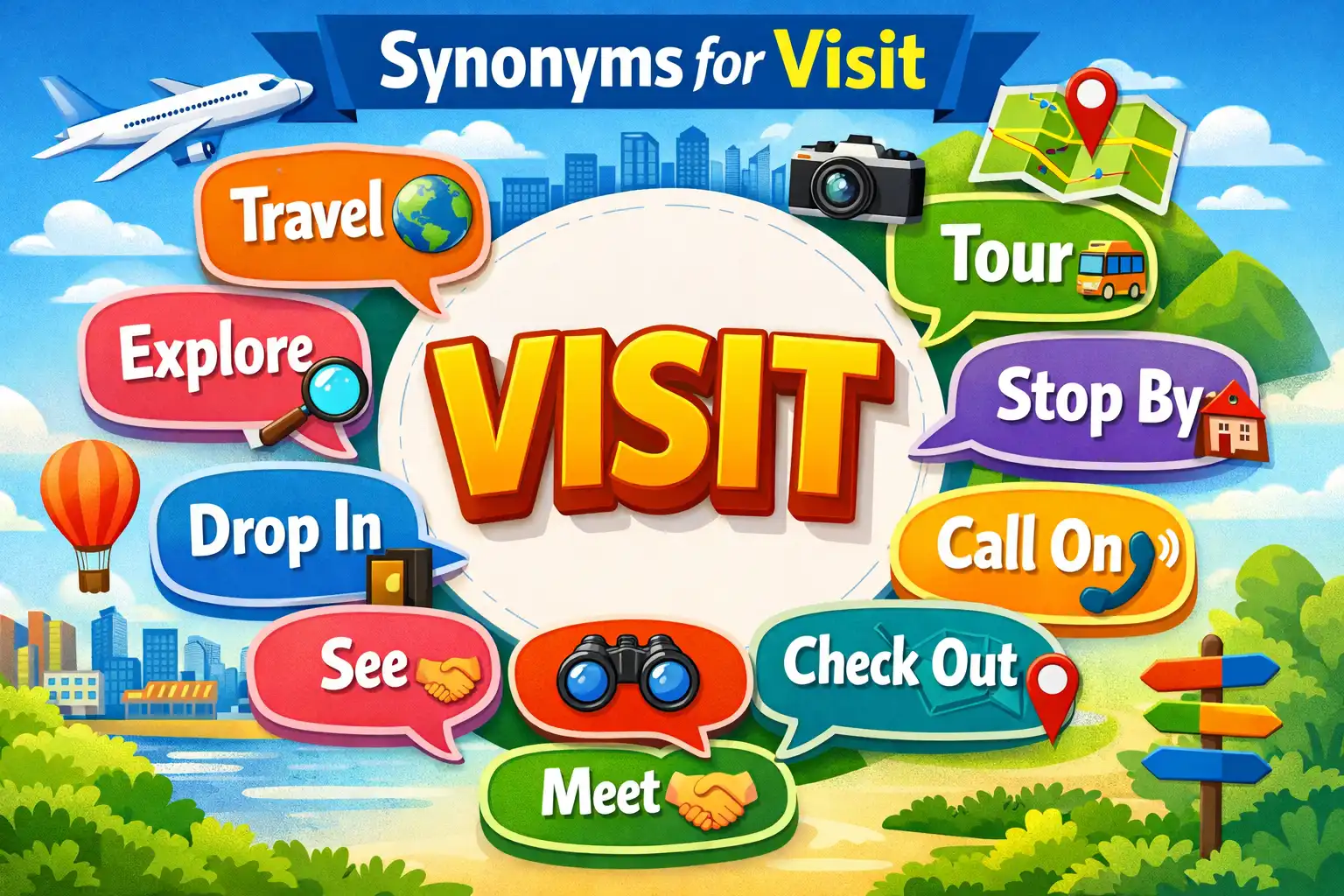
Learning synonyms for visit helps you speak and write more clearly. The word “visit” appears in daily conversation, emails, stories, and school writing. If you use different alternatives, your English sounds more natural and fluent.
This guide explains simple meanings, examples, and correct usage.
Quick Answer: Best Synonyms for “Visit” (By Context)
Synonyms for visit include words like see, meet, call on, drop by, attend, and tour. Each word changes slightly depending on the situation and level of formality.
Common synonyms:
- See
- Meet
- Call on
- Drop by
- Attend
- Tour
- Stop by
- Go to
- Check out
- Spend time with
Meaning of “Visit”
The word visit means to go somewhere or to spend time with someone for a short period.
Example:
I will visit my grandmother this weekend.
Categories of Synonyms
1. Personal or Social Visits
Used when you go to see friends, family, or someone you know.
Examples: see, meet, drop by.
2. Professional or Formal Visits
Used in business, official, or academic situations.
Examples: attend, call on, inspect.
3. Travel or Place-Based Visits
Used when going to a city, country, or attraction.
Examples: tour, explore, go to.
Synonyms Table
| Word | Simple Meaning | Example Sentence |
| See | Spend time with someone | I will see my cousin tomorrow. |
| Meet | Come together in person | She will meet her teacher after class. |
| Call on | Visit someone formally | The manager will call on the client. |
| Drop by | Visit briefly | Please drop by my office later. |
| Attend | Go to an event | He will attend the conference. |
| Tour | Travel around a place | They toured the museum. |
| Stop by | Visit quickly | I will stop by after work. |
| Explore | Look around a place | We explored the old town. |
| Inspect | Examine carefully | Officials inspected the building. |
| Check out | Look at something | Let’s check out the new café. |
Master Synonyms List (Grouped by Level)
Beginner / Simple
See
Meaning: Spend time with someone
Example: I will see my friend tonight.
Meet
Meaning: Come together with someone
Example: We will meet at the station.
Go to
Meaning: Travel to a place
Example: She will go to her uncle’s house.
Intermediate
Drop by (Informal)
Meaning: Visit briefly and casually
Example: Please drop by anytime.
Stop by (Informal)
Meaning: Visit for a short time
Example: I’ll stop by after dinner.
Attend (Formal)
Meaning: Be present at an event
Example: He will attend the meeting.
Tour
Meaning: Travel around and look at a place
Example: They toured the castle.
Call on (Formal)
Meaning: Visit someone officially
Example: The ambassador will call on the president.
Advanced / Formal
Inspect (Formal)
Meaning: Examine carefully during a visit
Example: The officer inspected the factory.
Explore
Meaning: Travel around to learn about a place
Example: Tourists explored the island.
Check out (Informal)
Meaning: Visit or look at something interesting
Example: Let’s check out the art gallery.
Formal vs Informal Synonyms
Some synonyms work better in formal writing.
Use attend, call on, inspect in business or academic contexts.
Use drop by, stop by, check out in casual conversation.
Choosing the right tone makes your English sound natural.
Real-Life Usage Examples
Conversation
I will see you tomorrow.
Academic Writing
Students attended the seminar.
Business Writing
The director will call on the regional office.
Blogging
We explored five hidden beaches last summer.
Emotional Expression
She stopped by to support her friend.
Similar Words Comparison
Understanding the small differences between visit and similar words helps you avoid mistakes. Many learners confuse these words because they look similar in meaning. Below is a clear comparison guide.
Visit vs Go to
Visit means you go somewhere for a purpose and usually spend time there.
Go to only focuses on movement, not the activity.
Example:
I visited my aunt. (I spent time with her.)
I went to my aunt’s house. (Focus is on traveling there.)
Use visit when you want to show interaction.
Use go to when you only want to show direction or movement.
Visit vs See
Visit often focuses on the place.
See focuses more on the person.
Example:
I visited my doctor.
I saw my doctor. (I had an appointment with him.)
In casual speech, people often use see instead of visit.
Visit vs Call on
Visit is neutral and common.
Call on is more formal and often used in business or official contexts.
Example:
The manager visited the client.
The manager called on the client. (More formal tone)
Use call on in professional writing or formal speech.
Visit vs Stop by
Visit can mean any length of time.
Stop by usually means a short, informal visit.
Example:
I visited my friend for two hours.
I stopped by my friend’s house for a few minutes.
Use stop by in casual conversation.
Visit vs Tour
Visit means going to a place.
Tour means traveling around a place to see different parts.
Example:
We visited Rome last summer.
We toured Rome and saw many landmarks.
Use tour when you move around and explore multiple locations.
Quick Summary
- Visit = general word for going and spending time
- Go to = movement only
- See = focus on meeting someone
- Call on = formal visit
- Stop by = short, casual visit
- Tour = travel around and explore
Knowing these differences makes your English clearer and more natural.
Example Sentences (Mixed Patterns)
Below are varied sentence types using visit and its common alternatives.
They include statements, questions, negatives, and different structures to sound natural.
- I plan to visit my parents this weekend.
- Did you go to the museum yesterday?
- She didn’t see her cousin during the holidays.
- We attended the workshop, but we left early.
- Why didn’t you stop by when you were nearby?
- He often drops by without calling first.
- They have never toured the northern region before.
- I won’t call on the client without an appointment.
- When was the last time you visited a new city?
- She rarely goes to social events after work.
- We checked out the restaurant, but we didn’t eat there.
- He asked if he could see the manager today.
- The inspector did not inspect the site in person.
- Are you planning to visit or just stop by briefly?
- Tourists usually tour the area in small groups.
Common Mistakes
- Using “attend” for people.
Wrong: I attended my friend.
Correct: I visited my friend. - Using “meet” when you mean travel.
Wrong: I met London last year.
Correct: I visited London last year. - Using informal words in formal writing.
Avoid “drop by” in business reports. - Overusing one synonym repeatedly.
Use variety for clearer writing.
Tips for Choosing the Right Synonym
- Think about tone. Is it formal or casual?
- Consider context. Is it a place, event, or person?
- Keep clarity first.
- Avoid overusing the same word.
- Do not force advanced words if simple ones work better.
When NOT to Use “Visit”
Do not use “visit” when you mean long-term relocation.
Wrong: I visited Canada for five years.
Correct: I lived in Canada for five years.
Also avoid it when referring to online interaction unless clearly stated.
Opposite Words (Antonyms) of “Visit”
The word visit means going somewhere or spending time with someone.
Its opposites describe not going, leaving, or intentionally staying away.
Below are the most useful antonyms with clear explanations.
1. Leave
Meaning: To go away from a place.
While visit focuses on arriving and spending time, leave focuses on going away.
Examples:
- We visited the museum in the morning and left in the afternoon.
- She left her friend’s house at 9 p.m.
Use leave when the action is about departure, not arrival.
2. Depart
Meaning: To leave a place, usually in a formal or travel context.
It sounds more formal than leave.
Examples:
- The train departs at 6:00 a.m.
- After visiting the city, they departed for home.
Use depart in travel writing, announcements, or formal communication.
3. Avoid
Meaning: To stay away from someone or something on purpose.
This is the strongest opposite because it shows intention not to visit.
Examples:
- He avoided the crowded mall.
- She avoids visiting places that feel unsafe.
Use avoid when someone chooses not to go somewhere.
4. Stay Away
Meaning: To keep distance from someone or something.
It can be neutral or emotional, depending on tone.
Examples:
- The doctor told him to stay away from crowded places.
- She stayed away from her former workplace.
This phrase is common in everyday conversation.
5. Ignore
Meaning: To choose not to give attention.
It does not always mean physical absence, but it can imply refusing to visit.
Examples:
- He ignored his neighbor’s invitation.
- She ignored requests to visit the office.
Use ignore when someone refuses contact or interaction.
Quick Comparison: Avoid vs Leave vs Depart
- Avoid = Do not go on purpose.
- Leave = Go away after being there.
- Depart = Formal way to say leave, often for travel.
Example comparison:
- I avoided the event. (I chose not to go.)
- I left the event early. (I went, but I did not stay.)
- I departed at noon. (Formal way to say I left.)
Understanding these differences helps you choose the correct opposite of visit in writing and conversation.
FAQs
What does “visit” mean?
It means to go somewhere or spend time with someone briefly.
Is “visit” formal or informal?
It is neutral and works in both contexts.
How can I use it in conversation?
You can say, “I will visit you tomorrow.”
What is the best synonym for visit?
It depends on context. “See” is common in casual speech.
Can “visit” be replaced with “meet”?
Yes, if the focus is on coming together.
Can I use “attend” instead of visit?
Only when talking about events.
Is “drop by” polite?
Yes, but it is informal.
Is “tour” the same as visit?
No. “Tour” means traveling around a place.
Can “visit” refer to places only?
No, it can refer to people and places.
Conclusion
In this guide, you learned the meaning of visit, its most useful synonyms, clear differences between similar words, correct opposites, and how context changes usage. You also saw how tone, formality, and intent affect which word sounds natural. Using the right alternative helps you avoid repetition and communicate more precisely in speaking and writing.
CTA:
Try using three different synonyms for “visit” in your next paragraph or conversation.
For deeper practice, you can also explore related guides like synonyms for go, synonyms for see, or formal vs informal verbs in English to keep building strong, natural vocabulary.

Andrew Collins writes vocabulary-focused articles that explore word meanings and alternative expressions for better communication.