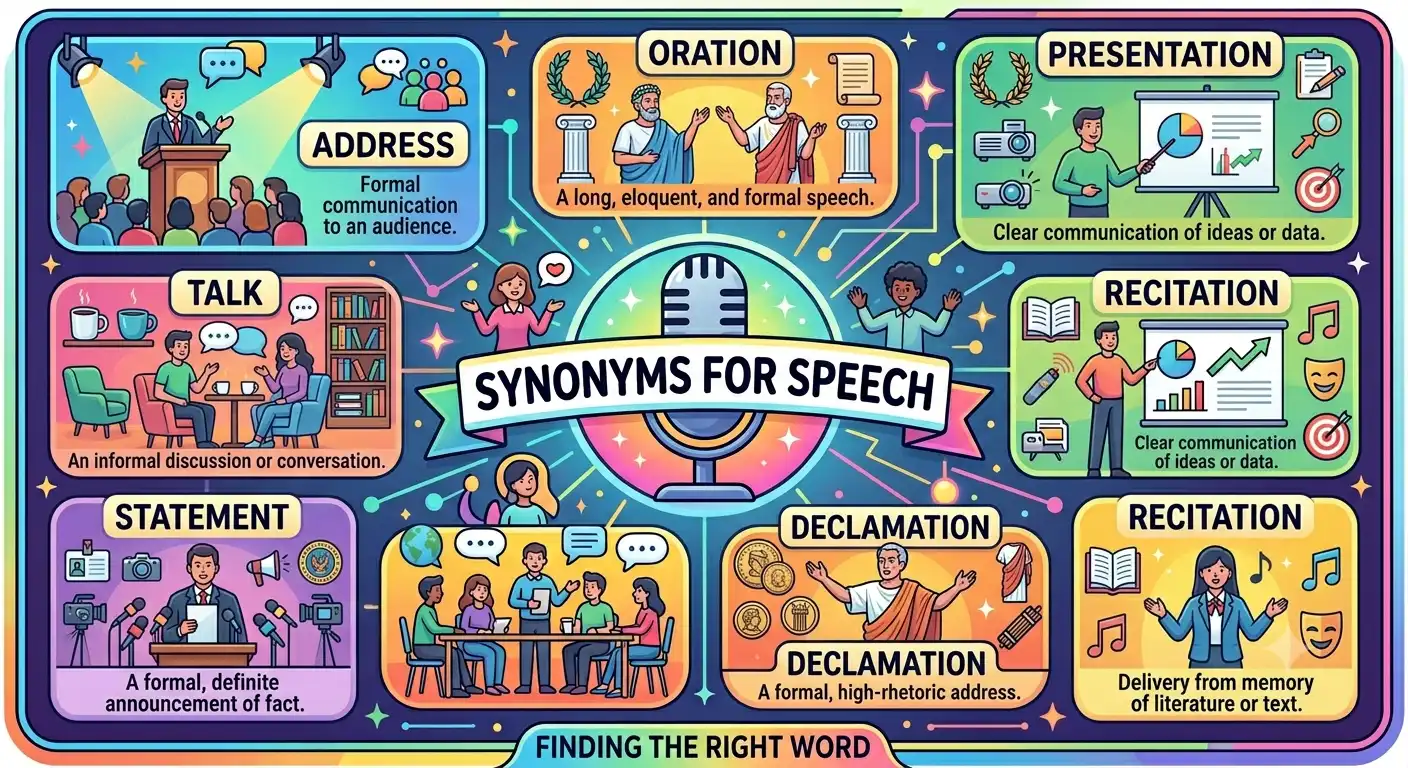
Learning the best synonyms for speech will make your writing clean and clear. When you use other synonyms for speech, your readers learn faster. Knowing different synonyms for speech helps you share ideas easily in school essays, emails, or blogs.
Imagine a girl named Clara. Clara wants to give a beautiful talk to her classmates. She tells her friends that she has an exciting message to share. By using a fresh word, Clara makes her message fun and exciting to hear. This simple shift keeps her classmates listening right away.
“Speech is power: speech is to persuade, to convert, to compel.” — Ralph Waldo Emerson
The term synonyms for speech means different words that show how we speak, share news, and connect with other people.
“Kind words can be short and easy to speak, but their echoes are truly endless.” — Mother Teresa
These words are very helpful for many people:
- Students can write better class papers and get top grades.
- Bloggers can keep their readers happy with simple, fresh words.
- Content writers can make businesses sound smart and modern.
- Daily English users can chat with friends without repeating the same word.
Linguistic Analysis of “Speech”
This section shows how the word “speech” works in the English language.
Connotative Meaning
The word “speech” carries a feeling of voice, truth, and community. It makes us think of big stages, quiet chats, and shared human connections.
Etymology
- Origin: From the Old English word spǣc (meaning “talk” or “language”).
- History: Linked to the West Germanic word sprekan (meaning “to speak”), which grew into modern English to describe both the act of speaking and formal talks.
Pronunciation
- US IPA: /spiːtʃ/
- UK IPA: /spiːtʃ/
Syllables
The word has only one syllable: speech.
Affixation Pattern
- Speech: Base root noun derived directly from the verb “speak.”
Synonym Comparison Table
This table helps you choose the exact word you need. It compares some of the most common words that mean speech.
| Keyword | Meaning | Usage Type | Context |
|---|---|---|---|
| Address | A formal talk given to a large crowd | Formal | School, work, government meetings |
| Talk | A casual or friendly chat with others | Casual | Family dinners, coffee shops, friendly meets |
| Lecture | A long lesson taught by a teacher | Professional | College classes, training rooms, study halls |
| Dialogue | A conversation between two or more people | Professional | Business talks, book scripts, team chats |
| Oration | A powerful and grand public speech | Formal | Holiday events, political stages, historic talks |
Master Your Vocabulary Today (Search Intent Hub)
- Informational: Read our complete list of 50 synonyms below to find the exact word you need.
- Commercial: To check your writing style and flow, we highly recommend using tools like the Hemingway Editor or Grammarly to compare word choices.
- Navigational: To find deep academic definitions, you can visit the official Merriam-Webster Thesaurus or the Oxford English Dictionary.
- Transactional: Ready to boost your communication skills instantly? $$Download our Free Speech Synonyms Cheat Sheet PDF$$ or subscribe to our free weekly vocabulary email newsletter below!
50 Synonyms for “Speech”
Here is your complete list of 50 synonyms to use in your writing and speech.
1. Address
Pronunciation: of address (US: /əˈdres/ & UK: /əˈdres/ – IPA).
Meaning: This is a formal talk given to a large group of people.
Examples:
- The leader gave a warm address to the nation.
- Our principal wrote an address for the new students.
2. Talk
Pronunciation: of talk (US: /tɔːk/ & UK: /tɔːk/ – IPA).
Meaning: This is an informal or friendly chat about a topic.
Examples:
- We had a nice talk about our holiday plans.
- The scientist gave a short talk about stars.
3. Lecture
Pronunciation: of lecture (US: /ˈlek.tʃɚ/ & UK: /ˈlek.tʃə/ – IPA).
Meaning: This is an educational talk given to a class or group.
Examples:
- The history lecture was very long but interesting.
- She wrote down notes during the science lecture.
4. Presentation
Pronunciation: of presentation (US: /ˌprez.ənˈteɪ.ʃən/ & UK: /ˌprez.ənˈteɪ.ʃən/ – IPA).
Meaning: This is a talk where you show and explain new facts.
Examples:
- He gave a beautiful presentation about green energy.
- My slide presentation was ready for the big meeting.
5. Oration
Pronunciation: of oration (US: /ɔːˈreɪ.ʃən/ & UK: /ɔːˈreɪ.ʃən/ – IPA).
Meaning: This is a grand and formal public talk.
Examples:
- The mayor delivered a powerful oration at the park.
- Her famous school oration won a gold medal.
6. Discourse
Pronunciation: of discourse (US: /ˈdɪs.kɔːrs/ & UK: /ˈdɪs.kɔːs/ – IPA).
Meaning: This is a serious talk or piece of writing about a topic.
Examples:
- They held a long discourse about world peace.
- His deep discourse helped us understand the law.
7. Sermon
Pronunciation: of sermon (US: /ˈsɝː.mən/ & UK: /ˈsɜː.mən/ – IPA).
Meaning: This is a religious talk about good behavior.
Examples:
- The pastor gave a kind sermon on Sunday morning.
- We listened to a gentle sermon about helping neighbors.
8. Pitch
Pronunciation: of pitch (US: /pɪtʃ/ & UK: /pɪtʃ/ – IPA).
Meaning: This is a quick talk meant to sell something.
Examples:
- The young team gave their business pitch to the judges.
- His sales pitch was very smart and clear.
9. Monologue
Pronunciation: of monologue (US: /ˈmɑː.nə.lɑːɡ/ & UK: /ˈmɒn.ə.lɒɡ/ – IPA).
Meaning: This is a long talk by just one person.
Examples:
- The actor spoke a funny monologue on the stage.
- I listened to her monologue without saying a word.
10. Keynote
Pronunciation: of keynote (US: /ˈkiː.noʊt/ & UK: /ˈkiː.nəʊt/ – IPA).
Meaning: This is the main talk at a big conference.
Examples:
- She is preparing the keynote for the technology show.
- The guest speaker gave a wonderful keynote on Friday.
11. Conversation
Pronunciation: of conversation (US: /ˌkɑːn.vɚˈseɪ.ʃən/ & UK: /ˌkɒn.vəˈseɪ.ʃən/ – IPA).
Meaning: This is a friendly talk between two or more people.
Examples:
- We enjoyed our warm conversation over hot tea.
- He started a fun conversation about comic books.
12. Chat
Pronunciation: of chat (US: /tʃæt/ & UK: /tʃæt/ – IPA).
Meaning: This is a very light and quick talk.
Examples:
- I had a quick chat with my mom today.
- Let’s have a cozy chat on the porch.
13. Dialogue
Pronunciation: of dialogue (US: /ˈdaɪ.ə.lɑːɡ/ & UK: /ˈdaɪ.ə.lɒɡ/ – IPA).
Meaning: This is a formal discussion to solve a problem.
Examples:
- The two nations started a peaceful dialogue.
- We need open dialogue to settle our small fights.
14. Discussion
Pronunciation: of discussion (US: /dɪˈskʌʃ.ən/ & UK: /dɪˈskʌʃ.ən/ – IPA).
Meaning: This is a talk where people share different ideas.
Examples:
- Our class had a great discussion about nature.
- The family discussion helped us choose a pet.
15. Utterance
Pronunciation: of utterance (US: /ˈʌt̬.ɚ.əns/ & UK: /ˈʌt.ər.əns/ – IPA).
Meaning: This is any spoken word or sound.
Examples:
- Her very first utterance was the word “mama.”
- He did not make a single utterance during the play.
16. Voice
Pronunciation: of voice (US: /vɔɪs/ & UK: /vɔɪs/ – IPA).
Meaning: This is the sound you make when you speak.
Examples:
- She has a very soft and sweet voice.
- We could hear his loud voice from the kitchen.
17. Language
Pronunciation: of language (US: /ˈlæŋ.ɡwɪdʒ/ & UK: /ˈlæŋ.ɡwɪdʒ/ – IPA).
Meaning: This is the system of words people use to communicate.
Examples:
- She speaks more than one language at home.
- Sign language is a beautiful way to talk.
18. Dialect
Pronunciation: of dialect (US: /ˈdaɪ.ə.lekt/ & UK: /ˈdaɪ.ə.lekt/ – IPA).
Meaning: This is a local form of a spoken language.
Examples:
- He speaks a warm southern dialect of English.
- They understand the local dialect of the mountain village.
19. Tongue
Pronunciation: of tongue (US: /tʌŋ/ & UK: /tʌŋ/ – IPA).
Meaning: This is another word for a spoken language.
Examples:
- Spanish is her native tongue and she loves it.
- He speaks a very rare tongue from his homeland.
20. Words
Pronunciation: of words (US: /wɝːdz/ & UK: /wɜːdz/ – IPA).
Meaning: These are the sounds we write or speak to share ideas.
Examples:
- His kind words made me feel very happy.
- Please choose your words carefully during the test.
21. Vocalization
Pronunciation: of vocalization (US: /ˌvoʊ.kə.lɪˈzeɪ.ʃən/ & UK: /ˌvəʊ.kə.laɪˈzeɪ.ʃən/ – IPA).
Meaning: This is the act of making sounds with your throat.
Examples:
- The baby made a happy vocalization during bath time.
- We listened to the birds make a sweet vocalization.
22. Pronouncement
Pronunciation: of pronouncement (US: /prəˈnaʊns.mənt/ & UK: /prəˈnaʊns.mənt/ – IPA).
Meaning: This is an official or grand statement.
Examples:
- The king made a grand pronouncement to the crowd.
- We waited for the judge to make a pronouncement.
23. Statement
Pronunciation: of statement (US: /ˈsteɪt.mənt/ & UK: /ˈsteɪt.mənt/ – IPA).
Meaning: This is a clear speech that tells people facts.
Examples:
- The company sent out a clean statement to the press.
- She read her written statement to the court.
24. Toast
Pronunciation: of toast (US: /toʊst/ & UK: /təʊst/ – IPA).
Meaning: This is a short speech to honor someone at a party.
Examples:
- He raised his glass to give a wedding toast.
- Her toast to the birthday girl made everyone smile.
25. Eulogy
Pronunciation: of eulogy (US: /ˈjuː.lə.dʒi/ & UK: /ˈjuː.lə.dʒi/ – IPA).
Meaning: This is a speech that praises someone who recently died.
Examples:
- He gave a beautiful eulogy for his grandfather.
- Her sweet eulogy brought tears to our eyes.
“A speech is like a love affair. Any fool can start one, but to end it requires considerable skill.” — Lord Mancroft
26. Briefing
Pronunciation: of briefing (US: /ˈbriː.fɪŋ/ & UK: /ˈbriː.fɪŋ/ – IPA).
Meaning: This is a short talk that gives key facts quickly.
Examples:
- The captain gave a quick safety briefing before we flew.
- We went to the morning briefing in the main office.
27. Seminar
Pronunciation: of seminar (US: /ˈsem.ə.nɑːr/ & UK: /ˈsem.ɪ.nɑː/ – IPA).
Meaning: This is a class or meeting for discussion and learning.
Examples:
- I went to an online seminar about writing books.
- The health seminar taught us how to eat well.
28. Homily
Pronunciation: of homily (US: /ˈhɑː.mə.li/ & UK: /ˈhɒm.ɪ.li/ – IPA).
Meaning: This is a short, simple sermon or moral talk.
Examples:
- The priest gave a comforting homily about kindness.
- We listened to a brief homily during the service.
29. Soliloquy
Pronunciation: of soliloquy (US: /səˈlɪl.ə.kwi/ & UK: /səˈlɪl.ə.kwi/ – IPA).
Meaning: This is a speech where an actor talks to themselves.
Examples:
- Hamlet spoke a very famous soliloquy on the dark stage.
- She practiced her dramatic soliloquy in the mirror.
30. Declamation
Pronunciation: of declamation (US: /ˌdek.ləˈmeɪ.ʃən/ & UK: /ˌdek.ləˈmeɪ.ʃən/ – IPA).
Meaning: This is a loud, artistic, and powerful speech.
Examples:
- His poetic declamation won first prize at school.
- She delivered her declamation with great passion.
31. Colloquy
Pronunciation: of colloquy (US: /ˈaʊ.t̬ɚ.ki/ & UK: /ˈkɒl.ə.kwi/ – IPA).
Meaning: This is a formal conversation or high-level talk.
Examples:
- The leaders held a private colloquy in the library.
- We enjoyed a quiet colloquy about old books.
32. Chatter
Pronunciation: of chatter (US: /ˈtʃæt̬.ɚ/ & UK: /ˈtæt.ə/ – IPA).
Meaning: This is quick, friendly, and non-stop talk.
Examples:
- The happy chatter of children filled the room.
- I love the morning chatter of the backyard birds.
33. Gossip
Pronunciation: of gossip (US: /ˈɡɑː.səp/ & UK: /ˈɡɒs.ɪp/ – IPA).
Meaning: This is casual talk about other people’s lives.
Examples:
- We do not listen to mean gossip at school.
- She told us some harmless gossip about the movie star.
34. Babble
Pronunciation: of babble (US: /ˈbæb.əl/ & UK: /ˈbæb.əl/ – IPA).
Meaning: This is fast talk that is hard to understand.
Examples:
- The sweet baby’s babble made the family laugh.
- I could hear the distant babble of the happy crowd.
35. Accent
Pronunciation: of accent (US: /ˈæk.sent/ & UK: /ˈæk.sent/ – IPA).
Meaning: This is the unique way a person pronounces words.
Examples:
- She has a lovely and warm Irish accent.
- He speaks with a clear, soft British accent.
36. Pronunciation
Pronunciation: of pronunciation (US: /prəˌnʌn.siˈeɪ.ʃən/ & UK: /prəˌnʌn.siˈeɪ.ʃən/ – IPA).
Meaning: This is the correct way to say a word.
Examples:
- The online dictionary shows the exact pronunciation of words.
- She has a very clear pronunciation of Spanish names.
37. Tone
Pronunciation: of tone (US: /toʊn/ & UK: /təʊn/ – IPA).
Meaning: This is the feeling or mood in a person’s voice.
Examples:
- His friendly tone made the new boy feel safe.
- Please use a polite tone when you talk to teachers.
38. Expression
Pronunciation: of expression (US: /ɪkˈspreʃ.ən/ & UK: /ɪkˈspreʃ.ən/ – IPA).
Meaning: This is the act of showing your thoughts in words.
Examples:
- Art is a wonderful expression of human feelings.
- She found freedom in the expression of her ideas.
39. Delivery
Pronunciation: of delivery (US: /dɪˈlɪv.ɚ.i/ & UK: /dɪˈlɪv.ər.i/ – IPA).
Meaning: This is the way a speaker stands and talks to a crowd.
Examples:
- Her smooth delivery made the difficult lesson easy.
- He practiced his voice delivery for the big play.
40. Diction
Pronunciation: of diction (US: /ˈdɪk.ʃən/ & UK: /ˈdɪk.ʃən/ – IPA).
Meaning: This is the clear choice and use of words in speech.
Examples:
- The singer has very clear diction so we hear every word.
- Good actors work hard to improve their diction.
41. Slang
Pronunciation: of slang (US: /slæŋ/ & UK: /slæŋ/ – IPA).
Meaning: These are informal words used by specific groups.
Examples:
- The teenagers used cool slang that I did not know.
- Avoid using local slang in your formal school essays.
42. Phrase
Pronunciation: of phrase (US: /freɪz/ & UK: /freɪz/ – IPA).
Meaning: This is a small group of words spoken together.
Examples:
- She repeated the sweet phrase to help her relax.
- “Thank you” is a wonderful phrase to use every day.
43. Parlance
Pronunciation: of parlance (US: /ˈpɑːr.ləns/ & UK: /ˈpɑː.ləns/ – IPA).
Meaning: This is a specific way of speaking used by a group.
Examples:
- In legal parlance, this word has a different meaning.
- He learned the technical parlance of computer programmers.
44. Articulation
Pronunciation: of articulation (US: /ɑːrˌtɪk.jəˈleɪ.ʃən/ & UK: /ɑːˌtɪk.jəˈleɪ.ʃən/ – IPA).
Meaning: This is the clear and neat sounding of words.
Examples:
- The teacher praised her beautiful articulation of the poem.
- Good articulation helps everyone understand your voice.
45. Verbiage
Pronunciation: of verbiage (US: /ˈvɝː.bi.ɪdʒ/ & UK: /ˈvɜː.bi.ɪdʒ/ – IPA).
Meaning: This is an overabundance of words in speech.
Examples:
- The report was full of confusing legal verbiage.
- We cut the extra verbiage to make the message clear.
46. Communication
Pronunciation: of communication (US: /kəˌmjuː.nəˈkeɪ.ʃən/ & UK: /kəˌmjuː.nɪˈkeɪ.ʃən/ – IPA).
Meaning: This is the act of sharing information with others.
Examples:
- Clear communication helps teams work fast and well.
- Email is a very popular form of modern communication.
47. Report
Pronunciation: of report (US: /rɪˈpɔːrt/ & UK: /rɪˈpɔːt/ – IPA).
Meaning: This is a speech or paper that explains facts.
Examples:
- He gave his school report on green forests today.
- The weather report says we will have rain tomorrow.
48. Announcement
Pronunciation: of announcement (US: /əˈnaʊns.mənt/ & UK: /əˈnaʊns.mənt/ – IPA).
Meaning: This is a public statement that gives new facts.
Examples:
- We heard the train announcement over the loud speaker.
- The teacher made a fun announcement about the field trip.
49. Remarks
Pronunciation: of remarks (US: /rɪˈmɑːrks/ & UK: /rɪˈmɑːks/ – IPA).
Meaning: These are quick, short comments spoken to others.
Examples:
- The boss made a few positive remarks about our work.
- She sat down after her brief closing remarks.
50. Say
Pronunciation: of say (US: /seɪ/ & UK: /seɪ/ – IPA).
Meaning: This is a person’s chance to speak or share an opinion.
Examples:
- Every student should have a say in the classroom rules.
- Let him finish his say before you ask questions.
Antonyms of “Speech”
When there is no communication, we use these antonyms:
- Silence: The total lack of sound or communication.
- Quiet: A peaceful place with no noise or spoken words.
- Muteness: The state of not being able to speak or make sound.
- Stillness: A calm state with no motion or voice.
- Dumbness: The temporary or permanent loss of speech.
Prototype Meaning and Categorization of “Speech”
In cognitive linguistics, words group together in our minds. The main class for “speech” is “Verbal Expression.”
Verbal Expression (Main Class)
   |
   +-- Formal Talks (e.g., Address, Lecture, Oration, Sermon, Presentation, Keynote)
   |
   +-- Verbal Interaction (e.g., Conversation, Chat, Dialogue, Discussion, Chatter)
   |
   +-- Voice & Style (e.g., Accent, Pronunciation, Tone, Delivery, Diction, Articulation)
   |
   +-- Spoken Systems (e.g., Language, Dialect, Tongue, Slang, Parlance)
By sorting these words into groups, you can easily choose the right word for your sentence.
Frequently Asked Questions
The word speech can be both singular and plural. We say “one speech” or “many speeches” depending on the count.
Speech is the physical sound we make with our mouths. Language is the system of words and rules we hold in our minds.
No. Slang is very casual. You should use it only with close friends and avoid it in school papers.
They stop you from repeating the word “speech” over and over. This makes your sentences fun, fresh, and beautiful to read.
Yes. A warm tone makes people feel happy, while a sharp tone can make listeners upset or scared.
An address is a formal talk for a large crowd at a special event. A lecture is a teaching talk to help students learn.
Conclusion
Learning synonyms for speech is a great way to grow your English skills today. When you know more words, your writing becomes beautiful. Your blog posts will keep your readers excited. Your spoken stories will sound clear, warm, and highly powerful.
“Words have incredible power to build up or to tear down.” — Unknown
We encourage you to practice these terms as much as you can. Try to use them when you write daily emails to colleagues. Use them in your school essays to get better grades. Use them in your everyday conversations to share your thoughts easily with others.
“Speak clearly, if you speak at all; carve every word before you let it fall.” — Oliver Wendell Holmes Sr.
Choosing the right word shows that you are a smart communicator. Start using these new words today, and watch your English skills soar!

Andrew Collins is an academic English educator with over 12 years of experience helping university students, IELTS candidates, and ESL learners improve their writing vocabulary.