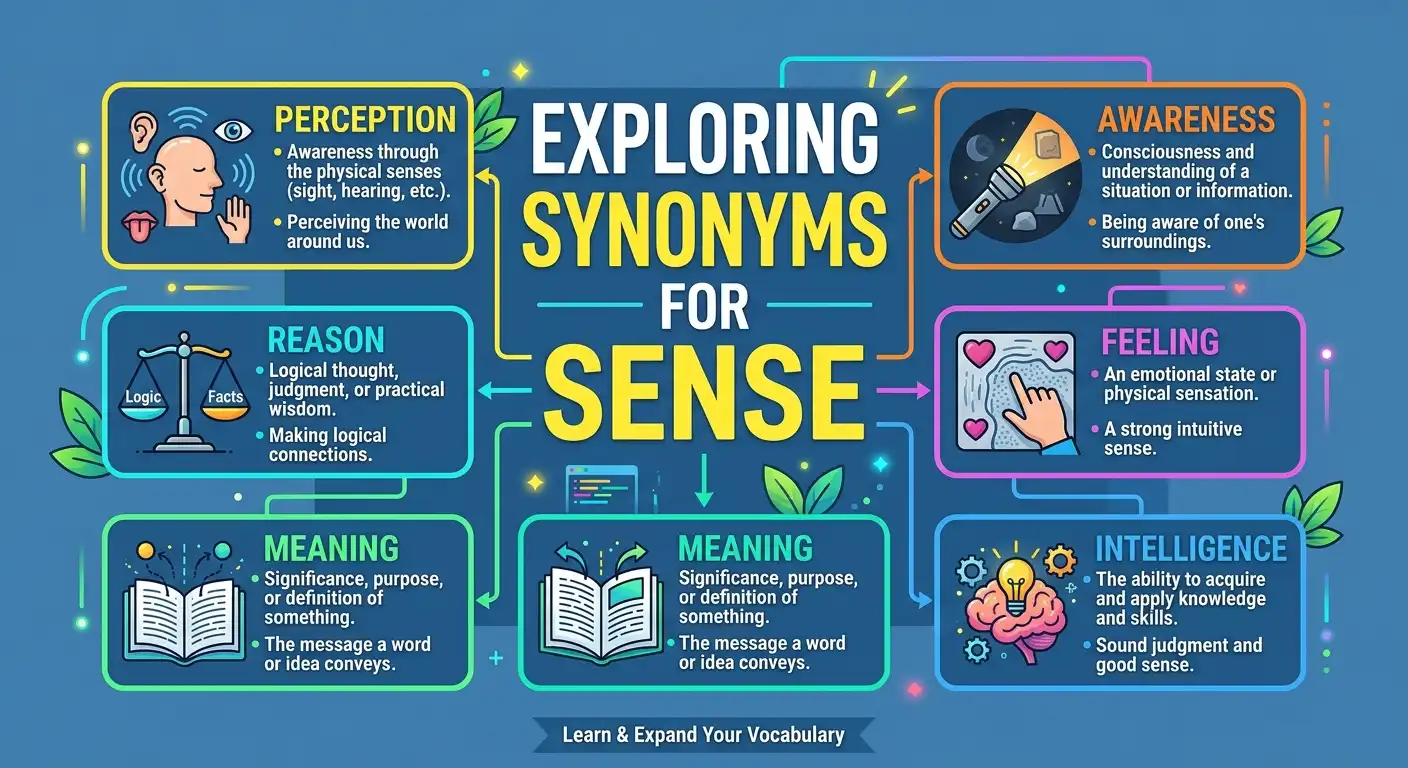
Searching for synonyms for sense helps you find the exact word to express human feeling, logic, or meaning. When you learn different synonyms for sense, you can describe physical feelings, smart decisions, or core ideas easily. Using clear synonyms for sense makes your speaking and writing far more vivid, accurate, and easy to understand.
Imagine walking into a bakery and smelling fresh bread right out of the oven. Your brain immediately understands that warm, delicious smell. That quick physical and mental reaction is what we call sense. You can describe this feeling or thought using words like perception, awareness, logic, or feeling.
“Common sense is in spite of, not as the result of, education.” — Victor Hugo
Using different words for sense is very helpful for:
- Students: Express complex ideas clearly in school essays and exams.
- Bloggers: Connect with readers using simple, engaging, and varied words.
- Content Writers: Craft sharp copy that clearly conveys product benefits and ideas.
- Daily English Users: Speak naturally and build confidence in everyday conversations.
“The eye sees only what the mind is prepared to comprehend.” — Robertson Davies
Word Profile: Sense
Connotative Meaning
The word sense carries a neutral to highly positive feeling. It describes physical awareness (like touch or sight), mental ability (good judgment and clear thinking), or the deeper meaning behind words and actions.
Etymology (Origin)
- Latin Root: Sensus (meaning “feeling, perception, or meaning”)
- Latin Root: Sentire (meaning “to feel or to perceive”)
- Old French: Entered Middle English as sens in the 14th century.
- Original Meaning: “Ability to feel or perceive physical surroundings.”
Pronunciation
- US IPA: /sɛns/
- UK IPA: /sens/
Syllables & Affixation
- Syllables: sense (1 syllable)
- Root: Sense (feel / perceive)
- Suffix: None (Base noun/verb)
Comparison Table: Popular Synonyms for Sense
| Keyword | Meaning | Usage Type | Context |
| Sense | Ability to feel, understand, or think logically. | General / Neutral | Everyday life, feelings, decisions |
| Perception | How you notice or interpret things around you. | Formal / Academic | Science, psychology, personal views |
| Logic | Clear and step-by-step thinking based on facts. | Professional / Intellectual | Problem-solving, math, debates |
| Intuition | Knowing something instinctively without proof. | Emotional / Personal | Hunches, gut feelings, relationships |
| Meaning | The idea or intent behind a message or word. | Casual / Educational | Reading, conversations, definitions |
| Sanity | A healthy and stable state of mind. | Serious / Medical | Stress, decision-making, mental health |
| Awareness | Knowledge that something exists around you. | Neutral / Casual | Safety, learning, social life |
50 Best Synonyms for Sense
1. Perception
- Pronunciation: US: /pɚˈsɛp.ʃən/ | UK: /pəˈsep.ʃən/
- Meaning: The way you notice or understand things through your senses.
- Examples:
- Her perception of the room helped her spot the lost key.
- Cold weather can change your perception of distance.
2. Feeling
- Pronunciation: US: /ˈfiː.lɪŋ/ | UK: /ˈfiː.lɪŋ/
- Meaning: An emotion or physical touch that you experience.
- Examples:
- He had a warm feeling of joy in his heart.
- Soft grass gives a pleasant feeling under your bare feet.
3. Awareness
- Pronunciation: US: /əˈwɛr.nəs/ | UK: /əˈweə.nəs/
- Meaning: Knowing or realizing that something exists around you.
- Examples:
- She showed great awareness while driving in heavy rain.
- Raising awareness helps keep our public parks clean.
4. Intellect
- Pronunciation: US: /ˈɪn.t̬ə.lɛkt/ | UK: /ˈɪn.tə.lekt/
- Meaning: The power of your mind to think and learn new things.
- Examples:
- The young girl used her intellect to solve the hard puzzle.
- Reading books builds your intellect over time.
5. Reason
- Pronunciation: US: /ˈriː.zən/ | UK: /ˈriː.zən/
- Meaning: The ability to think clearly and make fair choices.
- Examples:
- She used good reason to settle the small argument.
- There is a clear reason for every safety rule.
6. Logic
- Pronunciation: US: /ˈlɑː.dʒɪk/ | UK: /ˈlɒdʒ.ɪk/
- Meaning: Sensible thinking that follows clear steps and facts.
- Examples:
- Simple logic helps you solve easy math problems.
- His plan makes sense because it uses sound logic.
7. Meaning
- Pronunciation: US: /ˈmiː.nɪŋ/ | UK: /ˈmiː.nɪŋ/
- Meaning: What a word, idea, or action represents to you.
- Examples:
- Look up the word in a dictionary to find its true meaning.
- Her sweet gesture had a deep meaning for her friend.
8. Wisdom
- Pronunciation: US: /ˈwɪz.dəm/ | UK: /ˈwɪz.dəm/
- Meaning: Good judgment that comes from experience and learning.
- Examples:
- The old teacher shared his wisdom with the new students.
- She showed great wisdom by saving her money early.
9. Instinct
- Pronunciation: US: /ˈɪn.stɪŋkt/ | UK: /ˈɪn.stɪŋkt/
- Meaning: A natural feeling that guides actions without thinking.
- Examples:
- Mothers have a strong instinct to protect their babies.
- My first instinct was to pull my hand back from the stove.
10. Sensation
- Pronunciation: US: /sɛnˈseɪ.ʃən/ | UK: /senˈseɪ.ʃən/
- Meaning: A physical feeling caused by something touching your body.
- Examples:
- Cold ice gives a sharp sensation on warm skin.
- She felt a light tingling sensation in her fingers.
11. Understanding
- Pronunciation: US: /ˌʌn.dɚˈstæn.dɪŋ/ | UK: /ˌʌn.dəˈstæn.dɪŋ/
- Meaning: Knowledge about how something works or why it happens.
- Examples:
- He has a complete understanding of how cars work.
- Showing understanding makes it easy to help others.
12. Sanity
- Pronunciation: US: /ˈsæn.ə.ti/ | UK: /ˈsæn.ə.ti/
- Meaning: A healthy mind that can think and act normally.
- Examples:
- Taking quiet walks helps preserve your peace and sanity.
- He kept his sanity despite working long hours.
13. Judgment
- Pronunciation: US: /ˈdʒʌdʒ.mənt/ | UK: /ˈdʒʌdʒ.mənt/
- Meaning: The ability to form smart opinions and make good choices.
- Examples:
- You can trust her judgment when picking a good book.
- Good judgment comes from learning through practice.
14. Intuition
- Pronunciation: US: /ˌɪn.tuːˈɪʃ.ən/ | UK: /ˌɪn.tjuːˈɪʃ.ən/
- Meaning: Knowing something automatically without needing written proof.
- Examples:
- Trust your intuition when making a quick decision.
- Her intuition told her that rain was coming soon.
15. Significance
- Pronunciation: US: /sɪɡˈnɪf.ə.kəns/ | UK: /sɪɡˈnɪf.ɪ.kəns/
- Meaning: The special value, importance, or meaning of something.
- Examples:
- We celebrated the historical significance of the old building.
- He explained the significance of the new family rule.
16. Gist
- Pronunciation: US: /dʒɪst/ | UK: /dʒɪst/
- Meaning: The main point or central idea of a story.
- Examples:
- I did not read every page, but I got the main gist.
- She explained the gist of the speech in two short lines.
17. Wit
- Pronunciation: US: /wɪt/ | UK: /wɪt/
- Meaning: Quick and clever mental power to think and speak.
- Examples:
- His quick wit always makes people laugh at lunch.
- She used her sharp wit to solve the riddle.
18. Brains
- Pronunciation: US: /breɪnz/ | UK: /breɪnz/
- Meaning: Intelligence or smart thinking power inside your head.
- Examples:
- It takes real brains to build a fast computer.
- She has the brains needed to pass any tough test.
19. Mind
- Pronunciation: US: /maɪnd/ | UK: /maɪnd/
- Meaning: The part of a person that thinks, feels, and remembers.
- Examples:
- Keep an open mind when trying new food.
- Reading keeps your mind active and strong.
20. Insight
- Pronunciation: US: /ˈɪn.saɪt/ | UK: /ˈɪn.saɪt/
- Meaning: A clear and deep understanding of a complex problem.
- Examples:
- The chart gave us clear insight into customer needs.
- Her brief talk provided valuable insight into history.
21. Impression
- Pronunciation: US: /ɪmˈprɛʃ.ən/ | UK: /ɪmˈpreʃ.ən/
- Meaning: An idea or feeling you get about someone or something.
- Examples:
- A warm smile leaves a good first impression.
- I got the impression that she enjoyed the movie.
22. Clue
- Pronunciation: US: /kluː/ | UK: /kluː/
- Meaning: A piece of information that helps you understand something.
- Examples:
- The footprint gave a helpful clue to the detective.
- He did not have a single clue about the surprise party.
23. Consciousness
- Pronunciation: US: /ˈkɑːn.ʃəs.nəs/ | UK: /ˈkɒn.ʃəs.nəs/
- Meaning: The state of being awake and aware of your surroundings.
- Examples:
- The patient slowly regained consciousness after sleeping.
- Music entered her consciousness as she woke up.
24. Point
- Pronunciation: US: /pɔɪnt/ | UK: /pɔɪnt/
- Meaning: The core purpose or main meaning of an action or message.
- Examples:
- Please speak clearly and get right to the point.
- What is the point of waiting in this long line?
25. Drift
- Pronunciation: US: /drɪft/ | UK: /drɪft/
- Meaning: The general meaning or direction of what someone is saying.
- Examples:
- I caught the drift of his story even without full detail.
- If you follow my drift, we should leave before dark.
26. Substance
- Pronunciation: US: /ˈsʌb.stəns/ | UK: /ˈsʌb.stəns/
- Meaning: Real meaning, solid worth, or true truth in a message.
- Examples:
- Her short report was full of useful facts and substance.
- There is no real substance to these rumors.
27. Smartness
- Pronunciation: US: /ˈsmɑːrt.nəs/ | UK: /ˈsmɑːt.nəs/
- Meaning: The state of being clever, quick, and intelligent.
- Examples:
- His smartness helped him finish the job early.
- She showed great smartness during the math quiz.
28. Practicality
- Pronunciation: US: /ˌpræk.tɪˈkæl.ə.ti/ | UK: /ˌpræk.tɪˈkæl.ə.ti/
- Meaning: Focus on real-world usefulness rather than decorative ideas.
- Examples:
- Choose boots for their comfort and practicality.
- Her practicality kept the project on budget.
29. Discrimination
- Pronunciation: US: /dɪˌskrɪm.əˈneɪ.ʃən/ | UK: /dɪˌskrɪm.ɪˈneɪ.ʃən/
- Meaning: The ability to judge quality and notice subtle differences.
- Examples:
- He shows fine discrimination when picking high-quality fruit.
- Good art critics read with great care and discrimination.
30. Acumen
- Pronunciation: US: /əˈkjuː.mən/ | UK: /ˈæk.jʊ.mən/
- Meaning: The skill to make fast, smart decisions in specific areas.
- Examples:
- Her business acumen helped the small shop succeed.
- He is famous for his keen financial acumen.
31. Sharpness
- Pronunciation: US: /ˈʃɑːrp.nəs/ | UK: /ˈʃɑːp.nəs/
- Meaning: High mental quickness or acute physical sensing power.
- Examples:
- Eagles are famous for the sharpness of their eyes.
- His mental sharpness remained strong into old age.
32. Cleverness
- Pronunciation: US: /ˈklɛv.ɚ.nəs/ | UK: /ˈklev.ə.nəs/
- Meaning: The ability to learn, understand, or invent things easily.
- Examples:
- The fox used its cleverness to find extra food.
- Her cleverness made the hard task look easy.
“Good sense is of all things in the world the most equally distributed.” — René Descartes
33. Recognition
- Pronunciation: US: /ˌrɛk.əɡˈnɪʃ.ən/ | UK: /ˌrek.əɡˈnɪʃ.ən/
- Meaning: Knowing who or what someone is when you see them.
- Examples:
- He gave a warm smile of recognition to his friend.
- Quick recognition of signs keeps drivers safe.
34. Hunch
- Pronunciation: US: /hʌntʃ/ | UK: /hʌntʃ/
- Meaning: A strong belief or feeling about something without full proof.
- Examples:
- I had a strong hunch that our team would win today.
- She followed a simple hunch and found the missing key.
35. Vibe
- Pronunciation: US: /vaɪb/ | UK: /vaɪb/
- Meaning: The mood or emotional feeling a place or person gives off.
- Examples:
- The friendly coffee shop has a warm and peaceful vibe.
- I got a good vibe from the new neighbor.
36. Intention
- Pronunciation: US: /ɪnˈtɛn.ʃən/ | UK: /ɪnˈten.ʃən/
- Meaning: An aim, purpose, or clear plan in your mind.
- Examples:
- She had every intention of finishing her homework early.
- His kind intention was to bring lunch for everyone.
37. Direction
- Pronunciation: US: /dəˈrɛk.ʃən/ | UK: /daɪˈrek.ʃən/
- Meaning: The general course or path that thoughts or plans take.
- Examples:
- Her clear speech gave good direction to the team.
- We need a new direction for our group project.
38. Purpose
- Pronunciation: US: /ˈpɝː.pəs/ | UK: /ˈpɜː.pəs/
- Meaning: The main reason why something is created or done.
- Examples:
- What is the main purpose of this small tool?
- She works with great energy and clear purpose.
39. Implication
- Pronunciation: US: /ˌɪm.pləˈkeɪ.ʃən/ | UK: /ˌɪm.plɪˈkeɪ.ʃən/
- Meaning: A suggested meaning that is not said directly out loud.
- Examples:
- I understood the quiet implication of his words.
- The article has a clear implication for safety.
40. Taste
- Pronunciation: US: /teɪst/ | UK: /teɪst/
- Meaning: The ability to notice, appreciate, and choose good things.
- Examples:
- She has excellent taste in art and home design.
- Good taste in music comes from listening widely.
41. Sensitivity
- Pronunciation: US: /ˌsɛn.səˈtɪv.ə.ti/ | UK: /ˌsen.sɪˈtɪv.ə.ti/
- Meaning: The quality of being aware of small feelings and changes.
- Examples:
- He handled the quiet issue with great sensitivity.
- Her skin has a high sensitivity to cold wind.
42. Tact
- Pronunciation: US: /tækt/ | UK: /tækt/
- Meaning: The skill to say or do things without offending others.
- Examples:
- She used great tact when pointing out the small mistake.
- Speaking with tact keeps relationships peaceful and happy.
43. Thought
- Pronunciation: US: /θɑːt/ | UK: /θɔːt/
- Meaning: An idea, opinion, or mental picture formed in your mind.
- Examples:
- Give some careful thought to your next career move.
- That sweet thought made her smile all morning.
44. View
- Pronunciation: US: /vjuː/ | UK: /vjuː/
- Meaning: A personal opinion or way of looking at a topic.
- Examples:
- He shared his clear view on the new school rule.
- From my view, simple plans work best.
45. Realization
- Pronunciation: US: /ˌriː.əl.əˈzeɪ.ʃən/ | UK: /ˌrɪə.laɪˈzeɪ.ʃən/
- Meaning: The moment you suddenly understand or notice something clearly.
- Examples:
- A sudden realization helped her fix the broken code.
- His realization came after reading the full letter.
46. Comprehension
- Pronunciation: US: /ˌkɑːm.prəˈhɛn.ʃən/ | UK: /ˌkɒm.prɪˈhen.ʃən/
- Meaning: The mental power to understand language, facts, or ideas.
- Examples:
- Reading daily improves your reading comprehension skills.
- The story was beyond the comprehension of young kids.
47. Clarity
- Pronunciation: US: /ˈklær.ə.ti/ | UK: /ˈklær.ə.ti/
- Meaning: The quality of being clear, sharp, and easy to grasp.
- Examples:
- She spoke with great clarity so everyone understood.
- A good night of sleep brings mental clarity.
48. Rationality
- Pronunciation: US: /ˌræʃ.əˈnæl.ə.ti/ | UK: /ˌræʃ.ənˈæl.ə.ti/
- Meaning: The quality of basing choices on clear reasons and facts.
- Examples:
- Try to maintain rationality when making financial decisions.
- His rationality helped calm the worried group.
49. Balance
- Pronunciation: US: /ˈbæl.əns/ | UK: /ˈbæl.əns/
- Meaning: A calm mental state where thoughts and feelings stay steady.
- Examples:
- Good sleep helps you keep a healthy mental balance.
- Her inner balance kept her calm during the storm.
50. Shrewdness
- Pronunciation: US: /ˈʃruːd.nəs/ | UK: /ˈʃruːd.nəs/
- Meaning: Sharp practical smartness in making advantageous choices.
- Examples:
- His financial shrewdness saved the shop money.
- She showed great shrewdness when buying her first home.
Antonyms of Sense
To understand sense fully, it helps to look at its opposite words:
- Nonsense: Words or ideas that make no sense at all.
- Foolishness: Doing things without good thought or smart judgment.
- Absurdity: Something that is silly, strange, or completely illogical.
- Ignorance: A lack of knowledge, learning, or general awareness.
- Irrationality: Making choices based on wild feelings rather than facts.
Prototype Meaning and Categorization of Sense
We can organize these 50 synonyms into simple groups to help you choose the best word:
- Mental Logic & Wisdom (Smart Thinking):
- Logic, Reason, Intellect, Wisdom, Judgment, Sanity, Brains, Mind, Smartness, Acumen, Sharpness, Practicality, Rationality, Shrewdness, Cleverness, Wit, Discrimination.
- Physical Sensing & Feeling (Body & Mind):
- Perception, Feeling, Awareness, Sensation, Consciousness, Sensitivity, Realization, Comprehension, Clarity.
- Inner Hunches & Intuition (Instinctive Feeling):
- Instinct, Intuition, Impression, Hunch, Vibe, Taste, Tact, Balance.
- Central Meaning & Ideas (Core Intent):
- Meaning, Significance, Gist, Point, Drift, Substance, Insight, Clue, Recognition, Implication, Thought, View.
- Goal & Direction (Purposeful Drive):
- Intention, Direction, Purpose.
Frequently Asked Questions (FAQ)
What is the best synonym for common sense?
The best synonym for common sense is practicality, good judgment, or reason. These words show that a person uses simple, real-world logic to make choices.
Is “feeling” the exact same as “sense”?
Not always. Feeling often refers to emotions or direct physical touch. Sense is broader because it includes physical touch, mental logic, and overall awareness.
What synonym for sense works best in formal writing?
In academic or formal writing, words like perception, comprehension, acumen, or rationality work best to express mental power and clarity.
How do I choose the right synonym for sense in my essay?
Look at your sentence context. Use gist or meaning for text ideas, intuition or hunch for gut feelings, and logic or judgment for decisions.
What is the adjective form of sense?
The most common adjective forms are sensible (having good judgment) and sensitive (aware of small feelings or physical touches).
Conclusion
Building a strong vocabulary filled with synonyms for sense makes your writing much clearer and far more interesting. When you swap overused words with precise terms like perception, intuition, gist, or acumen, your content becomes far more enjoyable to read.
For students, bloggers, and content writers, using varied synonyms for sense keeps readers engaged from start to finish. Good communication relies on choosing the best word for every sentence. Start practicing these 50 synonyms for sense in your emails, essays, and daily conversations today!
“Logic will get you from A to B. Imagination will take you everywhere.” — Albert Einstein
“The ultimate value of life depends upon awareness and the power of contemplation rather than upon mere survival.” — Aristotle

Andrew Collins is an academic English educator with over 12 years of experience helping university students, IELTS candidates, and ESL learners improve their writing vocabulary.