Introduction
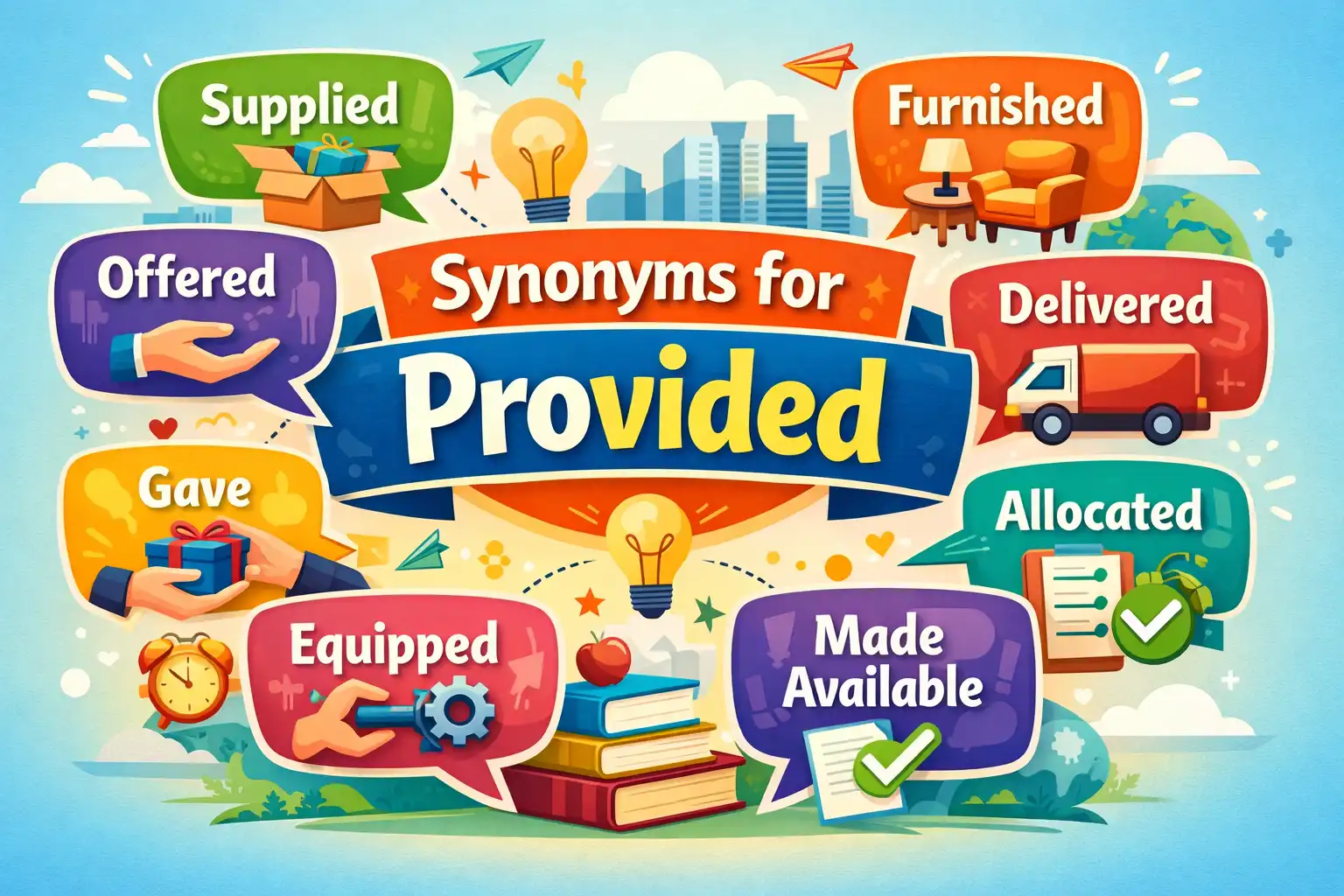
Synonyms for “provided” are words that carry the same or similar meaning as the word provided. The word provided means to give something to someone, to make something available, or to supply what is needed. When you say “She provided food for the guests,” you mean she gave or supplied food. Knowing synonyms for “provided” helps you say the same thing in fresh, interesting ways.
Think about a student writing the same school essay five times. Every sentence starts with “provided.” It feels boring. It sounds robotic. Now imagine that same student switching to words like offered, supplied, delivered, or granted. The writing comes alive. The reader stays interested.
“The difference between the right word and the almost right word is the difference between lightning and a lightning bug.” — Mark Twain
That is exactly what synonyms for “provided” do for your writing. They bring the right spark at the right moment.
A teacher who furnished students with books did more than just hand them out. A manager who allocated resources to a team sounds professional and decisive. A friend who offered help sounds warm and generous. Each synonym carries its own tone, weight, and color — and knowing all of them gives you the power to choose wisely.
“Enrich your language, and you enrich your thoughts.” — Anonymous
This guide covers the meaning, pronunciation, etymology, connotative meaning, and 50 strong synonyms for “provided” — all with simple examples you can use right away.
Connotative Meaning of “Provided”
The word provided carries a neutral to positive connotation. It suggests responsibility, care, and action. When someone provides, they are seen as helpful, giving, and reliable. In formal contexts, it suggests duty. In personal contexts, it suggests generosity.
Etymology of “Provided”
- Origin: Latin providere — “to foresee, to prepare in advance”
- Latin roots: pro- (before, forward) + videre (to see)
- Old French: pourvoir — to supply, to arrange
- Middle English: providen — to supply, to furnish
- First used in English: around the 14th century
Pronunciation of “Provided”
| Variety | IPA |
|---|---|
| US English | /prəˈvaɪ.dɪd/ |
| UK English | /prəˈvaɪ.dɪd/ |
- Syllables: pro-vi-ded (3 syllables)
- Stress: Second syllable — vi
Affixation Pattern of “Provided”
| Part | Form |
|---|---|
| Root | vide (Latin: to see) |
| Prefix | pro- (before, forward) |
| Suffix | -ed (past tense marker) |
| Base verb | provide |
| Noun form | provision, provider |
| Adjective form | provided, providing |
Comparison Table — Synonyms for “Provided” at a Glance
| Keyword | Meaning | Usage Type | Context |
|---|---|---|---|
| Provided | Gave or made available | Formal / Neutral | Any context |
| Supplied | Gave goods or materials | Formal / Professional | Business, school |
| Offered | Made available willingly | Neutral / Friendly | Daily life, workplace |
| Furnished | Equipped with something | Formal | Official documents |
| Granted | Gave officially or formally | Formal | Law, permission |
| Delivered | Brought to a destination | Neutral | Business, personal |
| Allotted | Gave a fixed amount or share | Formal | Budgets, planning |
| Presented | Gave formally or publicly | Formal / Professional | Events, meetings |
| Contributed | Gave a part of something | Positive / Generous | Community, charity |
| Arranged | Set up or organized | Neutral | Planning, events |
| Shared | Gave a portion with others | Casual / Warm | Daily use, family |
| Extended | Offered or stretched out | Formal / Polite | Invitations, help |
| Equipped | Gave tools or resources | Formal | Training, military |
| Allocated | Assigned officially | Formal | Government, business |
| Afforded | Gave the chance or means | Formal / Neutral | Opportunity, access |
50 Synonyms for “Provided” — Full List with Meanings and Examples
1. Supplied
Pronunciation: US /səˈplaɪd/ | UK /səˈplaɪd/
Meaning: Gave or delivered goods, materials, or information that were needed.
Examples:
- The company supplied fresh drinking water to every village in the region.
- She supplied her team with all the tools they needed before the project started.
2. Offered
Pronunciation: US /ˈɔːfərd/ | UK /ˈɒfəd/
Meaning: Made something available to someone willingly and openly.
Examples:
- He offered his seat to the elderly woman on the bus without hesitation.
- The school offered free tutoring sessions to struggling students every Friday.
3. Furnished
Pronunciation: US /ˈfɜːrnɪʃt/ | UK /ˈfɜːnɪʃt/
Meaning: Supplied or equipped someone with what they need, often in a formal setting.
Examples:
- The landlord furnished the apartment with new furniture before the tenant moved in.
- The lawyer furnished the court with all the necessary documents on time.
4. Granted
Pronunciation: US /ˈɡræntɪd/ | UK /ˈɡrɑːntɪd/
Meaning: Officially gave something, especially permission, a right, or a request.
Examples:
- The government granted permission to build the new hospital in the city center.
- His manager granted him three days off to attend his brother’s wedding.
5. Delivered
Pronunciation: US /dɪˈlɪvərd/ | UK /dɪˈlɪvəd/
Meaning: Brought something to a person or place as expected or promised.
Examples:
- The courier delivered the package to our doorstep before noon.
- The speaker delivered a powerful speech that moved everyone in the room.
6. Allotted
Pronunciation: US /əˈlɒtɪd/ | UK /əˈlɒtɪd/
Meaning: Gave a fixed share or amount of something to someone.
Examples:
- Each student was allotted thirty minutes to complete the reading test.
- The budget committee allotted extra funds for the community health program.
7. Presented
Pronunciation: US /prɪˈzentɪd/ | UK /prɪˈzentɪd/
Meaning: Gave something formally or showed it to others officially.
Examples:
- The principal presented the award to the best-performing student at the ceremony.
- The team presented their new product idea to the board of directors on Monday.
8. Contributed
Pronunciation: US /kənˈtrɪbjuːtɪd/ | UK /kənˈtrɪbjuːtɪd/
Meaning: Gave a part of something — like money, time, or effort — toward a shared goal.
Examples:
- Every employee contributed something to the office charity drive last winter.
- She contributed her own savings to help rebuild the flooded community center.
9. Extended
Pronunciation: US /ɪkˈstendɪd/ | UK /ɪkˈstendɪd/
Meaning: Offered or stretched something out to someone, especially help, time, or an invitation.
Examples:
- The organization extended a warm welcome to all new volunteers.
- The bank extended an extra loan period to help customers during the crisis.
10. Allocated
Pronunciation: US /ˈæləkeɪtɪd/ | UK /ˈæləkeɪtɪd/
Meaning: Assigned or distributed something according to a plan or official decision.
Examples:
- The government allocated new funding to rural schools across the country.
- The manager allocated each department a specific portion of the annual budget.
11. Arranged
Pronunciation: US /əˈreɪndʒd/ | UK /əˈreɪndʒd/
Meaning: Planned and made something available or ready in an organized way.
Examples:
- She arranged transport for all the guests who came from out of town.
- The hotel arranged a private dining experience for the couple’s anniversary.
12. Equipped
Pronunciation: US /ɪˈkwɪpt/ | UK /ɪˈkwɪpt/
Meaning: Gave someone the tools, skills, or resources they need to do something.
Examples:
- The training program equipped new staff with practical workplace skills.
- The army equipped its soldiers with the latest protective gear before deployment.
13. Shared
Pronunciation: US /ʃerd/ | UK /ʃeəd/
Meaning: Gave a portion of something with one or more people in a friendly way.
Examples:
- He shared his lunch with a classmate who had forgotten his food at home.
- The teacher shared a list of helpful study tips with the whole class.
14. Afforded
Pronunciation: US /əˈfɔːrdɪd/ | UK /əˈfɔːdɪd/
Meaning: Gave someone the opportunity, ability, or means to do or have something.
Examples:
- The scholarship afforded her the chance to study at a top university abroad.
- The new bridge afforded villagers easy access to the nearest town.
15. Dispensed
Pronunciation: US /dɪˈspenst/ | UK /dɪˈspenst/
Meaning: Gave out or distributed something, often in measured or official amounts.
Examples:
- The nurse dispensed the correct medication to each patient on the ward.
- The government agency dispensed food supplies to displaced families.
16. Imparted
Pronunciation: US /ɪmˈpɑːrtɪd/ | UK /ɪmˈpɑːtɪd/
Meaning: Gave or passed on knowledge, information, or a quality to someone.
Examples:
- The wise teacher imparted decades of knowledge to her final graduating class.
- His father imparted a strong sense of honesty and discipline to all his children.
17. Rendered
Pronunciation: US /ˈrendərd/ | UK /ˈrendəd/
Meaning: Gave or provided a service, help, or assistance, usually in a formal setting.
Examples:
- The medics rendered emergency aid to the accident victims at the roadside.
- The consultant rendered professional advice to the struggling business owners.
18. Bestowed
Pronunciation: US /bɪˈstoʊd/ | UK /bɪˈstəʊd/
Meaning: Gave something as a gift, honor, or mark of respect, usually formally.
Examples:
- The king bestowed a medal of honor on the bravest soldier in the battle.
- The university bestowed an honorary degree upon the celebrated scientist.
19. Handed Over
Pronunciation: US /ˈhændɪd ˈoʊvər/ | UK /ˈhændɪd ˈəʊvə/
Meaning: Physically gave something to someone directly and completely.
Examples:
- The outgoing CEO handed over all company files to the new leadership team.
- She handed over the winning lottery ticket to the claims office downtown.
20. Made Available
Pronunciation: US /meɪd əˈveɪləbl/ | UK /meɪd əˈveɪləbl/
Meaning: Put something in a place or position where others can access or use it.
Examples:
- The library made available thousands of free e-books to registered members.
- The clinic made available free flu vaccines to senior citizens this winter.
21. Given
Pronunciation: US /ˈɡɪvən/ | UK /ˈɡɪvən/
Meaning: Transferred something to someone as a gift, duty, or act of generosity.
Examples:
- He was given extra time to finish the exam because of a medical condition.
- The children were given new school bags at the start of the academic year.
22. Conferred
Pronunciation: US /kənˈfɜːrd/ | UK /kənˈfɜːd/
Meaning: Granted or awarded an honor, degree, or benefit in a formal or official way.
Examples:
- The board conferred full authority on the deputy to make decisions during the crisis.
- The university conferred degrees on over five hundred graduates at the ceremony.
23. Yielded
Pronunciation: US /ˈjiːldɪd/ | UK /ˈjiːldɪd/
Meaning: Gave up or produced something, often after effort or as a natural result.
Examples:
- The farm yielded a rich harvest of vegetables after months of careful work.
- The negotiations yielded a fair agreement that both parties were happy to sign.
24. Administered
Pronunciation: US /ədˈmɪnɪstərd/ | UK /ədˈmɪnɪstəd/
Meaning: Formally gave, applied, or managed something — especially medicine or a program.
Examples:
- The doctor administered the vaccine to all children under five in the clinic.
- The aid agency administered food relief to thousands of affected families.
25. Lent
Pronunciation: US /lent/ | UK /lent/
Meaning: Gave something temporarily with the expectation of getting it back.
Examples:
- My neighbor lent me her ladder so I could fix the roof over the weekend.
- The school lent textbooks to students who could not afford to buy their own.
26. Donated
Pronunciation: US /ˈdoʊneɪtɪd/ | UK /dəʊˈneɪtɪd/
Meaning: Gave something freely and generously, usually to a cause or charity.
Examples:
- The businessman donated a large sum of money to rebuild the local hospital.
- She donated clothes she no longer needed to the neighborhood food bank.
27. Issued
Pronunciation: US /ˈɪʃuːd/ | UK /ˈɪʃuːd/
Meaning: Officially gave out or distributed something, like documents or instructions.
Examples:
- The passport office issued travel documents to citizens within three working days.
- The manager issued a new set of safety guidelines to all factory workers.
28. Endowed
Pronunciation: US /ɪnˈdaʊd/ | UK /ɪnˈdaʊd/
Meaning: Gave a lasting gift, quality, or benefit — often money, talent, or a natural ability.
Examples:
- A generous donor endowed the university with funds to build a new science lab.
- She was naturally endowed with a calm and confident speaking voice.
29. Passed On
Pronunciation: US /pæst ɒn/ | UK /pɑːst ɒn/
Meaning: Transferred or gave something to another person, especially knowledge or items.
Examples:
- The chef passed on her famous recipes to her daughter before retiring.
- He passed on the leadership role to his younger colleague after ten years.
30. Awarded
Pronunciation: US /əˈwɔːrdɪd/ | UK /əˈwɔːdɪd/
Meaning: Officially gave a prize, grant, or recognition to someone based on merit.
Examples:
- The judges awarded first place to the student with the most original science project.
- The court awarded the injured worker compensation for his medical expenses.
31. Contributed to
Pronunciation: US /kənˈtrɪbjuːtɪd tuː/ | UK /kənˈtrɪbjuːtɪd tuː/
Meaning: Played a part in giving or supporting something larger.
Examples:
- Every volunteer contributed to making the food festival a great success.
- The research team contributed to a major breakthrough in cancer treatment.
32. Forwarded
Pronunciation: US /ˈfɔːrwərdɪd/ | UK /ˈfɔːwədɪd/
Meaning: Sent or passed something on to someone else for their use or action.
Examples:
- The secretary forwarded all urgent emails to the director before the meeting.
- He forwarded the complaint letter to the right department for a quick response.
33. Presented with
Pronunciation: US /prɪˈzentɪd wɪð/ | UK /prɪˈzentɪd wɪð/
Meaning: Gave someone something formally, especially as a gift or recognition.
Examples:
- The mayor presented the firefighter with a bravery award at the town hall.
- The school presented each graduate with a personalized certificate of achievement.
34. Brought
Pronunciation: US /brɔːt/ | UK /brɔːt/
Meaning: Carried or caused something to arrive at a place or to a person.
Examples:
- She brought fresh flowers for her grandmother every Sunday afternoon.
- The new manager brought a new energy and focus to the entire sales team.
35. Fed
Pronunciation: US /fed/ | UK /fed/
Meaning: Gave food, data, or information to someone or something that needs it.
Examples:
- The volunteers fed over two hundred homeless people at the shelter last night.
- The analyst fed current data into the system to update the financial report.
36. Stocked
Pronunciation: US /stɒkt/ | UK /stɒkt/
Meaning: Filled a place or supply with the things that are needed.
Examples:
- The manager stocked the shelves with new inventory before the store opened.
- They stocked the first-aid kit with bandages, antiseptic, and pain relief medicine.
37. Contributed
Pronunciation: US /kənˈtrɪbjuːtɪd/ | UK /kənˈtrɪbjuːtɪd/
Meaning: Added something useful or valuable to a group effort or situation.
Examples:
- The artist contributed three original paintings to the community art exhibition.
- Every department contributed ideas during the annual strategic planning session.
38. Outfitted
Pronunciation: US /ˈaʊtfɪtɪd/ | UK /ˈaʊtfɪtɪd/
Meaning: Gave someone all the equipment or clothing they need for a task.
Examples:
- The expedition team was outfitted with warm gear before heading to the mountains.
- The company outfitted its technicians with the latest diagnostic equipment.
39. Transferred
Pronunciation: US /trænsˈfɜːrd/ | UK /trænsˈfɜːd/
Meaning: Moved or gave something from one person, place, or account to another.
Examples:
- The bank transferred the funds to the correct account within two hours.
- She transferred all her responsibilities to the new team leader before leaving.
40. Put Forward
Pronunciation: US /pʊt ˈfɔːrwərd/ | UK /pʊt ˈfɔːwəd/
Meaning: Offered or suggested something for consideration or use.
Examples:
- The committee put forward a new proposal to improve public transportation.
- She put forward her name as a volunteer to organize the school’s annual sports day.
41. Yielded Up
Pronunciation: US /ˈjiːldɪd ʌp/ | UK /ˈjiːldɪd ʌp/
Meaning: Gave up or surrendered something, especially after effort or reluctance.
Examples:
- The old archive yielded up valuable documents that historians had long searched for.
- After long negotiations, the company yielded up the disputed land to the community.
42. Set Aside
Pronunciation: US /set əˈsaɪd/ | UK /set əˈsaɪd/
Meaning: Reserved or kept something specifically for a particular person or purpose.
Examples:
- The city council set aside a portion of the park specifically for children’s play.
- She set aside extra money each month for her child’s future education fund.
43. Procured
Pronunciation: US /prəˈkjʊrd/ | UK /prəˈkjʊəd/
Meaning: Obtained and made something available, often with effort or planning.
Examples:
- The charity procured medical supplies for the clinic from international donors.
- The manager procured the best software for the team after months of research.
44. Ensured
Pronunciation: US /ɪnˈʃʊrd/ | UK /ɪnˈʃɔːd/
Meaning: Made certain that something was available, correct, or properly given.
Examples:
- The supervisor ensured that every worker had proper safety equipment before starting.
- The school ensured that every student received a healthy meal each school day.
45. Secured
Pronunciation: US /sɪˈkjʊrd/ | UK /sɪˈkjʊəd/
Meaning: Obtained or guaranteed something for someone through effort or arrangement.
Examples:
- The negotiator secured a better deal for the workers after weeks of talks.
- She secured a scholarship for her daughter through persistent applications.
46. Submitted
Pronunciation: US /səbˈmɪtɪd/ | UK /səbˈmɪtɪd/
Meaning: Formally gave or handed in something to an authority or for review.
Examples:
- The researcher submitted the final report to the ethics committee for approval.
- All employees submitted their expense claims to the accounts department by Friday.
47. Catered to
Pronunciation: US /ˈkeɪtərd tuː/ | UK /ˈkeɪtəd tuː/
Meaning: Gave or arranged what someone needed or wanted, especially in a service setting.
Examples:
- The hotel catered to every special dietary requirement of its guests professionally.
- The new app catered to users who needed a simple, distraction-free writing tool.
48. Dedicated
Pronunciation: US /ˈdedɪkeɪtɪd/ | UK /ˈdedɪkeɪtɪd/
Meaning: Set something apart specifically for one person or purpose with full commitment.
Examples:
- The foundation dedicated an entire floor of the building to youth development programs.
- The coach dedicated extra hours every week to training the less experienced players.
49. Reserved
Pronunciation: US /rɪˈzɜːrvd/ | UK /rɪˈzɜːvd/
Meaning: Kept or held something specifically for a person or future use.
Examples:
- The restaurant reserved the best table for the guest of honor at the dinner event.
- Several hospital beds were reserved specifically for critical emergency cases only.
50. Distributed
Pronunciation: US /dɪˈstrɪbjuːtɪd/ | UK /dɪˈstrɪbjuːtɪd/
Meaning: Gave out or spread something among a number of people or places evenly.
Examples:
- The Red Cross distributed food parcels to thousands of displaced families.
- The teacher distributed exam papers to every student in the classroom at once.
Antonyms of “Provided”
Here are the key opposites of provided:
- Withheld — kept back, did not give
- Denied — refused to give
- Deprived — took away from
- Refused — said no to giving
- Retained — kept for oneself
- Withdrew — took back what was given
- Withheld — held back deliberately
- Neglected — failed to give what was needed
Prototype Meaning and Categorization of “Provided”
The prototype meaning of provided is: to give something needed to someone who needs it.
The most typical example in everyday language is: “She provided food and shelter to the homeless family.” This is the clearest, most natural use of the word.
Categorization of synonyms for “provided”:
| Category | Words |
|---|---|
| Formal / Official | granted, allocated, conferred, issued, rendered |
| Professional | supplied, delivered, furnished, administered, procured |
| Generous / Giving | donated, contributed, bestowed, endowed, shared |
| Action-Based | equipped, outfitted, stocked, forwarded, distributed |
| Casual / Everyday | offered, given, brought, handed over, lent |
Frequently Asked Questions (FAQs) About “Provided”
1. What does “provided” mean in simple English? “Provided” means to give something to someone or to make something available for use. For example: “The school provided free meals to all students.”
2. What is the best synonym for “provided” in professional writing? In professional writing, words like furnished, supplied, allocated, or rendered are strong, formal choices that sound polished and precise.
3. Can “provided” be used as a conjunction? Yes! “Provided” can also mean “on the condition that.” Example: “You may leave early, provided you finish your work first.” In this use, it works just like “if.”
4. What is the difference between “provided” and “offered”? “Provided” suggests that something was actually given or made available. “Offered” means it was made available but the other person could choose to accept or refuse. Example: She provided lunch (it was given) vs. She offered lunch (it was their choice).
5. How do I use synonyms for “provided” in an essay? Replace “provided” with a synonym that matches your tone. In a formal essay, use furnished or allocated. In a personal story, use gave, shared, or offered. This makes your writing more varied and more engaging.
6. Is “provided” formal or informal? “Provided” works in both formal and informal settings. However, synonyms like supplied or furnished lean more formal, while gave or shared feel more casual and friendly.
7. Why should I learn synonyms for “provided”? Repeating “provided” too many times makes writing feel dull and repetitive. Synonyms help you match the right tone, keep readers engaged, and show a stronger command of the English language.
Conclusion
Learning synonyms for “provided” is one of the smartest things you can do for your writing, speaking, and everyday communication. When you have more words at your fingertips, you express yourself more clearly. You choose the right word for the right moment. You sound more confident — whether you are writing a blog post, sending a professional email, or just having a conversation.
For students, these synonyms help in essays, reports, and creative writing, For bloggers, they reduce repetition and keep readers coming back for more, For content writers, they boost SEO, improve readability, and signal expertise. For daily English users, they make every sentence feel natural and alive.
Start small. Pick five synonyms from this list today. Use them in your next email or journal entry. Then try five more tomorrow. Over time, your vocabulary grows without effort.
“Words are the most powerful drug used by mankind.” — Rudyard Kipling
“If you talk to a man in a language he understands, that goes to his head. If you talk to him in his language, that goes to his heart.” — Nelson Mandela
The words you choose shape how people feel when they read your writing. A word like bestowed sounds regal and formal, A word like shared sounds warm and human. A word like distributed sounds organized and efficient. Each synonym for “provided” opens a new door of expression.
“To have another language is to possess a second soul.” — Charlemagne
Keep practicing. Keep writing, Keep choosing better words. Your readers will notice the difference — and so will you.

Andrew Collins is an academic English educator with over 12 years of experience helping university students, IELTS candidates, and ESL learners improve their writing vocabulary.