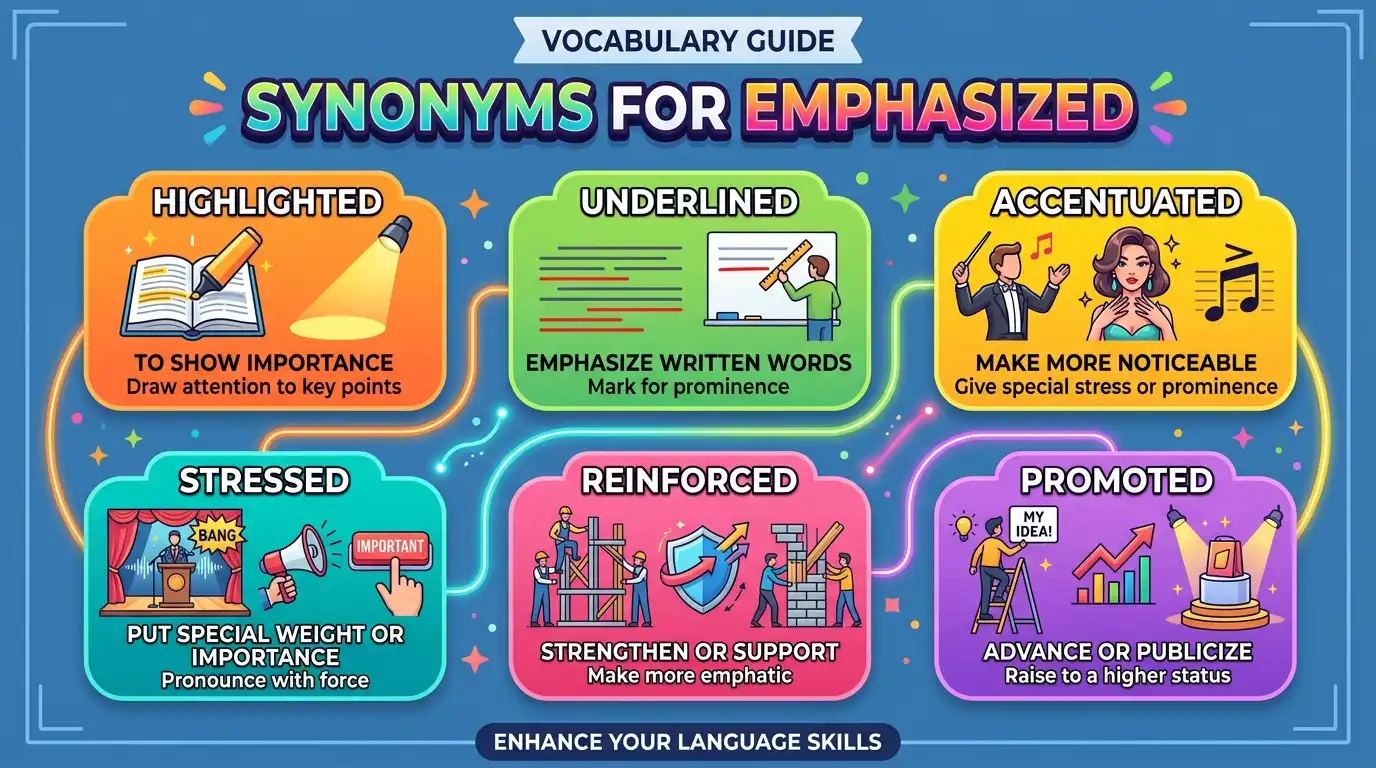
When you search for synonyms for emphasized, you look for words that show special importance. Finding the right synonyms for emphasized helps you make your main points clear in any message. Using varied synonyms for emphasized keeps your essays, reports, and emails engaging and easy to read.
Picture a teacher drawing a bright yellow line under a key date on the whiteboard. That action shows how an idea is emphasized. You can express this same idea in writing using words like highlighted, stressed, spotlighted, and underlined.
Using different words for emphasized is very helpful for:
- Students: Write strong essays and get better grades.
- Bloggers: Keep readers focused on key points.
- Content Writers: Build clear articles that hold attention.
- Daily English Users: Speak with clarity in everyday talks.
“The difference between the right word and the almost right word is the difference between lightning and a lightning bug.” — Mark Twain
“Words have energy and power with the ability to help, to heal, to hinder, to hurt, to harm, to humiliate, and to humble.” — Yehuda Berg
Word Profile: Emphasized
Connotative Meaning
The word emphasized carries a strong, clear, and direct feeling. It means giving extra force or attention to an idea so people do not miss it.
Etymology (Origin)
- Greek Root: Emphasiss (meaning “expression” or “significance”)
- Greek Root: Emphainein (meaning “to show or display”)
- Latin: Emphasis (meaning “added force in language”)
- English: Adopted into Modern English as emphasize in the 16th century.
Pronunciation
- US IPA: /ˈɛm.fə.saɪzd/
- UK IPA: /ˈem.fə.saɪzd/
Syllables & Affixation
- Syllables: em-pha-sized (3 syllables)
- Prefix: Em- (in / upon)
- Root: Phase (show / display)
- Suffix: -ized (past tense verb)
Comparison Table: Popular Synonyms for Emphasized
| Keyword | Meaning | Usage Type | Context |
| Emphasized | Gave extra weight or attention to an idea. | Formal / General | Speeches, writing, work meetings |
| Highlighted | Made something easy to see or notice. | Visual / Casual | Documents, presentations, study notes |
| Stressed | Placed strong focus on a key point. | Direct / Serious | Instructions, rules, warnings |
| Accentuated | Made a feature stand out more clearly. | Descriptive | Design, fashion, speech tone |
| Spotlighted | Brought full attention to one thing. | Media / Casual | News, shows, team praise |
| Underlined | Showed the deep value of an idea. | Academic / Formal | Essays, reports, key arguments |
| Featured | Placed in a central position to be seen. | Commercial | Products, news stories, websites |
50 Best Synonyms for Emphasized
1. Highlighted
- Pronunciation: US: /ˈhaɪ.laɪ.t̬ɪd/ | UK: /ˈhaɪ.laɪ.tɪd/
- Meaning: Made a point easy to notice among other things.
- Examples:
- She highlighted the important terms in her notes.
- The report highlighted the team’s strong sales.
2. Stressed
- Pronunciation: US: /strɛst/ | UK: /strest/
- Meaning: Gave special attention or force to a main idea.
- Examples:
- The doctor stressed the need for daily water.
- He stressed that safety comes first.
3. Accentuated
- Pronunciation: US: /ækˈsɛn.tʃu.eɪ.t̬ɪd/ | UK: /əkˈsen.tʃu.eɪ.tɪd/
- Meaning: Made a detail stand out clearly to the eyes or ears.
- Examples:
- Her bright jacket accentuated her dark hair.
- The quiet room accentuated his clear voice.
4. Underlined
- Pronunciation: US: /ˌʌn.dɚˈlaɪnd/ | UK: /ˌʌn.dəˈlaɪnd/
- Meaning: Showed the true importance of an idea in a direct way.
- Examples:
- The principal underlined the rule during assembly.
- Her talk underlined the need for honest communication.
5. Underscored
- Pronunciation: US: /ˌʌn.dɚˈskɔːrd/ | UK: /ˌʌn.dəˈskɔːd/
- Meaning: Showed how vital a point is to everyone.
- Examples:
- The news story underscored the storm danger.
- His hard work underscored his devotion to the job.
6. Spotlighted
- Pronunciation: US: /ˈspɑːt.laɪ.t̬ɪd/ | UK: /ˈspɒt.laɪ.tɪd/
- Meaning: Focused full attention on one specific topic.
- Examples:
- The museum spotlighted local artists this week.
- Her article spotlighted the new science discovery.
7. Featured
- Pronunciation: US: /ˈfiː.tʃɚd/ | UK: /ˈfiː.tʃəd/
- Meaning: Placed something in a leading position for all to see.
- Examples:
- The store featured local fruit in the window.
- The magazine featured a story on young writers.
8. Pointed out
- Pronunciation: US: /ˈpɔɪn.t̬ɪd aʊt/ | UK: /ˈpɔɪn.tɪd aʊt/
- Meaning: Directed attention toward a facts or mistake.
- Examples:
- He pointed out the small error on the map.
- The guide pointed out the oldest tree in the park.
9. Showcased
- Pronunciation: US: /ˈʃoʊ.keɪst/ | UK: /ˈʃəʊ.keɪst/
- Meaning: Displayed skills or items in a proud way.
- Examples:
- The event showcased new student inventions.
- Her singer showcased her long vocal range.
10. Focused on
- Pronunciation: US: /ˈfoʊ.kəst ɑːn/ | UK: /ˈfəʊ.kəst ɒn/
- Meaning: Gave deep thought or care to one central subject.
- Examples:
- The lesson focused on simple math rules.
- We focused on solving the main issue first.
11. Pressed
- Pronunciation: US: /prɛst/ | UK: /prest/
- Meaning: Urged an idea strongly upon other people.
- Examples:
- She pressed the need for quick action.
- He pressed his view during the friendly debate.
12. Insisted
- Pronunciation: US: /ɪnˈsɪs.tɪd/ | UK: /ɪnˈsɪs.tɪd/
- Meaning: Stated a demand or point firmly without backing down.
- Examples:
- Mom insisted that we wash our hands before eating.
- He insisted on paying for our lunch.
13. Marked
- Pronunciation: US: /mɑːrkt/ | UK: /mɑːkt/
- Meaning: Set a detail apart so it catches the eye easily.
- Examples:
- She marked the key map locations with stars.
- His sharp speech marked a big change in plans.
14. Magnified
- Pronunciation: US: /ˈmæɡ.nə.faɪd/ | UK: /ˈmæɡ.nɪ.faɪd/
- Meaning: Made a detail seem larger or more noticeable.
- Examples:
- The silence magnified the sound of his footsteps.
- Media news magnified the small town story.
15. Amplified
- Pronunciation: US: /ˈæm.plə.faɪd/ | UK: /ˈæm.plɪ.faɪd/
- Meaning: Increased the strength or force of a message.
- Examples:
- The speaker amplified her main point with examples.
- Good reviews amplified customer trust in the brand.
16. Reinforced
- Pronunciation: US: /ˌriː.ɪnˈfɔːrst/ | UK: /ˌriː.ɪnˈfɔːst/
- Meaning: Made an argument stronger by adding support.
- Examples:
- Facts reinforced the claim made by the team.
- The lesson reinforced our basic grammar skills.
17. Foregrounded
- Pronunciation: US: /ˈfɔːr.ɡraʊn.dɪd/ | UK: /ˈfɔː.ɡraʊn.dɪd/
- Meaning: Moved a point to the front of attention.
- Examples:
- The book foregrounded the historical events.
- Her speech foregrounded the need for unity.
18. Illuminated
- Pronunciation: US: /ɪˈluː.mə.neɪ.t̬ɪd/ | UK: /ɪˈluː.mɪ.neɪ.tɪd/
- Meaning: Made an idea bright and easy to understand.
- Examples:
- The teacher illuminated the problem with a story.
- A clear chart illuminated the survey results.
19. Heightened
- Pronunciation: US: /ˈhaɪ.tən d/ | UK: /ˈhaɪ.tən d/
- Meaning: Raised the degree or feeling of something.
- Examples:
- Music heightened the drama in the movie.
- The announcement heightened public interest.
20. Prioritized
- Pronunciation: US: /praɪˈɔːr.ə.taɪzd/ | UK: /praɪˈɒr.ə.taɪzd/
- Meaning: Placed a main goal ahead of less urgent matters.
- Examples:
- She prioritized health above all work projects.
- The team prioritized urgent tasks first.
21. Brought out
- Pronunciation: US: /brɔːt aʊt/ | UK: /brɔːt aʊt/
- Meaning: Made a hidden feature easy to notice.
- Examples:
- The light brought out the gold colors in her hair.
- Questions brought out the core facts of the case.
22. Punctuated
- Pronunciation: US: /ˈpʌŋk.tʃu.eɪ.t̬ɪd/ | UK: /ˈpʌŋk.tʃu.eɪ.tɪd/
- Meaning: Interrupted a statement with emphasis or sudden action.
- Examples:
- He punctuated his speech with cheerful hand gestures.
- Applause punctuated the leader’s warm talk.
23. Singled out
- Pronunciation: US: /ˈsɪŋ.ɡəld aʊt/ | UK: /ˈsɪŋ.ɡəld aʊt/
- Meaning: Selected one item or person for special attention.
- Examples:
- The coach singled out Sam for his great game.
- The judge singled out her painting for an award.
24. Flagged
- Pronunciation: US: /flæɡd/ | UK: /flæɡd/
- Meaning: Marked an item so people review it closely.
- Examples:
- The editor flagged two typos on the page.
- She flagged the urgent email for her manager.
25. Keyed
- Pronunciation: US: /kiːd/ | UK: /kiːd/
- Meaning: Aligned or focused tightly around a main topic.
- Examples:
- The presentation was keyed to customer needs.
- Her talk was keyed to solving budget issues.
“To express yourself well, choose words that make your main message stand out clearly.” — Anonymous
26. Bolded
- Pronunciation: US: /ˈboʊl.dɪd/ | UK: /ˈbəʊl.dɪd/
- Meaning: Printed text in thick dark letters for emphasis.
- Examples:
- She bolded the headers to make them easy to read.
- The main keywords were bolded across the page.
27. Intensified
- Pronunciation: US: /ɪnˈtɛn.sə.faɪd/ | UK: /ɪnˈten.sɪ.faɪd/
- Meaning: Made a focus or feeling much stronger.
- Examples:
- Cold weather intensified our desire for warm soup.
- Practice intensified his focus before the big race.
28. Outlined
- Pronunciation: US: /ˈaʊt.laɪnd/ | UK: /ˈaʊt.laɪnd/
- Meaning: Summarized the main points in a simple form.
- Examples:
- The boss outlined the new plan on the board.
- She outlined her goals for the upcoming year.
29. Exaggerated
- Pronunciation: US: /ɪɡˈzædʒ.ə.reɪ.t̬ɪd/ | UK: /ɪɡˈzædʒ.ə.reɪ.tɪd/
- Meaning: Described something as larger or grander than it really is.
- Examples:
- The actor exaggerated his movements for comedy.
- He exaggerated the size of the fish he caught.
30. Clarified
- Pronunciation: US: /ˈklær.ə.faɪd/ | UK: /ˈklær.ɪ.faɪd/
- Meaning: Made a confusing statement clear and simple.
- Examples:
- The teacher clarified the instructions for the assignment.
- A brief talk clarified the project rules for everyone.
31. Framed
- Pronunciation: US: /freɪmd/ | UK: /freɪmd/
- Meaning: Presented an idea in a specific way to guide thinking.
- Examples:
- She framed her idea as a win for the whole team.
- The story was framed around a personal journey.
32. Called out
- Pronunciation: US: /kɑːld aʊt/ | UK: /kɔːld aʊt/
- Meaning: Drew public attention to an issue or detail.
- Examples:
- The report called out the top causes of delay.
- She called out the best effort of the week.
33. Pronounced
- Pronunciation: US: /prəˈnaʊnst/ | UK: /prəˈnaʊnst/
- Meaning: Made a feature very distinct or noticeable.
- Examples:
- He spoke with a pronounced accent from his home town.
- The chart showed a pronounced rise in sales.
34. Elevated
- Pronunciation: US: /ˈɛl.ə.veɪ.t̬ɪd/ | UK: /ˈel.ɪ.veɪ.tɪd/
- Meaning: Raised an idea to a higher place of importance.
- Examples:
- The award elevated her standing in the art community.
- His proposal elevated the conversation to new ideas.
35. Dramatized
- Pronunciation: US: /ˈdræm.ə.taɪzd/ | UK: /ˈdræm.ə.taɪzd/
- Meaning: Expressed an idea in an exciting or vivid way.
- Examples:
- The movie dramatized true events from the past.
- She dramatized her story to make her audience laugh.
36. Detailed
- Pronunciation: US: /ˈdiː.teɪld/ | UK: /ˈdiː.teɪld/
- Meaning: Explained every single part of a topic clearly.
- Examples:
- The guide detailed every step of the trail walk.
- He detailed his findings during the study meeting.
37. Exposed
- Pronunciation: US: /ɪkˈspoʊzd/ | UK: /ɪkˈspəʊzd/
- Meaning: Brought hidden details into open view.
- Examples:
- The investigation exposed key facts about the issue.
- Bright sunlight exposed the dust on the table.
38. Stamped
- Pronunciation: US: /stæmpt/ | UK: /stæmpt/
- Meaning: Marked an idea firmly onto mind or memory.
- Examples:
- The experience stamped a lesson in his memory.
- She stamped her approval on the final project paper.
39. Targeted
- Pronunciation: US: /ˈtɑːr.ɡə.t̬ɪd/ | UK: /ˈtɑː.ɡɪ.tɪd/
- Meaning: Directed attention toward one specific group or goal.
- Examples:
- The ad campaign targeted young sports players.
- His comments targeted the central concern of the meeting.
40. Tagged
- Pronunciation: US: /tæɡd/ | UK: /tæɡd/
- Meaning: Labeled a piece of content for quick finding.
- Examples:
- She tagged the file as urgent for her team.
- He tagged key pages in his textbook with clips.
41. Noted
- Pronunciation: US: /ˈnoʊ.t̬ɪd/ | UK: /ˈnəʊ.tɪd/
- Meaning: Mentioned a point so others would keep it in mind.
- Examples:
- The speaker noted the success of the project.
- She noted that the store closes early on Sundays.
42. Headlined
- Pronunciation: US: /ˈhɛd.laɪnd/ | UK: /ˈhed.laɪnd/
- Meaning: Featured an item as the main story or news.
- Examples:
- Newspapers headlined the news on front pages.
- The band headlined the outdoor summer concert.
43. Asserted
- Pronunciation: US: /əˈsɝː.t̬ɪd/ | UK: /əˈsɜː.tɪd/
- Meaning: Stated a conviction in a confident, strong manner.
- Examples:
- She asserted her right to share her opinion.
- He asserted that the figures were correct.
44. Affirmed
- Pronunciation: US: /əˈfɝːmd/ | UK: /əˈfɜːmd/
- Meaning: Confirmed a truth or value publicly and clearly.
- Examples:
- The vote affirmed support for the new community center.
- She affirmed her agreement with a warm smile.
45. Maintained
- Pronunciation: US: /meɪnˈteɪnd/ | UK: /meɪnˈteɪnd/
- Meaning: Stated a position firmly over time.
- Examples:
- He maintained that he was right all along.
- She maintained her focus throughout the race.
46. Declared
- Pronunciation: US: /dɪˈklɛrd/ | UK: /dɪˈkleəd/
- Meaning: Stated an official fact openly to everyone.
- Examples:
- The mayor declared a town holiday.
- She declared her intent to run for class leader.
47. Reiterated
- Pronunciation: US: /riːˈɪt̬.ə.reɪ.t̬ɪd/ | UK: /riːˈɪt.ər.eɪ.tɪd/
- Meaning: Said something again to make sure it was understood.
- Examples:
- The coach reiterated the game plan at half time.
- She reiterated her thanks to the volunteers.
48. Pinpointed
- Pronunciation: US: /ˈpɪn.pɔɪn.t̬ɪd/ | UK: /ˈpɪn.pɔɪn.tɪd/
- Meaning: Identified the exact location or cause of something.
- Examples:
- They pinpointed the exact location of the error.
- She pinpointed the reason for the sudden delay.
49. Deepened
- Pronunciation: US: /ˈdiː.pənd/ | UK: /ˈdiː.pənd/
- Meaning: Made a message or feeling richer and more intense.
- Examples:
- The discussion deepened our view on the topic.
- His story deepened our respect for his hard work.
50. Strengthened
- Pronunciation: US: /ˈstrɛŋk.θənd/ | UK: /ˈstreŋ.θənd/
- Meaning: Added power and support to an idea or argument.
- Examples:
- New facts strengthened her position in court.
- Practice strengthened his confidence on stage.
Antonyms of Emphasized
To understand emphasized better, it helps to know its opposite words:
- Downplayed: Made something seem less important than it really is.
- Ignored: Paid no attention to a fact or message.
- Minimized: Described something in a way that reduces its size or value.
- Overlooked: Failed to notice or consider a key detail.
- Neglected: Gave little or no care to a responsibility or idea.
Prototype Meaning and Categorization of Emphasized
We can group these 50 synonyms into simple categories to help you choose the right one:
- Visual & Print Marking (Eye-Catching Words):
- Highlighted, Underlined, Underscored, Bolded, Marked, Flagged, Tagged.
- Verbal Focus & Direct Speech (Strong Statements):
- Stressed, Insisted, Asserted, Affirmed, Declared, Reiterated, Pointed out.
- Media & Strategic Attention (Putting in the Front):
- Spotlighted, Featured, Showcased, Headlined, Foregrounded, Framed.
- Increasing Force & Scale (Making Ideas Stronger):
- Amplified, Magnified, Heightened, Intensified, Reinforced, Strengthened.
Frequently Asked Questions (FAQ)
What is the best general synonym for emphasized?
The best general synonym for emphasized is highlighted or stressed. Use highlighted when drawing attention visually, and stressed when speaking firmly about a topic.
Is “stressed” the exact same thing as “emphasized”?
Very close, but not identical. Stressed often implies vocal force or emotional urgency, while emphasized can be done visually through text formatting, structural design, or spoken tone.
How do I choose the right synonym for emphasized in essays?
Match the synonym to your context. Use underscored or reinforced for logical arguments, spotlighted for media topics, and accentuated for design or artistic descriptions.
What is the difference between “highlighted” and “emphasized”?
Highlighted usually points to visual attention or making a specific section easy to see. Emphasized covers any method used to give an idea greater importance or weight.
Can “accentuated” be used for physical appearance?
Yes. Accentuated is commonly used when physical clothing, lighting, or makeup makes a specific feature stand out clearly.
What is the verb form of emphasized?
The base verb form is emphasize. For example: “You should emphasize your main points in your summary.”
Conclusion
Learning fresh synonyms for emphasized expands your vocabulary and lifts your writing skills. When you replace overused words with terms like highlighted, underscored, or reiterated, your content becomes far more expressive and enjoyable to read.
For bloggers, students, and content writers, using varied synonyms for emphasized keeps readers focused from start to finish. Good communication relies on finding the perfect word for every situation. Start using these 50 synonyms for emphasized in your emails, essays, and everyday conversations today!
“Proper words in proper places make the true definition of a style.” — Jonathan Swift
“Language is the dress of thought.” — Samuel Johnson

Andrew Collins is an academic English educator with over 12 years of experience helping university students, IELTS candidates, and ESL learners improve their writing vocabulary.