Micro Introduction
The word belittle often appears in daily conversation, academic writing, and professional communication. People use it when someone tries to make another person seem less important or less capable. Learning synonyms for belittle helps improve vocabulary and makes communication clearer and more precise.
Direct Answer
Belittle means to make someone or something seem less important, less valuable, or less impressive.
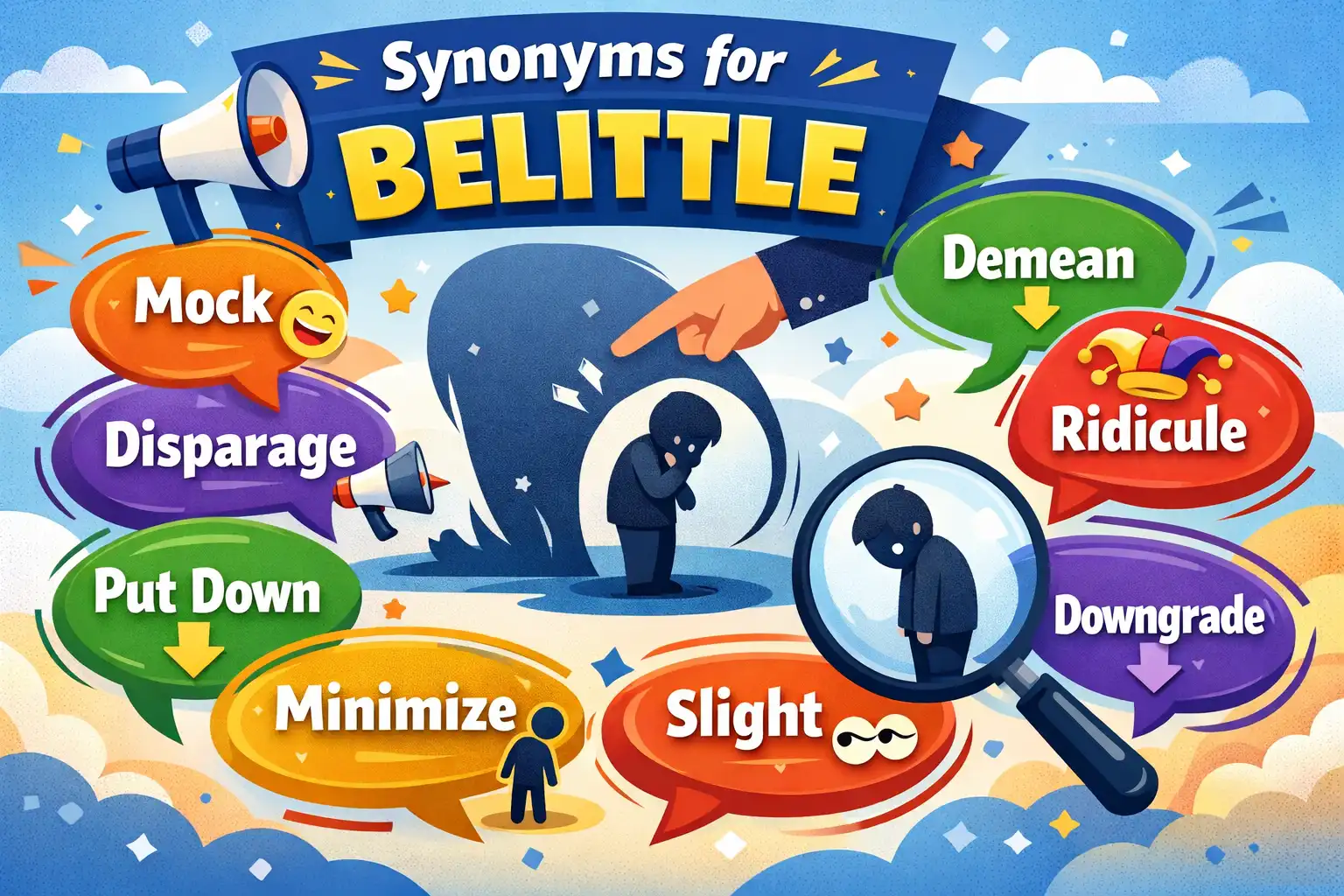
Common synonyms for belittle include:
- Dismiss
- Undermine
- Mock
- Ridicule
- Humiliate
- Disparage
- Demean
- Minimize
- Devalue
- Deride
Meaning of Belittle
Belittle means to speak about someone or something in a way that reduces their importance, ability, or value.
People often use it when someone makes negative comments to make others feel small or insignificant.
Example sentence:
The manager should not belittle employees for asking questions.
Categories of Synonyms
Different synonyms for belittle express slightly different meanings depending on context.
Social Disrespect
Some words describe openly treating someone as unimportant or inferior.
Examples include demean, disparage, and devalue.
Verbal Criticism
Other synonyms focus on negative speech or criticism directed at someone.
Examples include mock, ridicule, and deride.
Reducing Importance
Some synonyms emphasize minimizing someone’s achievements or contributions.
Examples include dismiss, undermine, and minimize.
Synonyms Table
| Word | Simple Meaning | Example Sentence |
| Dismiss | treat as unimportant | He dismissed her idea without discussion. |
| Undermine | weaken someone’s reputation | Negative rumors can undermine a leader’s authority. |
| Mock | make fun of someone | The students mocked his accent. |
| Ridicule | laugh at in a cruel way | Critics ridiculed the proposal. |
| Humiliate | cause deep embarrassment | Public criticism humiliated the athlete. |
| Disparage | speak badly about | Some people disparage new ideas too quickly. |
| Demean | lower someone’s dignity | The comment demeaned her effort. |
| Minimize | make something seem smaller | He minimized her role in the project. |
| Devalue | reduce importance or worth | Constant criticism can devalue someone’s work. |
| Deride | show contempt through laughter | The audience derided the poor performance. |
Master Synonyms List (Grouped by Level)
Beginner / Simple Synonyms
Mock
Simple meaning: make fun of someone.
Example: The class should not mock students who make mistakes. (Informal)
Dismiss
Simple meaning: treat something as unimportant.
Example: Do not dismiss helpful advice too quickly.
Minimize
Simple meaning: make something seem less important.
Example: She tried to minimize his contribution.
Intermediate Synonyms
Ridicule
Simple meaning: laugh at someone in a cruel way.
Example: The media often ridicule unpopular opinions.
Undermine
Simple meaning: weaken someone’s reputation or confidence.
Example: Constant criticism can undermine a person’s confidence.
Humiliate
Simple meaning: cause deep embarrassment or shame.
Example: The coach should never humiliate players in public.
Advanced / Formal Synonyms
Disparage
Simple meaning: speak negatively about someone’s value or quality.
Example: The article seemed to disparage the researcher’s work. (Formal)
Demean
Simple meaning: lower someone’s dignity or respect.
Example: Harsh comments can demean hardworking employees. (Formal)
Devalue
Simple meaning: reduce the importance or worth of something.
Example: Ignoring feedback may devalue team contributions. (Formal)
Deride
Simple meaning: express contempt through mocking or laughter.
Example: Critics often deride ideas they do not understand. (Formal)
Formal vs Informal Synonyms
Choosing the right synonym depends on the tone of your communication.
Informal words work well in everyday conversation:
- mock
- dismiss
- ridicule
Formal or professional alternatives fit academic or business writing:
- disparage
- demean
- undermine
- devalue
For example:
Casual conversation:
“He mocked my idea.”
Academic writing:
“The author appears to disparage earlier research.”
Understanding tone helps you communicate respectfully and clearly.
Real-Life Usage Examples
Conversation
“Please don’t belittle your achievements. You worked hard for them.”
Academic Writing
“The critic attempts to belittle the significance of the discovery.”
Business Writing
“Managers should never belittle employees during meetings.”
Blogging
“Online comments sometimes belittle creators instead of encouraging them.”
Emotional Expression
“It hurts when someone tries to belittle your abilities.”
Similar Words Comparison
Belittle vs Mock
Both involve disrespect, but the tone differs.
Belittle focuses on reducing importance.
Mock focuses on making fun of someone.
Example:
He tried to belittle her success.
They mocked his pronunciation.
Belittle vs Undermine
These words also overlap but have different intentions.
Belittle lowers perceived value directly.
Undermine weakens confidence or reputation indirectly.
Example:
She tried to belittle his achievements.
Rumors began to undermine his leadership.
Example Sentences
- Some critics try to belittle young entrepreneurs.
- Never belittle someone for learning slowly.
- Social media can sometimes belittle creative efforts.
- The teacher refused to belittle student questions.
- It is unfair to belittle someone’s hard work.
- He tried to belittle her experience in the meeting.
- Negative comments can belittle a person’s confidence.
- Good leaders never belittle their team members.
- The article seemed to belittle the artist’s talent.
- People should not belittle different opinions.
- The comedian refused to belittle the audience.
- She felt hurt when her colleague tried to belittle her ideas.
- Healthy discussions should not belittle others.
- Online debates often belittle opposing viewpoints.
Common Mistakes
1. Using Belittle Instead of Criticize
Belittle implies disrespect.
Constructive criticism is different.
Incorrect:
“The teacher belittled my essay.”
Better:
“The teacher criticized my essay.”
2. Using Mock in Formal Writing
Mock can sound casual or emotional.
Academic writing usually prefers disparage or undermine.
3. Confusing Belittle with Humiliate
Belittle reduces importance.
Humiliate causes strong embarrassment.
They are related but not identical.
4. Overusing Strong Words
Words like ridicule or deride are strong and may sound harsh if used frequently.
Tips / Best Practices
Use these tips to choose the right synonym:
- Consider tone: formal or casual context matters.
- Think about intention: are you reducing value or mocking?
- Choose clarity: simple words are often best.
- Match the context: academic, business, or casual speech.
- Avoid overuse: repeating the same word weakens writing.
Expanding vocabulary helps you communicate more effectively without repeating the same term.
When NOT to Use Belittle
Avoid using belittle when describing neutral feedback or constructive advice.
For example, editing someone’s work or offering suggestions is not necessarily belittling.
Also avoid the word when describing objective evaluation. In such cases, words like analyze or review are more appropriate.
Opposite Words (Antonyms)
Antonyms express the opposite meaning of belittle.
Common antonyms include:
- Praise
- Respect
- Appreciate
- Value
- Admire
- Encourage
- Support
Example:
Good teachers encourage students instead of belittling them.
FAQs
What does belittle mean?
Belittle means to make someone or something seem less important, less capable, or less valuable.
Is belittle formal or informal?
It works in both everyday speech and formal writing.
How can I use belittle in conversation?
Example:
“Please don’t belittle my effort. I tried my best.”
What is the best synonym for belittle?
Common alternatives include dismiss, mock, ridicule, and disparage.
Can belittle be replaced with ridicule?
Sometimes. However, ridicule focuses more on laughing at someone.
Is belittle always negative?
Yes. It usually describes disrespectful or dismissive behavior.
Can belittle describe actions, not just people?
Yes. Someone can belittle ideas, work, achievements, or contributions.
What is a formal synonym for belittle?
Formal options include disparage, demean, and devalue.
Is belittle a strong word?
It can be strong because it implies disrespect.
Why should writers learn synonyms for belittle?
Using synonyms improves clarity, tone, and variety in writing.
Conclusion
Learning synonyms for belittle helps writers and speakers express ideas more clearly. Different alternatives allow you to choose the right tone for conversation, academic writing, or professional communication.
Expanding your vocabulary also prevents repetition and improves communication skills. Try using three new synonyms from this list in your next sentence to strengthen your English.

Andrew Collins writes vocabulary-focused articles that explore word meanings and alternative expressions for better communication.