The word typical is common in daily speech, school writing, and business English.
It describes something normal or expected.
Learning synonyms for typical helps you avoid repetition and speak more clearly.
Direct Answer
Typical means normal, usual, or expected in a certain situation.
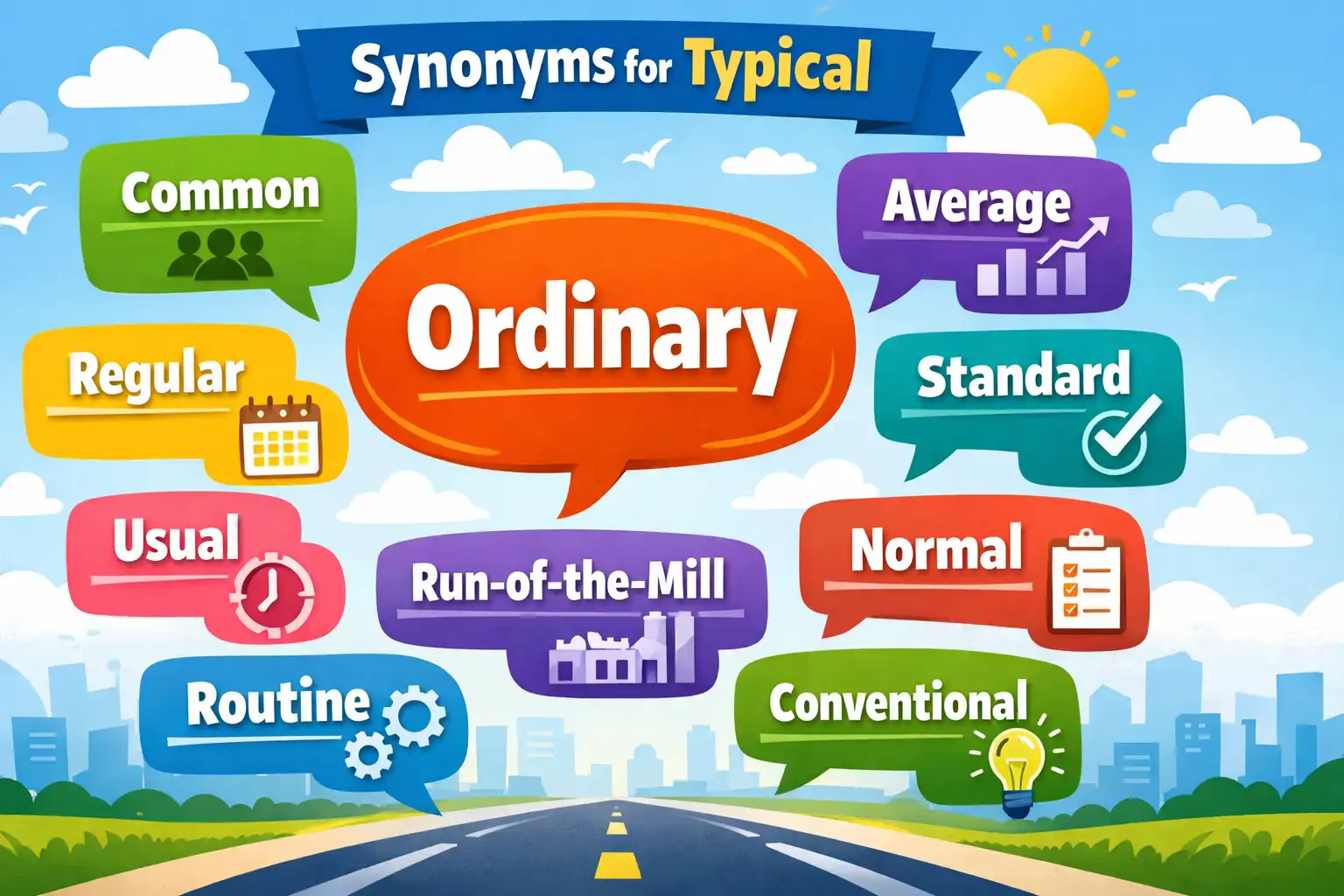
Common synonyms for typical:
- Normal
- Usual
- Common
- Standard
- Regular
- Average
- Ordinary
- Conventional
- Characteristic
- Representative
Meaning of Typical
Typical describes something that shows the usual qualities of a person, place, or thing.
Example:
It was a typical summer day with bright sun and high temperatures.
Categories of Synonyms
1. General / Everyday Use
These words describe something normal or expected in daily life.
Examples: normal, usual, common, regular
2. Statistical or Neutral Description
These words describe what happens most often or what represents a group.
Examples: average, representative
3. Formal or Descriptive Writing
These words are used in academic, business, or formal contexts.
Examples: standard, conventional, characteristic, ordinary
Synonyms Table (Meaning + Examples)
| Word | Simple Meaning | Example Sentence |
| Normal | not unusual | This is a normal reaction. |
| Usual | happens often | She arrived at her usual time. |
| Common | seen often | It is common to feel nervous. |
| Standard | accepted level | The product meets standard quality. |
| Regular | repeated often | He is a regular customer. |
| Average | typical amount | The average score was 80%. |
| Ordinary | not special | It was an ordinary day. |
| Conventional | traditional | They had a conventional wedding. |
| Characteristic | typical feature | Patience is characteristic of her. |
| Representative | typical example | This sample is representative of the group. |
Synonyms by Difficulty: Simple → Advanced
Beginner / Simple
Normal
Meaning: not strange or unusual
Example: This is a normal situation.
Usual
Meaning: happens most of the time
Example: She took her usual route home.
Common
Meaning: seen or experienced often
Example: It is common to feel tired after work.
Regular
Meaning: happening again and again
Example: He is a regular visitor here.
Intermediate
Average
Meaning: typical number or amount
Example: The average price is affordable.
Standard
Meaning: accepted level or quality
Example: The work meets standard requirements. (Formal)
Ordinary
Meaning: not special
Example: It was an ordinary meeting.
Advanced / Formal
Conventional
Meaning: traditional or widely accepted
Example: They chose a conventional design. (Formal)
Characteristic
Meaning: typical quality of someone or something
Example: Calm behavior is characteristic of her. (Formal)
Representative
Meaning: showing typical features of a group
Example: This result is representative of the data. (Formal)
Formal vs Informal Synonyms
- Use normal, usual, and common in everyday conversation.
- Use standard, representative, and characteristic in academic or business writing.
- Avoid very formal words in casual speech.
Example:
Casual: That’s normal.
Formal: That response is characteristic of the system.
Real-Life Usage Examples
Conversation
That’s so normal for him — he always forgets his keys.
Academic Writing
This behavior is common among teenagers.
Business Writing
The report reflects standard market trends.
Blogging
Here is a usual morning routine for busy parents.
Emotional Expression
It’s natural to feel nervous before a test.
Similar Words Comparison
Typical vs Normal
Typical shows something common for a specific person or group.
Normal means not strange or unusual.
Example:
It’s typical for him to wake up early.
It’s normal to feel tired after exercise.
Typical vs Average
Typical describes general patterns.
Average refers to numbers or statistics.
Example:
This is a typical winter day.
The average temperature is 10°C.
Example Sentences
- It was a normal Monday morning at the office.
- Her reaction was usual for someone under pressure.
- This kind of mistake is common in beginner writing.
- The weather is characteristic of early spring.
- That response is standard practice in customer service.
- He showed ordinary behavior during the meeting.
- The results are representative of the entire group.
- It’s natural to feel nervous before a big presentation.
- She followed her regular routine after work.
- The average salary in this field is increasing.
- That pattern is conventional in traditional design.
- Late deliveries are common during the holiday season.
- His calm attitude is characteristic of strong leaders.
- The company uses standard procedures for safety checks.
Common Mistakes
- Using typical when you mean average (number-based meaning).
- Using formal words like representative in casual speech.
- Overusing typical in essays instead of varying vocabulary.
- Confusing typical with normal in emotional contexts.
Tip: Choose the synonym that matches the context.
Tips / Best Practices
Choosing the right synonym for typical depends on context, tone, and purpose. Use this quick guide before deciding.
✅ Quick Checklist
Before replacing typical, ask yourself:
- Are you talking about daily behavior? → Use usual or normal.
- Are you describing statistics? → Use average.
- Are you writing formally? → Use standard, representative, or characteristic.
- Are you describing habits? → Use regular.
- Are you describing something not special? → Use ordinary.
If the sentence sounds unnatural after replacing the word, choose a simpler synonym.
🎯 Tone Guide (Choose Based on Context)
| Situation | Best Choice | Why |
| Casual conversation | normal, usual | Simple and natural |
| Academic writing | representative, characteristic | More precise and formal |
| Business writing | standard | Professional tone |
| Data or research | average | Refers to numbers |
| General description | common | Neutral and clear |
Smart Writing Tips
- Match the word to the situation.
- Avoid very formal words in casual speech.
- Do not overuse one synonym repeatedly.
- Choose clarity over complexity.
- Keep your sentence simple and natural.
A small vocabulary change can make your writing sound more professional and fluent.
When NOT to Use Typical
Do not use typical when:
- You are talking about exact numbers (use average).
- You mean acceptable behavior (use appropriate instead).
- You want to describe something unique or special.
Example:
Incorrect: This is a typical score of 85.
Better: The average score is 85.
Opposite Words (Contrasting)
- Unusual
- Rare
- Unique
- Exceptional
- Atypical
FAQs
What does typical mean?
It means normal, usual, or expected in a certain situation.
Is typical formal or informal?
It is neutral and works in both conversation and writing.
How can I use it in conversation?
Example: That’s typical of him to be late.
What is the best synonym for typical?
Normal is the most common everyday synonym.
Can typical be replaced with normal?
Yes, in many situations, but not when talking about statistics.
Conclusion
Learning synonyms for typical improves your writing and speaking.
It helps you sound more natural and clear.
Try using 3 new synonyms in your next sentence.

Andrew Collins writes vocabulary-focused articles that explore word meanings and alternative expressions for better communication.