Micro Introduction
The word “neutral” appears in daily conversation, news, school writing, and business communication. It describes balance or the absence of strong opinions. Learning synonyms helps you sound clearer and more precise. It also improves vocabulary for speaking and writing.
Direct Answer
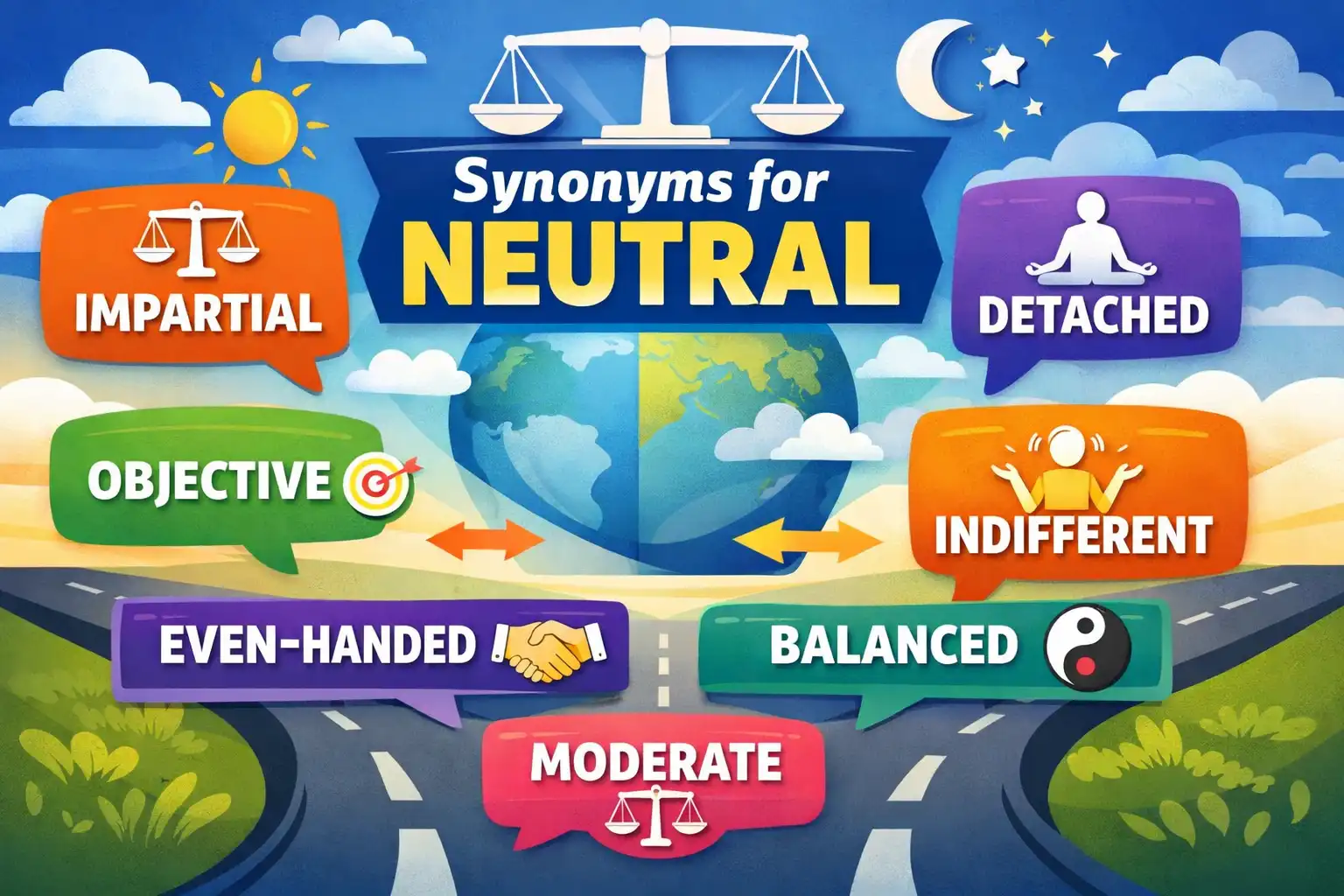
Neutral means not taking sides, not showing strong emotion, or staying balanced. Common synonyms include:
- impartial
- unbiased
- objective
- nonpartisan
- fair
- detached
- evenhanded
Meaning of Neutral
Neutral describes a person, opinion, or situation that does not support one side over another. It suggests balance and lack of preference.
Example: She stayed neutral during the argument and listened to both sides.
Categories of Synonyms
Neutral in Opinions and Judgment
These words describe fairness and lack of personal bias. They are common in debates, news, and academic writing.
Neutral in Emotion
These synonyms show emotional distance or calm reactions. They describe someone not emotionally involved.
Neutral in Social or Political Context
These words describe positions that avoid taking sides in conflicts or political discussions.
Synonyms Table
| Word | Simple Meaning | Example Sentence |
| impartial | fair to all sides | The judge remained impartial in the case. |
| unbiased | not influenced by opinion | The report was unbiased and factual. |
| objective | based on facts | We need an objective review. |
| nonpartisan | not supporting a party | The group is nonpartisan. |
| fair | treating people equally | She made a fair decision. |
| detached | emotionally distant | He sounded detached during the talk. |
| evenhanded | balanced and fair | The teacher was evenhanded. |
Master Synonyms List (Grouped by Level)
Beginner / Simple
fair
Simple meaning: treating everyone equally
Example: The referee was fair to both teams.
Informal/Common
balanced
Simple meaning: equal on both sides
Example: Her opinion was balanced and calm.
Neutral tone
Intermediate
impartial
Simple meaning: not choosing sides
Example: The mediator stayed impartial.
Formal
unbiased
Simple meaning: free from opinion
Example: The article felt unbiased.
Formal
objective
Simple meaning: based on facts
Example: Try to be objective in reviews.
Formal
Advanced / Formal
nonpartisan
Simple meaning: not political
Example: The organization is nonpartisan.
Formal
evenhanded
Simple meaning: equally fair
Example: The manager was evenhanded.
Formal
detached
Simple meaning: emotionally distant
Example: She sounded detached from the issue.
Neutral/Formal
Formal vs Informal Synonyms
Simple words like fair and balanced work best in conversation. Formal writing prefers impartial, objective, or nonpartisan. Emotional contexts often use detached. Choosing the right synonym depends on audience and tone.
Real-Life Usage Examples
Conversation:
“I’m neutral. I understand both sides.”
Academic Writing:
“The study remained objective and unbiased.”
Business Writing:
“We require an impartial review of the complaint.”
Blogging:
“I tried to give a balanced opinion.”
Emotional Expression:
“He stayed detached during the argument.”
Similar Words Comparison
Neutral vs Impartial
Neutral suggests no involvement. Impartial emphasizes fairness in judgment.
Example:
She stayed neutral in the fight.
The judge remained impartial.
Neutral vs Objective
Neutral avoids choosing sides. Objective focuses on facts instead of feelings.
Example:
He stayed neutral.
Her report was objective.
Example Sentences
- She remained neutral during the debate.
- His tone was calm and neutral.
- The teacher stayed neutral in the conflict.
- We need a neutral opinion.
- The country declared itself neutral.
- Her response was neutral and polite.
- He kept a neutral expression.
- The article sounded neutral.
- Try to stay neutral in discussions.
- A neutral voice helps mediation.
- The moderator stayed neutral.
- She gave a neutral answer.
- His face remained neutral.
- The report used neutral language.
- Neutral wording avoids offense.
Common Mistakes
- Using neutral when you mean emotionless
- Confusing neutral with careless
- Using formal synonyms in casual talk
- Repeating the same synonym too often
- Ignoring context or tone
Tips / Best Practices
- Match synonym to situation
- Consider formality level
- Use factual contexts for objective
- Avoid overusing one word
- Choose clarity over complexity
When NOT to Use Neutral
Do not use neutral when strong opinion is required. Avoid it when describing emotional reactions that are clearly positive or negative. Neutral suggests balance, not indifference or lack of care.
Opposite Words (Antonyms)
- biased
- emotional
- partial
- unfair
- opinionated
FAQs
What does neutral mean?
It means not taking sides or showing strong preference.
Is neutral formal or informal?
It works in both everyday and professional contexts.
How can I use it in conversation?
Say: “I’m neutral. I see both points.”
What is the best synonym for neutral?
Impartial is best for formal fairness.
Can neutral be replaced with fair?
Yes, when talking about equal treatment.
Conclusion
Learning synonyms for neutral improves speaking and writing clarity. It helps you express balance, fairness, and objectivity more precisely. A richer vocabulary also strengthens communication.
Try using 3 new synonyms in your next sentence.

Andrew Collins writes vocabulary-focused articles that explore word meanings and alternative expressions for better communication.