DIRECT ANSWER
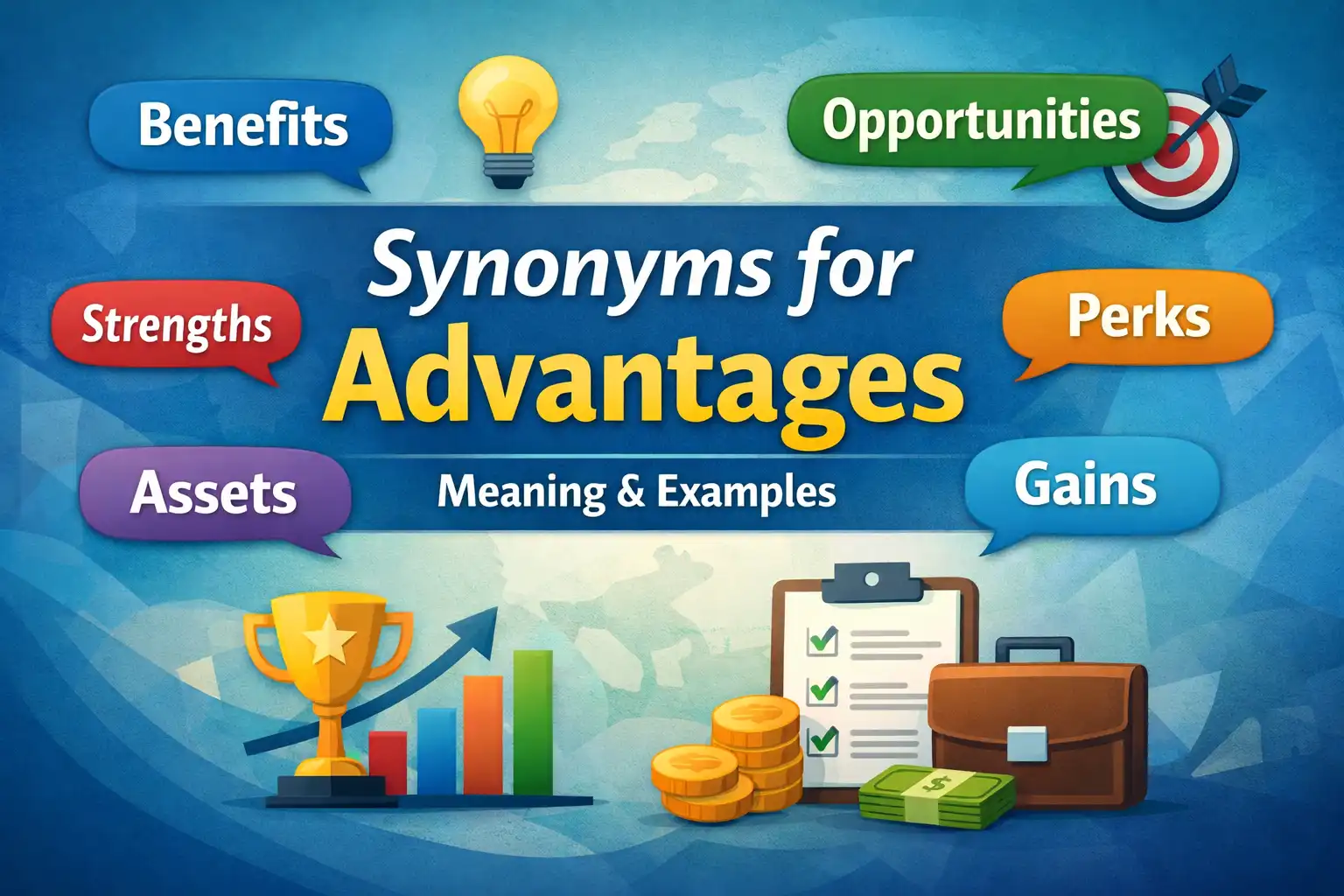
Common synonyms for “advantages” include:
- benefits
- strengths
- assets
- gains
- privileges
- opportunities
- merits
- perks
MEANING OF ADVANTAGES
The word advantages refers to favorable conditions, benefits, or factors that improve a situation or increase the chance of success. It describes something that gives a person, group, or thing a helpful edge or positive outcome.
Examples:
- One major advantage of online learning is flexibility.
- The new system offers several advantages over the old process.
SYNONYMS TABLE
| Word | Meaning | Example |
| Benefits | Positive results or helpful effects | The job includes health benefits. |
| Strengths | Positive qualities or abilities | Communication is one of her strengths. |
| Assets | Valuable qualities or resources | Experience is a strong asset in this role. |
| Gains | Improvements or progress achieved | The company saw gains in productivity. |
| Privileges | Special rights or opportunities | Club members receive travel privileges. |
| Opportunities | Favorable chances for progress | The internship provides career opportunities. |
| Merits | Good qualities worth recognizing | The proposal has several merits. |
| Perks | Extra benefits beyond basics | Free meals are one of the job’s perks. |
| Pros | Positive aspects of something | Let’s list the pros and cons. |
| Value | Usefulness or importance | The course adds value to your resume. |
| Edge | A competitive advantage | The new design gives us an edge. |
| Upside | Potential positive outcome | The upside of risk is growth. |
| Profit | Financial advantage or gain | The company earned a profit this year. |
| Leverage | Strategic advantage | Negotiation skills provide leverage. |
FORMAL AND INFORMAL SYNONYMS
Some synonyms for advantages are more common in professional or academic writing, while others are used in everyday conversation.
Formal usage synonyms:
- benefits
- merits
- assets
- leverage
- opportunities
- gains
These words often appear in business reports, academic writing, and professional communication.
Informal usage synonyms:
- perks
- pros
- upside
- edge
These are commonly used in conversations, workplace discussions, and casual writing.
For example:
- Formal: The proposal offers several strategic benefits.
- Informal: One perk of the job is working from home.
Choosing the right synonym depends on tone, context, and audience.
CONTEXT USAGE SECTION
Synonyms for advantages appear in many communication situations.
Conversations
In everyday speech, people often use simpler synonyms like benefits, perks, pros, and upside.
Example:
- The biggest benefit of living nearby is saving time.
These words sound natural and easy to understand.
Writing
In professional or academic writing, synonyms like assets, merits, gains, and opportunities are more common.
Example:
- The research highlights the economic gains of renewable energy.
These terms sound more precise and formal.
Emotional Expression
When expressing personal feelings or opinions, synonyms like strengths and value are often used.
Example:
- Patience is one of his greatest strengths.
In this context, the word emphasizes appreciation rather than comparison.
COMPARISON SECTION
Advantages vs Benefits
Advantages usually describe an overall positive position or condition, while benefits often refer to specific positive results.
Examples:
- The location of the office is an advantage.
- Health insurance is a benefit of the job.
An advantage can create benefits, but the two words are not always interchangeable.
Advantages vs Strengths
Advantages often depend on situation or context, while strengths describe personal or structural qualities.
Examples:
- Having experience is an advantage in the interview.
- Problem-solving is one of her strengths.
A strength can become an advantage when applied in the right situation.
EXAMPLE SENTENCES
- The new software provides many benefits for small businesses.
- Creativity is one of his greatest strengths.
- Her language skills are an important asset.
- The company reported financial gains this quarter.
- Employees enjoy several workplace privileges.
- The training program creates new opportunities.
- The plan has clear merits worth considering.
- Flexible hours are one of the job’s best perks.
- Let’s review the pros before making a decision.
- This certification adds value to your career.
- The team’s speed gives them a competitive edge.
- The upside of remote work is independence.
- The business made a steady profit last year.
- Good timing gave the investor leverage in negotiations.
- Experience in leadership roles can be a major advantage.
COMMON MISTAKES
1. Using “advantages” and “profits” interchangeably
“Profit” refers mainly to money, while “advantages” can be social, personal, or strategic.
Incorrect:
- The advantage of the company increased by 10%.
Correct:
- The profit of the company increased by 10%.
2. Confusing “perks” with essential benefits
“Perks” are extra rewards, not basic compensation.
Incorrect:
- Salary is one of the job’s perks.
Correct:
- Free meals are one of the job’s perks.
3. Using “strengths” for situational advantages
“Strengths” describe abilities, not external conditions.
Incorrect:
- The city location is a strength of the company.
Correct:
- The city location is an advantage of the company.
FAQ
What is the closest synonym for advantages?
“Benefits” is often the closest synonym in general use.
Can “pros” mean advantages?
Yes. “Pros” is an informal way to describe advantages when comparing options.
Is “assets” a synonym for advantages?
Yes, especially when referring to valuable qualities, skills, or resources.
CONCLUSION
The word advantages describes positive conditions, helpful qualities, or favorable opportunities. Depending on context, synonyms such as benefits, strengths, assets, perks, merits, and opportunities can express similar ideas. Choosing the right synonym depends on whether the situation is formal, casual, personal, or professional.

Andrew Collins writes vocabulary-focused articles that explore word meanings and alternative expressions for better communication.